
How Billionaire Sara Blakely Made Her First Sales Call Before She Felt Ready
Sales calls, startup founders, Future of Selling System
How Billionaire Sara Blakely Made Her First Sales Call Before She Felt Ready — A Founders’ Guide
Sara Blakely picked up the phone before she had a finished product, a polished deck, or any formal sales training. Jason wants every founder who is still leading sales themselves to know one thing: you can do the same — and you don’t have to do it alone.

Why Waiting Until You “Feel Ready” Is Why Most Founders Never Make the Call
Jason works with founders who are smart, ambitious, and already winning in many areas. Their product exists. There’s revenue. A small team believes in them. And yet, the first real sales call still feels heavier than it should.
The pattern is quiet but familiar. Another day fixing product. Another week tweaking the deck. Another month rebuilding the website. The call gets pushed to “next week” so often it becomes an inside joke. Meanwhile, the early-customer window slowly closes — not with a bang, but with a soft click the founders barely hear.
Research shows that 75% of sales professionals still rely on phone calls as a primary remote-selling tool in 2026, and that prospects decide within the first 7–10 seconds whether they’ll keep listening (TeleCRM, HubSpot). The phone is not extinct. It’s just uncomfortable — especially for founders who never planned to become “sales reps.”
Jason gently reminds them of something simple: feeling unready is not a personal flaw; it’s a human response. 81% of millennials experience phone anxiety, yet that anxiety drops with repetition. The nerves are not a verdict on you or your startup. They’re just your nervous system learning a new skill in front of other people.
As Jason teaches at AuthorJason.com, a simple sales call structure and the ability to read buyer signals in real time matter far more than waiting for confidence to appear on its own.
How Sara Blakely Made Her First Sales Call Before Spanx Was Finished
Before Spanx was complete, Sara Blakely called Neiman Marcus. No appointment. No PR agent. No polished track record. She simply called, asked for the buyer, and said she needed ten minutes to show them something she believed in. That was it. Ten minutes and conviction — not a perfect product, not a flawless script. Just honest belief and a clear request.
When she got the meeting, she didn’t hide behind slides. She brought her prototype. She walked the buyer to the dressing room, tried the product on herself, and let reality do the talking. She walked out with a purchase order. Her words were simple: “I believe in this product. I need 10 minutes to show you why. Can I come in?” No pressure tactics. No fake urgency. Just truth, courage, and a clear ask.
Blakely has shared many times that she was terrified before every cold call in the early days. Her rule wasn’t “wait until I feel confident.” Her rule was “feel scared and make the call.” She knew “readiness” would never arrive as a calendar invite. The first call would always feel weird. The second call would only feel easier because the first one happened today, not “someday.”
In interviews, Blakely has described spending two years making cold calls to sell fax machines before Spanx. That season of rejection trained her to separate her self-worth from each “no,” a mental pattern that later helped her keep calling luxury retailers without falling apart after every rejection. Her sales call advice for startup founders is simple: high call volume, resilience, and learning from every conversation.
When Spanx finally appeared on Oprah’s “Favorite Things” list in 2000, it wasn’t an accident. Blakely had already reached out to the show’s producers herself, sent samples in a gift basket, and followed up persistently. That outreach was another “I’m not ready” moment — no PR firm, just a founder making a direct ask. The result was a wave of demand that turned those early cold calls into a global brand.
Even later, when she negotiated with manufacturing partners who doubted her idea, Blakely used the same pattern: a clear explanation of the problem, a simple offer, and a calm but firm ask for a small first step. She didn’t try to close everything in one call; she treated each call as a bridge to the next concrete commitment.
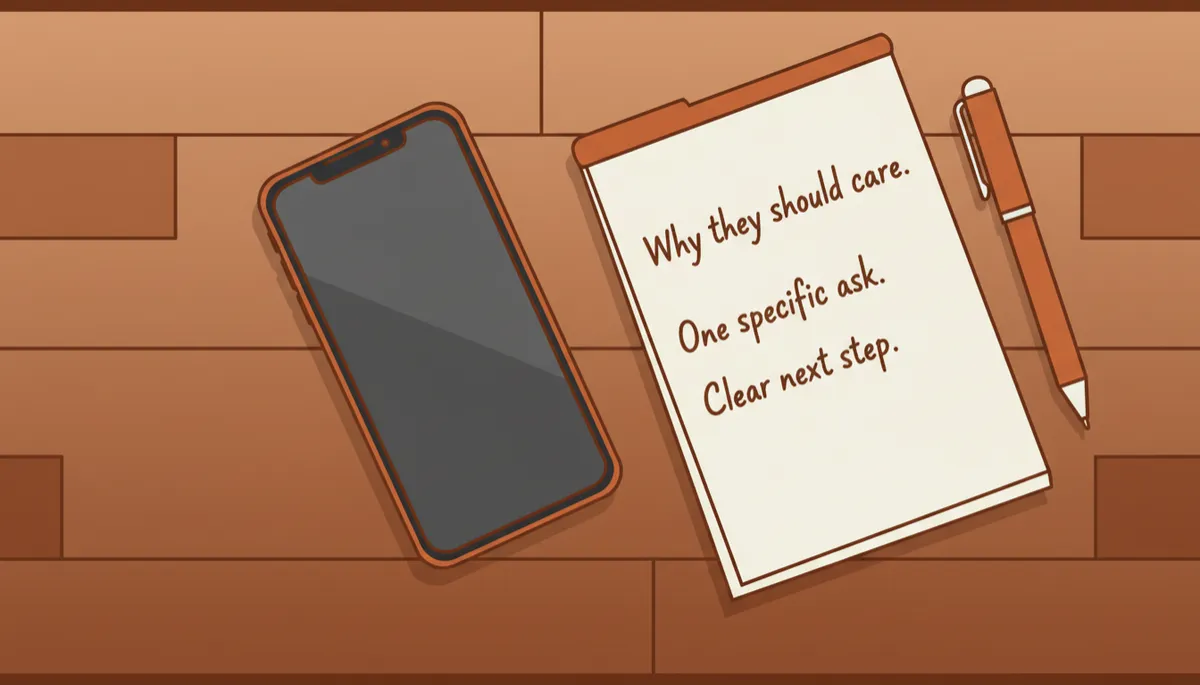
Blakely walked into Neiman Marcus with a prototype and one sentence of conviction. No memorized script. No pressure. Just honest belief in something real — and a specific ask.
The First Sales Call Framework Jason Teaches Every Startup Founder
Since 2015, Jason has helped more than 1,000 founders generate over $22M in combined sales. Many started where you are now: running all the sales, managing a team, and quietly wondering what to say on a sales call as a first-time founder without sounding pushy or fake. He doesn’t hand them a rigid script. He gives them a simple conversation shape so their own words can breathe inside it.
The shape has four parts, all in plain language:
- Start with connection and relevance. In the first 7–10 seconds, show that you know who they are and why this might matter to them — not just why it matters to you.
- Ask a few real questions. Not a survey. Just 4–6 open-ended questions about how they handle the problem today and what frustrates them most.
- Offer a tailored next step. A short demo. A trial. A follow-up with their team. One step, not twelve.
- Confirm the appointment. Don’t end the call with “I’ll send something over.” Leave with a date, a time, and a mutual promise.
This lines up with what the data already shows. High-performing calls have an ideal talk-to-listen ratio of about 43% talking and 57% listening (Gong, Nimitai research). Top reps ask more open-ended questions, not fewer. Jason’s framework lets you do that without pretending to be a traditional salesperson. You stay the founder — you just become a founder who knows how to guide a conversation instead of filling silence with features.
As Jason teaches at AuthorJason.com, the right sales call structure helps you hear buying signals in real time and respond with calm, specific next steps instead of improvised pitches.
What Should a Founder Say at the Start of a Sales Call to Set the Right Tone?
Jason teaches founders to open with one honest line of context and one line of relevance. Example: “Hi Alex, this is Maya, founder of BrightLedger. We help finance teams like yours close month-end in half the time — can I ask two quick questions to see if this actually matters to you?”
What’s the Biggest Mistake Technical Founders Make on Their First Sales Calls?
The biggest mistake is treating the call like a product demo instead of a human conversation. Technical founders often jump straight into features, architecture, and roadmap before the prospect has even confirmed that the problem matters. Jason gently reminds them: people don’t buy your tech stack; they buy relief from a specific headache in their day.
How Many Questions Should You Ask on a Sales Call Before Showing Your Product?
Jason suggests 4–8 focused questions on the first call. That range matches research showing that winning reps ask around 15–16 questions across the full conversation, keeping the talk-to-listen ratio near 43:57. Enough to understand their world — not so many that they feel interrogated.
How Cuban and Branson Think About the First Call
Mark Cuban’s favorite word in sales is “next.” As a kid selling garbage bags door to door, he learned that every closed door was just one step closer to an open one. For founders, his philosophy is a quiet kind of mercy: every “no” is feedback, not a personal attack. When a call goes badly, the answer isn’t to collapse. The move is to breathe, learn one thing, and say, “Next.”
Richard Branson adds another layer. His rule for any first outreach is simple: know exactly why the person on the other end should care. Not why your product is clever — why this conversation might matter to them today. When he reached out to Boeing about a plane for Virgin Atlantic, he started with what Boeing wanted — a new carrier customer — not his dream of starting an airline. One sentence. Their interest first. His ask second.
Cuban has described how, in his early days selling software at MicroSolutions, he made cold calls to companies and quickly assessed whether they were a fit. If not, he moved on with no hard feelings. That discipline of fast qualification is one of the most underrated pieces of sales-call advice for startup founders: protect your energy by not clinging to every “maybe.”
Branson’s Virgin Atlantic origin story is another example. When his original flight to the Virgin Islands was canceled, he chartered a plane, wrote “Virgin Airlines” on a sign, and sold seats to the stranded passengers. Later, when he formally approached Boeing, he framed the conversation around how Virgin could help Boeing sell more 747s. The move was always the same: understand the other side’s motive and speak directly to it.

63% of sales reps say the first call is the hardest. Cuban’s answer: “Next.” The call you make today while nervous is the reason next week’s call will feel a little less tense.
As Jason teaches at AuthorJason.com, when you pair Cuban’s “next” mindset with Branson’s buyer-relevance focus, you get a sales call structure that keeps you calm while you read and respond to live buyer signals in real time.
What’s the Ideal Talk-to-Listen Ratio on a High-Converting Sales Call?
The sweet spot is talking about 43% of the time and listening 57% of the time, according to Gong and other call-analytics platforms (Gong). Jason uses this as a gentle guardrail, not a rigid rule: if you notice you’re monologuing, it’s time to stop and ask another real question.
How Do You Handle Objections Mid-Call as a Founder With No Sales Training?
Jason teaches founders to treat objections as questions, not attacks. First, breathe. Then restate what you heard: “It sounds like timing is your biggest concern, is that right?” Next, ask one clarifying question. Finally, share a short, honest story or data point that speaks to that concern. No pressure. No arguing. Just two adults exploring whether this is a fit right now or not.
What Jason’s Founders Say After Their First Real Sales Call
Jason sees a familiar pattern after founders run their first calls using FOS. The words differ. The feeling is the same. “That call wasn’t nearly as scary as I imagined.” “I didn’t need a perfect deck; I just needed a structure.” “When I stopped trying to sound like a sales rep, the prospect actually opened up.”

Over 1,000 founders. More than $22M in combined sales. The ideal talk-to-listen ratio is 43:57. The founder who listens more tends to close more.
One fictional founder Jason often talks about is Maya, who led a 7-person SaaS team. She delayed going hard on outbound for months. When she finally used Jason’s approach, her first five calls were messy but honest. Call six turned into a paid trial. Call ten became their biggest customer of the year. The difference wasn’t magic words. It was finally knowing what to say on a sales call as a first-time founder without betraying her own voice.
As Jason teaches at AuthorJason.com, the founders who thrive on sales calls treat every conversation as practice in reading buyer signals and gently steering them toward a clear, mutual next step.
How the P.I.T.C.H. Equation Organizes the First Sales Conversation
Inside the Future of Selling System, Jason uses the P.I.T.C.H. equation to give founders a repeatable way to open, explore, and close conversations. It’s not a rigid script. It’s a set of simple moves you can run on every call so you’re never again sitting in front of the phone wondering where to start. You can read more about the P.I.T.C.H. equation here, but its core is: clarity, honesty, and a clear next step — every time.
In practice, the equation feels more like a calm guided journey than a checklist. The opening sets the goal of the call in one or two simple sentences so the buyer knows why you’re here. Then you move into a short question block that helps the buyer describe their current situation in their own words, without turning the call into an interrogation.
From there, you share one focused vision — something that reframes the problem or shows a simpler path forward — instead of drowning them in features. As the buyer engages, you listen for the moment when their language shifts from curiosity to “How would this work for us?” That’s your cue to ask whether it makes sense to take one specific next step together. The conversation ends with both sides agreeing on that step, followed by a quick post-call review so you can improve the next one. The transitions feel natural because each phase grows from what the buyer just said, not from a memorized line.
Self-Check
- When a sales call goes off track, do you know how to redirect it — or do you let it go wherever the buyer leads?
- Can you spot the moment when the buyer is ready to close while you’re still on the call — or only realize it after it’s over?
- Does every sales call end with a specific confirmed next step — or with a vague plan to “follow up”?
FOS turns these principles into practical tools: call outlines, question banks, objection maps, and short post-call checklists that take only minutes. For $19 a month — about $0.63 a day — the system pays for itself as soon as one call turns into one extra customer. Jason has lived through total collapse three times and rebuilt three times. FOS is designed to be forgiving. You’re allowed to be human on these calls. You’re allowed to get better in public.
As Jason teaches at AuthorJason.com, when you tie every sales call to a clear structure and pay attention to live buyer signals, you make better in-the-moment decisions instead of wishing you’d said something different after the call ends.
FAQs on What to Say on a Sales Call as a First-Time Founder
What’s the Ideal Talk-to-Listen Ratio on a High-Converting Sales Call?
Aim to talk for 40–45% of the time and listen for 55–60%. This keeps you out of “pitch mode” while giving you enough space to explain value clearly. Tools like Gong and modern call analytics support this range as a strong benchmark for B2B founders in 2026.
How Do You End a Sales Call With a Clear Next Step So the Deal Doesn’t Go Cold?
Jason keeps it painfully simple: summarize one thing they cared about, then propose one concrete next step with a specific time. “You mentioned month-end is exhausting for your team. The next step is a 25-minute demo with your CFO and ops lead. Does Tuesday at 10 or Wednesday at 3 work better?” Then lock the time in the calendar while you’re still on the line.
How Do You Keep a Sales Call on Track When the Buyer Takes It in a Different Direction?
Acknowledge their question, answer briefly, then steer back: “Great question — here’s the short version. Let’s come back to what I wanted to make sure we covered today…” That respects their curiosity while protecting your call structure.
What Are the Signs a Buyer Is Ready to Close on a Sales Call?
Look for operational questions (“How fast can we get started?”), first-person language (“How would this work for us?”), and talk about timelines or launch plans. Those are your cues to stop presenting and ask whether it makes sense to take the next step.
How Long Should a Sales Call Be for a Startup Founder Selling B2B?
For most early-stage B2B founders, 25–45 minutes is enough. Shorter than that and you rush discovery; longer and you risk fatigue. The key is pacing: a clear goal in the first minute, focused questions early, one strong teaching moment, then a specific next step before time runs out.
How Many Discovery Questions Is Too Many on the First Sales Call?
Usually 4–8 well-chosen questions are enough. If you’re working through a long checklist, you’re probably collecting data you’ll never use. Focus on questions that reveal urgency, impact, and decision process — the parts that actually change how you sell.
Should a Startup Founder Send a Deck Before the First Sales Call or After?
If possible, keep the first call light and conversational without a heavy deck. Use the call to understand their world, then send a short, tailored follow-up that speaks directly to what you learned. A generic pre-call deck often makes the conversation about features instead of problems.
How Can a Technical Founder Sound Confident on Sales Calls Without Faking It?
Anchor your confidence in facts: the problem you solve, the results early users see, and what you know from building the product. Speak simply, admit what you don’t know, and stay curious. Buyers trust quiet, grounded honesty more than polished hype — especially from founders.
Level-One Wins: What Happens When Founders Stop Waiting to Feel Ready
Jason has seen what happens when founders stop waiting and start calling with a clear structure. Tan generated $29,693 in 16 days when his team shifted from long email threads to focused calls with clear asks. Teo added 63 customers in 100 days by running the same simple call outline every afternoon, even on days he felt exhausted. Leon took a company from $2.5K to more than $2M in revenue by leading from the front on sales calls, then teaching his team the same FOS moves.
On one of Tan’s early FOS calls, a prospect opened by saying they were “just exploring options.” Instead of launching into a pitch, Tan asked a handful of focused questions, then shared one vision about how similar clients cut onboarding time in half. When the buyer asked, “How fast can we get started?” he recognized it as a buying signal, proposed a start date, and confirmed the next step on the spot. That one call made up a noticeable chunk of the $29,693 streak.
Teo’s breakthrough came on a late-afternoon call with a skeptical operations lead. The buyer kept steering toward edge cases. Teo used Jason’s structure: answer briefly, then return to the core problem they’d agreed mattered most. Near the end, the buyer said, “If this really saves us that much time, our regional team needs to see it.” Teo paused, named that as a next step, and booked a multi-party demo before ending the call. That sequence repeated across dozens of calls to reach 63 customers.
Leon remembers one founder call that changed his revenue trajectory. Midway through, the prospect started asking detailed implementation questions. The old Leon would have kept pitching. This time, he recognized the shift from “How does it work?” to “How will it work with us?” He paused, confirmed they were serious about moving forward, and proposed a trial with clear timelines. That call became a reference account that helped move revenue from thousands to millions.
These founders weren’t failures when they started. They were just frustrated. They had teams to protect, investors to answer to, and families watching. They didn’t need to become charismatic closers. They needed something gentler and more practical: a way to be themselves on the call while still giving the conversation a clear direction and a real chance to turn into revenue.
Jason’s message to you is the same one he gives them: you’re allowed to be nervous and still be effective. You’re allowed to stumble over a word and still earn trust. You’re allowed to learn sales without becoming someone you don’t recognize. The first call is not a test of your worth as a founder. It’s just the bridge between the product you’ve already built and the people quietly needing it.
3 Sales Call Mistakes That Cost Founders the Close — and the Bonus Mistake That Hurts Most
Mistake one (Maya, founder of an education company): she let the buyer run the entire call. She answered every question without steering the conversation back to the problem. By the end, she’d given away a free consulting session and still didn’t have the information she needed to close. The right move: answer the question, then return to structure — “Let’s come back to what I wanted to make sure we covered today…” It keeps the frame without ignoring the buyer.
Mistake two (Maya): she talked over a buying signal. The buyer asked, “How fast can we get started?” — a classic closing cue — and Maya answered the question, then went back to pitching. The buying signal stayed alive for 30 seconds, but she talked past it. The right move: when a buyer asks an operational question, stop pitching. Say, “We can get started within [timeframe]. Based on what we’ve discussed, does it make sense to take that step?” That’s the close.
Mistake three (Maya): she ended the call with “I’ll send a follow-up email.” The email took two days. The buyer’s excitement cooled. The next step should have been agreed on during the call, not deferred to a document. The right move: create the next-step agreement on the call. “I’ll send the proposal — and let’s book 20 minutes on Friday to walk through it together” is both a next step and a confirmed second meeting.
The add-on (Jason, in the third person): he found that the most common problem on sales calls wasn’t what founders said — it was what they listened for. Most founders listen to respond. They hear a question and start preparing an answer. The founders who close the best deals listen to understand — specifically, they listen for the moment the buyer’s language shifts from evaluation to imagination. “How does this work?” versus “How would this work with us?” That shift is the closing signal. Jason teaches founders to listen for the move from third-person questions to first-person application. When that happens, the moment to ask is ready. The right move: on your next sales call, listen for the buyer shifting from “How does this work?” to “How would this work for us?” That sentence is your invitation to close.
As Jason teaches at AuthorJason.com, the founders who win more are the ones who notice subtle language shifts and gently steer the call back to structure whenever it drifts.
The Sales Call That Closes — the Founder’s Word-for-Word Arc
The full sequence Jason teaches startup founders is simple enough to fit on a small card. You open with a clear goal: “We booked 30 minutes to see whether [problem] is big enough that we can actually help right now.” That line tells the buyer this is a focused conversation, not a sprawling pitch. Next, you confirm the problem in their words by asking a handful of open questions about how they handle it today and what’s most painful.
Once you have that, you teach one vision that reframes the problem or shows a shorter path to the outcome they care about. Not ten features — one perspective that makes them think, “We haven’t tried that before.” Then you listen. When the buyer asks an operational question (“How fast can we get started?”), you treat it as a buying signal: answer briefly, then ask whether it makes sense to take that step together. Finally, you confirm the next step before the call ends: date, time, and a specific action both sides agree to. That’s the sales call that closes.


