
How Billionaire Mark Cuban Structures Every First Sales Call to Open the Deal
Sales, Startup Founders, First Discovery Call Scripts
How Billionaire Mark Cuban Structures Every First Sales Call to Open the Right Doors — A Founders’ Guide
Jason wrote this guide for founders who are already closing some deals, but know their first calls could open bigger doors, faster. It’s a gentle reset—not a harsh teardown—of how to run a first call when your team and your runway depend on it.

Why the Goal of the First Sales Call Is Not to Pitch
Think about the last time someone tried to sell you something in the first ten seconds. You probably tightened your shoulders and started looking for an exit, even if you stayed polite on the surface. Your buyers feel the same when you rush into your product story too fast.
Cuban learned this the hard way. His first “script” at age 12 was simple: knock on the door, say “I’m selling garbage bags,” and ask for money. It worked just enough to keep going, but over decades he realized something deeper. The first call is not about the product. It’s about understanding whether there’s a real problem, and whether you’re the right person to help solve it.
Modern data backs this up. Insight7’s analysis of more than 6,000 sales calls found that top-performing calls contained far more questions and a balanced talk ratio, while average calls were skewed and product-heavy (Insight7, 2026). In other words, winning founders listen more than they pitch.
Jason sees the same pattern with founders using the Future of Selling (FOS) system. Before FOS, their first calls feel like rushed demos. After FOS, the same founders show up like calm investigators. They care just as much—but they channel that energy into questions instead of monologues, and doors that used to stay half open suddenly swing wide.
As Jason teaches at AuthorJason.com, when you treat the first-call structure as a diagnosis—not a pitch—the way you open the conversation quietly determines how confident you’ll feel closing it later.
How Mark Cuban Structures Every First Call to Open the Right Doors
Across MicroSolutions, Broadcast.com, the Mavericks, and hundreds of investments, Mark Cuban has sharpened a simple, clear-headed structure for first calls. He starts strong, not soft. “Don’t start with compliments. Start with why you’re calling.” Those first seven to ten seconds determine whether the other person keeps listening, as TeleCRM research also shows (Worldmetrics, 2026).
His flow is short and sharp: state the goal in one sentence. Ask the main qualifying question. Let the prospect talk. Dig in until the pain is clear. Decide whether there’s a fit. Close with a specific next step, not “I’ll send you something.” The first call is a filter and a door-opener, not a full pitch.
Jason teaches founders to adapt this to their own style. No fake bravado. No Shark Tank cosplay. Just a clean, respectful structure that honors your prospect’s time and your own. When a founder runs a call this way, they feel less like a “desperate salesperson” and more like a trusted guide. That shift alone calms the entire room—even over Zoom.
One famous story comes from the early days of Broadcast.com. Cuban was cold-calling sports departments and radio stations with a single line: “I’m calling because we can stream your games online to every alum who can’t be in the stadium—is that something you’re already doing?” That clear goal and direct question pulled real pain to the surface and opened doors that led to multi‑year broadcast deals.
Years later, when he was evaluating sponsorship pitches for the Dallas Mavericks, Cuban flipped the structure. He’d start calls by saying: “Tell me exactly what outcome you need from this season.” Then he’d listen. By the time he talked about packages, he was tying every suggestion to a specific fan, brand, or revenue outcome the other side had already mentioned—shortening the path to yes.
On Shark Tank, you can see the same “first-call script” applied in public. Cuban will often cut off a rambling founder with: “Stop. What problem are you solving, and for whom?” It’s the same move: reset the call to the goal, surface the problem in buyer language, then decide whether to walk through the door or walk away.
As Jason teaches at AuthorJason.com, the founder who opens with a clear goal and one sharp question quietly lays the floor for the close—because a focused opening makes it easy to agree on a focused next step.
The Five‑Stage First‑Call Framework Jason Teaches Every Startup Founder
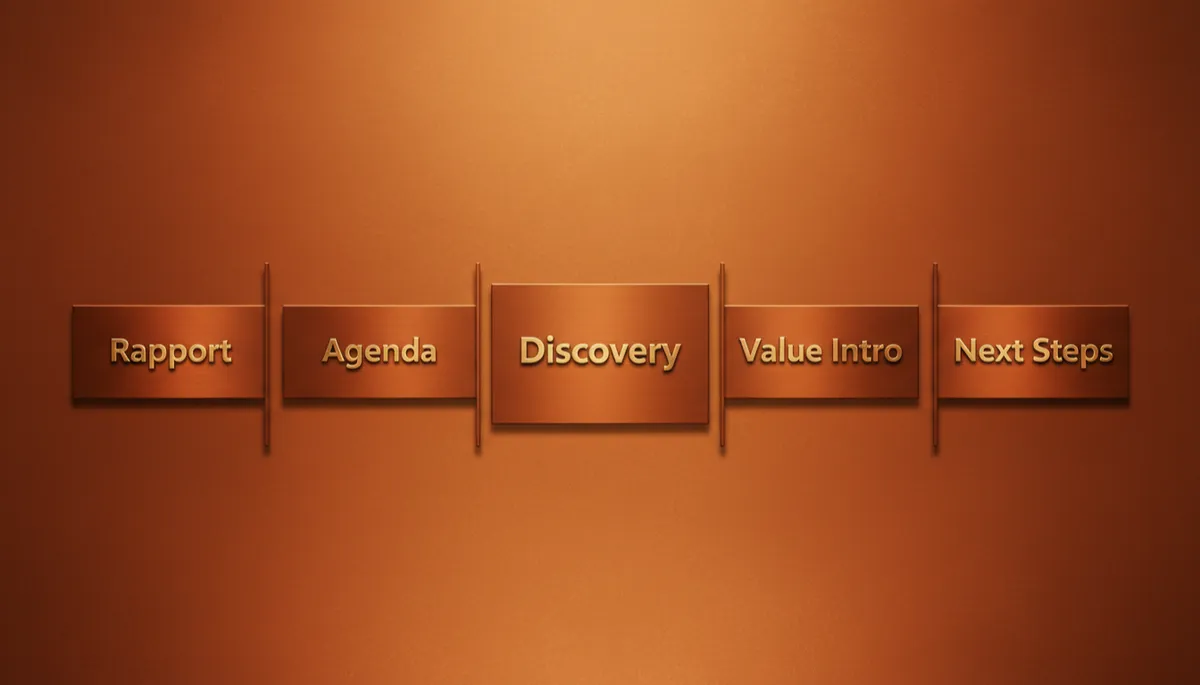
A horizontal diagram in burnt orange #9a3412 showing a five‑stage journey bar labeled…
Jason’s Future of Selling system turns Cuban’s philosophy into a clear five‑stage arc for every first call: Rapport, Agenda, Discovery, Value Intro, Next Steps. Think of it like driving through a city. You don’t floor the gas at the first light. You ease out, follow the route, and only accelerate when the road is clear.
Rapport is a short on‑ramp—not forced small talk. Just enough human connection to show you’re present. The Agenda is where you say, in one sentence, why you’re here and what you hope to decide together. That alone can calm a nervous prospect who’s been ambushed by too many surprise pitches this week.
Then comes Discovery, the widest part of the road. Gong’s research found that top reps ask 11–14 questions per call, while average reps ask about half that (Gong, 2026). Jason trains founders to live here. Ask. Listen. Reflect back what you heard. Stay curious longer than feels comfortable. Only then do you move into a brief Value Intro, tying what you heard to the outcomes you can create. Finally, you land on Next Steps, with a specific time, decision, or trial—never a vague “let’s follow up later.”
As Jason teaches at AuthorJason.com, when founders follow this five‑stage first‑call script for startup founders, the way they open each stage quietly shapes how confident they feel when they ask for—and get—the close.
What’s the Core Goal of the First Sales Call—and What Do Most Founders Get Wrong?
The real goal is to understand the prospect’s world well enough to judge fit, yet most founders treat it like a rushed product demo and talk just long enough to lose the second‑meeting opportunity.
What’s the Biggest Mistake Sales Reps Make on the First Call?
They talk too much, too early—instead of asking structured questions and letting the buyer describe their situation in their own words.
How Many Questions Should You Ask on the First Sales Call?
Aim for 11–14 thoughtful questions, which matches what top reps do in high‑conversion discovery calls.
How Branson and Perkins Prepare for Questions, Not Answers

A startup founder at a desk in burnt orange #9a3412 tones, on a video call, leaning forward and listening closely…
Richard Branson walks into first conversations with a list of questions, not talking points. He wants to know the other person’s priorities, frustrations, and hopes before he dares to share his own. Melanie Perkins took the same approach with Canva. Her best early calls happened when she stopped describing Canva and started asking about “design headaches” instead.
Jason highlights these stories for founders who feel guilty that they’re “not selling hard enough.” He reminds them: Branson listens. Perkins stays curious. Cuban waits until the problem is fully on the table. You’re not weak because you ask more questions. You’re in very strong company. And with today’s data, you also know this approach pays. Top callers spend around 40% of their time asking questions and keep their talk ratio under 50% (Nimitai, 2026).
When Branson launched Virgin Atlantic, he personally called business travelers and corporate travel buyers. Instead of leading with seat counts or routes, he’d ask: “What’s the most annoying part of flying to New York for you right now?” The answers—lines, cramped cabins, bad service—became the blueprint for everything he later sold them.
Perkins tells a similar story from Canva’s early days. On calls with small businesses and teachers, she’d ask: “Walk me through the last time you tried to design something—where did it start to hurt?” A school principal described spending an entire Sunday in Microsoft Publisher. That single moment of pain became a core story she reused in later pitches.
For founders using a first sales call script for startup founders, these examples are a reminder that the questions you prepare before the call determine the stories you can tell after—and those stories are what close deals.
As Jason teaches at AuthorJason.com, when your opening questions are sharp and rooted in the buyer’s world, the first‑call structure naturally pulls you toward a close instead of drifting into a friendly dead end.
How Do You Structure the First Sales Call in Five Stages?
Move through rapport, a clear agenda, deep discovery, a short value intro tied to their words, then agreement on a clear next step or decision.
How Do You Follow Up After the First Sales Call to Get a Second Meeting?
Send a short summary in their language, confirm the agreed next step, and propose a specific time with a clear agenda that continues the problem you explored together.
What Should a Founder Say in the First 60 Seconds of a Sales Call?
State your goal in one sentence, point to the problem you came to discuss, then ask a simple confirmation question like: “Does that line up with what you were expecting from today’s call?”
How Do You Keep the First Sales Call from Turning into a Free Consulting Session?
Teach one or two key insights that reframe the problem, but stop short of delivering a full implementation plan. Keep the detailed “how” for paying clients or a committed next step.
When Should a Founder Try to Close on the First Call?
Ask for the close when the buyer has clearly confirmed the problem, agreed your approach makes sense, and you’ve answered the main objections. If those conditions are met, you don’t need a second call.
What Jason’s Founders Experience After Their First Structured Call

A startup founder in burnt orange #9a3412 tones ending a video call, smiling with relief, laptop calendar showing a second meeting booked…
Jason has watched more than 1,000 founders walk into their first FOS‑structured call with shaky hands and walk out with quiet surprise. The prospect talked more. The founder felt less pressure. The call ended with a clear next step instead of a polite fade‑out. Nothing magical. Just structure and kindness, applied to a tense moment.
One founder, Maya, was running a 12‑person AI company. She was already closing some deals, but her calendar looked like a graveyard of “great conversations” that went nowhere. After using the Future of Selling system to rewrite her first call, she ran a week of experiments. Same prospects, same product, same pricing. The only change was structure. She spent nearly half the call in discovery, asked an average of 13 questions, and ended every call with a confirmed next step. Her rate of second meetings doubled in ten days. Her confidence followed.
The top‑line numbers are strong. Tan added $29,693 in 16 days. Teo brought in 63 clients in 100 days. Leon’s revenue stretched from $2.5K to over $2M. But Jason keeps reminding his founders: the deeper win is emotional. Feeling in control of the first call again. Knowing what to say—and what not to say—even on a hard day.
As Jason teaches at AuthorJason.com, the way you structure and open that first call often decides whether the close feels forced—or arrives smoothly as the obvious next sentence.
How the P.I.T.C.H. Equation Starts on the Very First Call
The Future of Selling system includes Jason’s P.I.T.C.H. equation, a simple way to turn messy founder stories into buyer‑ready pitches. But he’s clear about one thing: the equation really starts on the first call, long before you open any slide deck. That first conversation is where you gather the raw language that makes your pitch land later.
When you ask better questions, you hear better sentences. Those sentences become the spine of your pitch. Instead of guessing what to say, you echo what buyers have already told you. Jason goes deeper into how the P.I.T.C.H. equation works in this guide: The P.I.T.C.H. equation. For now, it’s enough to know that every strong pitch is built on strong discovery—and that starts with the first call.
Practically, the equation gives founders a single map they can lay right on top of the first sales call. The same rhythms that make a clear pitch—a defined problem, sharp vision, specific outcome, realistic ask—are discovered and rehearsed in that first conversation. The call becomes a low‑pressure draft of the story you’ll later tell at scale.
Instead of improvising from scratch every time, founders using a first‑call script for startup founders can treat each question as part of a journey. Early questions surface stakes and context. Mid‑call questions pinpoint the problem. Late‑call questions test commitment and readiness. By the time you “pitch” formally, you’re simply organizing what the buyer has already said, using the P.I.T.C.H. equation as the backbone.
Self‑check
- Do you open every first call with a clear goal statement—or do you start with small talk and hope the call finds its own direction?
- After your first call, does the buyer know exactly what will happen next—or do you both leave with a vague plan to “follow up”?
- Do you ask for the close on the first call when the buyer is ready—or do you wait for a second call that often never happens?
As Jason teaches at AuthorJason.com, when your first‑call structure feeds directly into the P.I.T.C.H. equation, the way you open the conversation almost writes the close for you.
FAQs About the First Sales Call Script
What Should You Research Before Going Into a Sales Call?
Review recent company news, the person’s role, current tools, and any public signals of the problems you solve so your questions land as relevant, not random.
As you build your own script, remember you don’t have to invent everything from scratch. Jason has already done the hard part inside the Future of Selling system. You get a ready‑to‑use first‑call script for startup founders, live breakdowns, and gentle coaching on how to adapt it to your voice and market. You’re allowed to make this easier on yourself.
How Long Should the First Sales Call Take for a Startup Founder?
Most founders do well with 25–45 minutes. That’s enough time for rapport, deep discovery, a short value intro, and a clear next step—without drifting into an unstructured “free consulting” session.
What Talk‑to‑Listen Ratio Works Best on the First Sales Call?
Aim to talk 40–50% of the time and let the buyer own the rest. That usually means asking 11–14 questions and resisting the urge to fill every silence with more explanation.
What’s a Simple Note‑Taking Structure for the First Sales Call?
Use three columns: “Problems in their words,” “Current attempts,” and “Desired outcomes.” Capture short phrases, not full sentences, so you stay present while recording what matters.
How Fast Should You Follow Up After the First Sales Call?
Send your summary and next‑step confirmation within 24 hours. Reference specific phrases they used, restate the agreed outcome, and attach a calendar link or two concrete time options.
3 First‑Call Mistakes—and the Bonus Mistake That Hurts Most
Mistake 1 (Kai, B2B software founder): He opened with five minutes of weather and weekend talk. By the time the conversation turned to business, the tone had settled into “casual chat.” The buyer never mentally moved into decision mode. The move: open with the goal. “The reason for today’s call is X—does that match what you were expecting?” That sets the frame in the first 15 seconds.
Mistake 2 (Kai): He gave all the answers away for free on the first call. By the end, the buyer had everything they needed to solve the problem themselves or take the approach to a cheaper competitor. The move: teach the vision that creates the question. Give them the “what.” Save the “how” for after the decision.
Mistake 3 (Kai): He ended the call without naming a next step. “Great call, let’s stay in touch.” Three days of silence followed. The move: always leave the call with a specific action booked—a meeting time, a document sent, a mutual commitment. “Let’s stay in touch” is not a close.
The bonus (Jason, in third person): He discovered that the first three minutes of the first sales call determine 80% of the outcome. Not the pitch. Not the ask. The opening. When the opening was intentional and problem‑centered, buyers leaned in. When the opening was vague and social, buyers stayed relaxed and non‑committal the whole way through. He stopped training founders to pitch first and started training them to open. Founders who mastered the first three minutes closed deals at twice the rate of those who didn’t. The move: write your three opening sentences before every first call. Not a word‑for‑word script—just a clear goal statement, a nod to the problem, and one question. That’s all it takes.
As Jason teaches at AuthorJason.com, the way you structure the opening of the first sales call quietly sets the ceiling on how strong a close you can ultimately earn.
The First Sales Call That Moves Things Forward—The Exact Founder Script
A simple first‑call script for startup founders might sound like this. You open with: “Thanks for making the time. The reason for today’s call is to understand how you’re handling X right now and see whether it makes sense to explore Y together—does that match what you were expecting?” That one sentence sets the goal and permission.
From there, you confirm the problem in their words: “Walk me through the last time this went wrong.” After 10–15 minutes of questions, you reflect back what you heard and share one vision that changes their understanding: “What we’re seeing across companies like yours is that the real bottleneck isn’t A, it’s actually B.”
Then you ask a forward‑moving question: “If we could remove B over the next 90 days, what would that be worth to you?” When they answer, you make the ask for the next step: “Based on what you’ve shared, the right next step is a deeper working session with your team. Are you open to scheduling that for next week?” You finish by confirming the time and what will happen in that meeting before you hang up.
As Jason teaches at AuthorJason.com, when you script those key moments—the opening, the vision, the ask—the entire first call feels like a guided path toward a close instead of a loose, hopeful conversation.


