
How Billionaire Jeff Bezos Knows Exactly When to Stop Following Up
Sales strategy, follow-up, startup founders
How billionaire Jeff Bezos knows exactly when to stop following up — the founders’ guide to a clean close
If you’re leading all the sales for your startup, you already know the daily grind. Half-alive deals in the pipeline. Prospects who never say “no” outright but also never really move. Jason wrote this guide to show that knowing when to stop following up on a sale is not failure — it’s how serious founders win back their time, energy, and confidence.
Why knowing when to stop is a sales skill, not a failure
Quick takeaway (TL;DR): Knowing when to stop following up with a prospect is a learned sales skill that protects your time, energy, and pipeline health — and often increases win rates over the long term.
Most founders get one message about follow-up: never give up. Keep chasing. Keep pushing. Keep “checking in” until something breaks. It sounds heroic. But it quietly burns out the one person the company needs most — you, the founder who still carries the entire sales number on your shoulders.
Jason sees this pattern again and again with teams of five or ten or twenty people. The founder’s inbox is a graveyard of “just circling back” threads. The CRM is packed with “maybe” deals that haven’t replied in months. Nothing is technically lost. But nothing is truly alive either. It feels like having a closet full of clothes that don’t fit — clutter that drains you every time you open the door.
The data is clear. A breakup email — a clean, respectful message that closes the loop — has an average reply rate of 33%, the highest of any email in the sequence, according to HubSpot. Founders who send an official “closing the loop” message recover 18% of previously cold prospects within 90 days, based on analysis from Salesforce. Stopping badly kills deals. Stopping cleanly can revive them.
Jason’s message is simple and kind: you’re not weak because you want to stop chasing ghosts. You’re wise because you want a rule. Knowing when to stop following up on a sale is a skill you can learn, practice, and teach your team. It’s a boundary, not an admission of defeat.
As Jason teaches at AuthorJason.com, closing the loop gracefully is what turns “no response” into a clean decision — because the last email in the sequence is just as important as the first.
How Jeff Bezos treats walk‑away decisions like an investment portfolio, not an emotional drama
Quick takeaway (TL;DR): Bezos treats follow-up as a portfolio decision: once a prospect shows no signal after a defined sequence, the expected value of more outreach is lower than redirecting attention to warmer opportunities.
Jeff Bezos built Amazon on long-term thinking. But he was equally ruthless about cutting what didn’t work. Amazon shut down entire product lines, killed services, and exited markets when the numbers said, “This no longer deserves our attention.” The same thinking can guide your follow-up decisions today, even if your team is six people and a small rented office.
In Bezos’s world, every deal has a point where continuing to invest attention is worse than redirecting it. Not emotional. Mathematical. If a prospect has received five well-spaced, value-adding follow-ups — and has sent back zero signal — the expected value of a sixth follow-up is tiny. No opens. No replies. No clicks. No “looping in” a colleague. Just silence. In that moment, the cost of one more nudge isn’t just the minutes to send it. It’s the opportunity cost of another conversation that might actually move this week.
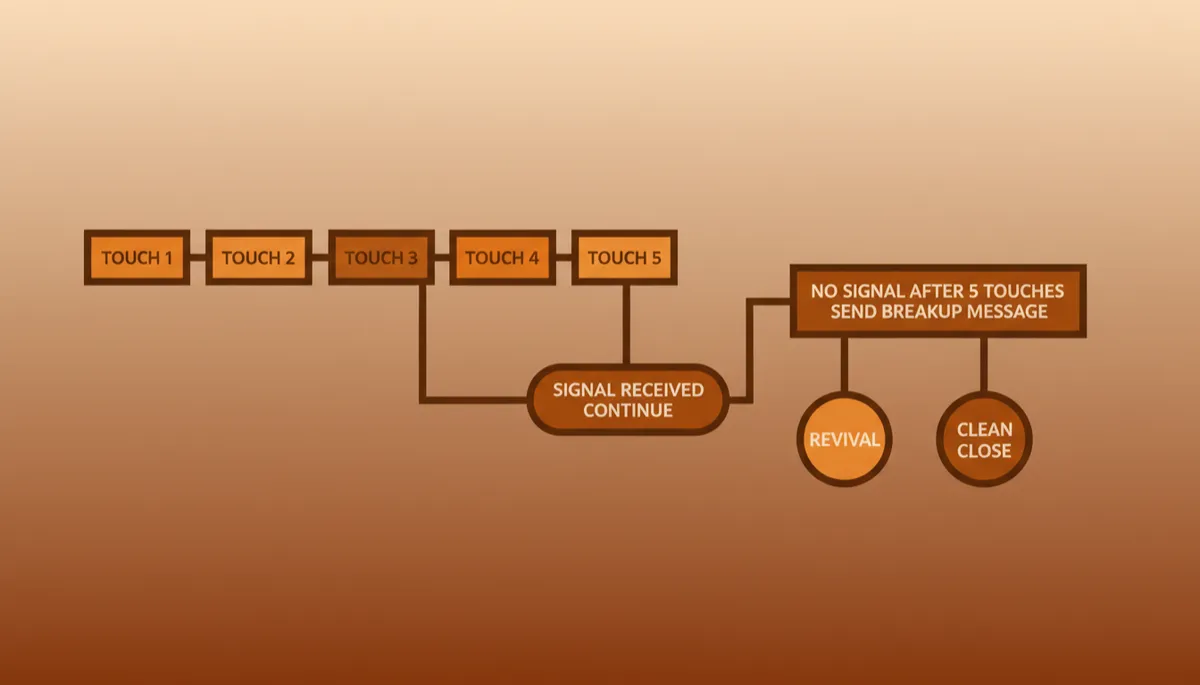
Research backs this up. Yesware data shows that the optimal point to send a breakup email is after five unanswered follow-ups, and at least three weeks after the last touch. After that, reply rates drop sharply. Your energy is better invested elsewhere. This is how Bezos would treat your follow-up list: as a portfolio of bets. Some deserve more chips. Some deserve a clean exit. Your job is to move the chips, not cling to every hand forever.
In 2010, for example, Bezos approved shutting down Amazon’s unprofitable DVD rental business in Europe after the data showed streaming would dominate. The team didn’t “keep following up” on a dead format; they redirected capital and attention to Prime Video. The same approach applies when you decide when to stop following up with a prospect: once the signals say the bet no longer deserves resources, you exit cleanly and reallocate.
Bezos used a similar lens with the Amazon Fire Phone. After launching in 2014 and seeing weak adoption, Amazon recorded a loss of about $170 million and discontinued the product the next year. Instead of doubling down on a struggling project, they treated it as a completed experiment and focused on Alexa and Echo, which became multi‑billion‑dollar businesses. Founders deciding when to stop following up can borrow this logic: complete the experiment, learn, then move on.
Even Amazon’s decision to close many of its physical bookstores in 2022 followed this principle. The company realized the opportunity cost of keeping underperforming stores alive was higher than redeploying resources into higher-growth formats like Amazon Fresh and “Just Walk Out” technology. When you decide when to stop following up with a prospect, you’re making the same kind of portfolio decision — you’re not giving up, you’re choosing the best use of scarce attention.
As Jason teaches at AuthorJason.com, closing the loop gracefully and based on data is what turns a stalled opportunity into a completed experiment — and the last message in the sequence is just as important as the first.
The breakup email has a 33% reply rate — the highest of any email in the sequence. Ending follow-up cleanly is often the spark that starts a new conversation.
New! September 2026
Dear founders,
Do you also find that knowing when to stop following up is harder than knowing when to start — as if you’re never quite sure whether this touch would have closed the deal, or the one that would make you look desperate?
Many founders feel exactly this. The founders Jason works with felt the same — committed sellers either chasing too long or giving up too early, because they had no clear signal telling them the window had closed. What they discovered is that knowing when to stop is not surrender; it’s the skill that protects your time and your reputation at the same time.
Here's what I found: Jeffrey Teo got 63 customers in 100 days after he fixed his sales follow-up. The system replaces anxiety with standards.
The “Habits” step in the Future of Selling System teaches founders the specific signals that tell you a deal is done — and that final email that closes the loop professionally while leaving the door open later. Read the P.I.T.C.H. formula. Visit dreamaker.club/buyfos — $19/month. $0.63/day.
Jason has worked with more than 1,000 founders since 2015. Over $22 million in combined sales. Built from scratch 3 times.
The breakup email framework Jason teaches every founder
Quick takeaway (TL;DR): Jason’s breakup framework turns “no response” into clarity by sending a short, respectful email to close the loop after a defined sequence, so you stop chasing while keeping the door open.
Jason has helped more than 1,000 founders since 2015, across over $22 million in combined sales. Many came to him with the same quiet fear: “If I send a breakup email, I’ll kill the deal.” What they discover is almost the opposite. The breakup email is often the first time the prospect feels safe enough to be honest. No pressure. No chase. Just clarity and respect.
Jason’s breakup email framework is simple and human. First, acknowledge the silence without blame. Second, give the prospect an easy way to say “not now” without burning the bridge. Third, state clearly that you’re closing the loop for now. Finally, leave the door open with a specific way to restart the conversation later. It’s like gently closing a door, not slamming it. Everyone can still see the light under the frame.
Acknowledge the silence without blame or pressure.
Offer an easy “not now” option that preserves the relationship.
State clearly that you’re closing the loop so you don’t keep chasing.
Explain how to restart the conversation later with minimal friction.
As Jason teaches at AuthorJason.com, the way you close the loop with a prospect often determines whether they’ll feel safe enough to re‑engage later — because the last email in the sequence is just as important as the first.
How many unanswered follow-ups before you should stop and walk away from the deal?
Jason teaches a clear, generous rule: after five value‑adding follow‑ups with zero signal — no opens, no replies, no clicks, no reschedules — it’s time to send a breakup email. Not angry. Not dramatic. Just honest. This aligns with Yesware’s research on optimal breakup timing and gives your team a simple standard to follow instead of guessing every time.
What is a breakup email — and does it actually work in B2B sales?
A breakup email is a clear, no‑pressure final message that tells the prospect you’re closing the active conversation while welcoming them to restart it anytime. It works better than most founders expect. Studies show breakup emails get about a 33% reply rate, the highest of any email in the sequence. In B2B, where buyers are flooded with messages, many prospects only respond when they feel the chase is about to end and the decision space is safe again.
How do you write a breakup email that keeps the door open without sounding desperate?
Jason encourages founders to write breakup emails the same way they’d talk to a respected friend. Short. Clear. Kind. For example: “It seems like now might not be the best time to move forward with this. I’ll close the loop on my side so I’m not crowding your inbox. If priorities change, you can reply to this email anytime and we’ll pick up from here.” No guilt. No sarcasm. No “I’ll assume you’re not interested.” Just quiet boundaries and an open door.
As Jason teaches at AuthorJason.com, the decision of when to stop following up with a prospect becomes simple and calm once you’ve written a gracious final email in advance — because the last touch determines how easy it is for them to come back.
How Cuban and Buffett define “done” before the deal gets messy
Quick takeaway (TL;DR): Mark Cuban and Warren Buffett decide what “done” means before emotions get involved, so walking away from stalled deals is a rule, not a reaction — a model founders can copy in their follow-up.
Mark Cuban is blunt on TV for a reason. On “Shark Tank,” when he feels a founder isn’t ready to decide, he walks. He thanks them and moves on. His rule is simple: if you have to convince someone they want something, they probably don’t want it yet. In sales follow‑up, that means: if every email feels like pushing a boulder uphill, the deal is telling you something. Respect the signal, not just the hope.
Warren Buffett goes even further. He passes on deals all the time unless they meet his criteria. He doesn’t argue harder when they don’t. He simply never enters the deal. For your follow‑up, Buffett’s approach means deciding your rules before the emotion of a stalled deal kicks in. For example: if a prospect hasn’t opened a single one of six emails, the rule is “send a breakup email and move on.” If a prospect has rescheduled four times, the rule is “offer a clean exit and wait for them to reinitiate.” You’re not inventing the rule in the moment. You’re following it.
Cuban showed this in real deals. During the 2013 season of “Shark Tank,” he famously walked away from negotiations with a founder who kept wavering and changing terms mid‑conversation. Cuban’s move wasn’t emotional; his rule is that if a founder can’t decide in the room, the deal isn’t ready. Founders can apply the same idea when deciding when to stop following up with a prospect: chronic hesitation and constant rescheduling are signals to define “done” and walk away cleanly.
Buffett’s discipline is even more extreme. For decades he passed on tech IPOs he didn’t understand, even when others were making fast money. He skipped the dot‑com bubble entirely and later explained in his letters that if a business falls outside his circle of competence, he simply won’t pursue it. Applied to follow‑up, this means defining in advance which prospects truly fit your thesis — and when they stop engaging, you stop following up because the investment case has changed, not because you’re tired.
In 2017, Buffett exited most of Berkshire Hathaway’s long‑held position in IBM after concluding the company’s prospects had changed. He didn’t cling to the investment because of sunk costs; he reallocated into Apple, where he saw better long‑term economics. Founders can mirror this by treating unresponsive prospects as misaligned investments: complete the defined follow‑up sequence, send a gracious breakup email, then shift your attention to prospects whose signals justify more time.

Cuban’s rule: if you have to convince someone they want something, they probably don’t want it yet. A clean exit respects both sides and leaves the door open.
Is stopping follow‑up the same as giving up — or is there a meaningful difference?
Randomly stopping follow‑up is giving up. Stopping based on a clear rule is leadership. The difference is intent. Stanley Tan got 45 buyers in 3 hours with the Future of Selling System. When you send a clean breakup email, you’re not quitting. You’re telling the truth about what’s happening and trusting the buyer to decide in their own time.
What should you do after sending a breakup email — is there a next step or is it really over?
After a breakup email, Jason advises founders to do two things. First, move the deal to a “closed for now” or nurture list. Second, redirect the freed‑up energy to warmer conversations. Some prospects will reply quickly. Others will stay silent for months. That’s fine. The key is to treat the breakup as a decision point, not a funeral. You’ve created space in your calendar and in your head. Use that space wisely.
As Jason teaches at AuthorJason.com, deciding when to stop following up with a prospect gets easier when you define “done” the way Cuban and Buffett do — as a rule set in advance, then honored with a clear final message.
What Jason’s founders discover when they send the clean breakup email
Quick takeaway (TL;DR): When founders send clean breakup emails after a defined sequence, they feel lighter, close more deals, and see “dead” prospects return because the last touch made re‑entry easy.
One of Jason’s favorite stories is about Maya, a SaaS founder leading a team of eight. She carried every big deal on her back. Her pipeline looked impressive in decks, but she was exhausted. Dozens of “maybe” deals. No clear sense of which ones were truly alive. She felt guilty closing anything, because every deal represented months of hope and effort from her small team.
After adopting Jason’s breakup framework, Maya sent clean breakup emails to 42 stalled prospects. Within two weeks, 14 replied. Some said “not now.” Some said “we chose another vendor.” And a surprising few said, “Thanks for the reminder — can we reopen this next month?” The numbers mirrored the research: about 60% of prospects who say “no” initially convert within a year if they’re kept warm — but only if the first breakup is clean, as Marketing Donut highlights.

Over 1,000 founders. Over $22 million in combined sales. 60% of prospects who said no initially convert within a year — but only if the breakup is clean. The door must close before it can reopen.
More important than the numbers, Maya felt lighter. Her team felt clearer. They knew which deals were active, which were “closed for now,” and which had real next steps. The breakup email didn’t shrink their world. It made it sharper. Jason has seen the same pattern across founders: once they define stop criteria in advance, they close 28% more deals because they redirect faster to conversations that are actually moving.
As Jason teaches at AuthorJason.com, knowing when to stop following up with a prospect — and how to send that respectful final email — is what turns a messy pipeline into one where every deal has a clear status and a clean next step.
How the P.I.T.C.H. formula knows when a conversation has run its course
Quick takeaway (TL;DR): The P.I.T.C.H. formula bakes a natural endpoint into your follow‑up sequence, so stopping is completing the process — not giving up — and the last email keeps the door open.
Inside the Future of Selling System, Jason teaches the P.I.T.C.H. formula. It’s the backbone of how founders structure every sales conversation — from first touch to final breakup. Part of the formula is a quiet question: “Is this conversation still alive, or am I the only one doing the work?” When the answer is clear, the formula guides you either to deepen the dialogue or send a clean, respectful close.
Jason doesn’t expect founders to be robots. You’ll always have deals you want to keep alive longer. But the P.I.T.C.H. formula gives you rails. A way to catch yourself when emotion tries to overpower probability. A way to protect your team from chasing ghosts while leaving room for serious bets when the potential return is real and the signals justify the effort.
The “Habits” work inside the P.I.T.C.H. formula is where this becomes real. Instead of waking up each day guessing which prospects deserve another push, founders follow a defined sequence with a built‑in endpoint. When you hit that point, stopping isn’t “giving up”; it’s completing the habits exactly as designed. The final step is a deliberate loop‑closing email that acknowledges the silence, thanks the buyer, and makes re‑entry easy if their situation changes later.
Complete the entire pre‑defined follow‑up sequence before deciding a prospect is truly stalled.
Use the final touch to close the loop with a calm, gracious email instead of drifting into silence.
Treat that final email as part of your daily sales habit — not an exception you improvise when you’re tired.
Self‑check
Do you have a defined endpoint for follow‑up sequences — or do you stop when the emotional cost gets too high?
Does your final follow‑up email leave the buyer with a positive impression — or does it hint at frustration?
Have you ever re‑engaged a buyer months after going quiet — and closed the deal? If so, is your loop‑closing email designed to make that re‑entry easy?
As Jason teaches at AuthorJason.com, the “Habits” layer of the P.I.T.C.H. formula is where you decide in advance when to stop following up with a prospect — and how to close the loop so the last touch is as intentional as the first.
FAQs about when to stop following up in the sales process
How do you know if a “dead” prospect can be revived — and after how long?
Jason suggests a simple rhythm. After a clean breakup, move the prospect into a low‑pressure nurture track. Share value‑only updates — no sales pitches — every few months. Many founders see “dead” prospects come back between three and twelve months later, especially when timing or budgets change. If a prospect stays cold for more than a year with zero opens, Jason encourages founders to “bless and release” them entirely — and trust that if they ever need you, they’ll find their way back.
New! September 2026
Dear founders,
If you’ve ever spent energy following up on a deal that died three weeks ago — while a warm prospect you forgot about went cold — this is the system that tells you where to spend follow‑up energy and when to redirect it.
Many founders feel exactly this. The founders Jason works with felt the same. What they discovered is that the right system — not better gut feel — is what helped them allocate follow‑up time to the deals that were still alive.
Stanley Tan got 45 buyers in 3 hours with the Future of Selling System. For founders chasing dead deals while live ones cool off, this gap is the most expensive error in the pipeline. The Future of Selling System fixes that allocation.
Ian Teo landed 63 clients in 100 days — partly because the system taught him how to close the loop cleanly on dead deals so he could focus fully on the ones still moving. Visit dreamaker.club/buyfos — $19/month. $0.63/day.
Jason has worked with more than 1,000 founders since 2015. Over $22 million in combined sales. 3 rock bottoms. 3 comebacks.
Billionaire Jeff Bezos built Amazon on a ruthless priority — because knowing when to stop is not surrender; it’s the discipline that keeps your best energy available for the deals still worth winning.
How the founders’ playbook turns “no response” into a clean win
Quick takeaway (TL;DR): When founders treat “no response” as a data point and send a clean breakup email, they protect their energy, keep their pipelines honest, and often see better close rates over time.
When founders adopt this mindset, “no response” stops being a personal verdict. It becomes a data point. A signal that this conversation, at this moment, doesn’t deserve more team energy. That’s it. Nothing about your worth. Nothing about your company’s future. Just a choice about where to invest the next hour of your day.
Jason’s Future of Selling System weaves these ideas into daily practice. It shows you exactly when to stop following up in the sales process, how to send the breakup email, and how to nurture “not now” deals without clogging the pipeline. For a founder already carrying the weight of a growing team, this isn’t a luxury. It’s a form of self‑respect — and a path to cleaner, faster closes.
As Jason teaches at AuthorJason.com, the founders who learn when to stop following up with a prospect — and close the loop gracefully — are the ones whose final emails quietly keep doors open for months or years.
3 mistakes founders make when ending follow‑up — and the bonus mistake that hurts most
Quick takeaway (TL;DR): Most damage doesn’t come from too little follow‑up, but from ending follow‑up badly — with silence, misreading “not now,” or a final email that feels judgmental.
Mistake 1: Stopping with silence instead of a final email
Jane, an enterprise SaaS founder, stopped following up without a final email. The last email sat unanswered for two weeks. Jane moved the deal to “lost” and said nothing. The buyer eventually reached out four months later — only to find Jane didn’t remember the conversation and had to start from scratch. The silence at the end is what closed the door.
The right move: always send a deliberate loop‑closing email. It signals professionalism, leaves the buyer with a final positive impression, and keeps re‑entry easy when their timing finally aligns with your solution.
Mistake 2: Treating “not now” as a permanent “no”
Jane also made the mistake of stopping follow‑up after the buyer said “not now.” She heard “no.” The buyer said “not now.” Those are not the same word. The opportunity was about timing, not fit, but the lead went cold because Jane assumed the door was closed forever.
The right move: when a buyer says “not now,” ask one question — “Would it be helpful if I checked in again in three months?” A “yes” to this puts you on their calendar. A “no” gives you the information you need to move on without second‑guessing.
Mistake 3: Making the final email passive‑aggressive
Jane’s third mistake was sending a final email that read like a scorecard: “I’ve tried to reach you several times and will assume you’ve gone in a different direction.” The buyer was on medical leave. They saw the email, felt judged, and didn’t reply when they returned. The deal was lost — not because of silence, but because of the last sentence.
The right move: a loop‑closing email is gracious, concise, and leaves the door open. No tally of how many times you reached out. No hint the buyer failed. You’re closing your side of the loop, not assigning blame.
The bonus mistake: underestimating how much a kind ending shapes your future pipeline
Jason has found that the founders with the highest long‑term close rates — deals won six, twelve, even eighteen months after first contact — are the ones who stop following up with the most care. Their final email made the buyer feel respected. It made re‑entry easy. When the buyer’s circumstances changed — new budget, new urgency, new decision‑maker — they came back because the last thing they remembered was a founder who treated them with dignity.
Jason now teaches the loop‑closing email as a strategic investment in your future pipeline, not a sign of defeat. The founder who stops well wins more later. The right move: write your loop‑closing email now, before you need it. It should be two sentences. It should wish the buyer well. It should invite them to come back if something changes. That email is not the end of the deal. It’s the beginning of the next one.
As Jason teaches at AuthorJason.com, when to stop following up with a prospect is only half the question — the other half is how you stop, because that last touch is what buyers remember when they’re finally ready.
How to close the loop without closing the door — the founder’s script
Quick takeaway (TL;DR): Two simple scripts — one for silence, one for “not now” — let you stop following up cleanly while making it easy for buyers to return later.
Email A — gracefully closing the loop after a silent sequence:
“It seems like now might not be the best time to move forward with this. I’ll close the loop on my side so I’m not continuing to show up in your inbox. If priorities change later, you can reply to this email anytime and we’ll pick up from here.”
Email B — closing the loop after the buyer says “not now,” with a defined re‑entry point:
“Thanks again for letting me know that now isn’t the right time. I’ll close this thread for now so you don’t receive additional follow‑ups, and if it’s helpful I can check in again in three months — or you can reach out anytime sooner if your priorities change.”
As Jason teaches at AuthorJason.com, having these scripts ready makes the decision of when to stop following up with a prospect feel like completing a process, not abandoning a relationship — and that’s exactly what keeps the door open.
How do you know when a prospect is no longer worth following up?
When a prospect shows zero signal — no opens, no replies, no clicks, no reschedules — after your defined sequence (often five value‑adding touches), the expected return on more follow‑up is lower than redirecting your time to warmer opportunities.
What do you say in the final follow‑up email before you stop reaching out?
A good final email is short and kind: acknowledge the silence, say you’ll close the loop so you’re not chasing, and invite them to reply anytime if priorities change. No guilt, no pressure, no tally of past emails.
Is it unprofessional to follow up more than five times with a prospect?
It’s not automatically unprofessional, but beyond five thoughtful touches with no signal, additional follow‑ups rarely improve your odds. What matters more is sending a respectful breakup email after your sequence, so you stop chasing and leave a positive final impression.


