
How Billionaire Mark Cuban Disrupted Pharmaceutical Pricing
Biotech, Biotech Pricing Strategy for Startups
How Billionaire Mark Cuban Disrupted Drug Pricing — A Founders’ Guide to Biotech Pricing Strategy for Startups
Mark Cuban turned drug pricing upside down by making the numbers simple, honest, and public. Jason shows biotech founders how to use the same transparent logic to build a biotech pricing strategy for startups that earns institutional trust, accelerates approvals, and still protects healthy margins.

Why Opaque Biotech Pricing Destroys Institutional Trust — And What Transparency Builds Instead
Imagine a hospital formulary committee like a patient who has been misdiagnosed too many times. Every new meeting, they walk in guarded. Arms crossed. Waiting to be disappointed again by a glossy pitch and a vague price justification that feels more like a story than a number backed by science.
For years, opaque pricing models have trained institutional buyers to assume they’re being overcharged. Hidden rebates. Discounts behind closed doors. Invisible margins for pharmacy benefit managers. And as Rock Health’s 2024 report points out, startups that keep playing this game get punished — non-transparent pricing brings fewer conversations and slower decisions, not more bargaining power.
Transparent models do the opposite. Rock Health found that biotech startups that publish clear pricing logic, including cost components, generate 34% more institutional inquiries than those hiding behind “contact us for pricing.” Transparency becomes a signal: this founder isn’t here to play games. This founder is here to solve a problem — and can show the math behind the ask.
AMCP research shows that hospital committees approve products 2.4× faster when they see cost‑versus‑outcomes evidence instead of market-comparison slides alone. That speed matters when your financial runway is short and your five-person team is doing the work of twenty. A transparent biotech pricing strategy for startups isn’t just an ethical choice. It’s a survival strategy in a world of Inflation Reduction Act (IRA) negotiations, Most Favored Nation (MFN) rules, and payer fatigue with foggy pricing.
As Jason teaches at AuthorJason.com, the core of a biotech pricing strategy for startup founders is this: the founder who can defend their price with outcome data closes deals faster and discounts less than the founder who prices on gut alone.
How Mark Cuban Disrupted Drug Pricing by Publishing What Everyone Else Hid
When Mark Cuban launched Cost Plus Drugs in 2022, he did something almost childishly simple. He took a market built on shadows and turned the lights on. Actual manufacturing cost. Plus a 15% margin. Plus a $3 pharmacy fee. No hidden rebates. No PBM spreads. No mysterious coupons that appear and vanish like the weather. Just a price anyone could explain at a kitchen table in under a minute.
The result? Generics that cost hundreds of dollars at traditional pharmacies dropped to under $10 on Cost Plus Drugs. It wasn’t a clever promotion. It was a public X‑ray of how distorted the old system had become. Forbes and CNBC highlighted how this model pressured incumbents — not because Cuban secretly undercut them, but because he showed patients and institutions numbers they were never meant to see.
In 2023, when Cost Plus announced a partnership with Capital Blue Cross in Pennsylvania to extend its transparent prices to hundreds of thousands of members, the tactic became clear: enter through a single institutional gateway, then let the new pricing model become the de facto standard for the rest of the market. Cuban showed that a startup can use one deal with a major payer to shift pricing expectations across an entire state.
In another example, when Cost Plus cut the price of generic Gleevec (imatinib) from more than $2,500 a month at some pharmacies to under $20, the media began running “before/after” comparisons in headlines. The change in price wasn’t the real story; the story was that patients and institutions suddenly saw how unjustified the old margins had been. This kind of transparency is exactly what a biotech pricing strategy for startup founders needs when it faces skeptical committees.
Cuban’s deeper insight is what matters for biotech founders. The winning pricing model isn’t the most complex one. It’s the one you can defend without flinching. A model where you can look a hospital CFO in the eye and say: “Here’s what it costs us to deliver this outcome. Here’s the return per avoided hospitalisation, per quality‑adjusted life year, per prevented readmission. And here’s why this price is fair for both of us.”
As Jason explains at AuthorJason.com, the biotech founder who can break their price into cost components and clinical value becomes a trusted partner, while the one who leans on “this is how the market prices it” stays trapped in endless negotiation cycles.
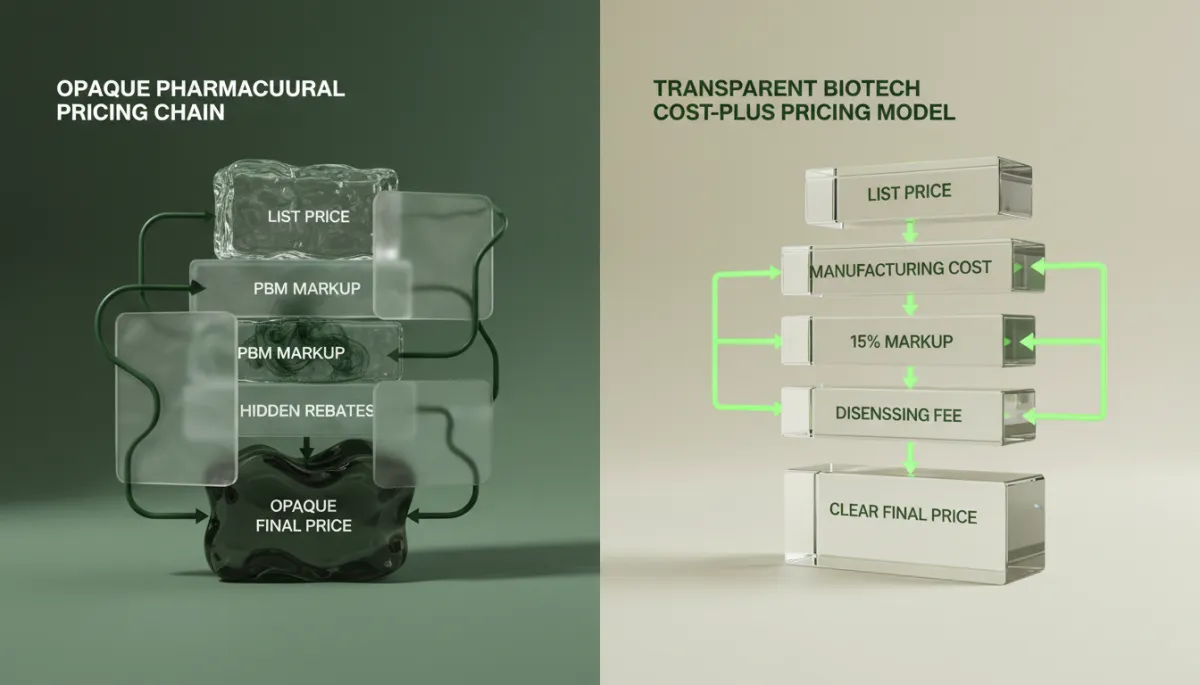
Biotech startups with transparent pricing models generate 34% more institutional inquiries and see approvals 2.4× faster when they present cost‑versus‑outcomes evidence.
The Biotech Pricing Framework Jason Teaches Every Startup Founder
Jason meets many biotech founders at the same painful moment. The science works. Early clinical data is promising. A hospital or payer is finally ready to talk. Then the founder realises they have a slide for mechanism of action, a slide for endpoints, a slide for safety — and no real slide for price beyond “to be determined after negotiations.”
His core message is kind but direct: pricing is not something you improvise in the room. It’s a story you design in advance. And that story has to be told in the buyer’s language. McKinsey’s healthcare report notes that the most common mistake in biotech pricing is the failure to frame cost per outcome in payer language. The problem isn’t weak science. It isn’t flimsy efficacy. It’s a fuzzy translation into the numbers that drive budgets and policy.
Jason’s framework starts with three simple questions founders can answer on a whiteboard before they ever open PowerPoint. What is the true cost of delivering one unit of clinical outcome? How does that compare to the current standard of care in cost per avoided hospitalisation, per quality‑adjusted life year, per prevented readmission? And how can the founder show, in a single clean table, that the payer saves or earns more than they spend at the proposed price?
As Jason explains at AuthorJason.com, a biotech pricing strategy for startup founders built on these three questions gives the founder an economic language they can use with any committee — from a local hospital to a national health system.
How Does a Biotech Startup Founder Decide What to Charge When There Are No Comparable Products on the Market?
Start from cost per outcome, not competitor benchmarks, then price so the payer’s savings and clinical gains clearly exceed your ask.
What Is Outcomes‑Based Pricing in Biotech — And How Do You Build a Pricing Model Around Patient Results?
Outcomes‑based pricing ties payment to agreed clinical results, with discounts, rebates, or staged payments triggered when real‑world outcomes fall short of expectations.
How Do You Justify the Price of a Biotech Product to a Hospital Formulary Committee or Insurance Payer?
Present transparent cost components, clear cost‑per‑outcome metrics, and side‑by‑side comparisons with the economics of the current standard of care.
How Do Biotech Startups Decide What to Charge for Their Product?
Smart founders link price to measurable outcomes, use health economics models to estimate cost savings versus standard of care, then set a price that leaves the payer with a net gain per patient.
What Is Health Economics Pricing and Why Does It Matter in Biotech?
Health economics pricing links price to outcomes and economic value, such as cost per quality‑adjusted life year or per adverse event avoided. In biotech, it lets payers compare your product directly to the costs of the status quo.
How Do Biotech Founders Defend Their Price in Front of Hospital Procurement Committees?
They use clinical outcome data, cost‑benefit models, and comparison tables that clearly show how their product reduces costs or improves outcomes versus standard of care, instead of leaning on vague “innovation.”
How Buffett and Bezos Set Prices to Build Long‑Term Institutional Trust
Warren Buffett has a simple rule: price based on value, not fear. When he looks at pharma or biotech companies, he doesn’t fall in love with patents alone. He asks whether the company’s prices align with real value for the patient. If the price makes sense in terms of outcomes — less time in hospital, fewer complications, longer healthy life — the business can survive policy shifts and public scrutiny. If not, it’s a house built on sand.
For founders, this means a biotech pricing strategy for startup founders must be able to stand in front of a skeptical committee and show value per dollar without hesitation. Not “we charge this because others do,” but “we charge this because every dollar buys this much real clinical impact.” This is the language IQVIA and AMCP see payers respond to when they approve coverage faster and with more confidence.
Jeff Bezos adds another layer. His principle of long‑term stable low prices isn’t about racing to the bottom. It’s about creating such deep trust in your pricing that customers stop comparing. In biotech, that looks like a hospital renewing the contract without turning it into an annual knife fight. A payer that doesn’t demand emergency renegotiation every budget cycle because the pricing logic was clear from day one and still makes sense as the evidence base matures.
A concrete example: in the early days of Amazon Pharmacy, Bezos focused on removing surprise fees and simplifying comparison, even when prices weren’t always the absolute lowest. The result was growing trust that the price was “fair” and consistent. That’s the same principle biotech founders need when they present long‑term pricing for chronic therapies or ongoing diagnostic solutions.
As Jason teaches at AuthorJason.com, the founder who builds a pricing model buyers can rely on for years — instead of a short‑term discount campaign — creates real institutional assets: renewing contracts, simpler negotiations, and less price pressure every cycle.
Should a Biotech Startup Price Differently for Public Health Systems Versus Private Hospitals — And What’s the Strategic Risk of Each Approach?
Yes — but anchor all tiers in a single defensible value story; extreme gaps invite reference pricing, mistrust, and painful renegotiations later.
How Do You Handle the “Your Competitor Charges Half Your Price” Objection from a Hospital Procurement Team?
Bring the conversation back to cost per outcome, total cost of care, and the documented savings your higher‑priced product creates over time.

71% of procurement leaders say clear cost‑versus‑benefit justification is the single biggest accelerator of approvals when evaluating new biotech products.
What Jason’s Biotech Founders Discover When They Price on Value, Not Market Fog
Jason watched one fictional founder, Dr. Maya Chen, walk this path. Maya led a health‑tech startup using AI‑guided diagnostics to reduce avoidable sepsis cases in mid‑sized hospitals. Her eight‑person team built remarkable technology, but their first pricing meetings were painful. They came in with a high list price justified by “AI innovation” and a stack of competitor slides. Hospital buyers were polite. Then they stalled for months.
Working with Jason, Maya rebuilt her pricing from scratch. They mapped today’s cost of each sepsis case. ICU days. Readmissions. Mortality impact. They calculated the cost per avoided case with her product, then built a simple table: total current cost of sepsis versus expected cost with her system and the proposed price. For the first time, her slide showed the hospital not just what they would pay, but what they would keep.
When Maya presented this new model, the conversation changed. The formulary committee started asking, “How fast can we implement this?” instead of “Can you cut the price by 30%?” Suddenly the IQVIA statistic — that co‑designed pricing accelerates reimbursement by 40% — felt personal, not theoretical. Maya didn’t become more aggressive. She became more transparent and precise. And the market rewarded her.
As Jason explains at AuthorJason.com, founders who reframe their offer around what the buyer gains per patient — not just what the product costs per dose — are the ones who see shorter cycles and smaller discounts in every negotiation.

Transparent, outcomes‑based pricing models increase formulary adoption rates by 28%, turning pricing into a trust‑building step.
How the P.I.T.C.H. Model Presents Biotech Pricing as Trust, Not Tug‑of‑War
Inside the Future of Selling System, Jason teaches founders a simple way to structure every institutional sales conversation so that price is the natural conclusion, not an awkward surprise. He calls it the P.I.T.C.H. Formula. It isn’t about clever comebacks or pressure tactics. It’s about guiding the buyer through the problem, impact, trust, and clinical value — and only then, the honest number that ties it all together.
Self‑Check
- Can you defend your biotech product’s price with clinical outcome data — or are you still pricing on gut “cost plus margin” instinct?
- Do you know what the current standard of care costs your buyer per patient — and how your price compares?
- Have you built a health economics model — or are you walking into pricing conversations without one?
Founders often tell Jason they feel like they’re on the witness stand when a payer asks, “Why does this cost this much?” The P.I.T.C.H. model helps them answer that question calmly, in one or two clear sentences, using the buyer’s own metrics. It turns a defensive moment into a leadership moment. Instead of scrambling, the founder can say: “Here is our cost per outcome, here is your current spend, and here is why this price is fair for both sides.”
At the heart of preparing for this kind of conversation is one thing: walking into every meeting with a completed health economics model. The founder who has already mapped current cost per patient, outcome scenarios with their product, and the payer’s net difference isn’t “picking” a number; they’re reading a conclusion from the model. That’s what makes the price defensible even when deal size or buyer type changes. If a formulary committee asks for a discount, the founder can point to the same model and show what happens when the price drops too far — where the payer starts losing value, and where the product is no longer sustainable for the startup.
For biotech founders in the P9 Biotech pillar, especially those following the comprehensive playbook for biotech pricing strategy for startup founders, this shift feels like finally exhaling. Pricing stops being a guessing game and becomes a repeatable script they can trust under pressure. As Jason reminds readers at AuthorJason.com, deep preparation before the meeting is what gives a founder the power to defend any reasonable price — because the number is no longer arbitrary.
Frequently Asked Questions About Biotech Pricing Strategy for Startups
When Should a Biotech Startup Consider an Outcomes‑Based or Pay‑for‑Performance Pricing Model — And What Does It Require?
Consider outcomes‑based pricing when you can reliably measure patient outcomes, track them over time, and align payment triggers with those measurable clinical milestones.
What’s the Difference Between Value‑Based Pricing and Cost‑Based Pricing in Biotech?
Cost‑based pricing starts from production expenses plus a margin, while value‑based pricing starts from the clinical and economic outcomes your product creates, then sets a price that leaves the payer with a net gain per patient versus standard of care.
How Does Real‑World Evidence (RWE) Affect Biotech Pricing Strategy for Startup Founders?
Real‑world evidence strengthens your health economics model, shows that benefits persist outside trials, and gives payers more confidence that your price reflects consistent performance, not just idealised study results.
What Should a Health Economics Table Include in a Biotech Pricing Deck?
Show the standard‑of‑care cost per patient, your product’s cost, the change in outcomes (for example, avoided hospitalisations), and the net cost or savings per patient. The buyer should be able to see exactly how your price creates savings or added value.
How Do Biotech Founders Handle Regulatory Uncertainty When Setting Prices?
They build multiple pricing scenarios tied to key regulatory milestones, keep a consistent outcomes‑based pricing logic, and use renegotiation clauses if reimbursement rules shift significantly, instead of betting everything on one fragile number.
How Can a Biotech Startup Use Willingness‑to‑Pay (WTP) Research Without Losing Payer Trust?
Use WTP research to identify acceptable ranges, but always anchor the final price in a transparent health economics model. That shows you’re not “charging what the market will bear,” but pricing in line with the value the payer actually sees.
What Role Do Health Technology Assessment (HTA) Bodies Play in Biotech Pricing Strategy for Startup Founders?
HTA bodies evaluate clinical effectiveness and value for money. Founders who build their models around HTA metrics — like cost per quality‑adjusted life year — find their pricing proposals align better with what decision‑makers need to approve coverage.
How Do International Reference Pricing Policies Affect Biotech Pricing Strategy for Startups?
Very low prices in one market can drag prices down in other markets that reference them. Founders need to plan global price bands that preserve the same value logic while avoiding sharp gaps that trigger aggressive repricing.
Cuban built Cost Plus Drugs not by being the cheapest, but by being the most defensible — publishing every cost component so thoroughly that the institutional buyer struggled to find a reason to say no. Buffett prices on clinical value because he knows a payer who understands what they’re buying doesn’t need to haggle. Bezos builds such deep trust in pricing that the institutional buyer stops shopping around. For Jason’s biotech founders, pricing strategy isn’t a number. It’s a conversation — and the founders with the clearest, strongest, most defensible answer to “why does this cost this much?” are the ones whose prices institutions accept without a war.


