
How Billionaire Mark Cuban Prices High-Ticket Services to Win on Value
High-Ticket Sales, Value-Based Pricing, Startup Founders
How Billionaire Mark Cuban Prices High-Ticket Services to Win on Value, Not Hours — The Founders' Playbook
Jason wrote this for the founder who leads every sales call, carries the whole revenue number on their shoulders, and knows their service is worth more than the hours on the calendar — but still feels that quiet doubt when it is time to name the price.
Why Do Smart Founders Still Underprice High Ticket Services?
Jason sees the same scene play out again and again. A founder runs the whole sales process. The team ships great work. Clients rave. But the bank balance still feels like a step behind the effort going in.
When it is time to quote, the founder opens a spreadsheet. Hourly rate. Estimated hours. Maybe a small buffer. Then they shave it down “so it feels reasonable.” The number lands in the middle of the page like a compromise with fear, not a decision based on value.
Meanwhile, a competitor offers a rougher service, less depth, less care — and charges three times more. The client buys from them anyway, because the competitor sold the result, not the time. That is the costly math of underpricing: the work is excellent, but the price is built on hours, not outcomes.
McKinsey’s pricing research shows that value-based pricing generates around 24% higher revenue per client than cost-plus models. Consulting.com reports founders who price on outcomes earn 3.4× more per engagement than those who price on hours. The gap is not talent. It is pricing structure and courage combined.
As Jason teaches at AuthorJason.com, the founders who master how to price high-ticket services as a startup founder know the price conversation starts in the buyer’s head long before any number is spoken — your job is to shape that story around value, not effort.
As Jason teaches at AuthorJason.com, most founders quietly undercharge because they are pricing from their own wallet and fear of rejection instead of from the buyer’s problem, upside, and what not solving it is already costing them.
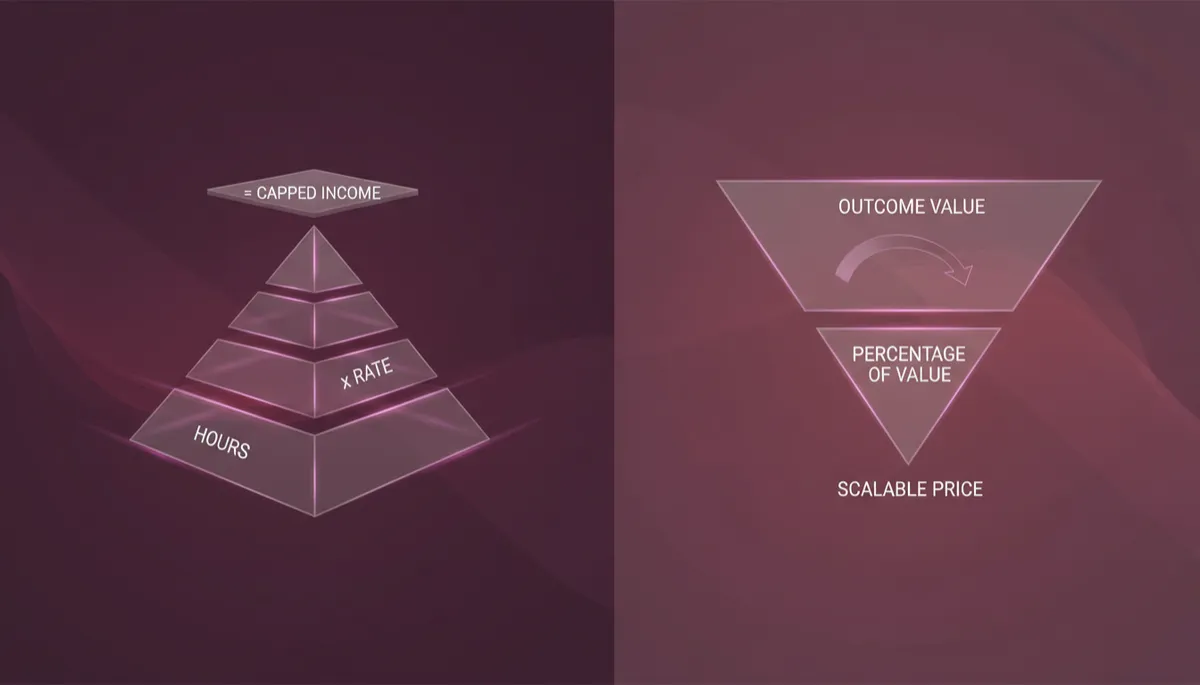
Value-based pricing lifts revenue per client and turns the same work into 3.4× more income.
How Mark Cuban Prices Services Based on What the Outcome Is Worth — Not What It Costs to Deliver
Mark Cuban built Broadcast.com into a $5.7 billion company by refusing to price like a freelancer. He did not ask, “How many hours will this take?” He asked, “What is this worth to the buyer if it works?” Then he priced like a solution to that number, not like a pile of tasks on a to-do list.
Cuban has said in interviews and on Shark Tank that the biggest pricing mistake founders make is confusing cost with value. If you sell your time, you will always be underpaid for the outcome. The buyer does not care how long it took you to build the skill. They care what the result is worth to their business in revenue, time, risk, and opportunity.
His principle is simple. Calculate what it costs the client to not solve the problem. Lost revenue. Wasted team hours. Increased risk. Missed opportunities. If the problem is quietly leaking $500,000 a year, then a service that reliably stops that leak should never be priced like an hourly project. It should be priced like part of a $500,000 solution — a clear fraction of that number, not a random fee.
Cuban brings the same lens to every Shark Tank deal. He does not ask what it costs to make the product. He asks what the market values the outcome at. That is the shift Jason invites founders into: you are not selling hours or deliverables. You are selling a specific business result. Price the result, not the effort.
In the early days of Broadcast.com, Mark Cuban negotiated streaming rights for major sports events, including college basketball games, at prices that looked aggressive against his internal costs but tiny against the advertising and subscription revenue those audiences could unlock for partners. When Yahoo acquired Broadcast.com in 1999 for $5.7 billion, it validated his belief that pricing should follow strategic value, not production expense.
On Shark Tank, Cuban often pushes founders to raise prices when he sees that their solution drives significant revenue or retention for enterprise buyers. In one deal with the company BeatBox Beverages, he argued that their party-sized drinks should command a premium because they owned a unique shelf presence and social media momentum, not because of what the liquid cost to produce. The result: higher margins and faster path to scale.
He has also publicly described how the Dallas Mavericks rethought ticket and sponsorship pricing by focusing on fan experience and brand exposure value rather than just seat count. By tying packages to outcomes sponsors actually cared about — brand reach, fan engagement, premium hospitality — Cuban turned what could have been a commodity into a differentiated, value-priced offer.
In 2011, Cuban backed the startup Cyber Dust (later Dust) and encouraged the team to pursue enterprise and influencer use cases where secure, disappearing messaging protected deal flow and reputation. His advice was to charge in line with what a leaked negotiation or legal dispute might cost a user, not what the engineering hours cost — a classic example of pricing against downside risk instead of feature lists.
During the 2011 NBA lockout, Cuban publicly spoke about the Mavericks’ investment in sports science, analytics, and fan experience as a way to protect franchise value beyond ticket revenue. Internally, that meant justifying seven-figure spends on technology and staff by modeling the long-term impact on wins, TV ratings, and sponsorships — again, pricing decisions anchored to compounding outcomes rather than short-term cost cuts.
On Shark Tank, his investment in Ten Thirty One Productions, the live horror attractions company, showed the same playbook. He pushed the founders to raise ticket prices in line with demand and the depth of the experience, arguing that a premium, immersive event should never be priced like a local haunted house. The company went on to expand into multiple locations and corporate partnerships before being acquired, proving that premium pricing can unlock growth instead of stalling it.
As Jason teaches at AuthorJason.com, when you learn how to price high-ticket services as a startup founder the way Cuban thinks — to the size of the win, not the size of the workload — the buyer starts seeing your fee as a lever, not a line item.
What Value-Based Pricing Really Means for High-Ticket Founders
Value-based pricing is not fluffy. It is math. But it is a different kind of math than “hours times rate.” It starts with the client’s world, not your cost structure. It asks, “What is this outcome worth to them in real numbers?” and then takes a confident slice of that value as your fee.
Gartner reports that 56% of B2B buyers say the quality of the pricing conversation directly influences who they choose. They are not just buying the offer. They are buying how clearly you help them understand the value. Salesforce data shows that 71% of high-ticket buyers will pay a premium to reduce delivery risk. They pay for certainty, not hours on a timesheet.
As Jason teaches at AuthorJason.com, the founders who really master how to price high ticket services as a startup founder use the pricing conversation to surface what the buyer already believes about the pain and upside — because the decision is made in that narrative long before a proposal is opened.

Start with the cost of the problem; your fee becomes a fraction of avoided loss and new upside.
How do you calculate the right price for a high ticket service — and what does value-based pricing actually mean?
Jason teaches founders to estimate the annual cost of the unsolved problem, then price their service as a clear, confident fraction of that number — not as hours on a calendar.
- Estimate the yearly financial impact of the problem: lost revenue, extra costs, and risk.
- Decide what fraction of that impact your service can realistically and reliably affect.
- Set your fee as a clear slice of that number, then sanity-check it against your delivery costs.
Should you ever charge by the hour for a high ticket service — or always by outcome?
For high-ticket work, Jason recommends moving away from hourly billing and anchoring fees to the business outcome, using hours only as an internal guardrail, never as the main story.
- Use hours to ensure the engagement is profitable for your team and margin targets.
- Externally, speak only about outcomes, time-to-value, and risk reduction — never your internal clock.
How do you raise your prices for high ticket services without losing existing clients?
Jason guides founders to lead with results already delivered, frame the new price as alignment with that value, and offer a clear transition plan so good-fit clients feel upgraded, not punished.
- Show specific outcomes you have already delivered, with numbers where possible.
- Explain that the new price reflects that value and supports continued delivery at that level.
- Offer a transition path or loyalty option so aligned clients feel taken care of.
As Jason teaches at AuthorJason.com, learning how to price high-ticket services as a startup founder means accepting that your own comfort is a poor benchmark — the only number that matters is what solving the problem is worth in the buyer’s world.
How Do Bezos and Buffett Show Founders to Price From Outcome and Value, Not From Cost and Hours?
Jeff Bezos asked one question when shaping AWS pricing: What is the alternative worth? Before AWS, companies spent millions on servers, staff, and redundancy. AWS did not look cheap in isolation. It looked like a bargain next to the old way. The price was a fraction of the alternative, not a reflection of internal cost alone.
For a founder selling a high-ticket service, that question is gold. What would it cost your client to get the same outcome without you? New hires. Agencies. Lost deals. Delayed launches. When you stack those numbers, your fee stops feeling “expensive” and starts feeling protective. It becomes a shield against bigger losses and missed upside.
Warren Buffett offers another lesson. He keeps his management fee structure steady across market cycles. He does not chase what the market can bear in a moment of fear or hype. His pricing reflects the long-term value of the relationship and the outcomes Berkshire Hathaway delivers. Clients who see that value stay. Those who do not were never the right fit.
Jason encourages founders to borrow both questions. From Bezos: “What is the alternative really costing them?” From Buffett: “What price reflects the long-term value we create, not today’s nerves?” That is how a high-ticket price becomes a stable, confident decision, not a number that changes with every objection.
When AWS launched in 2006 with services like S3 and EC2, Bezos priced them low enough that startups could avoid seven-figure data-center investments, yet high enough to build a massive, profitable business line. Harvard Business Review later highlighted AWS as a classic example of value-based pricing: charging according to the economic transformation delivered rather than marginal cost. That framing turned infrastructure into a strategic platform.
Buffett’s 1960s partnership letters show the same discipline. He structured his fees as a modest base plus a performance allocation only above a hurdle rate, meaning clients paid more when they earned more. During volatile markets, he refused to tweak terms opportunistically. That consistency built deep trust and attracted long-term capital, compounding Berkshire Hathaway’s ability to buy great businesses at scale.
For founders, these stories translate into a simple move: set your high-ticket price relative to the real alternatives and the multi-year value you create. As one Harvard Business Review analysis of value-based pricing shows, buyers pay more when they clearly see financial, emotional, and risk-reduction value stacked together.
As Jason teaches at AuthorJason.com, learning how to price high-ticket services as a startup founder the Bezos-and-Buffett way means pricing as a fraction of the alternative and the long-term upside — because that is the story already running in the buyer’s mind.

When the value story is clear, the middle tier becomes the obvious “yes” for serious buyers.
What is price anchoring and how do you use it when presenting high ticket service packages?
Price anchoring means showing a higher-value, higher-fee option first so your target package feels like a strong deal by comparison, a method Cialdini’s research links to a 34% boost in acceptance.
- Present a premium tier first that genuinely delivers more value at a higher price.
- Follow with your target tier, framed as the most efficient path to the main outcome.
How do you present three pricing tiers for a high ticket service so the middle option always wins?
Jason designs tiers so the top anchors value, the middle holds the core outcome most buyers want, and the bottom feels intentionally limited — making the middle the safest, smartest choice.
- Define the non-negotiable outcome your best-fit buyer wants — that becomes the middle tier.
- Build a lighter tier that clearly removes support or speed, not the core result, so it feels like a compromise.
What Do Jason's Founders Earn When They Switch From Cost-Plus to Value-Based Pricing?
Since 2015, Jason has worked with more than 1,000 founders across SaaS, agencies, and complex B2B services. Together, they have generated over $22M in combined sales. The common thread is not aggressive tactics. It is a calm, value-first way of pricing and selling that fits thoughtful founders who care about their clients.
One founder, Maya, led a 7-person revops consultancy. Her team rescued broken funnels and leaky pipelines, but she still quoted based on days and hours. After working with Jason, she calculated that a typical client was losing $300,000–$500,000 a year in missed deals and churn. Her old fee? Around $25,000. Her new fee? $90,000, framed as a fraction of the recovered revenue, with clear milestones and risk reduction.
Her first three clients at the new price all said yes. Nothing about her delivery changed. Only the story and structure of the price did. That is what Jason sees again and again. Founders are already delivering high-ticket outcomes. Value-based pricing simply lets the price catch up to the impact they are quietly creating.
As Jason teaches at AuthorJason.com, founders who learn how to price high ticket services as a startup founder around outcomes instead of effort don’t suddenly become more talented — they simply stop hiding the true economic value of what they already do.
How Does the P.I.T.C.H. Formula Set Up the Price Before You Ever Name It?
The Future of Selling System (FOS) gives founders a repeatable way to do this. At the heart of FOS sits Jason’s P.I.T.C.H. Formula. It is not a script. It is a simple sequence that makes the value of your work feel obvious before the number ever appears on a slide or proposal.
Instead of jumping straight to “Here is the price,” founders learn to walk prospects through the cost of the problem, the size of the opportunity, and the risk of delay. By the time the price shows up, it feels like a logical fraction of a much bigger number the client already believes. The conversation shifts from “Why is this so expensive?” to “How fast can we start?”
For a founder who has rebuilt from rock bottom multiple times, Jason knows how heavy it feels to raise prices when the memory of past struggle is still close. FOS meets that feeling with structure, not shame. It lets you honour your journey and still charge like the outcomes you now create.
One of the quiet powers inside the P.I.T.C.H. Formula is the moment where you stop answering questions and start teaching. In that phase, Jason has founders step back from features and timelines and instead explain how the problem behaves in the wild — why it keeps coming back, what it silently costs over 6–12 months, and what changes when it is fixed properly.
When you do this well, the buyer begins to see their situation differently. They realise the “nice-to-have” they thought they were buying is actually sitting on top of a compounding leak. They start naming the stakes in their own words: the deals lost, the churn, the stress on their team. You are no longer pushing a price; you are holding up a mirror.
By the time you eventually reveal the number, it lands against a backdrop they helped build. Relative to the cost of inaction they now recognise, your fee feels proportionate, even conservative. That is how the P.I.T.C.H. Formula makes the price feel inevitable instead of abrupt — the conversation has already justified it long before you say it out loud.
In Jason’s work with founders, the quiet engine behind the P.I.T.C.H. Formula is how thoroughly they prepare before the call. The founders who win big do not show up guessing what the problem costs; they have already modeled realistic ranges from public data, industry benchmarks, and past clients. That pre-work gives them a grounded sense of what solving the problem is worth, so the price is a conclusion, not a guess.
When a founder has done that homework, they can listen for the buyer’s numbers, pressure-test their assumptions, and refine the range in real time. By the time the conversation reaches the price, the founder has both logic and confidence: they know that charging $60,000 against a $500,000 leak is rational. That confidence changes tone, body language, and word choice. Instead of softening the number, they state it cleanly and let it stand.
Founders who skip that preparation default to pricing from instinct or fear. They shave numbers down because they are not anchored in the economics of the buyer’s world. The P.I.T.C.H. Formula, used properly, flips that: preparation gives them a numeric story they believe in, so they can name the price once, without qualifiers, and stay present with whatever reaction comes next.
Self-Check
- Is your high-ticket price set by the outcome you produce — or by what you think the buyer will accept?
- Do you present your high-ticket price with conviction — or with a qualifier like "it's a bit of an investment" or "I know it's not cheap"?
- Have you raised your price in the last 12 months — and if not, do you know why?
Self-Check
- Before presenting your price, do you confirm what the buyer believes the problem is costing them — or do you arrive at the number without context?
- Do you present your price with conviction — or does your voice or body language signal that you are uncertain about whether it is worth it?
- Have you raised your prices in the last 12 months — or are you still charging what felt safe when you started?
As Jason teaches at AuthorJason.com, when you use the P.I.T.C.H. Formula to learn how to price high ticket services as a startup founder, the real shift is that the buyer talks themselves into the value before you ever reveal the fee.
Frequently Asked Questions About How to Price High Ticket Services
What should you say when a prospect asks why your high ticket service costs more than a competitor?
Jason coaches founders to calmly bring the focus back to outcomes: compare expected results, risk reduction, and support, then explain that your price reflects the total value and certainty you deliver, not just the visible tasks.
How do you know if your high-ticket price is too high?
If best-fit buyers consistently say “we can’t afford this” even after you’ve clarified value and alternatives, your price may be ahead of the market. Occasional pushback is normal; universal rejection from ideal clients is a signal to recalibrate.
Should founders reveal pricing before or after a sales conversation?
Jason often recommends sharing a clear range on your site or in pre-call materials, then confirming the exact fee after you’ve explored the problem, stakes, and desired outcome. That way, buyers self-qualify without you pricing in a vacuum.
What's the best way to present a high-ticket price without losing the buyer?
State the outcome first, briefly recap the cost of inaction, then say the price plainly and stop talking. Hold the silence. Let the buyer process. When they respond, explore their reaction before adjusting anything.
How often should founders review and adjust high-ticket pricing?
Jason suggests a formal review every 6–12 months, or sooner if demand surges, your offer improves, or clients achieve bigger outcomes. If close rates stay high and delivery gets stronger, your price is probably due to move up.
How can startup founders test new high-ticket prices without risking their pipeline?
Start by offering the new price to a subset of well-qualified leads or on a new package version. Track acceptance, objections, and outcomes. Use those data points to refine your messaging and decide whether to roll the price out more broadly.
How do you handle discounts on high-ticket services without eroding perceived value?
If you discount, Jason recommends tying it to a clear condition: limited scope, earlier start date, or case-study permission. Avoid casual percentage cuts. Make any reduction feel like a strategic trade, not a sign that the original price was inflated.
How does payment structure affect high-ticket pricing acceptance?
Many founders find that splitting fees into milestones or monthly retainers reduces friction without cutting price. Align payment with delivered value moments so the buyer feels progress and ROI at each stage.
How do startup founders decide what to charge for a high-ticket offer?
Jason has them estimate the financial impact of the problem over 6–12 months, choose a realistic fraction they can influence, and set the price as a proportion of that number instead of guessing from hours or competitors.
Why do buyers pay more when a founder charges more?
In premium markets, higher prices signal confidence, selectivity, and deeper support. Buyers often equate higher investment with lower risk and better outcomes — as long as the founder clearly connects the fee to meaningful business results.
What's the difference between cost-based pricing and value-based pricing for startup founders?
Cost-based pricing adds a margin on top of your delivery costs. Value-based pricing ignores your internal hours and instead ties the fee to the revenue, savings, or risk reduction your work creates for the buyer.
3 High-Ticket Pricing Mistakes — and the Bonus One That Hurts the Most
Mistake 1 (Sofia, strategy consulting founder): Priced her services based on her hourly rate multiplied by estimated hours. The math felt safe. The result was a price that reflected her cost of delivery, not the value of the outcome. A competitor charged three times more for the same result. The buyer chose the competitor. Move: pricing based on delivery cost is a ceiling, not a strategy. Price to the outcome. What is the result worth to the buyer? Start there and work backward.
Mistake 2 (Sofia): Apologised for the price. "I know it might seem high but..." was how she opened the pricing conversation. The buyer immediately started negotiating. The apology was an invitation. Move: present the price plainly and then stop talking. Silence after the price is not awkward — it is necessary. The buyer needs a moment to process. Fill that silence and you have started negotiating against yourself.
Mistake 3 (Sofia): Dropped her price on the first ask without understanding the objection. The buyer said "that's more than we expected." Sofia immediately said "I can work with you on that." The buyer had been surprised by the price, not opposed to it. Surprise and resistance are not the same signal. Move: when a buyer responds to the price with concern, ask one question before adjusting anything: "Can you tell me more about what you had in mind?" That answer tells you whether to hold or adapt.
Bonus (Jason, 3rd person): Found that the most underpaid founders were not the ones with the weakest offers — they were the ones with the most anxiety about the price conversation. They discounted pre-emptively. They filled silences with justifications. They volunteered scope reductions before the buyer asked for them. Jason taught them one thing first: say the number and stop. Not "our fee is $25,000 but that includes X and Y and Z." Just: "Our fee for this engagement is $25,000." Then stop. The founders who learned to hold the silence after the number closed more deals at higher prices. Not because the offer changed


