
How Billionaire Melanie Perkins Used 100 Rejections to Build the Biotech Investor Pitch Playbook
Biotech, Fundraising, Investor Pitches, Startup Sales
How Billionaire Melanie Perkins Used 100 Rejections to Build the Biotech Investor Pitch That Works — A Founder’s Guide to Raising Capital in Biotech
Melanie Perkins turned more than 100 investor rejections into the pitch that convinced the world to build a $40B company. Jason helps biotech founders do the same with investor conversations that feel brutal today — but become the data that funds tomorrow.
Why Biotech Investor Pitches Fail More Than Any Other Startup Category — And What the Winners Do Differently
Jason sees the same pattern in biotech fundraising rooms around the world. Smart founders. Serious science. Deep care for patients. And they walk out with another polite “no.”
In 2026, capital is back… but it’s more selective. BioPharma Dive notes that 68 venture-backed biotechs raised more than $9.1B in the first half of the year, yet most of that went into a small number of mega-rounds of $100M+ ( BioPharma Dive ).
At the same time, S&P Global reports that U.S. biotech funding rounds have dropped to a five‑year low, even as billions continue to flow into the sector ( S&P Global ). Fewer shots. Harder scrutiny. And more pressure on every pitch.
That’s why biotech investor pitches fail more often than SaaS, medtech, or consumer. The science is harder to explain. Timelines are longer. Risk is harder to price. Yet the founders who win aren’t always the ones with the “best” data. They’re the ones who can make the investor feel the patient’s problem, trust the path, and see the commercial return — all in one clear story.
In another report on early life‑science investor expectations, STAT News highlights that specialist funds tend to back founders who balance scientific rigor and commercial clarity in the same pitch — a core skill when biotech founders think about how to pitch investors in a way that convinces investment committees.
As Jason teaches at AuthorJason.com , biotech founders who master how to pitch investors learn that investors fund founders who show scientific rigor and commercial clarity in the same conversation — not in separate decks.
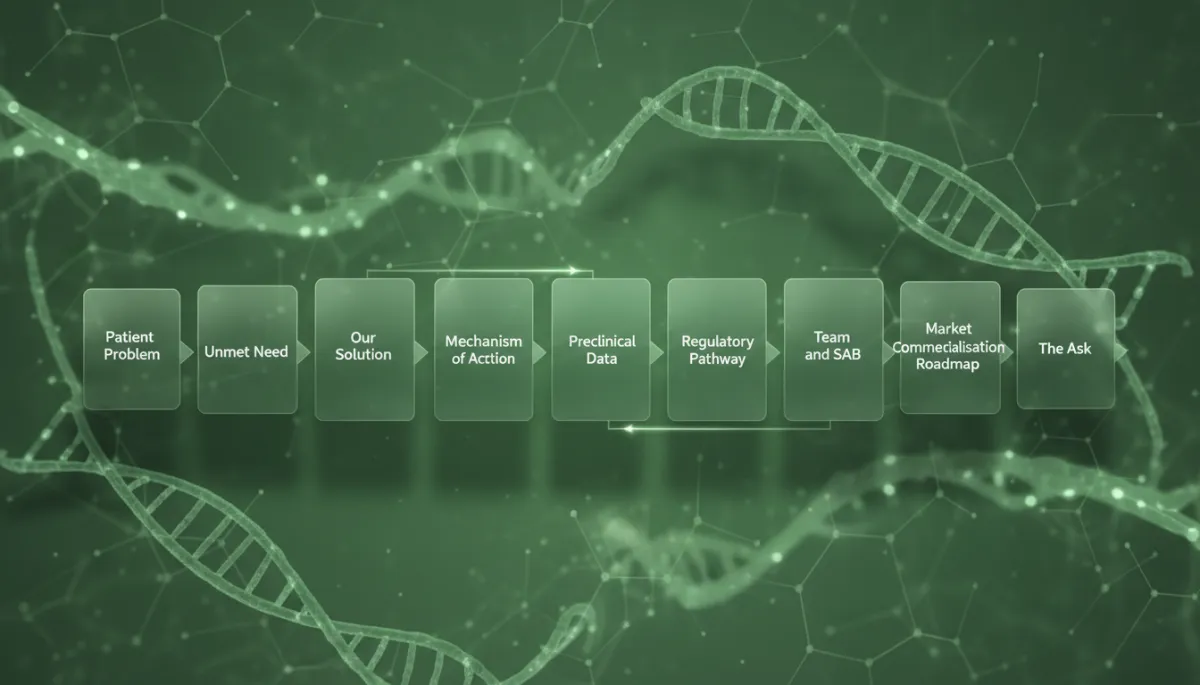
Diagram of a biotech pitch deck structure in green tones, ten clearly labeled slides arranged in sequence...
Rock Health found that biotech pitches starting with the patient problem — not mechanism of action — generate 2.4× more follow‑up meetings. CB Insights notes that the top three reasons pitches fail are: undefined patient segment, lack of a clear regulatory path, and failure to explain the science to non‑scientists. These are storytelling problems, not data problems ( Rock Health , CB Insights ).
How Melanie Perkins Used 100+ Rejections to Build the Pitch That Created a $40B Company — And What Every Biotech Founder Can Learn
Before Canva became a $40B company, Melanie Perkins heard “no” more than 100 times. She was selling a vision — design for everyone — to investors who couldn’t yet see the product, the market, or the revenue model clearly enough to commit. Her early pitches weren’t perfect. They didn’t have to be. They just had to get her to the next iteration .
Perkins refused to treat rejection as a final verdict. She treated every “no” as a data point. Was it the market‑size story that fell flat? The team slide? The go‑to‑market strategy? She listened, adjusted, and walked into the next room with a sharper story. Even the investors who said “no” helped her build the pitch that made the right investors say “yes.”
At an early stage, Perkins flew to Silicon Valley to pitch Mike Cannon‑Brookes and Bill Tai. Canva was still a prototype, but she showed up with paper mock‑ups and printed screenshots to make the experience tangible. When an investor asked why she believed non‑designer users would adopt the tool, she didn’t just flip to a slide; she told the story of students using her previous platform, Fusion Books, to create school yearbooks with no design training at all.
That blend of real data and a specific human story is what helped investors see that her vision wasn’t theoretical. In a later round, when Canva raised from Sequoia and Blackbird Ventures, the investing partner could trace the evolution of the pitch from “design tool for students” to “global design platform.” Every adjustment in the story was linked to a question a previous investor had asked — the same approach biotech founders need when they turn 20–30 rejections into one compelling pitch.
Perkins also understood something many biotech founders forget: the relationship mattered as much as the deck. She went to kite‑surfing sessions where Bill Tai and other investors were spending their time. She built trust in human spaces before asking for money in formal rooms. By the time the formal pitch showed up, the relationship was already there.
For biotech founders, the rejection rate is even higher than what Perkins faced. EvaluatePharma surveys point to an average of 23 investor rejections before the first institutional round. The founders who get funded are rarely the ones with a perfect first deck. They are the ones who, like Perkins, use every “no” as an improvement signal and keep showing up with a better story until the right investor finds themselves saying “yes” almost before they know why.
As Jason teaches at AuthorJason.com , biotech founders who understand how to pitch investors advance faster when they turn every rejection into a small experiment on the message — showing investors the same scientific rigor in how they develop their story that they apply to their data.
The Biotech Investor Pitch Framework Jason Teaches Every Preclinical and Early‑Stage Founder
Jason approaches biotech pitches the way a quant trader approaches a new strategy. Clear structure. Defined signals. Measurable outcomes. Every slide is a “position.” Every objection is market feedback. The pitch is not art. It’s a risk‑return model in story form.
His core structure mirrors what specialist biotech investors quietly expect. Start with the patient problem and unmet need. Then show the solution and mechanism of action in simple language. Move into preclinical data. Map the regulatory path. Introduce the team and scientific advisory board. Open the market opportunity. Lay out the commercial roadmap. Then present the ask with a clear use of funds and milestones.
How to Structure a Biotech Investor Pitch — And the Ten Sections Biotech Investors Always Evaluate
Use ten slides in this order: patient problem, unmet need, solution, mechanism of action, preclinical data, regulatory path, team and SAB, market opportunity, commercial roadmap, then the ask and use of funds.
- Start with the patient‑problem slide, showing who is in pain today and how.
- Define the unmet need and what current standards of care fail to deliver.
- Present the solution in simple language before diving into the science.
- Briefly explain mechanism of action using everyday analogies.
- Show preclinical data that proves the science works.
- Map the regulatory path from studies to approval.
- Introduce the team and scientific advisory board to prove you can execute.
- Open up the market size and commercial opportunity.
- Show the commercial roadmap from approval to first revenue.
- Close with a specific ask: amount, use of funds, and expected milestones.
As Jason teaches at AuthorJason.com , biotech founders who think clearly about how to pitch investors win when they treat every slide as part of a single coherent argument that weaves science, regulatory path, and commercial outcome into one story.
What Is the Most Common Reason Preclinical Biotech Pitches Fail — And How Do You Fix It?
The most common failure is an unclear or undefined patient segment; fix it by stating exactly who the patient is, how many there are, and how their life changes with your therapy — before you explain the science.
How Do You Find Specialist Biotech Investors — And Why Do Generalist VC Funds Waste a Biotech Founder’s Time?
Find specialist investors via sector‑focused funds, conference speaker lists, and syndicates; generalist funds often lack the mandate, patience, or expertise for long biotech timelines, so their polite interest rarely turns into term sheets.

Scene of a biotech founder in green tones leaving an investor meeting, seated at a café table...
How Musk and Branson Turn the Patient Story into the Investment Thesis
Neuralink’s fundraising leaned on Elon Musk’s credibility — and one simple habit. He carried the burden of complexity himself. Investors heard a human problem, a clinical logic, and a commercial opportunity — in that order, and in simple language. The science stayed “under the hood” unless someone asked to lift it.
Musk’s model for communicating with biotech investors is simple: if the investor leaves feeling the science is beyond their grasp, the pitch failed — no matter how strong the data. Biotech founders Jason coaches learn to translate mechanisms of action into everyday analogies. Like explaining receptor binding as a key finally finding the right lock in a hallway crowded with the wrong doors.
In one of Neuralink’s first public demos in 2019, Musk focused on paralyzed patients who could regain control of devices with thought alone before talking about neural electrodes and brain–computer interfaces. He let the scientists on the team dive into technical detail only after the audience — and potential investors — were emotionally connected to the story of a patient regaining independence. That sequence is exactly what biotech founders need when planning how to pitch investors in early rounds.
Richard Branson’s pattern is different in style but identical in principle. He backs health innovations when the founder makes him feel the patient problem before presenting the solution. For him, the patient story is the investment thesis, simplified. Once he feels the pain, he’s ready to talk science and numbers.
When Branson invested in companies like Virgin Care and digital‑health initiatives, he asked founders about “the real person” affected by the product, not the chart. The founders who could describe a single day in that patient’s life before explaining the technology were the ones who got extra time and follow‑up meetings. For biotech founders, this means the best answer to “what does your company do?” starts with the patient, not a molecule or platform.
As Jason teaches at AuthorJason.com , founders who understand how to pitch biotech investors outperform when they make the patient story the heart of the investment thesis — then prove that the science and commercial path can deliver that outcome.
How Do You Handle the Objection “The Science Is Interesting, but It’s Too Early for Us” from a Biotech Investor?
Acknowledge the comment, then reframe timing around specific risk‑reduction milestones and invite the investor to follow your progress; send concise updates tied to those milestones so “too early” today becomes “we’ve been following you for a year” tomorrow.
What Role Does the Scientific Advisory Board Play in a Biotech Pitch — and Who Exactly Should Be on It?
The scientific advisory board is your external credibility engine; include at least two recognized KOLs in the target indication plus one translational or regulatory expert who can speak to trial design and the realism of your path.
What Jason’s Biotech Founders Discover When They Stop Explaining the Science and Start Telling the Patient Story
Jason worked with a fictional founder we’ll call Dr. Amara Lin. Amara leads a health‑biotech company focused on early detection of autoimmune flares. Her early pitches were dense. Pathways. Biomarkers. Test sensitivity. Investors nodded politely, then passed. She felt she was failing her patients every time she left a room without a commitment.
Together, they rebuilt the pitch around a single patient. A young mother losing weeks of her life every year to sudden flares. They opened with a day in that woman’s life. School events missed. Nights in the hospital. The fear of the next flare. Only then did they show how Amara’s platform could predict and prevent those flares — and what that meant for quality of life and healthcare costs.
The science didn’t change. The data didn’t change. The order and emotional weight did. Follow‑up meetings doubled. Warm introductions increased. Within six months, Amara closed a seed round led by a specialist investor who said, “I could feel her patient in the room.” That’s what happens when you stop explaining and start translating.
As Jason teaches at AuthorJason.com , biotech founders who rethink how they pitch investors discover that the best scientific stories start with one specific patient, then expand to data, regulatory path, and commercial plan that show investors they’re funding real life change.
Scene of a biotech founder in green tones shaking hands with a specialist biotech investor...
How the P.I.T.C.H. Formula Sequences a Biotech Investor Pitch for Maximum Impact
Inside the Future of Selling System, Jason teaches a simple sequencing tool called the P.I.T.C.H. Formula . It’s not about adding more slides. It’s about putting the right ideas in the right order so the investor’s head and heart can follow without friction. Patient first. Risk second. Return third. Always in language a tired partner can absorb at 10 p.m. on a Sunday.
For biotech founders, the P.I.T.C.H. Formula becomes a calm checklist in a chaotic process. When a meeting goes badly, they don’t blame themselves or the science. They review the sequence. They adjust one piece at a time — like tuning a trading strategy after a drawdown instead of burning the system because of one bad week.
Jason sees the investor pitch as an advanced sales conversation at its core. The investor is the buyer. The company’s future — the science, clinical programs, and commercial path — is the product. The P.I.T.C.H. Formula helps founders set investor context before the meeting, clarify intent in the first minutes, teach the science and market in digestible doses, close with a specific ask, and build follow‑up habits that keep the relationship alive long after the check clears.
When biotech founders wonder how to pitch investors without feeling like they’re “selling,” Jason reminds them that the best salespeople are the best teachers. They use the same formula to set up the right questions, direct investor attention to the key de‑risked points, and make the final ask a logical extension of the story — not a sudden leap. The main article on the P.I.T.C.H. Formula links this sequence to every kind of high‑stakes conversation, from investors to strategic partners.
Self-Check
- Does your investor pitch start with the patient problem and its scale — or with the technology and mechanism?
- Can you explain your commercial path in three sentences — from approval to first revenue to a scalable market?
- Does your team slide include people who have already navigated the regulatory and commercial path you’re proposing — or only scientific credentials?
As Jason teaches at AuthorJason.com , biotech founders who master how to pitch investors become calmer when they see every pitch as part of a structured sales process — where trust around patient, science, and return is built across a series of conversations, not a single slide.
FAQs on How to Pitch a Biotech Startup to Investors
How Many Investor Rejections Should a Biotech Founder Expect Before the First Round — and What’s the Right Mindset for a 12‑Month Fundraise?
Expect at least 20–30 rejections and treat every “no” as structured feedback; adopt a 12‑month mindset where each conversation is a data point in a long experiment, not a final exam on your worth as a founder or scientist.
What Are Biotech Investors Looking For in a Startup Pitch?
They look for a clear, measurable patient problem; defensible science backed by early data; a realistic regulatory path; a large market opportunity; and a team or advisors who have walked this path before — plus a specific funding ask and verifiable milestones.
How Does a Biotech Pitch Differ from a Traditional Startup Pitch?
A biotech investor evaluates scientific and regulatory risk alongside market risk; they need to see valid data, a study plan, and an approval path — not just revenue‑growth indicators. Timelines are longer, so the founder must connect science, patients, and commercial return with more clarity.
What Is the Most Common Reason Biotech Investors Say “No” to an Early‑Stage Pitch?
The most common reason is that the founder fails to connect the science to a specific patient problem and a clear commercial path; if the investor can’t see who is affected, how risk is reduced, and how data becomes revenue, the answer is usually “no” — even when the science is strong.
The Future of Selling System for Biotech Founders Who Refuse to Quit After Rejection #23
The full name on first use matters here. The Future of Selling System is Jason’s global playbook for founders who want investor conversations, enterprise sales, and strategic partnerships to feel less like begging and more like building balanced deals. Biotech and health founders use it to turn complex science into clear, patient‑centered stories that specialist investors can act on quickly.
Biotech founders inside FOS discover they don’t need to become aggressive salespeople. They need a repeatable system. A communication structure. Follow‑up scripts. A way to log every objection and treat it as a data point. Over time, the fundraising path feels less like random rejection and more like a backtest that slowly turns profitable as the strategy improves.
Jason has seen first‑principle proof of this across sectors. Tan generated $29,693 in 16 days. Teo landed 63 customers in 100 days. Leon went from $2.5K to more than $2M. The numbers differ. The pattern doesn’t. The system turns scattered effort into compounding progress. For biotech founders, this system sits alongside the regulatory plan and scientific roadmap as a non‑negotiable asset.
In Stanley Tan’s case, $29,693 in 16 days wasn’t a fluke; it was the direct result of his discipline in ending every conversation with a clear ask or defined next step. He didn’t leave high‑value calls without proposing a follow‑up, a trial, or a decision point. When biotech founders think about how to pitch investors, they can borrow the same principle: never leave a meeting without a clear ask — a data‑update, a call with a scientific partner, or a decision on participating in the round. That closing discipline is what turns meetings into real fundraising progress.
As Jason teaches at AuthorJason.com , biotech founders who treat how they pitch investors as a repeatable skill — supported by a system like FOS — move much faster than those who reinvent the pitch every time.


