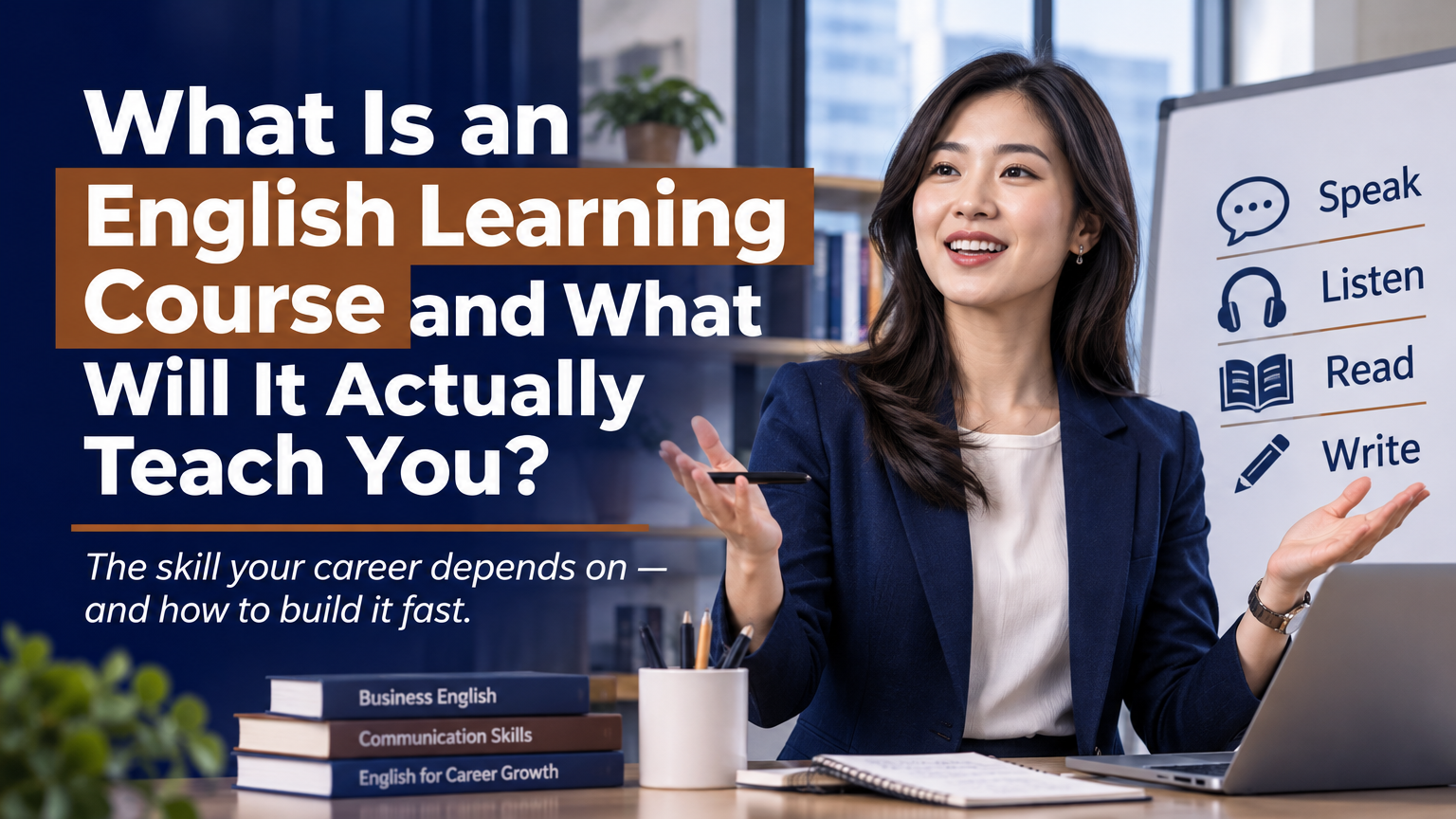
What Is an Online English Course and What Will It Actually Teach You?
What Is an Online English Course and What Will It Actually Teach You?
An online English course is a structured program that builds spoken fluency, conversational confidence, and real-world communication skills — delivered over the internet. The best courses go far beyond grammar and vocabulary drills: they prioritise live speaking practice, real-time feedback, and high-stakes scenarios like pitches, client calls, and presentations. If you need to communicate clearly under pressure, the right online English course is where you start.
From Fluency to Impact: What Most Courses Leave Out
Jason Lim has 24+ years of coaching and teaching experience, working with clients across 42 cities globally. When a franchisee he coached found the right words and delivery, a small conversation became a partnership deal that grew far beyond anyone’s expectations. If your English is functional but you still lose the room on a call or pitch, the gap is not grammar — it is speaking skill.
What Does a Strong Online English Course Actually Cover?
Picture a founder from Jakarta who reads and writes English confidently — but freezes when a client asks an unexpected question on a Zoom call. The vocabulary is there. The grammar is there. The confidence to speak clearly, in real time, under pressure, is not. That gap is exactly what a strong online English course is built to close.
The best online English programs cover these core skill areas:
| Skill Area | What You Practise | Why It Matters |
|---|---|---|
| Spoken fluency | Real-time conversation, role-play, retelling | Removes hesitation when it counts most |
| Pronunciation and clarity | Word stress, rhythm, consonant precision | First impressions form in seconds |
| Vocabulary in context | Business, negotiation, presentations | Words that land in real situations |
| On-camera delivery | Posture, eye contact, pacing on video | Most professional conversations now happen on screen |
| Live feedback loops | Instructor corrections, peer dialogue | Speaking is two-way; passive study is not enough |
Practical takeaway: If your online English course never puts you in live speaking situations with real feedback, it is a listening class with an English label on it. The reps matter more than the rules.
Who Gets the Most Out of an Online English Course?
The numbers reveal an opportunity worth seizing. Communication ranked as the most in-demand skill on LinkedIn for both 2024 and 2025, according to LinkedIn Talent Insights as cited in VoxBooster’s Public Speaking Statistics 2026 compilation. At the hiring stage, the NACE Job Outlook 2025 found that more than three-quarters of employers named communication a critical attribute for new hires, and more than two-thirds specifically screened for verbal communication skills — not written, not academic, verbal.
Yet confidence in spoken English is a widespread, unsolved problem. The Preply Public-Speaking Survey 2024 found that 63% of Gen Z respondents would avoid public speaking altogether if given the choice. Adults who built English skills through reading and writing — but never through live speaking — feel this gap most sharply. An online English course is especially valuable for:
- Non-native English speakers in sales roles — fluency gaps create hesitation, and hesitation kills deals.
- New reps in their 20s and 30s — pitching on calls and on camera demands real-time verbal agility.
- Executives and founders — investor and client meetings require clarity and confidence under pressure.
- Freelancers and consultants — when you are the product, how you speak is part of the value you offer.
Related:
→ Explore the Presentation Skills Coaching Programme
→ What Is an English Language Course and What Should It Actually Teach You?
→ What Is an English Class for Adults and What Will You Actually Learn?
When Is an Online English Course Not Enough on Its Own?
An online English course builds the foundation: vocabulary, fluency, comfort in live conversation. But there is a ceiling — and many professionals hit it without knowing why. You can speak clearly and still lose a client. You can speak fluently and still fail to close a deal.
Think of it like driving. A Gosu-level driver wins in any car because the skill is in the hands, not the engine. Fluency gets you into the room. But Presentation Skills — the ability to structure a message, read the room, pace your delivery, and move someone to a decision — is what wins it. Choosing a better textbook or switching platforms is not a substitute for that skill, any more than buying a better car makes you a better driver.
Key takeaways from this article:
- The best online English courses prioritise live speaking reps over passive study.
- Communication is the top skill employers screen for — verbal, not written.
- 63% of Gen Z avoid public speaking, which means confident communicators stand out immediately.
- Fluency is necessary, but not sufficient: Presentation Skills training closes the gap between speaking well and winning deals.
Ready to Go Beyond Fluency?
When a franchisee trained with Jason Lim and learned to deliver their message with clarity and presence, what started as a small conversation became a partnership that grew far beyond anyone’s expectations. If you can speak English but still struggle to move people to action on calls, pitches, or presentations, the next skill to build is not more English — it is Presentation Skills.
Sources
- VoxBooster — Public Speaking Statistics 2026 (citing LinkedIn Talent Insights 2024–2025 and NACE Job Outlook 2025)
- Preply — Public-Speaking Survey 2024
- Jason Lim — Future of Selling Presentation Skills Coaching Programme


