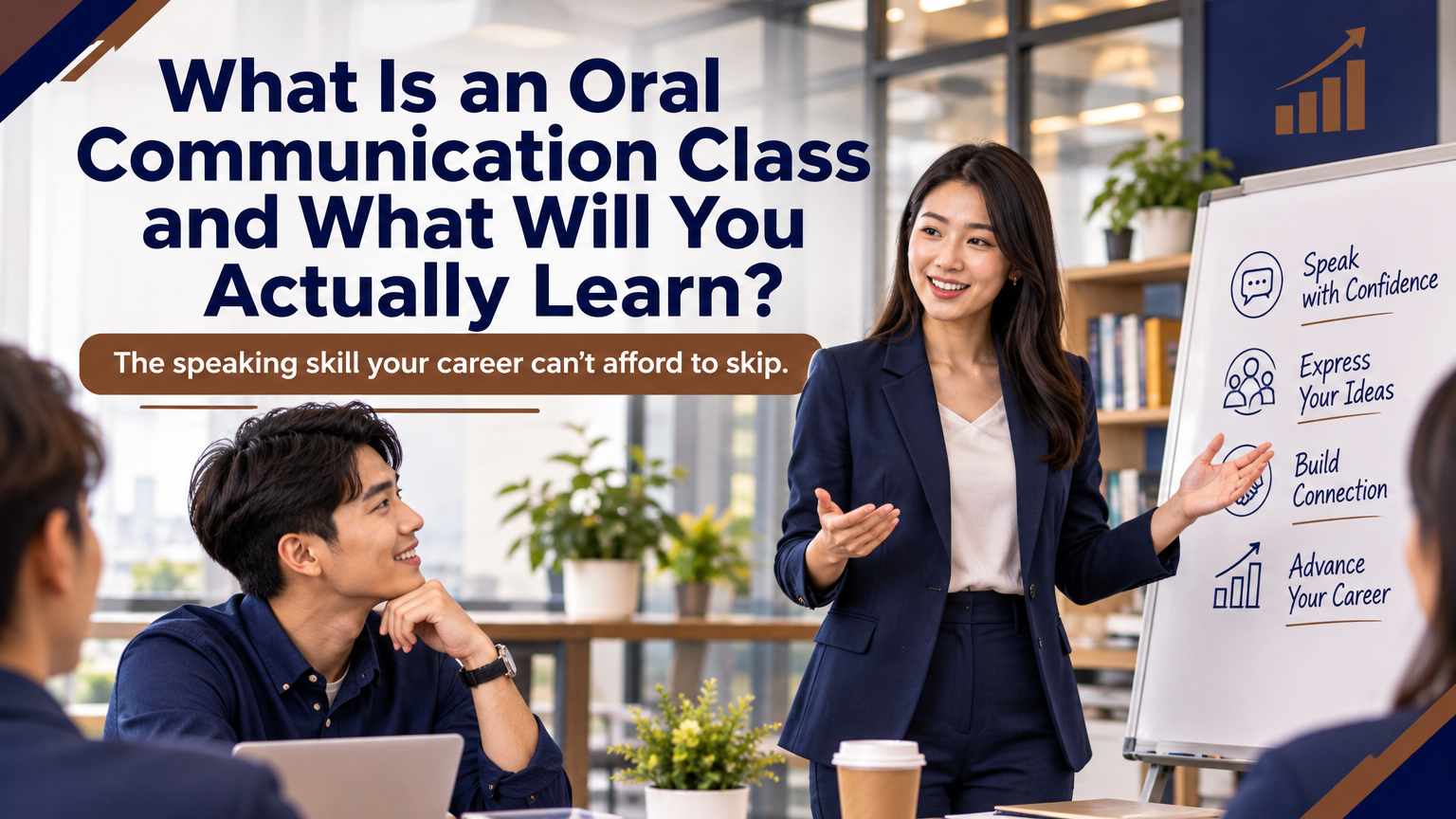
What Is an Oral Communication Class and What Will You Actually Learn?
What Is an Oral Communication Class and What Will You Actually Learn?
An oral communication class teaches you to speak clearly, confidently, and persuasively in real-world situations. You learn delivery mechanics, speaking structure, voice control, and audience awareness. It is not theory — it is the practical skill set that determines whether you hold a room, close a deal, or get remembered long after the meeting ends.
🌟 From a $2,500 Project to a 7-Figure Partnership
A franchisee student used Jason Lim’s presentation framework to transform a small project pitch into a 7-figure partnership deal. The room did not change. The speaking skills did.
Jason Lim brings 20+ years of coaching and teaching experience to founders, sales reps, and executives across 42 cities globally — helping them turn shaky pitches into signed deals through Presentation Skills and Speaking Skills training.
Why Does Oral Communication Matter More Than Ever?
Here is a number worth pausing on: communication ranked as the number-one most in-demand skill on LinkedIn for both 2024 and 2025. Not coding. Not project management. Speaking.
The NACE Job Outlook 2025 — a survey of hundreds of employers — found that more than three-quarters of hiring managers name communication a critical attribute for new hires. More than two in three specifically seek verbal communication skills. And yet the Chapman University Survey of American Fears 2025 found that 33.7% of Americans are afraid or very afraid of public speaking. Meanwhile, a 2024 Preply public-speaking study of 2,007 adults found that 63% of Gen Z respondents would avoid public speaking altogether if they had no obligation to do it.
That gap — between what employers demand and what most people can confidently deliver — is where deals stall, promotions go to someone else, and clients ghost without explanation. The root cause is almost never the product, the deck, or the follow-up email. It is weak speaking and presentation skills.
What Will You Actually Learn in an Oral Communication Class?
A well-structured oral communication class covers the mechanics that break down when the stakes are high. Here is what the best courses include:
| Skill Area | What You Learn | Why It Matters |
|---|---|---|
| Vocal Delivery | Pace, pause, volume, tone | Signals authority; keeps audiences engaged |
| Message Structure | Opening hooks, logical flow, clear calls to action | Listeners remember and act on what you said |
| Nonverbal Communication | Eye contact, posture, gesture | Conveys confidence before you say a word |
| Audience Awareness | Reading the room, adapting in real time | Keeps conversations two-way, not one-way |
| Handling Questions | Responding under pressure without losing the thread | Wins the room even when things go off-script |
Think of an oral communication class like a driving school. You can read every theory book about driving — but until you sit behind the wheel with a skilled instructor giving you real feedback, the knowledge stays theoretical. Speaking is the same. The class gives you the reps, the feedback, and the frameworks that stick.
Is an Oral Communication Class Enough on Its Own?
It depends on the stakes you are facing. For someone building foundational speaking habits, a structured class is an excellent starting point. For founders raising rounds, sales reps closing enterprise deals, or executives presenting to boards, a class is the floor — not the ceiling.
The professionals who close the biggest deals do not rely on a single course. They treat speaking as an ongoing skill: they get real-time coaching, record themselves, and train repeatedly in conditions that mirror actual high-pressure conversations. A Gosu-level driver does not need the best car to outperform a weaker driver — but they also did not stop practicing after their first driving lesson.
Key takeaways from this section:
- An oral communication class builds essential foundations: structure, delivery, and presence.
- Classes work best when paired with live feedback and deliberate practice in real-pressure settings.
- For high-stakes selling environments, consider coaching that targets your specific conversion gaps.
- The goal is not to feel comfortable speaking — it is to perform well when the stakes are highest.
Related:
🌟 Presentation Skills Coaching with Jason Lim — for founders, sales reps, and executives
📚 How Do You Improve Your Speaking Skills?
📚 How Do You Speak with Confidence in Presentations?
Who Gets the Most Out of an Oral Communication Class?
Oral communication classes deliver the highest return for people who are already in — or entering — environments where speaking drives outcomes. That means:
- New sales reps who need to build credibility fast in front of clients and prospects.
- Startup founders whose pitch quality directly affects whether investors and partners say yes.
- Executives and team leads whose communication style sets the tone for every room they enter.
- Individuals and freelancers in their 20s and 30s who know their ideas are strong but cannot yet make rooms respond the way they want.
If you have ever walked out of a pitch thinking “I had the right answer — I just could not get it across,” an oral communication class is not a nice-to-have. It is the missing piece.
🔥 Ready to Stop Getting Outspoken in the Room?
Jason Lim has spent 20+ years coaching founders, sales teams, and executives across 42 cities globally to close more deals through stronger speaking and presentation skills. One franchisee student turned a $2,500 project into a 7-figure partnership — not by switching tools, but by upgrading skills.
Presentation Skills and Speaking Skills are what win the room. Everything else is just equipment.
Sources
- VoxBooster — Public Speaking Statistics 2026 (Chapman University Survey of American Fears 2025; LinkedIn Talent Insights 2024–2025; NACE Job Outlook 2025)
- Preply — Speak with Confidence: Tackling the UK’s Public Speaking Phobia (2024)
- Jason Lim — Future of Selling Presentation Skills Coaching Program


