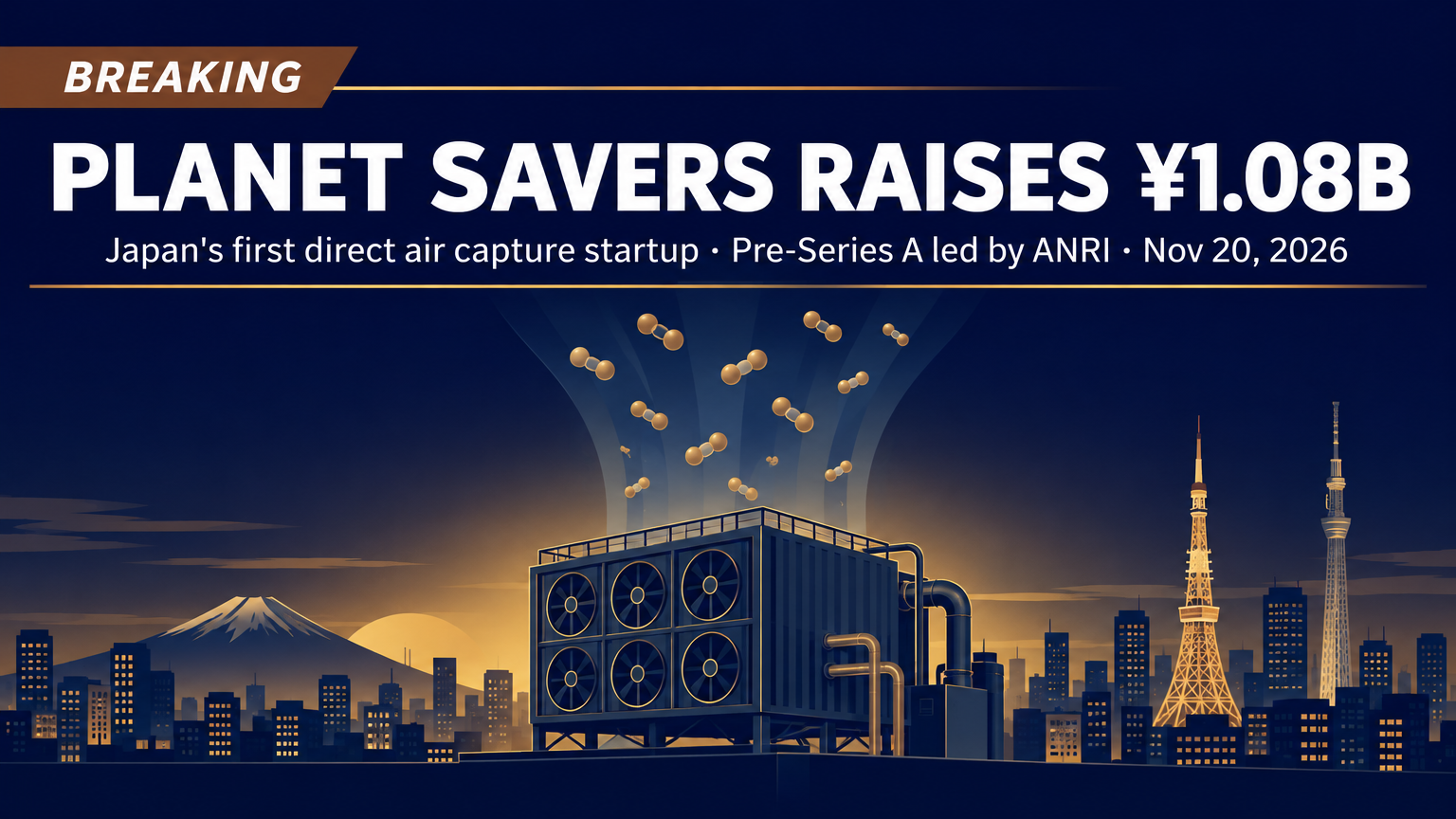
Planet Savers Raises ¥1.08B Pre-Series A: Japan's First DAC Startup Stacks Grants and VC Toward a 2029 Commercial Plant
Planet Savers K.K., which describes itself as Japan's first direct air capture (DAC) startup, has raised a ¥1.08 billion Pre-Series A led by ANRI — part of a package that tops ¥1.6 billion once government grants and programmes are counted.
The presentation lessons below come from Jason Lim, founder of DreaMaker Ventures and creator of the 1Pitch™ persuasion system; his About page describes 17 years in speaking, selling and closing.
Sponsored by DreaMaker · Ad
Opportunity: Deep-tech funding rounds like this one reward founders who can explain their value fast. Position your pitch to catch it — before the first ninety seconds decide.
Blueprint: a five-step method — Power, Intent, Teach, Close, Habits — taught step by step, by application.
Being heard: built for founders raising rounds and executives facing boards, to help your value be heard clearly.
Knowledge: the program's own copy warns that most presentations lose in the first ninety seconds.
Key Facts
- Planet Savers K.K., Tokyo — a University of Tokyo spin-out founded July 2023 and described in its release as Japan's first direct air capture (DAC) startup.
- Pre-Series A of ¥1.08 billion, announced Nov. 20, 2026 (10:00 JST), led by ANRI; Spiral Capital, JAFCO, DBJ Capital, HIRAC FUND (Money Forward Venture Partners) and SG Incubate (Saibu Gas's CVC) participated.
- With the Environment Ministry's SBIR Phase 3 and two Tokyo Metropolitan Government programmes, the total exceeds ¥1.6 billion — about US$10.7 million. Cumulative equity and grants since founding: over ¥2.5 billion, about US$16.7 million (Carbon Herald conversions).
- Nikkei: a commercial-scale plant is targeted for 2029.
Planet Savers K.K. (Planet Savers Inc.), a University of Tokyo spin-out led by CEO and Representative Director Kyo Ikegami (池上京), with CSO Iyoki (伊與木), announced the round in a release on PR Times. The dollar figures are Carbon Herald's conversions, so treat them as approximate.
Where the Money Goes
The round funds scale-up of the company's zeolite adsorbent and electrically driven capture system toward tens of tonnes of CO2 captured per year, field demonstrations, and team hiring, including a Finance Lead (PR Times). Nikkei reports a commercial-scale plant is targeted for 2029.
Zeolite Tech, Field-Scale Proof
Traction so far is field-scale, not commercial-scale: an outdoor demo unit, "Phobos", operates under Tokyo's Tokyo Bay eSG project; greenhouse demonstrations with Kansai Electric Power and Fukui Wago, and with North Japan Skytech in Hokkaido, test CO2 reuse in agriculture; and an MOU with Australian Carbon Vault Ltd covers capture-and-storage cooperation in South Australia's Arckaringa Basin. NEDO's GX Deep-Tech programme and a Mitsui & Co. co-creation fund grant also back the work (PR Times; Carbon Herald).
"Climate change has moved beyond a 'scorching heat' phase into a 'climate crisis' that causes unprecedented disasters. This is not a problem we can defer to the next generation… DAC — a technology that captures atmospheric CO2, uses it as a resource, and even removes it — must be delivered to society starting now," said Ikegami (translated from the Japanese release).
"We are proud to take on this challenge with a team that holds such overwhelming ownership — settling climate change within our own generation and handing a beautiful Earth to the next," said Junichiro Kawono, General Partner at ANRI (translated from the Japanese release).
Analysis: Ikegami's statement also cites new DAC technologies emerging in China and Korea, and a DAC market said to reach tens of trillions of yen — a company claim, not an independent estimate. Whether Japan can lead Asia's DAC race is unproven.
Related News
Sponsored by DreaMaker · Ad
Transformation: a pitch that lands can change how investors, boards and your own team hear you.
Blueprint: five moves, one repeatable method: Power, Intent, Teach, Close, Habits.
Community: coaching tiers, by application, for founders who want to be heard by investors, boards and teams.
Knowledge: start with the two FAQ guides below before choosing any program.
- What Is Public Speaking Skills Training and How Does It Work?
- What Are the Best Public Speaking Classes and How Do You Choose the Right One?
Five Presentation Lessons From the Planet Savers Announcement
- Open with the human stake. Ikegami's quoted statement frames the stakes in plain language — a "climate crisis" that "causes unprecedented disasters," and a technology that "must be delivered to society starting now." A useful way to structure your own pitch: let your first minute tell investors why people should care, before the technical detail.
- Explain the product in one sentence. Ikegami defines DAC in plain words: capture CO2 from the air, use it as a resource, even remove it. If a listener can repeat your one-liner after hearing it once, your deck is working.
- Put facts in order of importance. A useful way to structure your own pitch: state the news that matters most first — here, who invested and how much — then the proof points (Phobos, the greenhouse demos, the Australia MOU), then the plan. Credibility before the ask.
- Stack third-party validation. Grants from the Environment Ministry, the Tokyo Metropolitan Government and NEDO sit beside five venture firms. Name your validators, and say what each one actually tested.
- Follow up after silence. Rounds take months, and investors go quiet for reasons that may have nothing to do with you. A short, respectful follow-up that adds one new proof point keeps doors open — and the same discipline may also help people feel heard at work or at home.
A Rare Window of Opportunity for Singapore — and Asia's Deep-Tech Founders
In Chapman University's 2025 Survey of American Fears (fieldwork March 24–April 8, 2025, n=1,015), 33.7% of US adults said they were afraid or very afraid of public speaking.
Analysis: one reason founders in Singapore, China and Southeast Asia may take note is the funding stack: government grants and programmes can fund early, unproven science that private capital is slow to back, and a government-validated project can make the equity case easier when the raise comes. There is no guarantee — deep tech is hard, DAC economics are unproven at scale, and most startups will not raise. But the pattern now visible in Japan's climate deep tech, from university spin-out to grant-stacked funding to a global storage partner, is one Asian founders can study. Walking it will take more than technology. It will take the ability to stand up and make a room believe.
Sponsored by DreaMaker · Ad
Results: turn this funding window into momentum — walk into your next investor meeting with a pitch built to land.
Blueprint: the P.I.T.C.H. method gives you a step-by-step, five-move process you can rehearse.
Being heard: when your message lands clearly, investors, employees and audiences can see what you stand for.
Knowledge: 33.7% of US adults fear public speaking (Chapman University, 2025) — preparation can help.
— Leaders of Tomorrow newsroom


