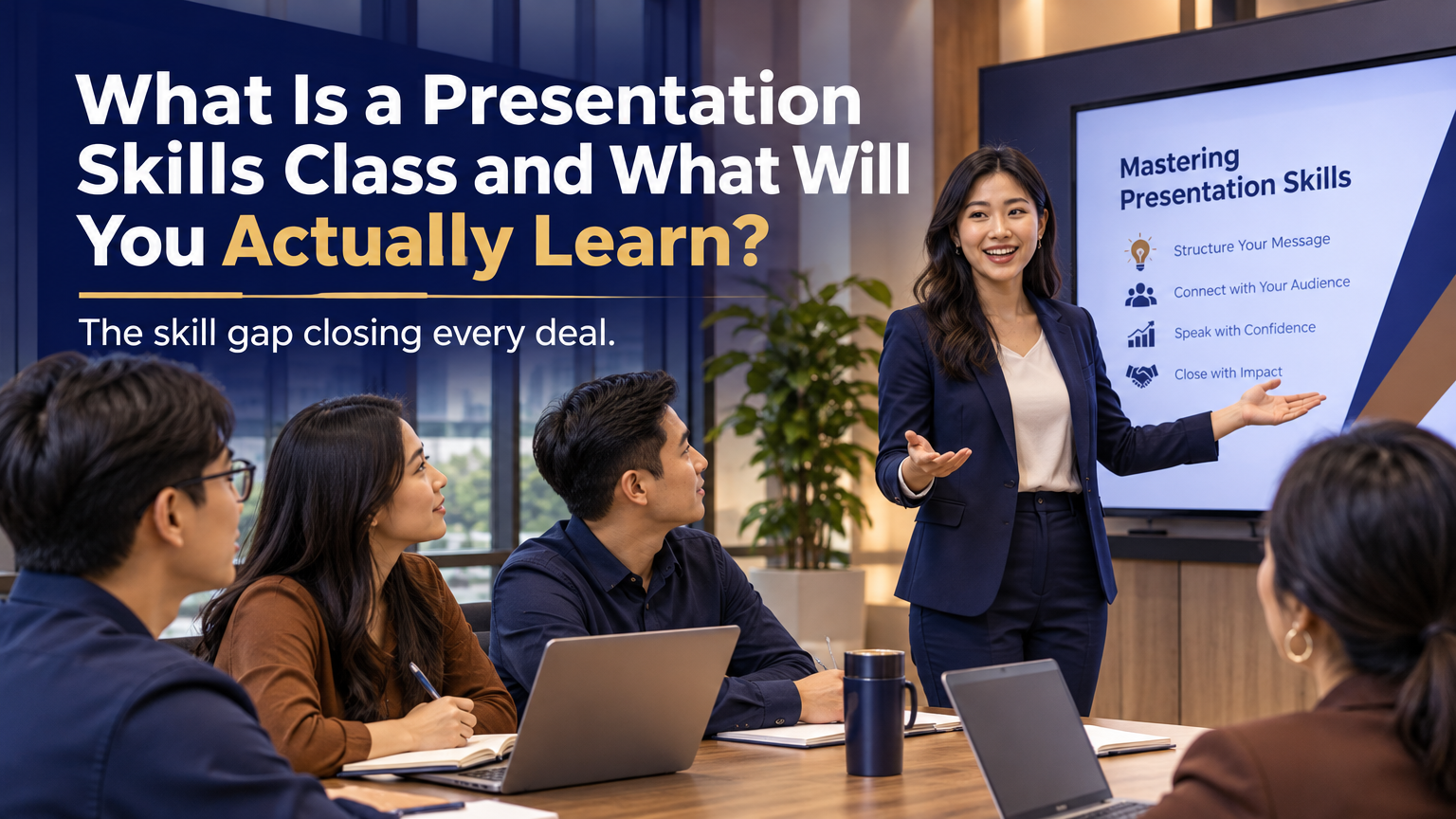
What Is a Presentation Skills Class and What Will You Actually Learn?
What Is a Presentation Skills Class and What Will You Actually Learn?
A presentation skills class teaches you how to structure a message, deliver it with confidence, handle objections, and close a room. It combines storytelling, vocal delivery, body language, and slide design into a repeatable system — so your ideas land every time, whether you are pitching investors, presenting to a team, or closing a deal.
Build the Skill That Wins Rooms
Jason Lim has coached from the stage for 20+ years across 42 cities globally. Students who complete his program walk away with a full close system — not just a better deck. If you are ready to present and win, this is where it starts.
Explore the Presentation Skills Program →What Does a Presentation Skills Class Actually Teach You?
Think of a presentation skills class as driver's education — not just the theory of driving, but actual hours behind the wheel under a qualified instructor. The goal is not to describe good presenting; it is to build it into your muscle memory.
A well-designed class covers these core areas:
- Structure and narrative — How to open with a hook that earns attention in the first 90 seconds, build a logical arc, and close with a clear call to action.
- Vocal delivery — Pace, pause, pitch, and projection. The science of silence. How to use your voice as a tool, not just a vehicle for words.
- Body language and presence — Eye contact, posture, gesture, and movement. What your audience reads before you say a single word.
- Slide and visual design — How to build slides that support your argument rather than replace your presence.
- Objection handling — What to say when the room pushes back, and how to steer a conversation that is drifting off course back toward a decision.
- Live practice with feedback — The differentiator between a good class and a great one. Repetition under observation beats solitary rehearsal every time.
According to VoxBooster’s Public Speaking Statistics 2026, citing the Chapman University Survey of American Fears 2025, 33.7% of Americans are afraid or very afraid of public speaking. Yet the same research shows that communication has ranked as LinkedIn’s most in-demand skill for both 2024 and 2025. The gap between that fear and that demand is exactly what a presentation skills class is designed to close.
Who Is a Presentation Skills Class For?
The honest answer: anyone who communicates to earn a result. That said, the people who gain the most from a focused class tend to share one trait — they already have something worth saying, but they are losing people before they finish saying it.
The most common profiles:
- Startup founders and freelancers — pitching to clients, investors, or partners who decide in minutes.
- Sales reps and business development executives — presenting on calls, in demos, and in final-round closes.
- Executives and team leads — running board updates, town halls, or high-stakes reviews.
- Professionals in their 20s and 30s — building the communication edge that accelerates careers and closes bigger deals earlier.
The Preply Public-Speaking Survey 2024 found that 59% of people would avoid public speaking altogether if there were no professional consequences. Among Gen Z, that figure climbs to 63%. Yet the NACE Job Outlook 2025 (cited in VoxBooster) shows that more than three-quarters of employers name communication a critical attribute — and two in three specifically look for verbal communication skills when evaluating candidates.
That is the paradox: the people most likely to skip a presentation skills class are the ones most likely to pay for it with missed deals, missed promotions, and unanswered follow-ups.
What Makes a Good Presentation Skills Class Worth Taking?
Not all classes are equal. A class that hands you a completed deck is not the same as one that teaches you how to build any deck for any room. When evaluating options, use this comparison:
| Feature | What to look for | Red flag |
|---|---|---|
| Live practice | Reps with real-time feedback | Video-only, no live delivery |
| Curriculum depth | Covers structure, delivery, and the close | Slide design only |
| Instructor experience | Track record presenting and coaching | Academic theory without real stage time |
| Outcome focus | A system reusable across every presentation | A one-off performance polish |
A class that installs a repeatable system is an asset you compound forever. A one-off polish is a haircut — it grows back. The right presentation skills class does not just make your next presentation better; it makes every presentation better, permanently.
Key takeaways:
- A presentation skills class trains structure, delivery, presence, and closing — not just slide design.
- The fear of presenting is real and common; the employer demand for the skill is even higher.
- The best classes include live practice with feedback, not passive video-watching alone.
- A strong class gives you a reusable system, not a single polished performance.
- The right audience: founders, sales reps, executives, and anyone who presents to earn a result.
Related:
Your Presentation Can Win Every Room
Jason Lim’s students walk away with a close system built for the presentations that matter most — pitches, demos, board decks, and final-round conversations. If you are ready to present with the confidence that moves a room from listening to signing, this is the next step.
Explore the Presentation Skills Program →Sources
- VoxBooster — Public Speaking Statistics 2026 (citing Chapman University Survey of American Fears 2025, LinkedIn Talent Insights 2024–2025, NACE Job Outlook 2025)
- Preply — Speak with Confidence: Tackling the UK’s Public Speaking Phobia (2024)
- Jason Lim — Future of Selling, Presentation Skills Coaching Program


