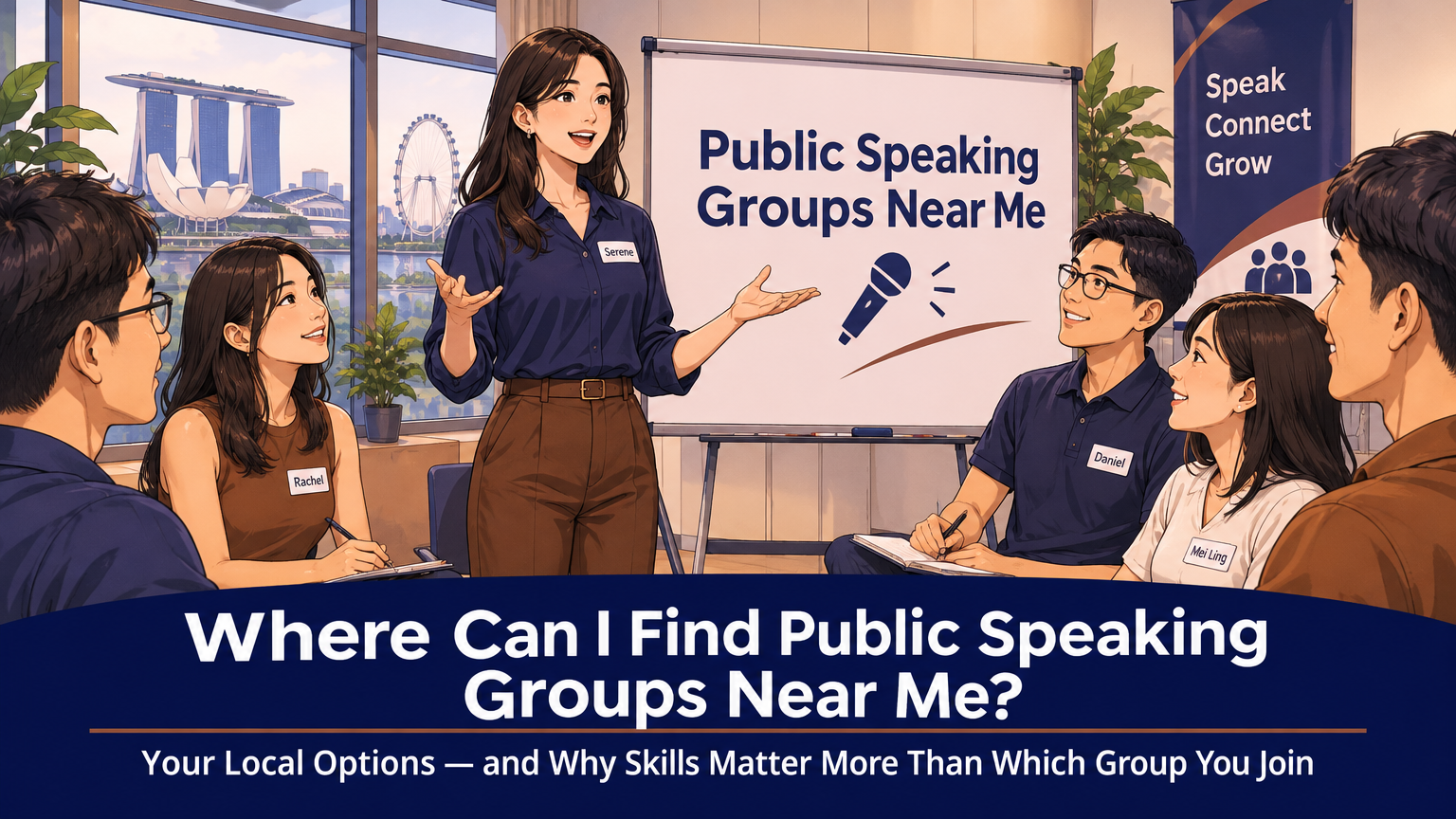
Where Can I Find Public Speaking Groups Near Me?
Where Can I Find Public Speaking Groups Near Me?
Public speaking groups near you typically include Toastmasters chapters, community Meetup groups, university debate clubs, and corporate Toastmasters affiliates. Search platforms like Toastmasters.org, Meetup.com, or your city's community boards to find a club within commuting distance. However, joining a group is only part of the equation — the skills you build there determine your results.
🔥 One founder turned a $2,500 project into a 7-figure partnership deal — by learning how to present, not by picking a better group.
Jason Lim has coached startup founders, executives, and sales teams across Asia. His Presentation Skills program gives you the frameworks that transform nervous presenters into confident deal-closers.
What Types of Public Speaking Groups Are Near Me?
Most cities and towns have at least one of these formats within reach:
| Group Type | What It Offers | Best For |
|---|---|---|
| Toastmasters | Structured speech paths, table topics, evaluations | Consistent long-term practice |
| Meetup speaking groups | Informal practice, varied formats, low pressure | Beginners and those building confidence |
| Corporate Toastmasters | Employer-sponsored, peers from same industry | Professionals seeking workplace relevance |
| Online speaking groups | Zoom-based practice, flexible scheduling | Those without nearby in-person options |
Toastmasters alone operates over 13,800 clubs with 265,000+ members worldwide, according to VoxBooster's Public Speaking Statistics 2026. That means in most major cities, finding a chapter within 20 minutes is entirely realistic.
What Should I Look for in a Local Speaking Group?
Not all groups are equal. Here is what separates a group that moves you forward from one that keeps you comfortable but stuck:
- Structured feedback — look for groups that give specific, actionable critique, not just applause
- Diverse formats — impromptu speaking, prepared talks, Q&A, and storytelling rounds all build different muscles
- Industry relevance — a sales or business-focused group accelerates growth faster than a general hobbyist circle
- Consistency — weekly or biweekly meetings create the repetition that makes skills permanent
- Coaching or mentorship — the best groups pair newer members with experienced speakers who give targeted, honest input
The trap most people fall into: they join any available group, attend a few times, and mistake comfort with competence. The group is the dojo; the technique you practice there is what actually changes results.
Can Online Speaking Groups Replace In-Person Practice?
Yes — with caveats. Online groups have exploded in relevance. With more than 300 million daily Zoom meeting participants globally (VoxBooster, 2026), the ability to present confidently on camera is now a business-critical skill in its own right. Practicing online means you are training in the exact medium where many deals are won or lost.
However, in-person practice adds dimensions that screens do not: physical presence, full-body language awareness, and the energy of a live room. The most effective practitioners use both formats — online for frequency, in-person for depth.
Why the Group Alone Is Not Enough
Here is an honest truth many group members discover after a year of attendance: showing up regularly does not guarantee you are developing the right skills. According to data cited by Preply's public speaking research (2024), 63% of Gen Z respondents said they actively avoid public speaking — not because they lack practice opportunities, but because the anxiety and skill gap never properly close.
Joining a group gives you reps. What closes deals, recovers ghosted prospects, and wins rooms is a trained skill set — structured messaging, persuasive framing, and delivery that commands attention. That is not something most community groups formally teach. Think of it this way: choosing the best Toastmasters chapter is like choosing the best driving practice road. It matters. But without Gosu-level driving technique, the road does not make you fast.
The NACE Job Outlook 2025 reports that more than 75% of employers cite communication skills as one of the most critical qualities they seek — yet most people are never formally coached on how to close that gap.
Key Takeaways
- Use Toastmasters.org and Meetup.com to find speaking groups near you in minutes
- Prioritize groups that offer structured feedback and varied formats over size or social atmosphere
- Online speaking groups are a legitimate and increasingly essential complement to in-person practice
- Community practice accelerates growth only when paired with intentional skills training — the group is the gym, not the coach
- If your goal is deals, presentations, or career advancement, structured presentation coaching closes the gap faster than attendance alone
Related:
👉 Presentation Skills Coaching with Jason Lim →
👉 Where Can I Find Public Speaking Coaching Near Me?
👉 Where Can I Find Public Speaking Workshops Near Me That Are Worth It?
🌟 Ready to build speaking skills that actually change outcomes?
Joining a speaking group is a great first step. The founders and sales professionals who consistently close deals and win rooms combine group practice with structured, coaching-led skills training. Jason Lim's Presentation Skills program is designed for exactly that moment when you are ready to go from showing up to standing out.
Sources
- VoxBooster — Public Speaking Statistics 2026 (Toastmasters global data, LinkedIn Talent Insights 2024–2025, NACE Job Outlook 2025, Zoom 300M+ daily participants)
- Preply — Public Speaking Fears Study (2024) (63% Gen Z avoid public speaking)
- NACE — Job Outlook 2025 (75%+ employers cite communication skills as critical)


