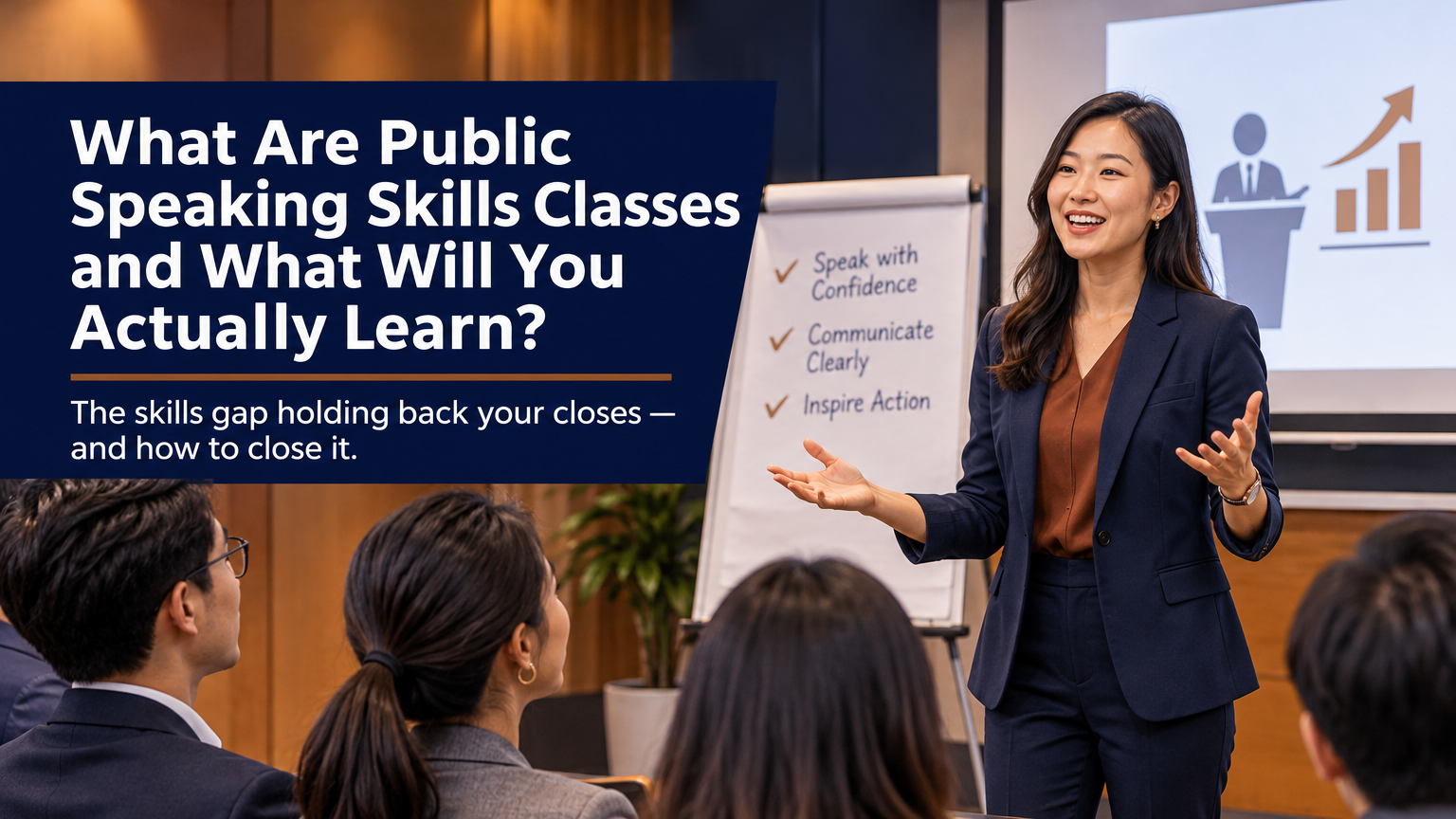
What Are Public Speaking Skills Classes and What Will You Actually Learn?
What Are Public Speaking Skills Classes and What Will You Actually Learn?
Public speaking skills classes are structured learning programs that teach you to organize ideas clearly, deliver with confidence in front of a group, manage nerves, and read a room. A good class goes beyond theory: you practice on your feet, receive feedback, and build repeatable habits that hold up under pressure — in pitches, presentations, and high-stakes sales conversations.
About Your Coach
20+ Years Delivering Proven Sales Presentations from the Stage
Jason Lim has spent over two decades on stage and in boardrooms, coaching founders, executives, and sales teams to present with authority and close with confidence. Students who have trained with Jason walk into their next pitch ready — not hoping.
Explore the Presentation Skills Program →What do public speaking skills classes actually cover?
Picture this: you walk into a room of twenty people who already have their phones out, their minds elsewhere, and zero obligation to listen to you. Public speaking skills classes exist to change what happens next.
Most credible classes organize their curriculum around five core areas:
- Message structure — How to open with a hook, build a logical flow, and close with a clear call to action. Without structure, even confident speakers lose the room.
- Vocal delivery — Pace, pause, pitch, and projection. The same words land completely differently depending on how they are spoken.
- Body language and stage presence — Eye contact, posture, gestures, and movement. Research consistently shows that non-verbal signals shape credibility before a single word is processed by the audience.
- Audience engagement — How to read the room, adjust on the fly, and handle questions without losing authority.
- Nerves management — Practical techniques to convert anxiety into energy rather than letting it collapse your delivery.
According to data compiled by VoxBooster (2026), citing the Chapman University Survey of American Fears 2025, 33.7% of Americans report being afraid or very afraid of public speaking. Yet the same research shows that communication ranked as the number-one in-demand skill on LinkedIn for both 2024 and 2025 — and the NACE Job Outlook 2025 found more than three-quarters of employers name it a critical attribute for new hires, with two in three specifically seeking verbal communication skills. The gap between how common the fear is and how urgently employers need the skill is exactly what a good public speaking skills class is designed to close.
Who gets the most out of public speaking skills classes?
The honest answer: anyone who has to speak to a group and wants the outcome to change. But in practice, the people who get the sharpest return are:
- Startup founders and executives pitching to investors, boards, or enterprise buyers — where one presentation can decide an entire deal cycle.
- Sales reps in their 20s and 30s who have strong products but keep getting ghosted after their demo or presentation.
- Freelancers and consultants whose proposals and pitches are consistently priced down — often a delivery problem, not a pricing problem.
A Preply public-speaking study (2024) found that 63% of Gen Z respondents would avoid public speaking entirely if it were not required. That avoidance has a cost: in a competitive sales environment, the person who can speak clearly and compellingly in front of a group — in a demo, a pitch, or a team presentation — consistently wins the room that the avoider exits early.
What most public speaking skills classes get wrong
Many classes stop at technique. They teach you to slow down, make eye contact, and breathe — and those things help. But technique without a system is like learning to hold a golf club without understanding the swing. You can look right and still miss every shot.
The classes that produce durable results go further: they teach you why audiences make decisions, how to structure your message so a room moves in the direction you need, and how to handle live objections without losing composure. That is the difference between a speaking class and a speaking system.
Choosing a different platform, upgrading your slides, or switching presentation tools is not a substitute for this. A better piano does not make a better pianist. The skill is what transfers from room to room, deal to deal.
Quick takeaways
- Public speaking skills classes cover structure, delivery, presence, audience engagement, and nerves management.
- Communication is the #1 in-demand skill on LinkedIn (2024 & 2025) — and 75%+ of employers consider it critical (NACE 2025).
- 63% of Gen Z avoid public speaking when possible (Preply 2024) — a gap that creates real competitive advantage for those who build the skill.
- Technique without a system only gets you so far. Look for classes that teach why audiences decide, not just how to stand and breathe.
- The skill travels. No slide deck, app, or tool replaces the ability to speak and close in any room.
Related
Ready to Build the Skill That Closes Rooms?
Learn to Speak, Present, and Close With Confidence
The gap between knowing what to say and commanding a room to act on it is a skill gap — and it is one of the most closeable gaps in sales and leadership. If you are ready to close it, the Presentation Skills Coaching Program gives you the system: the structure, the delivery, and the repeatable close that holds up in any room.
Explore the Program →Meta title: Public Speaking Skills Classes: What You Actually Learn
Meta description: Public speaking skills classes teach structure, delivery, and presence. Find out exactly what they cover, who benefits most, and what to look for.
Sources
- VoxBooster — Public Speaking Statistics (2026): 40+ Data Points (citing Chapman University Survey of American Fears 2025, NACE Job Outlook 2025, LinkedIn Talent Insights 2024–2025)
- Preply Language Learning Team — Speak with Confidence: Tackling the UK’s Public Speaking Phobia (2024)
- Jason Lim — Future of Selling, Presentation Skills Coaching Program (credential verification)


