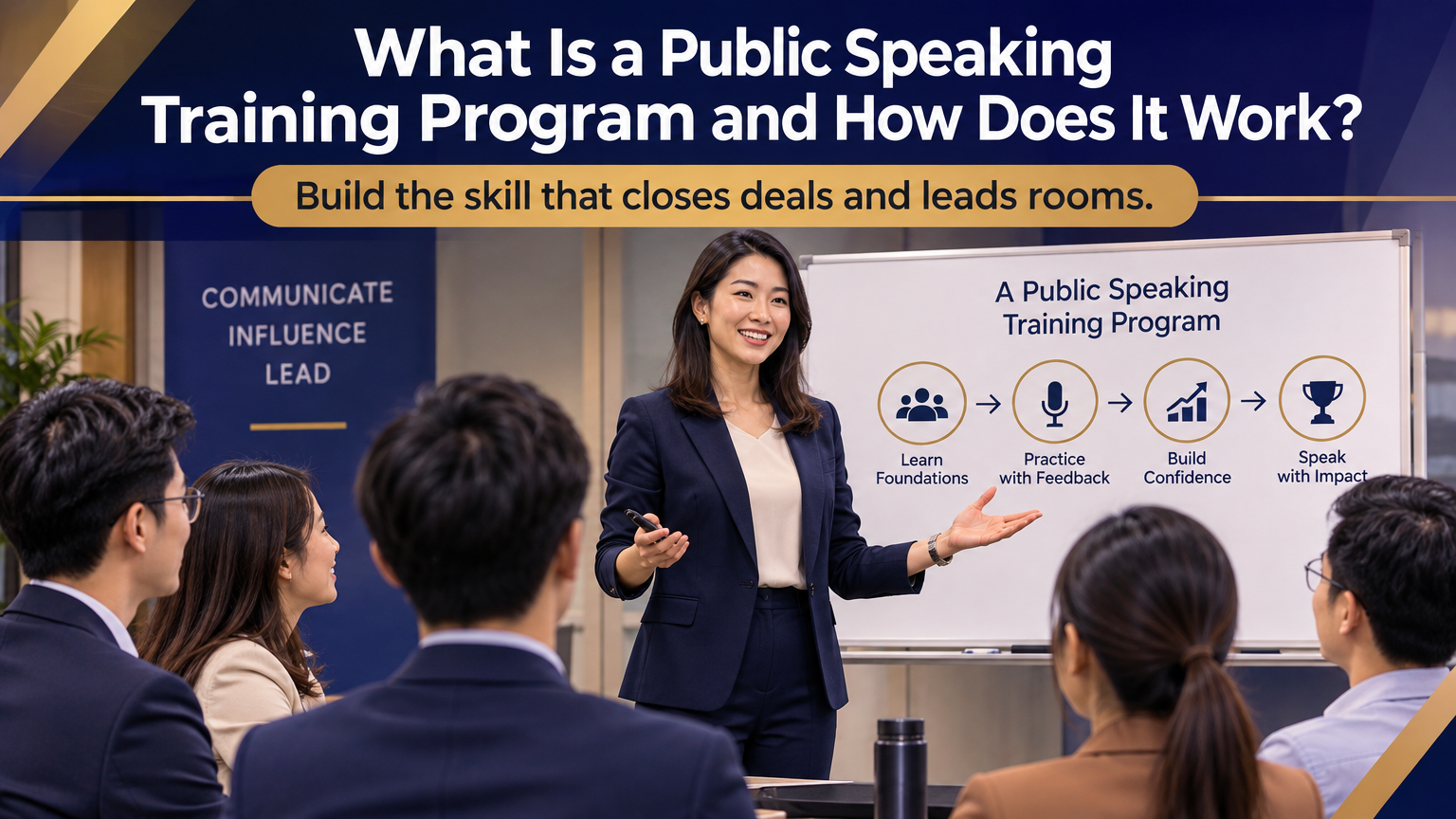
What Is a Public Speaking Training Program and How Does It Work?
What Is a Public Speaking Training Program and How Does It Work?
A public speaking training program is a structured course that builds your ability to speak clearly, confidently, and persuasively in high-stakes situations. It covers vocal delivery, message structure, body language, live-pressure handling, and on-camera presence — giving you the repeatable skills that close deals, lead rooms, and make people listen.
🌟 Real Result — Franchise Partnership
A franchisee student used Jason Lim’s presentation framework to turn a $2,500 project pitch into a 7-figure partnership. The room did not change. The speaking skills did.
Jason Lim brings 20+ years of coaching and teaching experience to founders, sales reps, and executives across 42 cities globally — helping them turn shaky pitches into signed deals through Presentation Skills and Speaking Skills training.
Build Your Speaking Skills with Jason →What Does a Public Speaking Training Program Actually Include?
Most people assume a program is just a series of talks or a pile of slides to review. The reality is different. A well-designed program is built around deliberate practice — structured repetition with feedback — targeting the specific mechanics that break down when stakes are high. Here is what the core curriculum of a strong program covers:
| Module | What You Learn | Business Impact |
|---|---|---|
| Vocal Delivery | Pace, pause, volume, tone | Commands attention; signals authority |
| Message Structure | Hook, through-line, clear call to action | Listeners remember and act on what you said |
| Body Language | Eye contact, posture, gesture, stillness | Builds trust before you say a word |
| Handling Live Pressure | Objections, tough questions, silence | Wins rooms that push back |
| On-Camera Presence | Eye-line, framing, energy on video calls | Critical for remote sales and virtual pitches |
Reading about these modules does not make you better at any of them. That is the central point of a training program — it gives you guided reps, corrective feedback in the moment, and frameworks that hold up under real-world pressure.
Why Do So Many Professionals Still Avoid This Training?
Here is a pattern that plays out every quarter. A sales rep has a strong pipeline, a polished deck, and a genuinely good product. They walk into a client presentation and get one difficult question they did not prepare for. They stumble, over-explain, and lose the room — not because the product was wrong, but because the speaking skill was not there when it mattered.
The numbers confirm how widespread this gap is. The Chapman University Survey of American Fears 2025 found that 33.7% of Americans are afraid or very afraid of public speaking — that is roughly one in three people in your sales team, leadership group, or founder cohort carrying a live anxiety into every high-stakes room. A 2024 Preply public-speaking study of 2,007 adults found that 63% of Gen Z respondents would avoid public speaking altogether if they had no obligation to do it. Two in three of your youngest professionals are actively dodging the one skill that determines whether a deal gets signed or quietly dies.
Yet the demand for exactly this skill keeps rising. Communication ranked as the number-one most in-demand skill on LinkedIn for both 2024 and 2025. The NACE Job Outlook 2025 found that more than three-quarters of employers name communication a critical attribute for new hires, and more than two in three specifically seek verbal communication skills.
The mismatch is not about effort or intelligence. It is about training. Most professionals never receive structured speaking skills development after school. They are handed a laptop, a CRM, and a quota — but no framework for the conversations that actually close deals.
Related:
🔗 Future of Selling — Presentation Skills Coaching with Jason Lim
🔗 What Are Public Speaking Training Classes and Are They Actually Worth It?
🔗 How Do You Improve Your Speaking Skills?
How Does a Public Speaking Training Program Actually Work Step by Step?
The best programs follow a clear sequence that mirrors how performance skills are built in any domain — from sport to music to surgery. Here is the typical flow:
- Assess your baseline. Before fixing anything, a good coach identifies exactly where your delivery breaks down. Is it the opening? The pacing? How you handle silence? The diagnosis determines the prescription.
- Learn the frameworks. You study the core structures: how to open with a hook, how to build a logical through-line, how to close with a clear ask. These are transferable across every speaking context.
- Practice in conditions that matter. Rehearsing alone in front of a mirror is not training — it is preparation. Real training involves speaking in front of people, handling interruptions, fielding live objections, and practicing under the kind of pressure a real pitch or presentation creates.
- Receive specific feedback. Generic encouragement does not build skill. Precise feedback — “You paused three words too early,” “Your eye contact broke at the objection” — is what actually changes behavior.
- Repeat and transfer. The skill becomes yours when it shows up without effort in a real meeting, a live sales call, or an on-camera pitch. Repetition is what moves a technique from “I know this” to “I do this automatically.”
Think of it the way you would think about driving. Reading a driving manual makes you a better test-taker. Putting a qualified instructor in the passenger seat and getting real reps on real roads makes you a driver. A Gosu-level driver does not need the best car to outperform someone who cannot control theirs under pressure. Speaking skill works the same way — no deck, no script, and no tool replaces the ability to hold the room when the pressure comes.
Who Is a Public Speaking Training Program Actually For?
The honest answer: anyone whose livelihood depends on making people listen, trust, and act. That is a wider group than most realize.
- Startup founders and freelancers who pitch investors, win clients, or sell their own services on calls and in rooms
- New sales reps in their 20s and 30s who are losing deals they should be closing because the follow-up died, the objection landed, or they got ghosted after a strong first call
- Executives and senior leaders who present to boards, run all-hands meetings, or represent their organizations on stage and on camera
- Sales team members who need a consistent, repeatable framework for every sales conversation — not just the pitch, but the closing call, the objection moment, and the silence that follows a price reveal
What all of these people share is a root cause: the problem is never the follow-up strategy, the email sequence, or the CRM workflow. Those are symptoms. The root cause is weak speaking and presentation skills in the conversation that actually determines whether a deal lives or dies.
Quick Takeaways
- A public speaking training program is built on deliberate practice, specific feedback, and structured repetition — not passive watching or reading
- Fear of public speaking affects 33.7% of Americans (Chapman 2025); 63% of Gen Z would avoid it if they could (Preply 2024) — this gap is your competitive opportunity
- Communication is the #1 skill demand on LinkedIn for 2024 and 2025; 75%+ of employers call it critical (NACE 2025)
- The five-step program sequence — assess, learn, practice under pressure, get specific feedback, repeat — is what separates performers from people who plateau
- Ghosting and stalled deals are symptoms; weak speaking skills in the actual conversation are the root cause
🌟 Ready to Build the Skill That Closes Deals?
Jason Lim has coached founders, executives, and sales teams across 42 cities globally for 20+ years. The professionals who go through a structured speaking training program stop getting ghosted — because they stop giving people a reason to leave the room.
If your pipeline is strong but your close rate is not, the conversation is the bottleneck. Build the skill that removes it.
Explore Jason’s Presentation Skills Program →Sources
- VoxBooster — Public Speaking Statistics 2026 (citing Chapman University Survey of American Fears 2025; NACE Job Outlook 2025; LinkedIn Talent Insights 2024–2025)
- Preply — Tackling the UK’s Public Speaking Phobia (2024)
- Jason Lim — Future of Selling Presentation Skills Program


