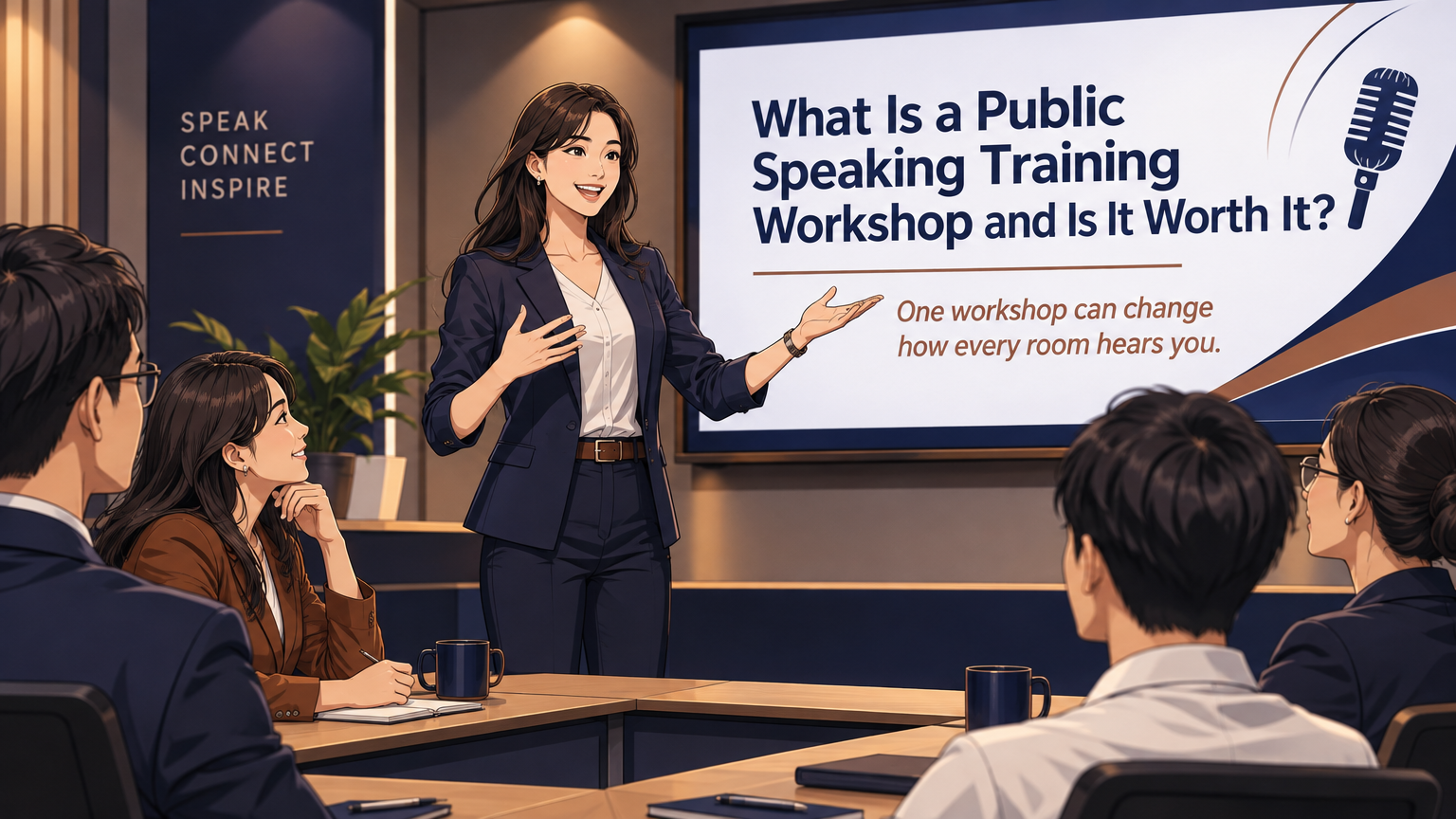
What Is a Public Speaking Training Workshop and Is It Worth It?
What Is a Public Speaking Training Workshop and Is It Worth It?
A public speaking training workshop is a hands-on, structured session where participants practice speaking in front of real or virtual audiences, receive specific feedback, and build delivery skills through live repetition. Done well, it is absolutely worth it — especially for founders, sales reps, and executives whose career momentum depends on how persuasively they communicate in rooms that matter.
One Workshop That Changed Everything
A franchisee walked into a conversation with a $2,500 project pitch. After working on presentation and speaking skills with Jason Lim — a coach with 20+ years of teaching and coaching experience across 42 cities globally — that same pitch became a 7-figure partnership deal. The room did not change. The skills did.
What Does a Public Speaking Training Workshop Actually Include?
Picture this: a startup sales rep has been delivering the same demo for three months. Same product. Same slides. Yet she keeps getting ghosted. The pipeline stalls not because the product is weak — but because how she speaks in the room is weak. She sounds unsure when challenged. She fills silence with filler words. She rushes the close. One focused workshop changes her opening, her pause, her landing. The next deal signs.
That is the promise of a workshop done right. But not all workshops deliver it.
According to the NACE Job Outlook 2025, more than three-quarters of employers name communication a critical attribute for new hires, and more than two in three specifically seek verbal communication skills. LinkedIn named communication the most in-demand professional skill two years running — in both 2024 and 2025. Yet most people receive almost no structured training in how to actually speak well under pressure.
A workshop worth your time should include:
- Live speaking practice — on your feet or on camera, not just listening to a presenter
- Real-time, specific feedback — on structure, delivery, pace, and word choice
- High-stakes scenario practice — sales calls, investor pitches, board presentations, or on-camera delivery
- Message clarity drills — opening strong, landing a point cleanly, handling pushback
- Repeated reps — skill builds through repetition with feedback, not theory alone
The Preply Public-Speaking Survey 2024 found that 63% of Gen Z respondents would avoid public speaking altogether if they had a choice. That avoidance is a career tax. A well-designed workshop creates a safe environment to practice the moments people normally avoid — so when they arrive in a live deal conversation, they are ready.
Workshop vs. Course vs. Coaching: Which Format Actually Works?
All three formats build speaking skill — but they work differently and suit different goals. The right choice depends on where your most important conversations happen and how much repetition you need.
| Format | Best For | Watch Out For |
|---|---|---|
| Workshop (1 or 2 days) | Rapid skill exposure, group practice, breaking old habits | No follow-up practice; skill fades without reinforcement |
| Online course (self-paced) | Foundational knowledge, flexible schedules, low cost entry | No live feedback; watching is not the same as doing |
| Coaching program (12 weeks+) | Role-specific skill, high-stakes deals, structured repetition with feedback | Higher commitment; needs to be matched to your context |
Practical takeaway: A workshop is an excellent starting point or a reset. For people whose deals close on Zoom, training on camera is non-negotiable. For people presenting to rooms, workshops that simulate live-audience pressure build the fastest results. And for anyone who needs the skill to hold under consistent pressure — sales calls, investor rounds, senior boardrooms — a longer coaching program compounds the gains that workshops begin.
👉 Related
How Do You Know If a Workshop Will Actually Help You?
The Chapman University Survey of American Fears 2025 found that 33.7% of Americans are afraid or very afraid of public speaking. Workshops that target this fear alone — without building a usable skill — are everywhere and they will not move your deals or your career.
Ask one question before you commit: “Will I practice speaking out loud and get specific feedback during this session?” If the answer is no or vague, keep looking.
The workshops that deliver real results do three things:
- Put you on your feet early — not at the end of a theory-heavy day, but in the first hour
- Give feedback on specifics — filler words, pace, structure, presence, eye contact, not just “good job”
- Connect practice to your real context — sales calls, Zoom demos, investor pitches, board presentations
Think of it the way you would think about driving. You would not read a manual about driving and then expect to pass the test. And choosing a better car does not make you a better driver. The skill is what travels with you — into the next pitch, the next close, the next room that could change your trajectory.
The Skill Is the Edge
Students who have trained with Jason Lim have walked into conversations and walked out with signed deals, partnerships, and opportunities they did not expect — not because the room changed, but because how they spoke in it changed. If you are ready to build the skill that travels with you everywhere, the next step is here.
Sources
- VoxBooster — Public Speaking Statistics 2026 (citing Chapman University Survey of American Fears 2025, LinkedIn Talent Insights 2024–2025, NACE Job Outlook 2025)
- Preply — Speak with Confidence: Tackling the UK’s Public Speaking Phobia (2024 survey)
- Jason Lim — Future of Selling: Presentation Skills Coaching Program (credibility, testimonials)


