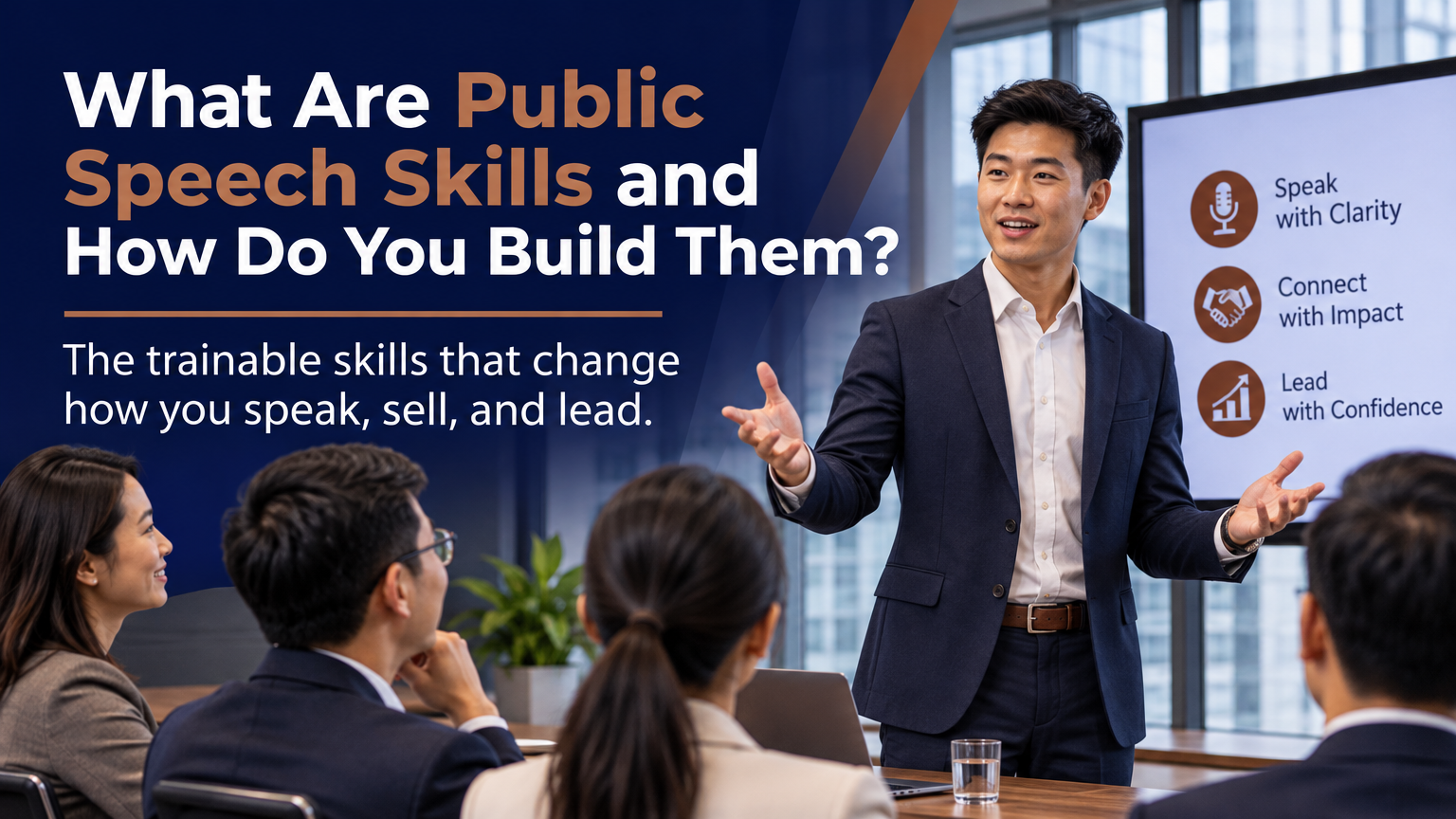
What Are Public Speech Skills and How Do You Build Them?
What Are Public Speech Skills and How Do You Build Them?
Public speech skills are the trained abilities that let you communicate clearly, persuasively, and confidently in front of any audience — from a job interview to an investor pitch. They include structure, vocal delivery, body language, storytelling, and composure under pressure. All of them are learnable. None of them come automatically with seniority or intelligence.
🌟 Real Transformation From a Student
A franchisee who worked on his presentation skills with Jason Lim walked into the same room with the same opportunity — and completely changed how the conversation ended. The deck was the same. The difference was how he spoke.
Jason Lim has 20+ years of coaching and teaching experience, training founders, executives, and sales professionals across 42 cities globally — live and online.
What Skills Does a Strong Public Speaker Actually Need?
Most people think public speaking is about confidence. It is not. Confidence is a byproduct of skill. The skills themselves are specific, trainable, and stackable. Here is what they are:
- Message structure: The ability to open with a hook, build a clear through-line, and close with a memorable ask. Without structure, even a confident speaker loses the room.
- Vocal delivery: Pace, tone, volume, and silence. On a call or on stage, your voice is your primary instrument. Knowing how to use it intentionally changes how people receive your message.
- Body language: Posture, gestures, and eye contact that reinforce your words — not contradict them. Audiences read the body before they hear the words.
- Storytelling: The ability to give a point a person, a problem, and a turn. Facts inform. Stories persuade and stick.
- Composure under pressure: Staying sharp during a tough Q&A, a hostile question, or a critical silence. This is where deals are won or lost.
According to the NACE Job Outlook 2025 (via VoxBooster Public Speaking Statistics 2026), more than 75% of employers list communication as a critical hiring attribute, and two in three specifically screen candidates for verbal communication skills. LinkedIn named communication the #1 most in-demand skill for both 2024 and 2025. The demand for people who can speak well — in rooms, on camera, and in conversations that count — is rising, not falling.
Why Do Public Speech Skills Matter More Than Ever for Sales and Career Growth?
Here is a story that plays out every week in boardrooms, Zoom calls, and sales meetings: two people walk into the same opportunity with the same product and the same price. One speaks with clarity and conviction. The other over-explains, loses the thread, and trails off on the close. Same room. Same stakes. Very different outcomes.
The Preply Public-Speaking Survey 2024 found that 63% of Gen Z would avoid public speaking if they had a choice. Avoidance feels safe. However, in a sales conversation, on a pitch call, or in a performance review, avoidance is not an option — and unpreparedness shows.
Consider this table of where public speech skills make a direct professional difference:
| Situation | Weak Speech Skills | Strong Speech Skills |
|---|---|---|
| Sales pitch | Rambling, ghosted after the meeting | Clear, confident, deal signed |
| Investor presentation | Confused room, follow-up questions spiral | Compelling narrative, next-step secured |
| Team meeting | Ignored or talked over | Ideas adopted, credibility rises |
| Video call / on camera | Flat, disengaging, forgettable | Compelling presence, trust built |
The same skills that make someone a good speaker also make them a better closer, a better leader, and a better presence in any room — physical or virtual. That is not an accident. It is by design.
How Do You Build Public Speech Skills Faster?
Three things actually move the needle — and two of them are almost never included in a standard course or workshop:
- Live, coached repetition. You cannot build a motor skill by watching someone else do it. The same is true for speaking. You need to speak, get corrected in the moment, and repeat. Online lessons work — when they include live feedback. Video libraries do not.
- High-stakes scenario practice. Generic speeches to imaginary audiences do not prepare you for a real deal conversation. Practice for the specific situations where speaking skills pay off: pitches, closes, camera presentations, one-on-one persuasion.
- Structural frameworks. Skilled speakers do not wing it. They use proven structures that do the heavy cognitive lifting so they can focus on delivery. Learning one strong framework — and ingraining it through repetition — transforms how you perform under pressure.
Quick Takeaways
- Public speech skills include structure, vocal delivery, body language, storytelling, and composure — all trainable
- 75%+ of employers say communication is critical (NACE Job Outlook 2025); LinkedIn ranked it #1 in-demand skill 2024 & 2025
- 63% of Gen Z avoid public speaking (Preply 2024) — avoidance is a training gap, not a personality type
- The fastest path to improvement: live coached repetition in high-stakes scenarios, not passive content consumption
- Weak speaking skills are the root cause of ghosted pitches, stalled deals, and lost credibility — not bad products or bad pricing
Related:
👉 Work with a speaking skills coach — DreaMaker Ventures
👉 What Are Public Speaking Lessons Online and Are They Actually Worth It?
👉 Where Can I Find Public Speaking Coaching Near Me?
🎯 The Skill Changes the Deal
The students who come through speaking skills coaching do not get a new product or a new price. They get a new way of communicating — and that changes what happens in the room. If you are still being ghosted after pitches, losing deals on the follow-up, or watching less-prepared speakers close rooms you worked harder for, the gap is not your effort. It is your speaking.
Sources
- VoxBooster — Public Speaking Statistics (2026) (citing NACE Job Outlook 2025; LinkedIn Talent Insights 2024–2025; Chapman University Survey of American Fears 2025)
- Preply — Speak with Confidence: Tackling the UK’s Public Speaking Phobia (2024)
- Jason Lim — Future of Selling Presentation Skills Coaching Program


