
How Billionaire Richard Branson Follows Up Relentlessly Without Ever Feeling Pushy
Sales Follow-Up, Startup Founders, Richard Branson
How Billionaire Richard Branson Follows Up Relentlessly Without Ever Feeling Pushy — The Founders' Playbook
Imagine your pipeline finally moving because your follow-ups feel like a favor, not a nag. This is how founders learn how to follow up without being annoying, close more deals, and still sleep at night.

Why Follow-Up Feels Pushy — and the One Mindset Shift That Changes It
📌 TL;DR: Follow-up feels pushy when it serves your anxiety. It feels professional when every touch helps the buyer decide — with new context, clarity, or options.
Jason works with founders who lead every big deal. Smart. Driven. Already winning in many ways. Yet follow-up still feels like walking a tightrope over a canyon with no net underneath. One wrong move and the relationship drops.
The data is brutal. Around 60% of customers say no four times before saying yes, but roughly 92% of salespeople give up after four follow-ups, according to Invesp. That gap is where your competitors quietly collect your revenue while you tell yourself, “They probably weren’t interested anyway.”
Here is the mindset shift Jason teaches first. Follow-up feels pushy when it is about you. Your quota. Your anxiety. Your need to “check in.” It feels helpful when it is about them. Their risk. Their timeline. Their outcomes. Same number of messages. Completely different emotional impact on both sides of the inbox.
Think of it like texting a friend about a restaurant they might love. If you keep saying, “Did you book yet? Did you book yet?” it gets old fast. But if each message shares a new reason they might enjoy it, it feels like care, not pressure. Sales follow-up works the same way. Different stakes, same human brain.
As Jason teaches at AuthorJason.com, the line between persistence and pushiness is whether every touch advances their decision — not your agenda.
How Richard Branson Followed Up Relentlessly and People Were Glad He Did
📌 TL;DR: Branson followed up often, but every touch brought new proof, allies, or angles — so buyers and regulators experienced him as committed, not clingy.
Richard Branson has built more than 400 companies under the Virgin brand. Almost none of those deals, partnerships, and approvals happened in a single conversation. He is one of the most relentless follow-up artists in business history. Yet people who work with him do not describe him as annoying. They describe him as energizing and committed.
When he was trying to launch Virgin Atlantic, he needed approval from the UK Civil Aviation Authority. That approval did not appear after one polite letter and a hopeful wait. It came after months of follow-ups. Each contact brought something new. Fresh data. A different angle. Another supporter on board. He was not repeating the same plea. He was advancing the argument step by step, like moving pieces on a chessboard with purpose, never panic.
In one well-documented episode, Branson personally chased aircraft leasing deals when Virgin Atlantic was still unproven. Rather than sending generic “any update?” notes to Boeing and leasing companies, he arrived with passenger forecasts, route plans, and marketing concepts that showed how the planes would make money. The follow-up was not, “Please trust me.” It was, “Here is why this works for you.” Those specifics shifted him from risky dreamer to credible operator in their eyes.
Years later, when negotiating Virgin Mobile and Virgin Trains partnerships, Branson kept turning up with tangible concessions and creative structures. He would revisit a reluctant partner not with pressure, but with a revised revenue share, a new co-branding idea, or evidence from another market. The tactic was consistent: each follow-up de-risked the decision for the other side. The outcome was a pattern of deals that looked improbable at the start, but inevitable in hindsight because he kept adding reasons to say yes.
Branson talks about persistence as a value. But he frames it as persistence in service of something he genuinely believes in, not just something he wants. That distinction is everything. When you follow up because you truly think your product will make the other person’s life better, your tone changes. Your words soften. Your creativity rises. Your energy feels like partnership, not pressure.
Follow-up feels pushy when the spotlight is on you. It feels welcome when the spotlight is on them. Branson’s secret is simple but rare: every follow-up is genuinely about what matters to the other person, not a reminder that his inbox is still waiting. Founders who learn this stop dreading follow-ups and start seeing them as another chance to serve.
As Jason teaches at AuthorJason.com, persistence feels professional when each new touch lowers the buyer’s risk — and feels pushy when it only lowers yours.
60% of customers say no four times before saying yes. 92% of reps give up at step four. The gap between those two numbers is where most startup revenue disappears.
NEW! September 2026
Dear Founders,
Do you also find yourself holding back on follow-ups because you are terrified of coming across as pushy — so you wait too long, the deal goes cold, and you blame yourself for not following up sooner?
Many founders feel exactly this way. The founders Jason works with felt the same — considerate people whose fear of being annoying cost them more deals than any pushiness ever would have. What they found was that the line between persistent and pushy is entirely about the content of each message, not the frequency.
Here's what I found: Jeffrey Teo got 63 customers in 100 days after he fixed his sales follow-up. A system teaches you the difference.
The Future of Selling System's Habits step builds a follow-up cadence that adds value at every touchpoint — so every message feels like service, not pressure. Read the P.I.T.C.H. Formula. Visit dreamaker.club/buyfos — $19/month. $0.63/day.
Jason has worked with 1,000+ founders since 2015. $22M+ in combined sales. Built from rock bottom 3 times.
What is the difference between following up and being pushy — and how do you know which side you're on?
Following up serves their decision. Being pushy serves your anxiety. If each message adds something new and makes it easier for them to decide, you are on the right side. If you are only asking, “Any updates?” you have slid into pressure, not partnership.
How do you follow up multiple times without repeating yourself?
Treat each follow-up like a new chapter, not a rerun. One might share a case study. Another might bring industry news that supports their business case. A third might offer a simpler option. When every touch adds a new angle, you never sound like an echo.
What should each follow-up message add that the last one didn't?
Each message should add a fresh piece of value. That might be a new insight, a clarified number, a risk removed, a shorter path, or even a graceful way out. If they could delete your last email and nothing would be lost, the next one must raise the bar.
The Value-Add Follow-Up Framework Jason Teaches Every Founder
📌 TL;DR: Use a simple, value-first sequence so each follow-up introduces new proof, insight, or options — never the same “just checking in” nudge twice.
Jason does not hand founders scripts that sound like they came from a call center. He gives them a simple pattern they can adapt to any deal. It lines up closely with what research from Gong and the RAIN Group confirms: follow-ups that add new information get around 3× higher reply rates, and reps who send three or more follow-ups close roughly 3× more deals than those who stop after one.
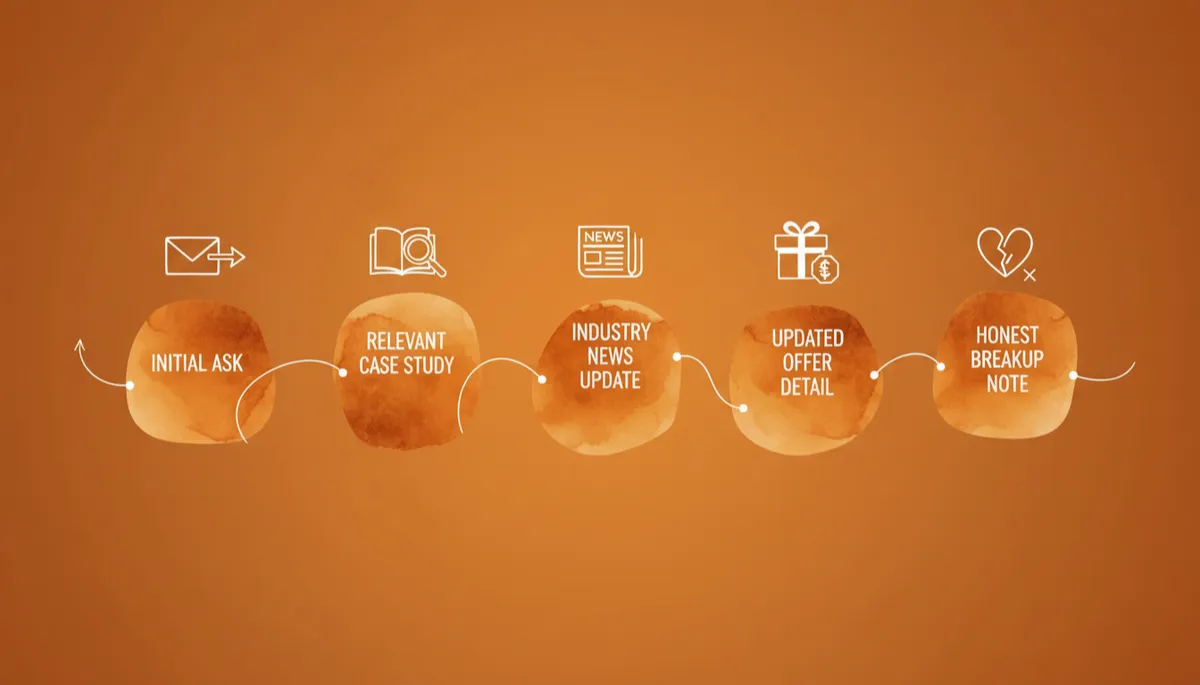
In practice, that means a sequence that moves like this. First, a clear initial ask. Then, a relevant case study that mirrors their world. Next, an industry update or insight that strengthens their internal case. After that, an updated offer detail, maybe a smaller starting point or clearer implementation path. Finally, an honest breakup note that still leaves the door open. No “just bumping this up.” Every step earns the right to land in their inbox.
Start with a clear, buyer-focused ask that anchors the decision you are inviting them to make.
Share a case study or proof point that closely reflects their world and desired outcome.
Bring an industry insight or external data point that strengthens their internal business case.
Refine the offer — a smaller starting point, clearer path, or reduced perceived risk.
Send a respectful breakup note that closes the loop while keeping the relationship intact.
As Jason teaches at AuthorJason.com, the difference between a persistent founder and a pushy one is whether your sequence tracks what the buyer still needs — not what you wish they would do.

Cuban's rule: add value every time, or don't send it. Persistence without value is noise. Value-based persistence trains people to open your messages.
How Cuban and Blakely Follow Up Without Ever Losing the Relationship
📌 TL;DR: Cuban and Blakely stay in touch by adding something useful or personal every time — so persistence feels like care, not chase.
Mark Cuban has a simple rule about follow-up: add value every time, or do not send it. He is known for replying to many of his own emails, often at unusual hours. But when he follows up, there is always a reason. A new piece of information. A sharper framing of the opportunity. A question that shifts the conversation. In his world, persistence without value is noise, and noise trains people to ignore you. Value-based persistence trains them to open your messages because something useful might be inside.
On Shark Tank and in his portfolio, Cuban is known for sending blunt, focused follow-ups to founders he backs. When a company misses numbers, his emails do not say, “What happened?” They often contain specific benchmarks from similar businesses, questions about cash runway, or suggestions on pricing tests. The tactic is the same as his dealmaking approach: every touch either clarifies reality or creates an experiment. The outcome is founders who may fear disappointing him, but rarely feel hounded — because the follow-up helps them run a better company.
Sara Blakely built Spanx with hundreds of calls and meetings. She followed up with Neiman Marcus buyers, hosiery buyers, and retail partners again and again. Yet her follow-up was never harsh. It was warm, specific, and human. She remembered names. She referenced small details from earlier chats. She made people feel like the priority, not the sale. To many of them, it felt more like a friendly check-in than a chase. The sale was the side effect of the relationship, not the other way around.
In her famous Neiman Marcus pitch, Blakely did not stop after the first in-store test. She kept in touch with the buyer, sharing how customers reacted, what women were saying in dressing rooms, and how quickly inventory turned. She even personally visited stores to talk to staff and relay their feedback back up the chain. The specific moment that tipped the relationship was not a hard ask; it was the accumulation of these grounded, human updates that made the buyer feel she had a partner who cared as much as she did.
As Jason teaches at AuthorJason.com, the difference between a follow-up that deepens trust and one that erodes it is whether the other person feels seen as a human — not just a pipeline stage.
Is it possible to follow up too much — and what are the signs you've crossed the line?
Yes. You have crossed the line when your messages stop adding value, shrink in length, and become mostly “just checking in.” Another clear sign is when you feel resentful or panicked hitting send. At that point, pause, reset, or send a clean, respectful breakup note.
How do you follow up after a prospect has gone silent three times in a row?
Acknowledge the silence with kindness. Offer a simple choice. For example, “Totally understand if priorities shifted. Want me to close the loop for now, or keep you posted when we help a similar company hit the result we discussed?” This respects their time while keeping the door open.
What makes a follow-up feel pushy versus professional?
Pushy follow-ups center your need for an answer. Professional follow-ups center the buyer’s decision, add context or clarity, and make it easy to say yes, no, or not now without guilt.
How do you stay top of mind with a prospect without annoying them?
Show up with relevant, spaced-out touchpoints: a short insight, a case study, or a resource tied to their goals. Consistency plus value keeps you remembered without feeling like noise.
What's the polite way to ask a buyer if they are still interested?
Try: “Totally okay if priorities changed. Should I close the loop for now, or keep you in the loop when we help similar teams hit [result]?” It’s clear, kind, and pressure-free.
What Jason's Founders Discover When They Stop Being Afraid of Following Up
📌 TL;DR: When founders shift to value-based persistence, they close more late-stage deals — without ever feeling like they are hassling people.
When founders step into Jason’s world, they often arrive with the same story. “We get interest, then it goes quiet. I do not want to be that annoying founder, so I back off.” They are not failing. Revenue is coming in. But they know they are leaving deals on the table. The fear of being annoying is quietly more expensive than any paid ad they run.
Inside the Future of Selling System, they start to see follow-up differently. One founder, Maya, led a team of eight. She was the closer on every big account. Before working with Jason, she stopped after two follow-ups, even when the prospect had been excited on the call. Once she shifted to value-based persistence, she sent a third and fourth message that each added something practical. A short Loom walking through their exact use case. A quick note on how another client handled internal objections. A lighter “no-pressure” option to start smaller.

1,000+ founders. $22M+ in combined sales. Salespeople who send 3+ follow-ups close 3× more deals than those who send one. The annoying follow-up has nothing new in it.
Within a quarter, Maya closed three deals on the fifth touch or later. Not by pushing harder, but by showing up more usefully. Her team watched her calendar fill with warmer conversations. They copied the approach and saw their own numbers rise. The relief on her face when she realized, “I can follow up and still be me,” is the moment Jason lives for. It is not about turning founders into aggressive closers. It is about helping them sell in a way they can be proud of.
As Jason teaches at AuthorJason.com, the real win is when persistence feels like integrity — because every follow-up serves the buyer’s world more than your weekly numbers.
How the P.I.T.C.H. Formula Takes the "Pushy" Out of Every Follow-Up
📌 TL;DR: A simple structure like the P.I.T.C.H. Formula stops you improvising anxious follow-ups — and keeps every touch grounded in the buyer’s reality.
The Future of Selling System includes Jason’s P.I.T.C.H. Formula, a simple way to structure conversations and follow-ups so they feel natural and grounded. It helps founders decide what to say next, how to keep the focus on the prospect, and when to step back gracefully. Jason only goes deep on it in a separate breakdown, which you can explore here: P.I.T.C.H. Formula.
What matters for follow-up today is this: when you have a simple structure, you stop winging it. You know which angle you have already covered and which one comes next. That alone removes a lot of the emotional weight. You are no longer staring at a blank screen wondering, “What do I even say now?” You are calmly moving to the next helpful step.
Inside the Habits step of the Future of Selling System, the P.I.T.C.H. Formula becomes a practical cadence. Founders map out a series of follow-ups in advance, each one tied to a specific kind of value the buyer will need as they move from interest to decision. Instead of guessing, they can see on one page which proof, story, or clarification belongs at each touchpoint.
That structure keeps follow-ups from turning into a flurry of “just checking in” emails. One message might clarify the problem in the buyer’s own language. Another might share a short, relevant case. A later note might remove a perceived risk or offer a smaller starting point. Even the breakup email is framed as a service: closing the loop so the buyer does not feel chased. The result is a rhythm that respects their attention while still moving the deal forward — how to follow up without being pushy in practice, not just theory.
Self-Check
When you follow up, are you leading with something useful to the buyer — or a reminder that you are still waiting?
Have you ever received a reply from a buyer that felt annoyed by your follow-up — and traced it back to the message's tone or frequency?
Can you follow up five times with five different angles — or do you repeat yourself and then stop?
As Jason teaches at AuthorJason.com, structure turns follow-up from an emotional coin flip into a calm habit — one where every message earns its place in the buyer’s inbox.
Frequently Asked Questions About How to Follow Up Without Being Annoying
What tone works best in a follow-up when you don't want to sound desperate?
Aim for calm, curious, and respectful. Write like a helpful peer, not a begging vendor. Show that you care about their outcome either way, and make it emotionally safe for them to say yes, no, or not now without guilt or drama.
How many follow-ups can you send before it feels pushy?
There is no magic number. Founders Jason works with often send five or more touches — as long as each adds value and is spaced out. Research cited by Harvard Business Review supports thoughtful, well-timed persistence over one-and-done outreach.
Should you apologize in a follow-up email if you are worried about being pushy?
Constant apologies (“Sorry to bother you again…”) make you sound unsure and add emotional weight. Instead, acknowledge their time once, then focus on why the message might genuinely help them decide faster or more confidently.
How soon after a sales call should you send the first follow-up?
Within 24 hours is ideal, while the conversation is fresh. Jason often recommends a same-day recap that confirms next steps, captures their words, and shares one useful resource — a follow-up that feels like service, not pressure.
What should you do if a buyer opens your emails but never replies?
Treat opens as a sign of interest, not a guarantee of intent. Send a short, value-led follow-up that names the likely obstacle and offers a simple choice: move forward, pause, or close the loop for now — all without blame.
How can you follow up with a warm intro without burning the relationship that referred you?
Keep your tone extra respectful. Reference the referrer once, then focus entirely on the buyer’s world. Limit frequency, lead with value, and send a clear, gracious breakup note if there is no response so the intro never feels abused.
How do you follow up with enterprise buyers who have long internal cycles?
Match your cadence to their process. Use each follow-up to equip your champion with internal ammo: ROI numbers, security answers, rollout examples. You are not chasing them; you are helping them win an internal argument on your behalf.
How the Future of Selling System Supports Your Follow-Up Habits Long-Term
📌 TL;DR: FOS turns follow-up into a repeatable habit — from first reply to fifth touch — so you always know what to send next and when.
The Future of Selling System is not a one-off playbook you read once and forget. It is a living system Jason keeps refining with real founder feedback. It plugs directly into the rest of your sales motion, especially your how to follow up without being annoying strategy. From the first reply within five minutes of interest to the fifth follow-up six weeks later, FOS gives you language, timing, and structure that respect your prospect’s world while still moving the deal forward.
NEW! September 2026
Dear Founders,
If you have ever let a warm deal go cold because you were afraid one more email would tip you from interested to annoying — this is the system that tells you exactly when and how to follow up without crossing the line.
Many founders feel exactly this way. The founders Jason works with felt the same. What they found was that the right system — not a thicker skin — was what gave them permission to follow up confidently without feeling like they were imposing.
Stanley Tan got 45 buyers in 3 hours with the Future of Selling System. For founders whose fear of pushiness keeps them from following up, this gap is costing them the very deals they worked hardest to start. The Future of Selling System resolves the tension.
Ian Teo acquired 63 customers in 100 days — including buyers he followed up with four and five times, because the system gave him messages that felt helpful, not hungry. Visit dreamaker.club/buyfos — $19/month. $0.63/day.
Jason has worked with 1,000+ founders since 2015. $22M+ in combined sales. 3× rock bottom. 3× back.
Billionaire Richard Branson built Virgin by staying in conversations long after others would have moved on — because persistence is only pushy when you have nothing new to offer, and the right system always gives you something worth saying.
3 Follow-Up Mistakes That Feel Pushy — and the Bonus One That Hurts the Most
📌 TL;DR: Pushy follow-ups center your deadlines, volume, or frustration. Respectful follow-ups center their timing, bandwidth, and decision — even when you are eager.
Mistake 1 — Sam’s calendar-first urgency. Sam, an HR tech founder, ended every follow-up with his own deadline: “I need to finalise my schedule by Friday” and “I have limited spots available this month.” The urgency was real to Sam. The buyer saw it as manufactured pressure and ignored both messages.
The move Jason taught him: urgency must come from the buyer's problem, not the founder's calendar. Frame the timing around what the delay costs them — stalled hiring, longer vacancy, lost productivity — not what it costs you in planning.
Mistake 2 — Daily follow-ups that suffocate the deal. After a warm meeting, Sam followed up every day for five days. On day three, the buyer replied asking him to slow down. The relationship recovered — barely. The close came three weeks later, after Sam rebuilt the trust his urgency had damaged.
The move: give the buyer room to breathe. Jason coached him to leave around three days between follow-up one and two, then five to seven days between each message after that. The thread stays alive, but the buyer does not feel chased.
Mistake 3 — Passive-aggressive comments that poison the tone. In his third follow-up, Sam added, “I guess you've been busy.” The buyer had been dealing with a family illness. They replied three days later — but the warmth was gone. The close came two weeks late and at a discount Sam did not intend to offer.
The move: never imply the buyer is at fault for not replying. Assume the best possible reason for their silence and keep your tone clean. Your message sets the emotional tone of the next reply — make it gracious, not guilt-inducing.
Bonus — The debt-based follow-up that quietly kills deals. Jason found the most damaging follow-ups were the ones that made the buyer feel like they owed the founder something: “I've been waiting to hear from you.” “I set aside time for you.” “I sent you that document last week.” Each line reframes the buyer as someone who has failed to act on a gift.
Buyers who feel guilty do not buy — they avoid. Jason taught founders to write every follow-up as if they were delivering something useful, not chasing a commitment the buyer never made. The move: reread your last three follow-ups. If any of them imply the buyer owes you something, rewrite them. The message that makes the buyer feel like a beneficiary converts. The one that makes them feel like a debtor does not.
As Jason teaches at AuthorJason.com, persistence feels respectful when your language assumes goodwill and agency — not obligation or guilt.
The Follow-Up That Stays in the Relationship — The Exact Founder Script
📌 TL;DR: Three short, value-first messages — insight, question, then clean close-the-loop — keep you in the relationship without feeling like a chase.
Message 1 — useful insight, no ask (4 sentences).
“Great talking earlier about your hiring bottlenecks. I pulled a short example of how another 80-person team cut time-to-hire by 27% with a similar approach. Sharing it here in case it helps your internal discussion. No need to reply — just wanted you to have it.”
Message 2 — specific question about their situation (3 sentences).
“Curious where things landed on your side. Are you still aiming to reduce time-to-hire this quarter, or did priorities shift to retention for now? Knowing that helps me share only what is actually useful to your team.”
Message 3 — gentle close-the-loop (3–4 sentences).
“Haven’t heard back, which I completely understand — things move fast on your side. Happy to step back if the timing isn't right — just let me know and I'll stop reaching out. If you’d like, I can also circle back when we publish a short case study in your space.”
Across all three, the tone is service-first: you are bringing insight, asking grounded questions, and offering a clear off-ramp. That is the essence of how to follow up without being pushy — staying in the relationship without making the buyer feel cornered.
As Jason teaches at AuthorJason.com, the follow-up script that wins is the one that lets them breathe — while still making it easy to take the next step if and when they are ready.
Branson followed up until the answer changed — not because he was desperate, but because he genuinely believed in what he was building. Cuban added value or said nothing. Blakely made every contact feel like a conversation, not a chase. For Jason's founders, the follow-up that annoys is the one that repeats. The one that opens doors is the one that brings something new.


