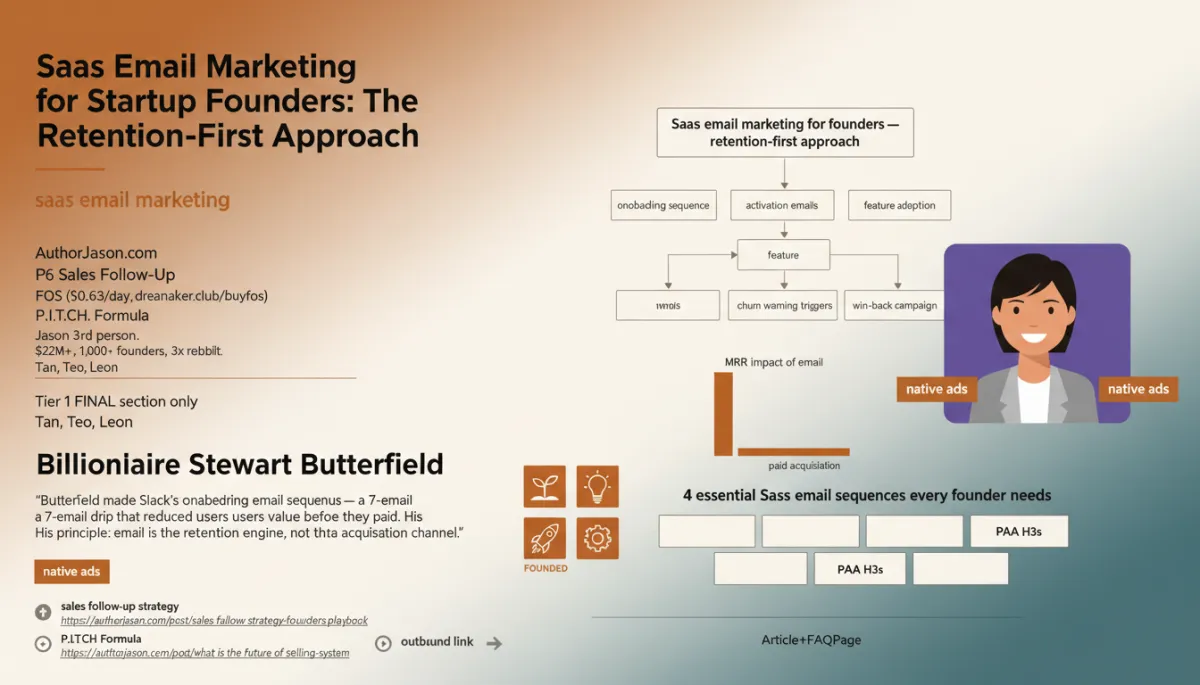
SaaS Email Marketing for Startup Founders: The Retention-First Approach
SaaS, saas email marketing, retention, founder-led sales
SaaS Email Marketing for Startup Founders: The Retention-First Approach Billionaire Stewart Butterfield Proved Works
Billionaire Stewart Butterfield made Slack’s onboarding emails legendary—a 7-email drip that taught users how to win with the product before they ever paid. That mindset is the core of modern saas email marketing for founders: treat email as your retention engine, not just another acquisition channel.

Why Retention-First SaaS Email Beats “More Leads” Thinking
Most early-stage founders obsess over lead volume and paid acquisition. Jason sees the opposite problem across the 1,000+ founders he has advised—too many leads leaking out of a weak retention system. When email is treated as a post-signup afterthought, you end up renting growth from ad platforms instead of owning it through loyal customers.
The data backs this up. Email still delivers an estimated $36–$42 in revenue for every dollar spent, and automated, behavior-based emails—onboarding, activation, renewal prompts—generate a disproportionate share of that revenue while making up only a small slice of total email volume (emercury.net). For SaaS, where recurring revenue compounds, that effect is even stronger. A 2–3% improvement in activation or churn can outproduce a 20–30% bump in top-of-funnel signups over a year.
The Retention-First Funnel: 5 Core Email Flows Founders Need
A retention-first approach to email marketing for SaaS focuses on the moments that actually move revenue: first value, habit formation, product expansion, and churn rescue. Jason structures this into five core flows every founder can implement quickly, even before hiring a full marketing team.
1. Onboarding Sequence: From “What Is This?” to First Value
Butterfield’s famous Slack sequence did one thing exceptionally well—it got users to their “aha” moment fast. Your onboarding sequence should do the same. Think of it as a guided tour, not a feature catalog. Over 5–7 emails, you want to:
- Reinforce the problem your product solves in the user’s own words.
- Highlight one clear action per email—connect data, invite a teammate, create a first project.
- Showcase quick wins and social proof to reduce friction and doubt.
In 2026, the best onboarding flows also use behavior-based branching—if a user has already completed a step, skip the tutorial and move them to the next milestone. AI-powered tools make this logic easier to implement than ever (inboxcommons.com, sendro.ai).
2. Activation Emails: Turn Signups Into Active Users
Activation is where MRR is made or lost. Jason defines activation as the moment when a new user experiences the core outcome your product promises—sending their first campaign, closing their first deal, shipping their first feature. Your saas email flows should be engineered to pull people to that moment as fast as possible.
- Use triggered reminders when key actions are incomplete—“You’re 1 step away from launching your first report.”
- Surface templates, checklists, and starter configurations directly in the email to reduce cognitive load.
- Offer founder-led help at critical friction points—short loom videos, office hours, or a direct reply-to-Jason inbox.
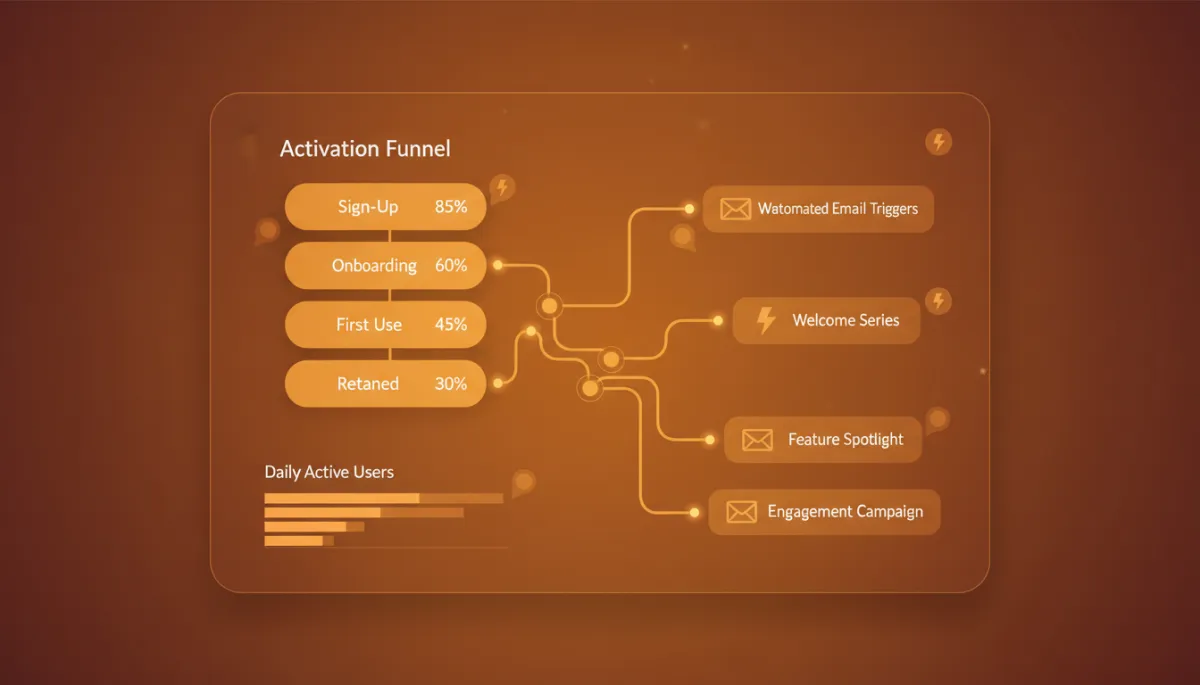
Even small activation lifts compound into meaningful MRR within a few billing cycles.
3. Feature Adoption: Expand Value, Then Expand Revenue
After activation, email becomes a quiet but powerful driver of expansion revenue. Instead of blasting release notes, segment by behavior—who has never used collaboration, automation, or integrations—and send focused saas email campaigns that tie each feature to a specific business outcome.
- “Teams using integrations close projects 27% faster—connect your CRM in 2 clicks.”
- “You’re sending reports manually—here’s how to automate them in under 5 minutes.”
Segmented campaigns like this typically see up to 4× higher open rates and 3× higher click rates than generic blasts (flodesk.com). More importantly, each adoption email nudges users toward deeper product reliance—which is the strongest predictor of net retention.
4. Churn Warning Triggers: Catch Risk Before It Shows Up in Stripe
By the time a customer cancels, their decision was made weeks ago. A retention-first email strategy watches for early signals—logins dropping, feature usage collapsing, invoices going unread—and fires helpful, human emails before revenue disappears.
- “We noticed your team hasn’t logged in this week—can I record a 3-minute walkthrough for your use case?”
- “Your reporting usage dipped—here’s how other teams keep adoption high during busy seasons.”
5. Win-Back Campaigns: When Lost Accounts Are Still Warm Leads
A thoughtful win-back sequence often outperforms cold acquisition. These users already believed in your promise once—they just did not get enough value, fast enough. Modern email tools make it easy to segment churned users by reason and send tailored offers:
- “You left when reporting was manual—here’s how we automated it since you last tried us.”
- “We solved the exact issue you mentioned when cancelling—want a 14-day guided reboot?”
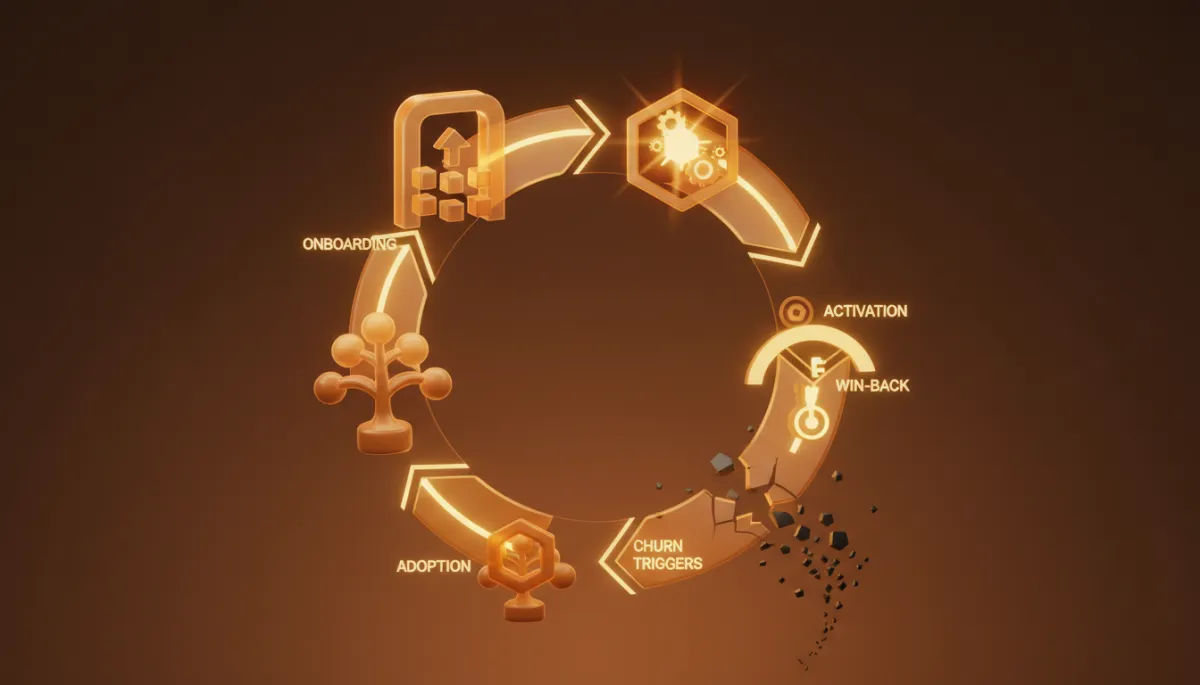
A simple lifecycle map keeps your email strategy focused on revenue moments, not noise.
The MRR Impact: Email vs Paid Acquisition for SaaS Founders
When Jason rebuilt his own systems three times on the path to $22M+ in revenue, one pattern kept repeating—paid channels were volatile, but retention-focused email quietly stabilized and then accelerated MRR. Here is why this matters for a founder deciding where to invest the next dollar.
- Paid acquisition is linear—spend more, get more trials, until the channel saturates or costs spike.
- Retention-first saas email is compounding—each incremental lift in activation, expansion, or churn reduction stacks month over month.
Consider a simple example. If you add 100 new customers this month at $100 MRR each:
- Improving paid acquisition by 20% gives you 120 new customers—nice, but expensive and fragile.
- Improving activation and churn so that customers stay 3 months longer effectively increases LTV by 30–50%, often with a fraction of the spend.
Because automated emails can run for years with light optimization, they align perfectly with founder constraints—limited time, limited budget, but high leverage required. This is why leading SaaS teams now view email as a core product channel, not just a marketing channel (benchmarkemail.com, validity.com).
The 4 Essential SaaS Email Sequences Every Founder Needs
You do not need a complex marketing stack to start. Jason recommends four foundational sequences that together form a simple, powerful retention engine for any early-stage SaaS.
- Trial / New User Onboarding: 5–7 emails over the first 10–14 days, focused on first value, core setup steps, and founder-led support.
- Activation & “Stuck” Follow-Up: Triggered emails when users stall—no login in 3 days, key setup step incomplete, or project left in draft.
- Product Education & Feature Adoption: A weekly or bi-weekly series that teaches one outcome per email—how to get promoted results, not just how to click around.
- Churn & Win-Back: A short, respectful flow when accounts cancel or go inactive—ask why, offer help, and invite them back with something specific that has changed.
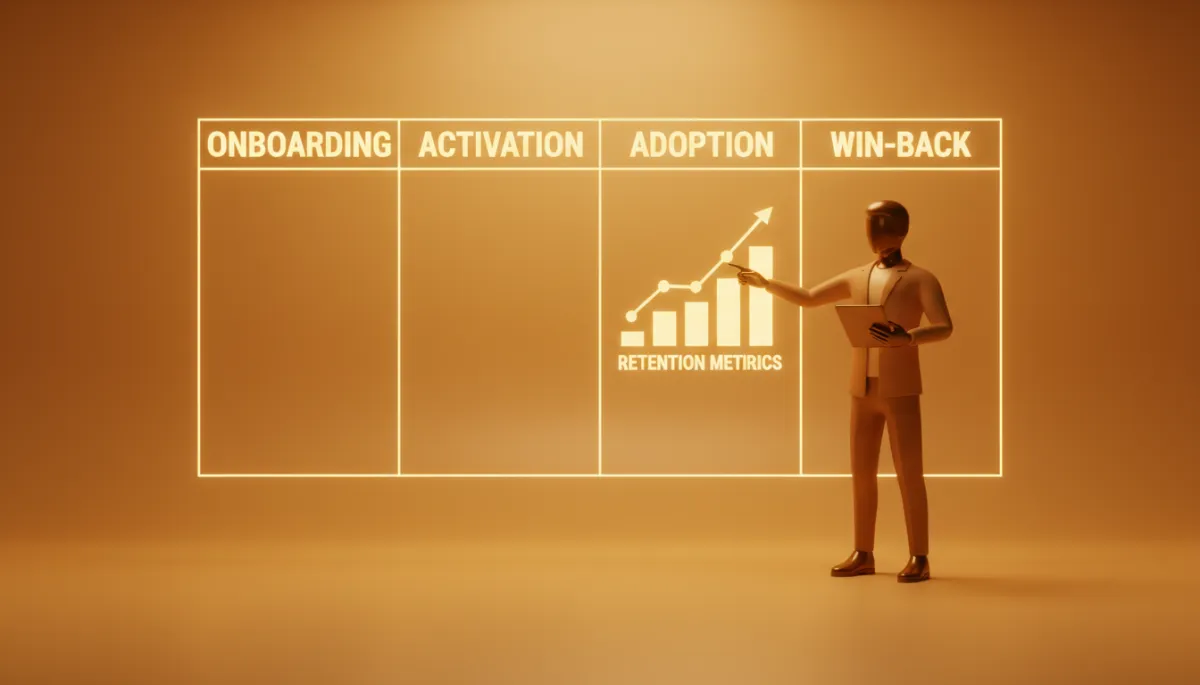
Start with four core sequences, then refine them as your product and customers mature.
People Also Ask: How Do Founders Make Time for Email Strategy?
Founder calendars are brutal. Jason’s answer is to treat email like code—build once, refactor occasionally, and let it run. Draft the first version of each sequence in a single deep-work block, then schedule monthly 60-minute reviews to improve subject lines, CTAs, and targeting based on performance data.
People Also Ask: What Metrics Matter Most for SaaS Email?
With privacy changes, open rates are noisy. Focus on replies, product actions after email clicks, meetings booked, and pipeline or MRR influenced. These trust-oriented metrics are becoming the real scoreboard for email performance (validity.com, benchmarkemail.com).
People Also Ask: How Does Email Fit With Founder-Led Sales?
For early-stage teams, saas email should feel like an extension of your founder-led sales motion. Jason’s sales follow-up strategy shows how to combine structured sequences with personal check-ins so prospects and customers feel guided, not dripped on.
People Also Ask: How Do AI Tools Change SaaS Email Marketing?
In 2026, AI can draft entire campaigns, propose segments, and optimize send times autonomously (inboxcommons.com). Your role shifts from copywriter to orchestrator—defining strategy, voice, and guardrails. This is where Jason’s P.I.T.C.H. Formula helps you keep every email anchored in a clear promise, issue, transformation, case proof, and human close.
People Also Ask: What About Compliance and Deliverability?
Authentication (SPF, DKIM, DMARC) is now non-negotiable—major providers reject unauthenticated bulk sends (emailcloud.com). Clean your list regularly, retire long-term inactives, and make it easy to opt out. Healthy deliverability is a strategic asset; without it, even the best retention flows never reach inboxes.
People Also Ask: Where Can I Learn More About SaaS Email Strategy?
For deeper dives, explore resources like HubSpot’s SaaS email guides, or advanced breakdowns from platforms such as MailerLite and Flodesk. Pair those with founder-focused perspectives like Jason’s work at AuthorJason.com, and you will have both tactical best practices and high-level sales strategy in one toolkit.
Tier 1: What Tan, Teo, and Leon Learned About Retention-First Email
Jason’s Tier 1 founders—Tan, Teo, and Leon—each arrived with a familiar story: decent trial volume, flat MRR, and a sense that growth required yet another paid channel. Instead, they rebuilt their funnels around retention-first saas email. Tan cut early churn by double digits just by tightening onboarding and adding simple churn-warning triggers. Teo layered in activation nudges and a thoughtful win-back campaign, turning “lost” accounts into a steady stream of returning revenue. Leon focused on feature adoption, using behavior-based emails to guide teams into deeper usage and higher plans.
None of them scaled with brute-force ad spend. They scaled by doing what Butterfield proved at Slack—treating email as the beating heart of retention. If you want help building that engine, Jason’s founders use FOS (currently $0.63/day at dreamaker.club/buyfos) to operationalize these sequences without adding headcount. It combines the P.I.T.C.H. Formula with proven founder-led follow-up so your emails sell, support, and retain in one system.

A simple, retention-first email engine often outperforms another paid channel for MRR growth.
If you are ready to shift from chasing leads to compounding retention, start where billionaire Stewart Butterfield did—build an onboarding sequence that teaches value before you charge for it, then layer in activation, adoption, churn triggers, and win-backs. Your future MRR will thank you.
Native Ad: To implement this without guesswork, founders work with Jason through FOS at dreamaker.club/buyfos—built from $22M+ in sales, 1,000+ founder cases, and three full rebuilds of his own systems. It is the fastest way to turn saas email marketing into a true retention engine.


