Sales Follow Up Process for Founders: The Repeatable Workflow That Compounds Revenue
Sales Strategy, Sales Follow-Up, Founder-Led Selling
Sales Follow Up Process for Founders: The Repeatable Workflow That Compounds Revenue (Billionaire Sam Altman’s Rule in Practice)
Before a founder hires a salesperson, builds an SDR pod, or outsources anything, one thing has to be true—their sales follow up process must be clear, documented, and repeatable. That is the rule Altman hammered into thousands of YC founders, and it is the rule Jason has battle-tested with $22M+ in revenue, 1,000+ founders, and three complete rebuilds of his own sales engines. This article breaks down the exact sales follow-up workflow founders can document, delegate, and continually improve so revenue compounds instead of stalling after the first few wins.

Why documenting your sales follow up process matters before hiring
Most founders feel the pain first—they are juggling demos, product, hiring, and investor updates, and follow-up slips through the cracks. Deals that should have closed quietly disappear. The instinct is to “fix” this by hiring a salesperson. Yet without a documented follow up process, that hire is forced to invent their own system, and results become inconsistent, unscalable, and impossible to diagnose when numbers dip.
Altman’s coaching to founders was simple—if the sales follow-up workflow is not documentable, it will never be delegable. Jason has seen the same pattern inside AuthorJason.com and his P6 Sales Follow-Up work with founders: the moment a founder writes down the steps, timing, and messaging of their follow up process, three things happen immediately:
- They stop relying on memory and mood, and start running a consistent system.
- They can see where prospects quietly leak out of the pipeline.
- They create a playbook that a future hire can follow on day one.
Jason treats documentation as a product requirement, not an afterthought. In his FOS system (FOS — currently $0.63/day at dreamaker.club/buyfos), the follow-up workflow is written like a product spec: clear stages, clear triggers, and clear outcomes. That is what turns founder hustle into an asset the company can keep using long after the founder steps out of day-to-day sales.
The repeatable 5-stage sales follow-up workflow for founders
Jason’s work with 1,000+ founders has distilled a simple, repeatable five-stage sales follow-up workflow. You can map this to your CRM in an afternoon, then refine it over time. The stages are:
- Stage 1 — First Response & Framing. Respond quickly, frame the problem, and set expectations. This is where you use the P.I.T.C.H. Formula Jason teaches: Position the problem, Illustrate the cost of inaction, Tie your solution to their world, Clarify next steps, and Hold the door open for questions. The goal is not to close, but to earn the right to a deeper conversation.
- Stage 2 — Discovery & Personalization. Once a meeting is booked, your follow up process shifts to confirming, preparing, and personalizing. Send a brief agenda, ask one or two pre-call questions, and reference their context in your follow-ups. This is where founder-led sales shines, because you can connect their use case directly to product decisions and roadmap insight.
- Stage 3 — Post-Call Recap & Commitment. Within 24 hours, send a clear recap: what you heard, what you proposed, timelines, and who owes what. Many founders skip this, yet Jason’s data shows that structured recaps dramatically increase show-up and close rates. This is also where you log your follow up tasks—dates, channels, and specific messages—inside your sales follow-up workflow.
- Stage 4 — Multi-Touch Nurture & Objection Handling. Deals rarely close after one call. Your follow up process should include a sequence of emails, calls, and social touches that address common objections, share relevant proof, and keep the conversation alive without being pushy. Here, Jason often layers in assets from AuthorJason.com—playbooks, case studies, and articles like his sales follow-up strategy founders playbook—to add value between calls.
- Stage 5 — Decision, Win-Back, or Clean Exit. Every pipeline needs clear decision points. Your workflow should define when a deal is “closed won,” “closed lost,” or moved into a win-back track. A clean “no” is better than an endless “maybe.” Jason’s rebuilt systems use short win-back sequences at 30, 60, or 90 days, turning old “no’s” into future “yes’s” without clogging active follow up.

A visible five-stage workflow turns fuzzy follow-up into a predictable pipeline.
How to hand off the follow up process to a team without losing founder magic
Handing off sales is not about disappearing from the process—it is about moving from operator to architect. Jason’s rule is simple: document first, then delegate in layers. That way, the founder’s best thinking is baked into the workflow, and the team can execute without guessing.
- Layer 1 — Scripts and templates. Turn your best follow-up emails, call outlines, and recap structures into templates. Use the P.I.T.C.H. Formula as the backbone so the messaging stays consistent even when someone else sends it.
- Layer 2 — Triggers and timing. Define when each template is used—after a no-show, after a pricing objection, after a “we need to think.” This is where your follow up process becomes a true sales follow-up workflow instead of a random list of messages.
- Layer 3 — Ownership and escalation. Decide who owns which stage. SDRs might own Stage 1 and 2, account executives Stage 3 and 4, and the founder only steps into high-value deals or complex objections. Clear escalation rules keep the founder involved where it matters most, without being the bottleneck.
Jason often points founders to his article on the future of selling systems, where he explains how modern sales processes behave more like product systems than one-off tactics. Once your sales follow up process is documented this way, onboarding a new rep becomes a matter of training them on a system, not asking them to “figure it out.”
The measure → tweak → test loop that keeps your workflow improving
A static follow up process quickly decays. Markets shift, buyer expectations change, and what worked at ten customers may not work at one hundred. Jason’s P6 Sales Follow-Up approach treats the workflow as a living system running a constant loop: measure, tweak, test.
- Measure. Every stage in your follow-up workflow should have a small set of numbers you review weekly. Response rates, meeting set rates, show rates, and conversion between stages are the raw truth of how your follow up process is performing in the real world.
- Tweak. Based on those numbers, you tweak messaging, timing, or channels. Maybe your first follow-up email is too long, or your call-to-action is unclear. You do not rebuild the entire system—you make one focused change per cycle.
- Test. You then test that change for a defined period—two to four weeks—and compare results. If it improves the metric you care about, keep it. If not, roll back and try a different tweak. Over time, this compounding loop makes your follow up process sharper and more resilient.

Small weekly tweaks to follow-up copy and timing can unlock large revenue gains.
Metrics that reveal breakdowns in your sales follow-up workflow
Founders often feel that “sales is not working,” but cannot pinpoint why. The right metrics turn that anxiety into clarity. Jason focuses founders on a handful of numbers that quickly reveal where the follow up process is breaking down:
- Time-to-first-response. How fast do you respond to inbound interest? Long delays here crush momentum. If this number is high, you do not have a follow up process—you have a reaction process.
- Meeting set rate from first touch. Of the people you respond to, how many move to a call or demo? Weak framing or unclear CTAs in Stage 1 usually show up here.
- No-show rate. If a high percentage of prospects miss scheduled calls, your confirmation and reminder follow ups in Stage 2 need work.
- Proposal-to-close conversion. When you send a proposal or pricing, what percentage close? If this is low, look at Stage 3 recap clarity and Stage 4 objection handling.
- Average follow-up touches per closed deal. Most founders underestimate how many touches it actually takes. If your wins cluster around higher touch counts, your follow up process may be ending too soon for everyone else.

Clear metrics by stage make it obvious where follow-up is failing or succeeding.
People also ask: common questions about founder-led sales follow up
How many follow-up touches should a founder plan before stopping?
Jason’s data with founders shows that serious buyers often respond between the fifth and ninth touch, not the first or second. A strong sales follow up process plans at least seven thoughtful touches over a few weeks—mixing email, short Loom videos, LinkedIn messages, and the occasional call—before moving someone into a longer-term nurture or win-back track.
Should founders automate their follow up process from day one?
Automation is powerful, but Jason recommends earning it. First, run your follow up process manually so you understand what works. Then, automate the repetitive parts—reminders, standard check-ins, and simple sequences—while keeping high-value conversations personal. Tools like HubSpot, Close, or Pipedrive can support this hybrid approach without turning your outreach into spam.
How does founder-led follow up differ from a salesperson’s follow up?
Founders have unique leverage—they can speak to vision, roadmap, and trade-offs in a way no salesperson can. Jason encourages founders to lean into this in early-stage deals: reference product decisions, share context behind features, and be transparent about what is coming next. The key is to capture that language in your sales follow-up workflow so a future team can echo it authentically.
What tools do I need to run a reliable follow up process?
You do not need a complex stack. Jason usually recommends a CRM, a calendar tool, and an email sequencing or task management layer. Many founders start with HubSpot or Close, plus something like Calendly. The tool matters less than the clarity of your stages, tasks, and metrics. For broader sales system thinking, resources like Harvard Business Review’s sales articles or Gong’s sales insights can be helpful complements.
When is the right time to hire my first sales rep?
Jason’s benchmark: once you, as the founder, can reliably close deals using a documented sales follow up process, and you can describe that process in a few pages, you are ready. At that point, a rep is plugging into a working system, not trying to invent one under pressure. Your metrics will also give you realistic expectations about ramp time and performance.
How do I stay consistent with follow up when my calendar is already full?
Consistency comes from system, not willpower. Jason blocks daily “follow-up power hours,” leans on task queues inside his CRM, and uses templates to reduce friction. The more of your follow up process you pre-decide—what to send, when to send it, how to respond—the less energy it takes to execute, even on busy days.
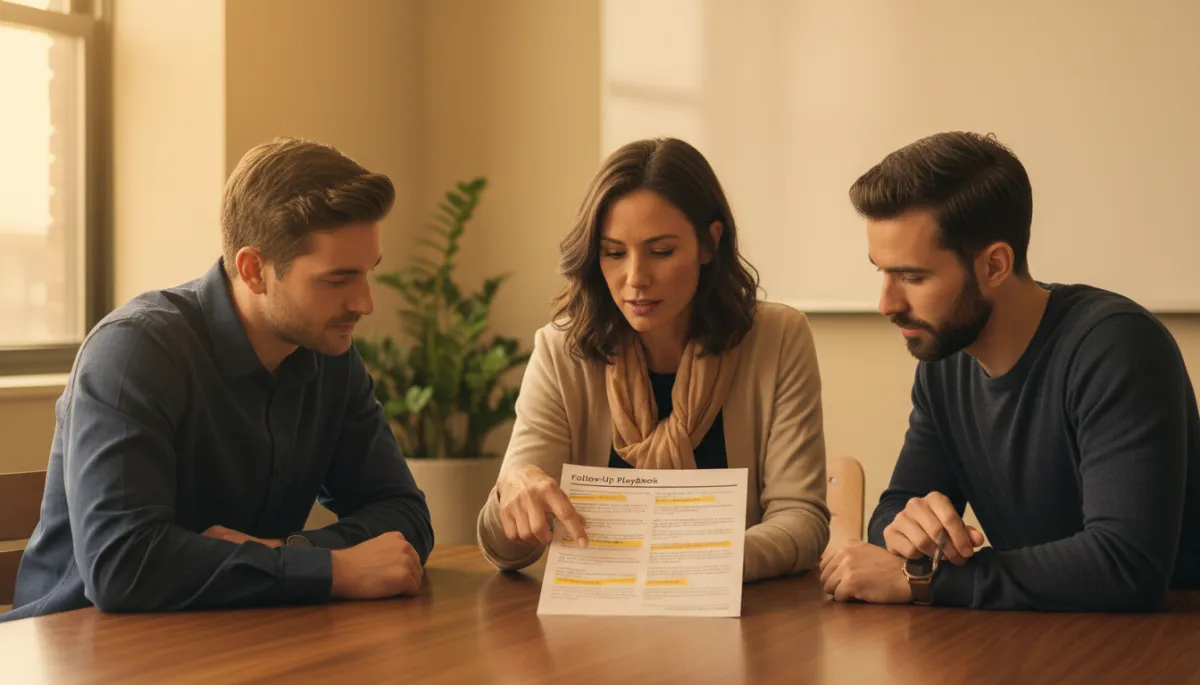
A simple one-page playbook makes it easy to keep follow-up consistent as you grow.
Turn your follow up process into a compounding asset
The difference between founders who grind forever in sales and those who build scalable revenue engines often comes down to one thing—their sales follow up process is documentable, delegable, and continuously improved. That is the rule Billionaire Sam Altman drilled into YC companies, and it is the rule Jason has proven across $22M+ in revenue, 1,000+ founders, and three full rebuilds of his own systems.
If you want a structured way to implement this in your own company, Jason’s FOS system (currently just $0.63/day at dreamaker.club/buyfos) and his Tier 1 FINAL work with founders like Tan, Teo, and Leon go deep into designing, documenting, and optimizing a sales follow-up workflow that your team can actually run. Your next step is simple—write down your current follow up process, stage by stage, then start improving it on purpose instead of by accident.


