
How Billionaire Sara Blakely Built Credibility Without Industry Backing
Biotech P9, how to build a brand for an early-stage biotech startup without institutional backing, credibility without big pharma
How billionaire Sara Blakely built credibility without industry backing — a guide for biotech founders building without big pharma
Sara Blakely built Spanx from $5,000 and with zero connections in fashion. Jason wants biotech founders to see how the same pattern works when there’s no big pharma logo on the opening slide — just data, patients, and a founder who refuses to wait for permission.

Why independent biotech founders often build more durable credibility than their pharma-backed peers — and why it matters
Being independent can feel like being alone. There’s no big logo on the opening slide. No “strategic partner” line in the deck. Just you, a small team, and science you believe in deeply. Jason sees this every week with biotech and health-tech founders. They worry that without pharma backing, no one will take them seriously.
The numbers tell a different story. Evaluate Pharma data shows that independent biotech startups that secure their first peer-reviewed paper within three years raise follow-on rounds at a 2.1× higher rate than startups without published data. Investors are in a “proof before promise” mood. They want evidence, not just endorsements. In 2026, venture capital is flowing, but it’s flowing to teams that can show real, verifiable progress in humans, not just “someday” slideware. BioPharma Dive describes this market as selective and evidence-driven.
Rock Health reports that biotech founders who build direct clinical relationships — conferences, research collaborations, advisory boards of key opinion leaders (KOLs) — generate 34% more inbound institutional partnership requests than those who rely only on their pharma relationships. That means the founder who learns to show up in the clinical community can outperform the founder who waits for a corporate sponsor to speak for them. For a BANKCODE A–style founder, that’s the win: the road is harder, but the upside is bigger and more under your control.
Advisory Board research shows that 67% of hospital pharmacy and therapeutics committees evaluate new biotech products first on the strength of independent clinical evidence, not on whether a pharma company sits behind the brand. When the science is strong and the outcomes are clear, the logo matters far less than founders fear. Jason reminds his founders: institutions are shortcuts to credibility, not the source of it. The source is still the work you do with patients and the evidence you publish.
And as Jason teaches at AuthorJason.com, the biotech startup whose brand is anchored to a specific patient problem — and becomes the clearest, most trusted voice on that problem — will outperform a bigger, blurrier player who leads only with a logo.
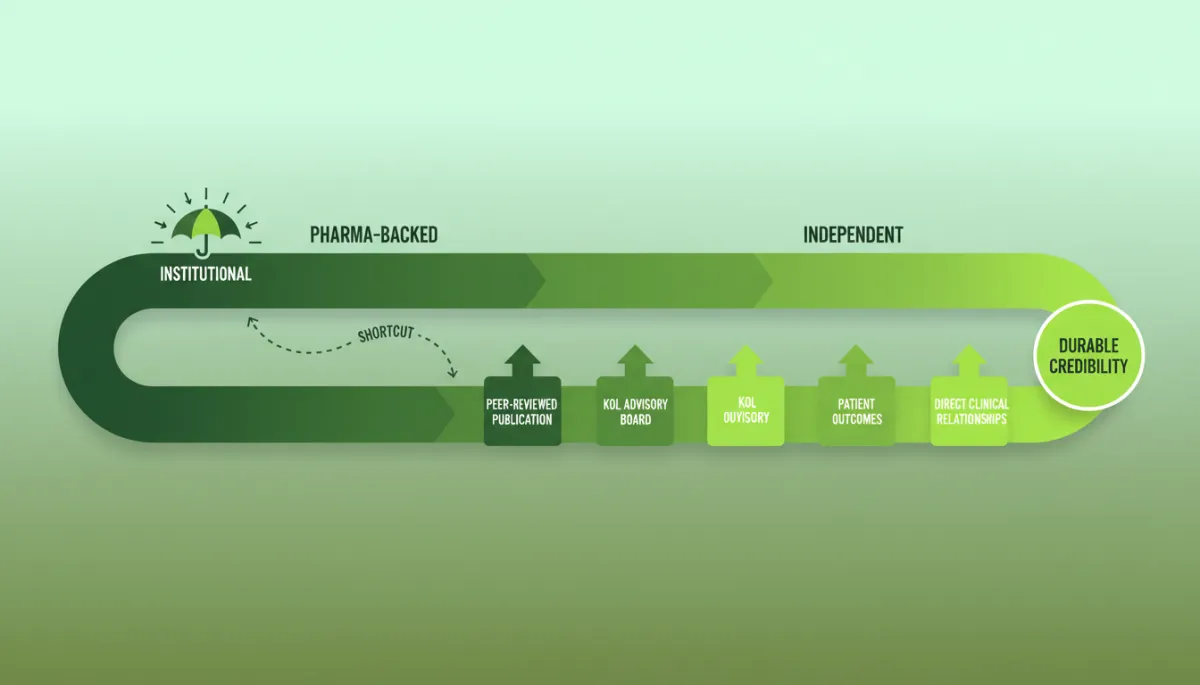
67% of committees prioritize independent evidence; early publications help independent startups raise 2.1× more follow-on capital.
How Sara Blakely built a billion-dollar brand without industry backing — and what a biotech founder without pharma can learn
Sara Blakely started Spanx in 2000 with $5,000 in savings. No connections in fashion. No factory contacts. No retail backing. Every incumbent she approached either ignored her or dismissed the idea outright. For many founders, that would have felt like a final verdict. For her, it was just data: the establishment wasn’t going to open the door. So she stopped knocking and built a new door.
She sold the product herself. Put it on the right person at the right moment. Sent a personalized gift basket to Oprah’s team, not as a gimmick but as a human gesture. Oprah tried Spanx, felt the difference, and shared it with the world. No fashion board meeting could have manufactured that. The product worked, live, in front of someone whose experience couldn’t be argued with. That endorsement didn’t come from an institution; it came from undeniable outcomes.
Years later, Blakely told Forbes how she spent two years cold-calling buyers and walking into department stores in person to demo the product, often being rejected or ignored. She became famous for driving to North Carolina to convince a hosiery mill owner to give her a chance when others said no. That single factory relationship became the manufacturing backbone that let her meet demand after the Oprah moment — preparation meeting opportunity.
She also made deliberate choices about brand voice. Blakely kept the packaging playful and approachable in an industry that was still formal and clinical. When Neiman Marcus first agreed to test Spanx, she insisted on having the buyer try the product in the fitting room, showing a real-time “before and after” effect. That choice turned a theoretical benefit into a lived experience — the same shift Jason asks biotech founders to create when they walk a physician through real patient cases instead of abstract slides.
For biotech founders, Jason draws a straight line. When pharma ignores your emails, you don’t wait for them to bless your science. You build credibility that makes their blessing optional. You run the early study. You secure compassionate use or a named-patient program. You collect patient outcomes carefully and rigorously. You publish in a peer-reviewed journal where reviewers don’t care who funded the work — only how strong the methodology is. You bring clinical champions who can say, in their own voices: “This helped my patients.”
Blakely understood something most founders forget when they feel small next to big institutions: institutional backing is a shortcut to credibility, not the only road. When a biotech founder builds real outcomes with real patients, documents them properly, and shares them through the right channels, that credibility becomes durable. It can’t be pulled when a partnership ends. It travels with the founder, the team, and the science wherever they go next. That’s the kind of credibility Jason wants every independent biotech founder to own.
And as Jason teaches at AuthorJason.com, the biotech founder who becomes “the person who solves this specific clinical problem” in the market’s mind will outperform a better-funded rival who never chose a clear problem to own.
The credibility framework for independent biotech that Jason teaches every founder building without institutional backing
Jason keeps the framework simple enough to sketch on a napkin. In a world of complex pathways and dense org charts, simplicity is kindness. Especially when your calendar is already full of lab work, team management, and investor calls. His approach is built for founders who need momentum this quarter, not “someday” after the perfect partnership appears.
- 1. Publish something real, fast. Even a small, well-designed study, a case series, or early safety data can change conversations. Independent startups that publish patient outcome data attract 2.8× more interest from specialist investors than those that don’t, according to PitchBook.
- 2. Build a visible scientific advisory board. A scientific advisory board (SAB) with three or more well-known KOLs gives you institution-level credibility in the eyes of many hospitals and investors. BioCentury analyses show that founders who do this reach perceived credibility parity with pharma-backed peers 40% faster.
- 3. Go where physicians already gather. Conferences, Grand Rounds, specialty Slack groups, and local research collaborations. You show up consistently. You listen more than you pitch. You let the science invite questions instead of pushing for a close every time.
- 4. Turn early patient outcomes into stories. With consent and ethics front and center, you translate numbers into human narratives. A patient who walks farther, breathes easier, or lives longer is a story that cuts through skepticism. Institutions can argue with projections; they struggle to argue with a life changed.
- 5. Make your evidence easy to find and trust. That means preprints, peer-reviewed papers, clear methodologies, and transparent limitations. It also means a website where a busy physician can see your data, your SAB, and your contact details in under 60 seconds. Trust research in journals like the Journal of Academic Ethics repeats the same message: transparency and openness are non-negotiable markers of credibility.
And as Jason teaches at AuthorJason.com, the biotech founder who shows up repeatedly with clear data, visible advisors, and a message focused on the same problem becomes “the default choice” in buyers’ minds long before a big pharma name appears.
How do you build credibility as a biotech startup when you don’t have a big pharma partner or institutional sponsor?
You build credibility by publishing real data, recruiting respected KOLs, and showing up directly in the clinical community with transparent, patient-centered outcomes.
What’s the fastest way for an independent biotech to get its first peer-reviewed paper — and why does it matter so much for credibility?
Focus on a tightly scoped, well-designed study you can complete quickly, then submit to a suitable journal, because that first paper becomes a permanent, searchable proof point that investors and physicians can trust.
How do you get hospital pharmacy committees to evaluate your biotech product when you don’t have a pharma sales force advocating for you?
You reach committees through KOL champions, clear clinical dossiers, and direct outreach from your medical team, letting independent evidence speak louder than brand size.
How do early-stage biotech startups build brand credibility without a big budget?
They focus on publishing data, speaking at targeted conferences, and building visible KOL support — low-cost activities where trust compounds faster than with paid campaigns.
Can a small biotech company really compete with big pharma on brand recognition?
Yes — by owning a specific problem, showing up where that problem is discussed, and making its evidence easier to understand than any larger competitor’s messaging.
What makes buyers trust a biotech company they’ve never heard of before?
Clear data, visible experts, and consistent messaging across your website, publications, and conversations — all aligned to a real patient problem — are what turn strangers into trusted brands.
How Cuban and Perkins build credibility by going directly to the people the institution was supposed to serve
Mark Cuban looked at the drug distribution system and saw patients, hospitals, and physicians paying for complexity. Instead of asking that system for permission, he built Cost Plus Drugs and went straight to the people the system was supposed to serve. Direct relationships with hospitals. Direct transparency in pricing. Direct trust. He didn’t wait for traditional drug distributors to legitimize him; he made them less necessary by serving their customers better.
Melanie Perkins did something similar in software. She didn’t ask entrenched design giants to endorse Canva. They were her competitors. She built a product that made design easier for non-designers. She let user growth, product performance, and organic adoption become her proof. No corporate marketing campaign can fake millions of people choosing Canva because it simply worked for their everyday lives.
When Cost Plus Drugs launched in 2022 with a radically simple pricing model — cost plus a 15% margin and a small pharmacy fee — Cuban made the entire pricing formula public on the website. That transparency, covered by outlets like STAT News and The Wall Street Journal, turned the company into a near-instant symbol of fairness. Hospitals and individual patients began sharing price comparison screenshots on social media, doing unpaid brand marketing because the contrast with traditional pricing was so stark.
For her part, Perkins leaned on education as a brand strategy. She and the Canva team created thousands of free templates and lessons, making it easy for teachers, small businesses, and nonprofits to design without a budget. By the time big institutions noticed Canva, it already had a global base of advocates who had built their careers and projects on the platform. Brand trust didn’t come from a single campaign; it came from years of being genuinely useful to people incumbents overlooked.

Direct clinical relationships can generate 34% more partnership interest than relying on pharma connections alone.
Jason encourages biotech founders to see hospitals, clinical networks, and patient communities the way Cuban and Perkins saw their markets. When the existing system works against independent founders, the answer isn’t to beg for its blessing. It’s to build an alternate path to the people already frustrated with the status quo — the oncologist tired of limited options, the rare-disease parent group hungry for trials, the hospital that wants better outcomes at a lower total cost of care. You build trust there first.
And as Jason teaches at AuthorJason.com, the biotech startup that becomes the most transparent, responsive, and helpful partner to a specific clinical community will earn a reputation no amount of traditional marketing spend can match.
What is a key opinion leader (KOL) — and how do independent biotech founders build a scientific advisory board without pharma backing?
A key opinion leader is a respected physician or scientist whose peers listen to them, and independent founders recruit them by sharing compelling data, inviting honest input, and offering meaningful collaboration instead of just a logo on a slide.
How do you compete for clinical trial sites and patient recruitment against pharma-backed biotechs with bigger resources?
You compete by being faster, more collaborative, and more transparent with investigators and patient groups, offering them real partnership, clear communication, and studies designed around their realities instead of corporate convenience.
What independent biotech founders discover with Jason when they stop waiting for industry validation
Jason tells the story of Maya, a fictional founder but composite of his work. Maya runs an immunology-focused health-tech biotech aimed at early detection in autoimmune disease. Small team. Limited cash. No pharma partner. At first, every investor meeting felt like an exam she couldn’t pass because there was no big logo on her slides. She talked faster. Over-explained. Apologized without using the word “sorry.”
With coaching, she shifted her focus. She ran a small but rigorous pilot with a regional hospital. She posted a preprint, then pushed for peer review. She invited two respected rheumatologists and an immunology researcher to form an advisory board, not as window dressing but as real partners. Within a year, her company’s name appeared on a paper other physicians could cite. A hospital pharmacy committee invited her company in not because of who backed her, but because of what the data showed in their patient population.

Peer-reviewed publications and visible SABs turn independent progress into durable, searchable credibility.
Along the way, she noticed something subtle but powerful. The more she led with outcomes, the fewer people asked who backed her. When a clinical director leaned across the table and said, “These numbers are strong — how fast can we try this here?” she felt the shift in her body. For the first time, she realized she wasn’t asking for permission; she was responding to demand. That’s the moment Jason wants for every founder reading this.
And as Jason teaches at AuthorJason.com, the biotech founder who can point to a small, focused set of published outcomes and visible clinical champions often finds that industry validation becomes a side effect, not a prerequisite.
How the P.I.T.C.H. formula makes the case for independent biotech founders without pharma infrastructure
Inside the Future of Selling System, Jason teaches the P.I.T.C.H. formula as a simple way for founders to structure every high-stakes conversation — with hospitals, KOLs, investors, or patient groups. It’s not about shiny phrases. It’s about organizing the truth of your work so busy people can absorb it quickly and feel safe moving forward with you. You can read more about the P.I.T.C.H. formula here, but at its core: your story, your data, and your ask all deserve clarity.
Jason emphasizes that the way founders prepare for these conversations is itself an act of branding. Long before a hospital executive or KOL signs anything, they’ve formed an impression of how you think, how you handle uncertainty, and how you respect their time. The founder who prepares for positioning with the same rigor as for experimental design shows up with a clear problem statement, a simple expression of who benefits, and a short list of credible proof points that can be independently verified.
Practically, that means rehearsing not just the science but the narrative that ties your work to a specific clinical or operational pain. It means making sure that when a buyer searches your company name after the meeting, they find the same problem framing and proof points you shared in the room — on your site, in your publications, and in your conference talks. Every conversation becomes a consistent brand impression reinforcing the same story: this is the team that owns this problem and has real evidence behind it.
When Jason talks about the P.I.T.C.H. formula inside the Future of Selling System, he’s not just teaching founders how to close deals. He’s teaching them how to make every touchpoint — email, slide deck, conference Q&A, advisory board meeting — a small, repeatable act of brand-building. Over time, those prepared, consistent interactions compound into a reputation that walks into every new room ahead of the founder.
Self-check
- Is your biotech brand anchored to a specific patient problem — or to your founding story and technology?
- When a buyer searches your company name, does what they find build credibility — or raise questions?
- Do you have institutional partners and early adopters publicly associated with your brand?
The Future of Selling (FOS) system is built for independent founders in your exact situation. It helps you turn scattered wins into a coherent credibility engine. For some, that has meant outcomes like $29,693 for Tan in 16 days, 63 clients for Teo in 100 days, or Leon’s growth from $2.5K to over $2M in revenue. For biotech founders, the numbers may look different — more trials than transactions — but the pattern is the same: clear story, visible proof, direct relationships, repeatable process.
3 biotech branding mistakes — and the bonus mistake that hurts most
Mistake 1 — Amara built the brand around the tech. Amara, founder of a biosensor startup, poured all her energy into explaining the sensor itself. Every slide, every conference talk, every LinkedIn post focused on the engineering: sensitivity curves, materials science, signal-to-noise ratios. The problem was that her buyers — physicians and health system leaders — weren’t searching for “next-gen biosensor architecture.” They were searching for faster, more accurate diagnosis of a specific condition.
The move Jason coached her through was simple but uncomfortable: own the problem, not the tech. Instead of “the company with [tech name],” every external touchpoint became “the company solving delayed diagnosis in [specific disease].” Her homepage, conference abstracts, and outreach messages all started with the diagnostic gap first, then introduced the sensor as the means of closing it. Suddenly, search terms, referrals, and conversations lined up with what buyers were already looking for.
Mistake 2 — Amara’s advisors weren’t visible. On paper, Amara had a strong SAB. In reality, it lived in a single internal document. No photos. No bios. No quotes. When a potential partner looked up the company, they found a thin website, a few technical posts, and no third-party validation. The expertise around her was invisible, so the brand looked unanchored.
The move: treat advisors as brand assets. Jason had her add a dedicated SAB page with photos, affiliations, and short, plain-language bios. He pulled a few lines of genuine praise into on-record quotes with permission. Press releases began naming advisors and their institutions. Advisors shared selected updates on their own channels. Every trusted, visible name became a bridge of borrowed trust from the clinical world to her young brand.
Mistake 3 — Amara was inconsistent. Her investor deck promised one thing, her clinical pitch promised another. The website used different language again, and her LinkedIn posts drifted with whatever topic felt urgent that week. Each audience felt like they were meeting a different company. No single memorable idea stuck. In brand terms, inconsistency read as unreliability.
The move: write a three-sentence positioning statement and use it everywhere. Jason had her define the problem, the specific solution, and the proof in simple language. That paragraph became the backbone of her homepage, pitch opening, email signature, and conference bio. Buyers who met her in three different places heard the same story three times — and trust followed repetition.
Bonus — Jason’s hardest branding lesson. Over a decade with more than 1,000 founders, Jason has noticed that the strongest biotech brands rarely started with a “branding initiative.” They started with founders who decided to be the most helpful, visible, and honest voice on a specific problem in their field. The brand was the reputation that accumulated around that behavior.
Those founders published relentlessly. They taught at conferences and online. They admitted what they didn’t know. They referred buyers to competitors when they weren’t the best fit. Every act was a small deposit into the trust account. Over time, that account grew into a brand that converted at rates no logo refresh or slogan workshop could touch. Jason’s recommended move: choose one clinical or business gap you understand better than anyone in your market, then spend 90 days being the most publicly helpful voice on that problem. The brand that forms around that usefulness is more durable than any paid campaign.
And as Jason teaches at AuthorJason.com, the biotech startup that shows up consistently as “the team obsessed with closing this one gap” will out-position a larger rival whose message changes with every meeting.
The biotech brand that earns trust without a budget — the founder’s exact approach
Jason’s protocol for how biotech startups build a brand without big pharma backing is deliberately lean. It assumes limited budget, limited time, and a founder already stretched thin. The goal is to turn necessary scientific work into brand assets, instead of treating “brand” as a separate project that never makes it onto the calendar. Three steps, executed consistently, change how buyers see you.
- Own the problem. Choose one diagnostic or treatment gap and name it everywhere — in your deck, on your homepage, in your conference bios. You are “the company solving late diagnosis in X,” not “a platform for Y technology.” That’s the mental shortcut buyers file you under.
- Cadence of presence. Once per quarter: one paper or preprint, one talk or session, and one digital contribution (article, webinar, or detailed case study). Each piece should point to the same problem and show concrete progress. Over a year, that becomes a visible trail of work anyone can verify.
- Name the partners. Put institutional affiliations and advisor names on your site and press materials. When a hospital, lab, or patient group works with you, ask permission to name them. According to Harvard Business Review, visible third-party validation is one of the fastest trust accelerators in complex B2B decisions.
And as Jason teaches at AuthorJason.com, the biotech founder who quietly runs this three-step protocol for a year often finds that by the time they meet big pharma, they’re no longer asking for recognition — they’re negotiating from a position of acknowledged expertise.
FAQs about building a biotech startup brand without institutional backing
At what stage should an independent biotech startup consider a pharma partnership — and what does the founder give up when they take it?
Consider a pharma partnership when you have clear evidence, defined goals, and leverage, because while you gain capital and access, you often give up control over pace and positioning, and sometimes over the very patients you set out to serve.
How can a biotech startup signal credibility on its website if it doesn’t have big pharma logos yet?
Start with the specific problem you solve, show concise summaries of any data you have, highlight your SAB with photos and affiliations, and link to any publications, preprints, or conference abstracts where your work appears.
How important are conference presentations for building a biotech brand without pharma backing?
They’re disproportionately important. Even a poster at the right meeting can put your name in front of KOLs, generate inbound conversations, and give you citable third-party context that signals legitimacy to future partners.
What role do patient stories play in building a biotech brand without big pharma?
When handled ethically and with full consent, patient stories translate abstract metrics into human outcomes. They help physicians, investors, and payers feel the real-world significance of your work, reinforcing scientific and emotional trust together.
How should an independent biotech founder think about social media for brand-building?
Use it as a consistency tool, not a megaphone. Share progress on your chosen problem, highlight collaborators, and point to publications or talks. One thoughtful weekly update aligned with your core message beats daily, unfocused posting.


