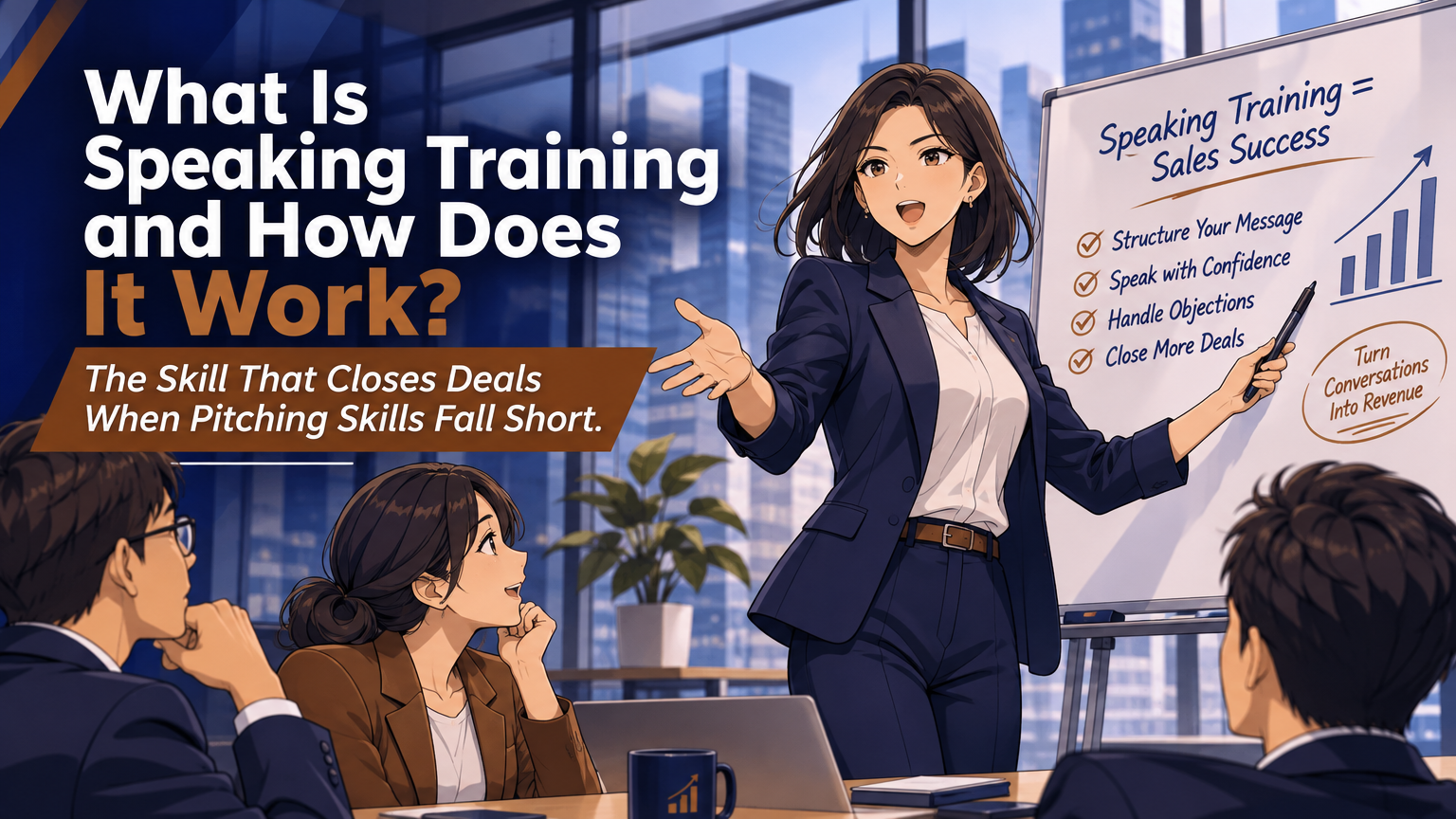
What Is Speaking Training and How Does It Work?
What Is Speaking Training and How Does It Work?
Speaking training is a structured program that builds your ability to deliver clear, confident, and persuasive speech in high-stakes situations. It targets vocal delivery, message structure, body language, on-camera presence, and live-pressure handling — the skills that determine whether a pitch lands, a deal closes, or a room tunes out.
🌟 From a $2,500 Project to a 7-Figure Partnership
A franchisee student used Jason Lim’s presentation framework to transform a small project pitch into a 7-figure partnership deal. Same room. Same idea. Different speaking skills.
Jason Lim brings 20+ years of coaching and teaching experience across 42 cities globally, helping founders, executives, and sales reps turn stalled pitches into signed deals through Presentation Skills and Speaking Skills training.
Why Do So Many Professionals Search for Speaking Training?
Picture this: a startup sales rep spends three weeks preparing for a client presentation. The slides are sharp. The proposal is tight. And the moment the client asks “Why should I choose you over the others?” — the rep stutters, over-explains, and watches the room go cold.
It is not a knowledge problem. It is a speaking skills problem.
The data shows how widespread this is. The Chapman University Survey of American Fears 2025 found that 33.7% of Americans are afraid or very afraid of public speaking. A 2024 Preply public-speaking study of 2,007 adults found that 63% of Gen Z respondents would avoid public speaking altogether if they had no obligation to do it.
Yet the professional world runs on speaking. Communication ranked as the number-one most in-demand skill on LinkedIn for both 2024 and 2025. The NACE Job Outlook 2025 found that more than three-quarters of employers name communication a critical attribute for new hires, and more than two in three specifically seek verbal communication skills.
That is the gap speaking training closes. Even with the right product, the right leads, and the right timing — weak delivery costs deals. However, the same skills that lose rooms can be trained, corrected, and rebuilt.
What Does Speaking Training Actually Cover?
Not all programs are equal, but the strongest speaking training addresses the specific mechanics that break down under pressure — exactly when it matters most. Here is what the best programs build:
| Skill Area | What You Build | Why It Wins Deals |
|---|---|---|
| Vocal Delivery | Pace, pause, volume, tone | Signals authority; holds attention |
| Message Structure | Hook, through-line, clear call to action | Listeners remember and act |
| Body Language | Eye contact, posture, stillness | Builds trust before you say a word |
| Live Pressure Handling | Objections, tough questions, silence | Keeps deals alive when rooms push back |
| On-Camera Presence | Eye-line, energy, framing on video calls | Essential for remote sales and virtual pitches |
Think of speaking training the way you would think of driving instruction. Reading the highway code does not make you a confident driver in traffic. Even the best car will not compensate for a driver who freezes at the first lane change. Speaking skill works the same way — it is not the deck, the CRM, or the script that closes. It is the person delivering it. Gosu driving skill beats horsepower. And so does Gosu speaking skill.
Related:
🔗 Future of Selling — Presentation Skills Coaching with Jason Lim
🔗 How Do You Improve Your Speaking Skills?
🔗 What Are Public Speaking Training Classes and Are They Actually Worth It?
Who Actually Needs Speaking Training?
Speaking training is not just for people with stage fright. The professionals who benefit most are often already in the room — they just are not winning it.
- Startup founders and freelancers who can build a product but cannot pitch it in a way that earns a yes
- Sales reps in their 20s and 30s who generate leads but lose them in the closing conversation
- Executives and team leads who need to present to boards, investors, or enterprise clients with real authority
- Anyone getting ghosted after a pitch — ghosting is a symptom; weak delivery is the root cause
The issue is rarely a lack of knowledge. Most professionals know their product. What they miss is the ability to communicate its value clearly and confidently under pressure. That gap — between knowing and conveying — is exactly what speaking training addresses.
How Do You Know If Your Speaking Training Is Actually Working?
Progress in speaking training is measurable. Here are the signals that your skills are genuinely improving:
- You speak at a controlled pace under pressure — no more rushing when stakes go up
- You recover cleanly from tough questions rather than over-explaining or going blank
- Your follow-up conversations move forward — when delivery improves, deal momentum improves with it
- Audiences stay engaged — no phones out, no glazed eyes, real back-and-forth
The takeaway: speaking training is not a one-time event. It is a craft. The reps, founders, and executives who build real speaking skill are the ones who treat delivery as seriously as they treat product knowledge — and they practice in conditions that mirror the real thing.
🚀 Ready to Build Your Speaking Skills?
Founders and sales teams who train with Jason Lim learn to hold any room, handle any objection, and close deals they were previously losing in the delivery stage — not the product stage.
Jason’s 20+ years of coaching experience across 42 cities globally is available through a structured, application-only Presentation Skills program built for people who are serious about closing.
Sources
- Chapman University Survey of American Fears 2025, via VoxBooster Public Speaking Statistics 2026 — voxbooster.com
- Preply Public-Speaking Study 2024 (2,007 adults; 63% Gen Z avoidance) — preply.com
- NACE Job Outlook 2025 (75%+ employers; 2/3 seek verbal skills), via VoxBooster — voxbooster.com
- LinkedIn Talent Insights 2024–2025 (#1 in-demand skill), via VoxBooster — voxbooster.com
- Jason Lim offer page (20+ years, 42 cities globally) — start.dreamaker.club/present


