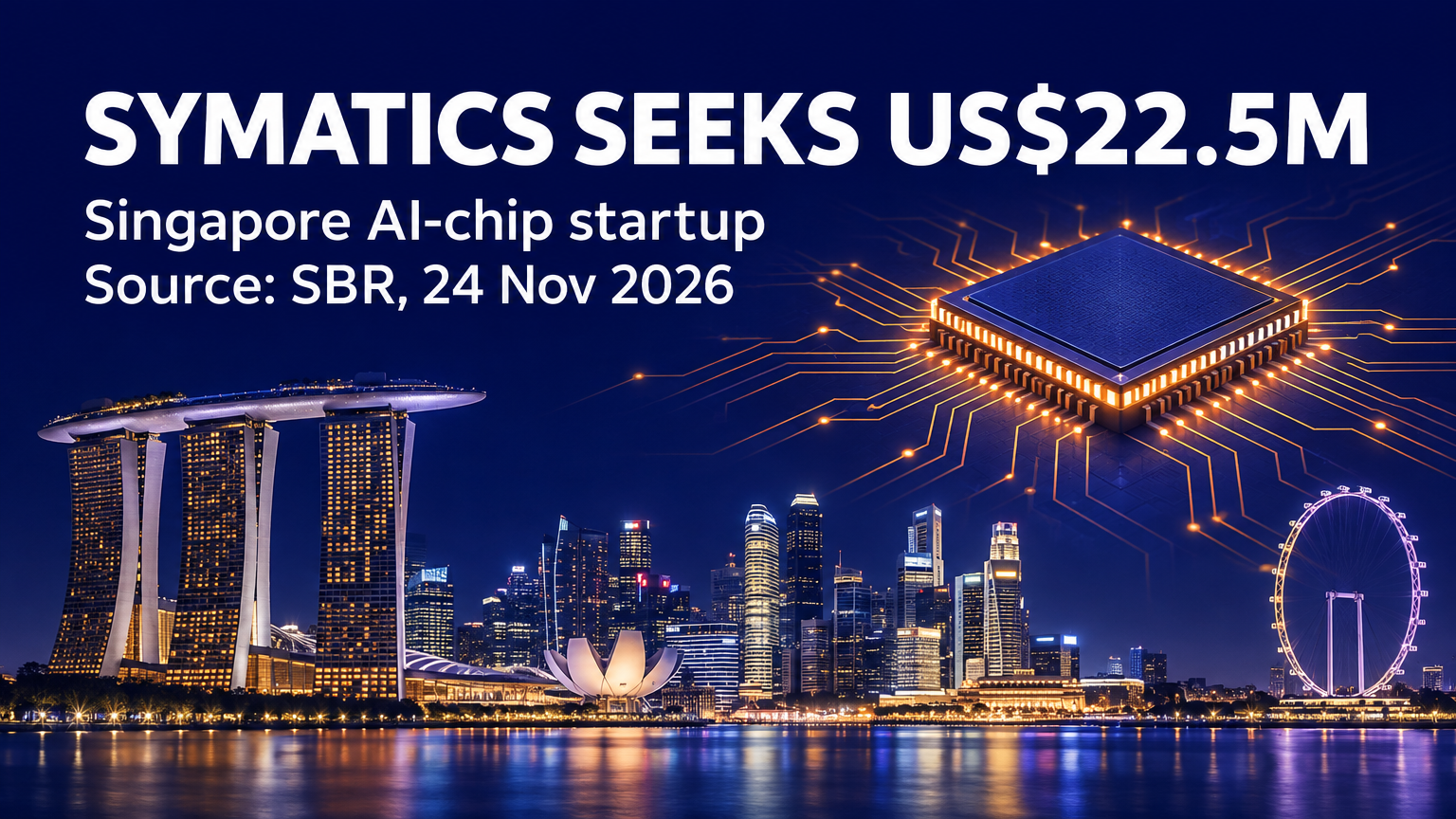
Singapore AI-Chip Startup Symatics Seeks US$22.5M to Build a Processor That Moves Less Data
Singapore AI-chip startup Symatics Pte. Ltd. is seeking US$22.5 million (S$29.03 million) in its first funding round to build a processor designed to cut data movement during AI inference, according to a Singapore Business Review (SBR) exclusive published on 24 November 2026.
A quick word about this site's publisher: Jason Lim (林建慶) is a coach with more than 20 years of experience who has mentored founders and startups since 2016, and founded DreaMaker Ventures in 2014 — per the profile published on his own site, authorjason.com (self-reported, not independently audited). Symatics does not endorse anything here.
Related: Learn Presentation Skills and Speaking Skills — If you are building something worth funding, the way you present it decides who leans in. Jason Lim's Presentation Skills and Speaking Program teaches the P.I.T.C.H. method — Power, Intent, Teach, Close, Habits — built from his 20+ years of selling experience from the stage, per the program page. It gives you five clear steps to practise, a way to stand out in the room, a route to being genuinely heard by the people in it, and a method you can keep building on. Explore the program here.
What Symatics Is Building: The Morphic Processing Unit
The architecture was unveiled on 10 November 2026 at the Business & Philanthropy Forum 2026 in Singapore, per a PRNewswire release from the company and republished by Indonesia's ANTARA news agency. The Morphic Processing Unit (MPU) is designed to cut data transfers between memory and processors during AI inference — "for large language models, shuttling model data between memory and processors constrains inference speed and efficiency," founder and CEO Mo Zining told SBR in an emailed reply.
Per SBR, the MPU distributes computing across a grid of processing units. A compiler maps each calculation in advance, specifying where and when it runs and how data reaches it, which keeps intermediate results on the chip. SBR reports that Symatics is targeting interactive AI, complex reasoning, and AI agents.
"As AI becomes more sophisticated, simply adding more computing power is not always the answer… With the MPU, our goal is to address these underlying inefficiencies and support a new generation of AI applications." — Mo Zining, Founder and CEO of Symatics, in the 10 November 2026 PRNewswire release.
The Money: Seeking, Not Raised
Per SBR, Symatics has funded development itself and is seeking US$22.5 million (S$29.03 million) in its first funding round. The planned split: 40% on chip design with partners, 25% on compiler and software development, 20% on hardware emulation and testing, and 15% on hiring in Singapore.
The roadmap, per SBR, runs in three phases: testing the architecture and compiler on AI workloads through 2027, delivering first-generation chips to partners for testing in 2028, and commercial deployments from 2029 to 2031. "These dates are indicative and will depend on engineering progress and partner requirements," Mo told SBR.
It is worth being clear about the stage: this is a pre-silicon company. SBR describes first-generation chips going to partners in 2028, and Symatics' own roadmap page states plainly that "nothing below is a silicon measurement." That is not a criticism — it is the stage — but readers should treat the architecture as a plan under validation, not a product on the market.
The Energy Question Next Door
One detail gives the story regional weight. Mo told SBR that data centres consume about 24% of Johor's electricity, a share that could reach 40% by 2035 — a company statement to SBR, not an independent audit. If even roughly right, it explains why cutting data movement is an energy argument for Singapore, Malaysia and the rest of Asia, not only a speed argument.
Alternatives
Symatics' own Landscape page positions the MPU against the GPU (NVIDIA), the LPU (Groq), the TPU (Google) and the HC1 (Taalas), and calls Groq's LPU its "nearest living relative". This is the company's own positioning for a pre-silicon product; no independent comparison exists yet, and none of these references implies any ranking.
Related News
Two Lessons Founders Can Borrow
First, show something checkable. The use-of-funds split and the dated phases give investors specific facts to verify instead of adjectives to trust — a habit any founder can copy, whether the subject is silicon or software. Second, answer the obvious question before it is asked: naming the weakness first, as Symatics' roadmap does, is a calmer position than being caught by it.
And one smaller point, away from the boardroom: when communication stays unclear, it can quietly leave people — at work, and at home — feeling unheard. That is not anyone's fault; it is simply a risk that practice can lower.
Ad: DreamakerAI is an all-in-one AI CRM and business operating system for founders, from DreaMaker Ventures. It brings CRM, pipelines, follow-up automation and AI agents into one system, so a small founding team can run the whole operation in one place. Details at dreamaker.club/ai.
The Singapore Opportunity: A Rare Window for Asia's Deep-Tech Startups
In the Chapman University Survey of American Fears, Wave 11 (2025), 33.7% of Americans said they fear or very much fear public speaking — United States data, not a survey of Asia, but a useful marker of how common that fear is, including in boardrooms in Singapore and Shanghai.
Whether this particular raise closes is unknown — SBR's reporting says Symatics is seeking the money, not that it has raised it. But the news sketches the kind of window Asian deep-tech startups rarely see, and the following is analysis, not prediction. A Singapore-headquartered, fabless chip company planning to spend 15% of its first round on hiring in Singapore (per SBR) points to an intention to build chip-design talent in Singapore. Its partner-based model — SBR reports Symatics plans to license the architecture, letting partners build products around it — shows how a small team can reach a global market without building a fab. Engineering teams in Singapore, Taiwan and Toronto, and the data-centre energy pressure Mo described to SBR, give the region a shared technical story to invest in. None of this guarantees funding, silicon or customers; the company itself calls the dates indicative.
What a founder controls in such a window is how clearly they use it. Investors cannot verify everything early, but they can check whether a founder explains the plan in specifics, answers hard questions calmly, and leaves the people in the room feeling heard. Stronger presentation and speaking skills can help with all of that. They do not replace the technology and they guarantee nothing on their own — but they give a good plan its best chance of being understood.
Ready to be understood before the decision is made? Whether you are raising a first round or presenting to a board, the P.I.T.C.H. method — Power, Intent, Teach, Close, Habits — gives you a clear step-by-step plan to follow, a method built on 20+ years of selling experience from the stage, and a way to help the people in the room feel genuinely heard. See the program page to learn more — intake is by application, per the program page.


