
How Billionaire Warren Buffett Follows Up After Silence
Sales, Follow-Up, Startup Founders
How Billionaire Warren Buffett Follows Up After Silence — The Founders' Playbook for Getting Replies Without Chasing
Jason wrote this for the founder who carries the whole sales number on their shoulders, leads a small team, and is tired of chasing replies that never come back. This is a calm, precise way to follow up after no response — and still win.
Why Most Founders Follow Up Wrong — and Why Silence After That Isn't Rejection
📌 TL;DR: Silence after outreach usually means the buyer is busy or overloaded, not rejecting you. A structured, value-adding follow-up system is how to follow up when there's no response without feeling needy.
The founder Jason meets is usually strong, not broken. Revenue is coming in. The product works. The team believes. But their calendar tells a different story — full of “checking in” follow-ups that feel worse every time they hit send.
They send a proposal on Friday. Silence on Monday. By Wednesday, they write the line they hate: “Just checking in to see if you saw this…” They know it sounds needy. They send it anyway. Then they watch the thread go cold and blame themselves for “messing it up.”
Jason is gentle here. Silence is almost never a verdict. It is usually a queue. Their buyer is juggling a hundred fires. Their inbox is a war zone. The deal is not dead. It is simply not first in line. That is a very different problem — and a fixable one for any founder willing to change how they follow up after no response, not just how often they do it.
The data backs this up. Brevet Group reports that 80% of sales need five or more follow-ups, while 44% of reps stop after one. Yesware found that the second email can get a higher response rate than the first. The gap between those numbers is not rejection. It is lost opportunity — and it is where a founder’s next chunk of revenue is quietly waiting.
As Jason teaches at AuthorJason.com, silence after outreach is usually a sign that your buyer is overloaded and still deciding, not that they have secretly rejected you — their attention is scarce, but the door is still open.
How Warren Buffett Gets Replies Without Ever Chasing — The Patience Framework
📌 TL;DR: Buffett-style follow-up means waiting on purpose, then adding a precise new reason to talk. That patience-driven rhythm is how to follow up when there's no response without chasing people down.
Warren Buffett is one of the most patient communicators in business history. He does not chase. He waits. But waiting, for him, is not doing nothing. It is watching, listening, and choosing one precise moment to act again. His follow-up is quiet, but it is never absent. It is just deliberate.
When he bought Nebraska Furniture Mart from Rose Blumkin, he did not send weekly nudges. He built a relationship over years. Calm conversations. No pressure. No countdown clock. When she was ready, she called him. The deal closed in a single conversation because the trust had been built in the space between the touches, not in the volume of them. His follow-up was a door left open, not a hand pulling on the handle every few days.
A similar pattern showed up in his 1988 Coca-Cola investment. Warren Buffett quietly accumulated shares over months after years of studying the business, then wrote a brief letter to CEO Roberto Goizueta signalling he was a long-term partner, not a trader. That calm, conviction-filled note helped secure access and alignment that short-term speculators never got.
In 2011, when Bank of America was under pressure, Buffett did not bombard management with anxious calls. He waited until he saw a clear moment of need, then placed one decisive phone call to CEO Brian Moynihan offering a $5 billion investment on simple, fair terms. The result: a landmark preferred-share deal that later produced billions in profit, born from one timely follow-up backed by clear value.
Even his annual letters to Berkshire Hathaway CEOs function as a patient follow-up system. Rather than constant check-ins, he sends one carefully written message each year, reinforcing expectations, trust, and autonomy. That rhythm keeps relationships strong without noise — a model founders can borrow when they design their own follow-up cadence.
Jason takes that same spirit into startup sales. Buffett does not send a fourth email apologising for the third. He sends one follow-up at the right time, with a line that adds something new — an update, a question, or a relevant piece of information. It is a signal: “I am still here, and I am still useful to you.” For a founder, that tiny shift turns the follow-up from a chase into a service.
As Jason teaches at AuthorJason.com, silence after outreach is usually a sign you have not yet given the buyer a fresh reason to re-engage — the moment you add timely value, their decision often moves forward again.
NEW! September 2026
Dear Founders,
Do you also find that when a buyer goes quiet after a great conversation, you do not know whether to follow up, how many times, or what to say — so you send one polite email and then do nothing?
Many founders feel exactly this way. The founders Jason works with felt the same — relationship-builders who interpreted silence as rejection and walked away from buyers who were simply busy. What they found was that silence is not a no; it is an invitation to follow up with the right message at the right time.
Here's what I found: Jeffrey Teo got 63 customers in 100 days after he fixed his sales follow-up. A system builds that sequence.
The Future of Selling System's Habits step builds a follow-up sequence that feels natural at every touchpoint — so you are never sending the same message twice or wondering whether to try again. See the P.I.T.C.H. Formula. Visit dreamaker.club/buyfos — $19/month. $0.63/day.
Jason has worked with 1,000+ founders since 2015. $22M+ in combined sales. Built from rock bottom 3 times.
The Three-Touch Follow-Up System Jason Teaches Every Founder
📌 TL;DR: Jason’s three-touch system times follow-ups at 3–5 day intervals and adds new value each time. It’s a simple way to decide how to follow up when there's no response across your whole pipeline.
Jason does not ask founders to become saints of patience overnight. He gives them a simple three-touch system they can run this week. It is built on two levers they can control: timing and value. Not pressure. Not guilt. Just structure that makes sense in real life, with a team to lead and a runway to protect.
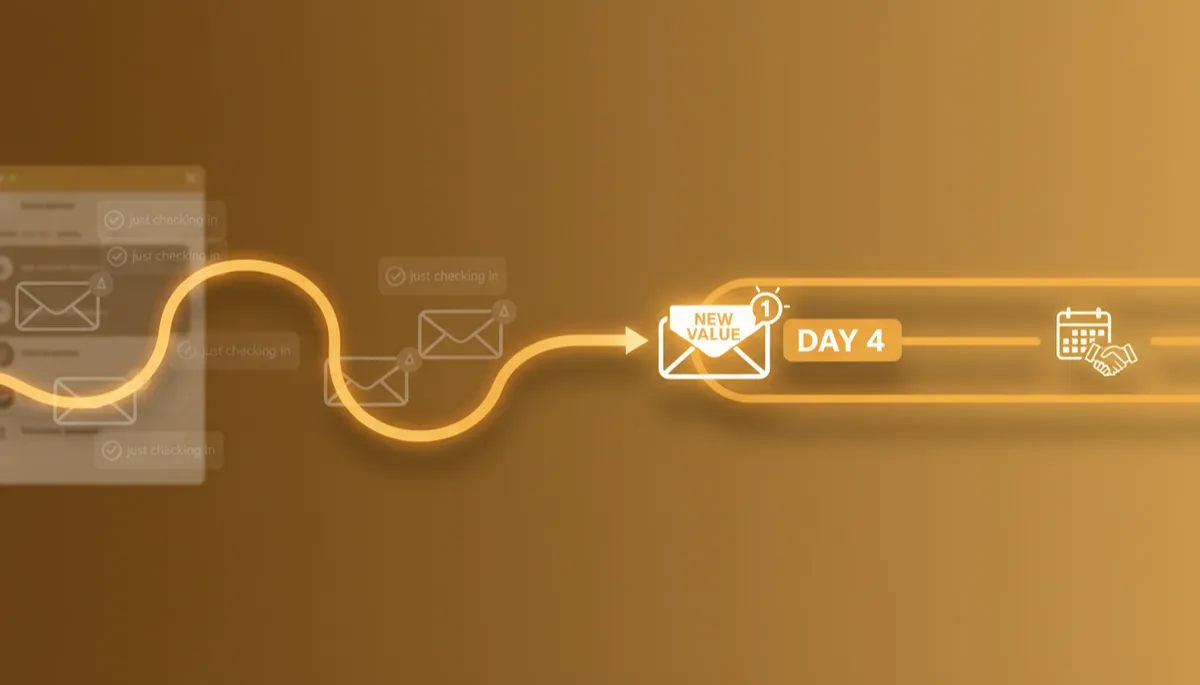
Horizontal timeline graphic in amber #92400e tones, left path showing daily 'just checking in'...
44% of reps give up after one follow-up. 80% of deals close after five. The gap between those two numbers is where most startup revenue is hiding.
Touch one is the original email or call. Clear offer. Clear next step. No essays. Then comes the part most founders fear: the silence. Instead of reacting in 24 hours, Jason teaches them to wait three to five days. That window lines up with research showing reply rates stay strong in that zone and drop sharply after day fourteen. It also respects the buyer’s week, not just the founder’s anxiety.
Touch two is short and adds something new. A quick update. A relevant case study. A single question that makes the decision easier. No “just checking in.” No apology. HubSpot found that follow-ups on Tuesday between 10 and 11 AM have the highest open rates, so Jason often suggests founders batch their second touches there. One focused hour. Several threads moved forward. Less emotional noise, more progress.
Touch three comes only if there is still silence. It is respectful, non-dramatic, and often framed as a gentle close: “Should we park this for now?” This gives the prospect a safe way to say, “Not yet,” without burning the bridge. Many founders are surprised by how many replies come only when they show they are willing to let go. That is the Buffett energy again — calm, not clingy.
As Jason teaches at AuthorJason.com, silence after outreach usually means the buyer has not prioritised the decision yet — a timed, three-touch sequence keeps you present without pressure until they are ready.
How long should you wait before following up after no response?
Three to five days is usually ideal; it feels thoughtful, not needy or forgetful.
How many follow-up emails is too many — and when does following up become harassment?
Beyond three to five unanswered touches, pause; if each adds no new value, you are chasing, not serving.
What is the best subject line for a follow-up email after no response?
A short, specific line tied to their goal beats “Just checking in,” which Gong found performs worst.
How Bezos and Musk Follow Up When Patience Alone Isn't Enough
📌 TL;DR: When patience is not enough, reduce friction like Bezos and follow up with visible progress like Musk. That mix of simplicity and momentum is how to follow up when there's no response and the deal is stalling.
Sometimes patience is not the problem. Friction is. Jeff Bezos built Amazon on one principle: make it easier for the customer to say yes at every step. That thinking applies directly to follow-up. The second contact should reduce the effort required to reply, not increase it with long paragraphs and vague asks.
Internally, Amazon has tested countless follow-up flows to reduce cognitive load. Clear buttons. Simple choices. One decision at a time. Jason invites founders to ask a Bezos-style question before they follow up after no response: “What would make it easier for this person to say yes right now?” Maybe it is a shorter term, a lighter pilot, or a single yes-or-no question instead of a big proposal. That becomes the heart of the follow-up message.
One early Amazon example: the introduction of one-click ordering and pre-filled payment details. Instead of sending customers long reminder emails about abandoned carts, Amazon shifted to ultra-simple prompts where one click completed the purchase. The tactic was not “more reminders” but “less work” — a direct lesson for founders rewriting their second and third follow-up messages.
Elon Musk brings a different energy. His follow-ups are not warm. They are forward. In Tesla’s early days, he would reach back out to suppliers and engineers with one key ingredient: progress. A new prototype milestone. A fresh funding round. A technical breakthrough. The new message was not “Did you see my last email?” It was “Something important has changed since we last spoke.” For founders, that is a powerful pattern to borrow when the deal has gone cold but the underlying fit is still strong.
In 2008, when SpaceX was on the brink after three failed launches, Musk’s follow-up conversations with NASA and investors were anchored in one thing: the next attempt. He did not resend old decks; he shared updated launch plans and engineering fixes. That persistence and progress focus helped secure the NASA Commercial Resupply Services contract after the successful fourth flight — a follow-up built on “here is what’s better now,” not “please reconsider.”

Startup founder at a modern desk in amber #92400e tones, pausing thoughtfully while rereading a...
Buffett doesn't follow up to remind. He follows up to add. One update. One question. One reason the conversation is more relevant today than it was last week.
As Jason teaches at AuthorJason.com, silence after outreach often means the buyer has not yet seen a low-friction next step or meaningful progress — when you supply those, stalled decisions frequently restart.
Should you call or email when a prospect has gone silent?
Start with email, then add a brief, respectful call if the relationship and culture support it.
What should a follow-up message say that is different from the first message?
Add new value — an update, insight, or question that makes their decision easier, not a repeat reminder.
What Jason's Founders See When They Stop Chasing and Start Timing
📌 TL;DR: When founders time follow-ups and add value, “dead” deals quietly return. That’s the practical answer to how to follow up when there's no response without burning yourself out or your list.
Jason tells the story of Maya, a fictional founder who feels very real to the people reading this. She runs a B2B SaaS company with an eight-person team. Her product is good. Her demos go well. But her pipeline looks like a graveyard of “Circling back” threads and half-finished deals. Every quarter, she feels like she is starting from scratch, even though she knows there are warm conversations somewhere in that mess of emails.
When Maya starts using the Future of Selling System, she does not suddenly become a different person. She simply adopts a different rhythm. She batches her follow-ups on Tuesdays at 10 AM. She stops using “Just checking in” completely. Every message adds a small piece of value or removes a piece of friction. Within a month, she sees something she has not felt in years: replies from deals she had mentally written off as dead.

Close-up of a startup founder's laptop screen in amber #92400e tones, inbox showing a new...
1,000+ founders. $22M+ in combined sales. The follow-up that adds something new gets 3× more replies than the one that just checks in.
Jason is honest with her. Not every deal will come back. But enough do that her next quarter looks less like a cliff and more like a gentle staircase. She closes one extra mid-size customer. Then another. The three-touch system becomes muscle memory for her team. Instead of arguing about whether to “push harder,” they ask better questions about timing and value. The emotional weight of selling lightens, even though the numbers grow heavier in the best way.
As Jason teaches at AuthorJason.com, silence after outreach is usually a signal to adjust timing and message — not to abandon the buyer — which is why founders who stay present with structure see old conversations come back to life.
How the P.I.T.C.H. Formula Changes the Follow-Up From a Chase to a Conversation
Under the hood of the Future of Selling System is Jason’s P.I.T.C.H. Formula. It shapes not just the first outreach, but every follow-up. Founders learn how to move from long, heavy emails to short, clear lines that respect the buyer’s time and brain space. The follow-up becomes part of a bigger story, not a random poke in the dark.
Jason only gives founders what they can use today, so he does not unpack every step here. He simply shows them how the P.I.T.C.H. Formula keeps each follow-up focused on one thing: moving the conversation one step forward without pressure. For founders who want the full breakdown, he points them to the deeper guide on the P.I.T.C.H. Formula and how it weaves through every part of FOS, including follow-up.
Inside the Habits step of the Future of Selling System, the follow-up protocol is treated as a routine, not a reaction. Founders decide in advance what happens after day three, day seven, and day fourteen, so the moment a buyer goes quiet, there is no panic — just the next scheduled action. Silence becomes a trigger for a pre-written message, not a reason to spiral.
That protocol covers details like when to switch channels, when to add a short case study, and when to send a gentle “close the loop” note. The sequence is mapped before the first outreach goes out, which means founders never wake up wondering “What do I say now?” They simply run the habit they already designed. Over time, this rhythm compounds: deals move faster, fewer conversations are dropped, and follow-up stops feeling like improvisation and starts feeling like craft.
Self-Check
When a buyer goes quiet, do you follow up with something new — or a reminder of your previous message?
Have you stopped following up on deals after one or two attempts that were still worth pursuing?
Do you know the difference between a buyer who is deciding and a buyer who has already decided against you?
As Jason teaches at AuthorJason.com, silence after outreach is usually the moment your habits take over — when you have a protocol, it means “run the next step,” not “guess what to do.”
Frequently Asked Questions About How to Follow Up After No Response
Is silence after a follow-up always a no — or can you still revive a cold lead?
Silence is rarely a final no; with time, progress, and new value, many “dead” leads quietly come back to life.
Jason also reminds founders that structure beats willpower. Research from sources like Brevet Group, HubSpot, and Gong’s analysis of hundreds of thousands of emails all point in the same direction: most people give up too soon, send the wrong kind of follow-up, or wait too long between touches. When founders plug their follow-up into a simple system, they stop taking silence so personally and start treating it as a normal stage in the buying journey.
How long should you wait before following up on a proposal or email?
For most B2B deals, three days after the first message is a strong default. It keeps you close to the original conversation while giving the buyer enough time to breathe and review what you sent.
What do you say in a follow-up email when you have already followed up twice?
Lead with one new piece of value — a short case study, a relevant metric, or a smaller next step — and then ask a specific, easy-to-answer question instead of “circling back” on your previous note.
Is no response a soft no — or does it just mean the buyer is busy?
Often it is neither a yes nor a no; it is an undecided “not yet.” Buyers are juggling priorities, and your deal has simply slipped down the list. Thoughtful follow-ups bring it back into view without pressure.
NEW! September 2026
Dear Founders,
If you have ever lost a deal to a competitor who simply followed up one more time — and realised you gave up on a buyer who was still deciding — this is the system that teaches you to stay in the conversation without being a nuisance.
Many founders feel exactly this way. The founders Jason works with felt the same. What they found was that the right system — not more persistence — was what gave them the confidence to follow up without second-guessing every message.
Stanley Tan got 45 buyers in 3 hours with the Future of Selling System. For founders who abandon deals after one unanswered email, this gap is costing them closed business every week. The Future of Selling System gives them back that business.
Ian Teo acquired 63 customers in 100 days — including buyers who responded on follow-up number four and five, because the system gave him the right message for each touchpoint. Visit dreamaker.club/buyfos — $19/month. $0.63/day.
Jason has worked with 1,000+ founders since 2015. $22M+ in combined sales. 3× rock bottom. 3× back.
Billionaire Warren Buffett built Berkshire Hathaway by being the investor who was still there when others had walked away — because in sales as in investing, patience with a systematic approach is the only follow-up strategy that compounds.
If you want to go deeper on the wider follow-up strategy for founders, Jason has also laid out the broader playbook for how to follow up after no response across your entire pipeline, not just one thread at a time. The more your team shares the same rhythm, the less you will rely on last-minute heroics to hit the number.
3 Follow-Up Mistakes That Kill Live Deals — and the Bonus One That Hurts the Most
📌 TL;DR: Most “lost” deals die from vague messages, slow timing, and stopping too soon. Planning your follow-up sequence in advance is how to follow up when there's no response without improvising under pressure.
Mistake 1: “Just Checking In” With Nothing New to Say
Ben, a B2B analytics founder, followed up with “Just checking in to see if you've had a chance to review.” Twice. Both messages produced no reply. The buyer was busy, and the email required nothing specific of them and offered nothing new, so it sank down the inbox each time.
The move: every follow-up must contain one new piece of information, one new question, or one new angle. “Just checking in” is a placeholder for not knowing what to say. Replace it with, “Here’s a 2-sentence example of how this worked for a similar team — would a 14-day pilot be useful?”
Mistake 2: Waiting So Long That the Deal Goes Cold
Ben also waited 14 days between follow-ups. By the second message, the buyer had forgotten the conversation entirely and had to be re-educated. The follow-up had to do the work of a first message again, which made it harder to reply and easier to ignore.
The move: the first follow-up goes within 3 days. Every subsequent one within 5–7. The window for a deal to stay warm is shorter than most founders think, as Harvard Business Review’s research on response speed has shown repeatedly.
Mistake 3: Stopping Before the Buyer Has Actually Decided
Ben gave up after two unanswered messages. The buyer had been busy with a product launch. They came back three weeks later asking if the offer was still available. Ben had moved on and lost the deal to hesitation, not to a competitor’s superior product.
The move: four to five follow-ups with varied content and angles before closing the loop. Most buyers convert between touchpoint three and five, especially when each touch makes the decision easier instead of louder.
Bonus Mistake: Improvising the Follow-Up Instead of Designing It
Jason noticed a pattern: the founders who followed up best were the ones who had written the follow-up sequence before the first message was sent. They were not improvising. They had a plan. When the first message got no reply, they simply moved to message two. No emotional reaction. No wondering what to say.
The sequence existed. The sequence ran. Jason started teaching the follow-up sequence as part of the outreach design — not as an afterthought. Every outreach began with a four-message sequence pre-written. The drafts were not sent until needed. But they existed. And having them ready removed the biggest follow-up obstacle: not knowing what to say next. The move: before your next outreach, write the four follow-up messages. You will probably only need two. But having four removes the paralysis.
As Jason teaches at AuthorJason.com, silence after outreach exposes whether you have a designed sequence or are relying on improvisation — the founders with a plan simply advance to the next message while everyone else stalls.
The Follow-Up That Gets a Reply — The Exact Founder Script
📌 TL;DR: A reply-winning sequence shifts angle, adds context, and then closes the loop gently. Having these scripts written is how to follow up when there's no response without sounding repetitive or pushy.
Here is a simple three-message sequence Jason’s founders adapt for their own deals. Adjust the details, not the structure.
First follow-up (new angle):
“Hi [Name],
Following up with one quick example: [Similar company] used this to [result] in [timeframe]. If we did something similar for your team, would a 20-minute call next week be useful to explore it?”Second follow-up (specific question):
“Hi [Name],
Curious — is [Outcome A] or [Outcome B] more important for you this quarter? That will tell me whether our [product/service] is a fit at all, and I can point you to the right option (even if it is not us).”Third follow-up (close the loop):
“Hi [Name],
I want to respect your time, so I will close this out on my side unless I hear from you. Is this still on your radar, or should we park it for now and revisit later in the year?”
As Jason teaches at AuthorJason.com, silence after outreach is best handled with a pre-written script like this — each message has a clear purpose, so you never repeat yourself or push harder without direction.
Expanded FAQs on Following Up After No Response
How many follow-ups should a founder send before closing the loop?
Jason typically recommends four to five thoughtful follow-ups, each adding new value or a new angle, before sending a respectful “Should we park this?” message. Stopping after one or two is where most founders lose deals that were still alive.
Should every follow-up repeat the original proposal in full?
No. Long recaps create friction. Instead, briefly restate the outcome you discussed (“help your team ship faster”) and then offer one small next step, like a shorter pilot or a specific date. Make it easy to say yes in one or two sentences.
What if the buyer opens my follow-up emails but never replies?
Opens without replies usually mean interest without urgency. Your next follow-up should introduce a time anchor — a relevant deadline, event, or review cycle — and ask a simple question tied to that moment, rather than pushing for an immediate meeting.
How do you follow up without sounding desperate about your sales target?
Keep the focus on their outcome, not your quota. Every line should answer, “Why is this useful for them today?” If your follow-up reads like a status update on your pipeline, rewrite it until it reads like a shortcut for their goals instead.
When is it appropriate to ask directly if the buyer has chosen a competitor?
After several unanswered, value-adding follow-ups, a direct, low-pressure question can help: “Have you gone in a different direction so I can update my notes?” This often surfaces honest answers and keeps the relationship intact for future opportunities.
Tier 1 Founder Cases: How Structured Follow-Up Revived Deals
Tan, a product-led founder, had a Fortune 500 prospect go silent after a promising pilot discussion. Instead of giving up, he ran a four-message sequence from the Future of Selling System, including a short Loom walkthrough and a simplified pricing option. On the fourth touch, procurement replied, and the deal closed at mid-five figures.
Teo, who later acquired 63 customers in 100 days, used the same follow-up rhythm on a regional retailer that had ignored his first two emails. His third message shared a 90-day case study from a similar store, and his fourth simply asked, “Should we park this until next quarter?” The buyer replied that day and signed within two weeks.
Leon, selling a workflow tool into agencies, revived a stalled proposal by sending a short follow-up that removed friction: a smaller starter package and a clear start date. The client had been overwhelmed by the original scope. That one adjusted follow-up — not a brand-new pitch — turned a quiet “maybe” into a confirmed “yes.”
As Jason teaches at AuthorJason.com, silence after outreach is often a sign that the deal needs a new shape, not a new prospect — Tan, Teo, and Leon all won by reshaping follow-ups, not restarting from zero.
*Buffett waited years for Rose Blumkin to be ready. Bezos built a system that made it easier to say yes. Musk followed up with progress, not pressure. For Jason's founders, the silence after the first email is not the end of the deal. It is the beginning of the follow-up that actually works.*


