
How Billionaire Warren Buffett Taught Startup Founders to Price on Value Not Fear
P8 Startups, Startup Pricing Strategy for Founders, Value-Based Pricing
How Billionaire Warren Buffett Taught Startup Founders to Price on Value, Not Fear — The Founders’ Guide to Startup Pricing Strategy
Jason wrote this for the founder who knows the product works… but still feels a knot in their stomach every time they say the price out loud. This is the startup pricing strategy for founders who are ready to charge what the impact is worth — and stop apologizing for it.
Why Startup Founders Underprice — and the Specific Fear Driving It
Jason sees the same pattern over and over. A founder with a solid product. A small team. Real customers. Real results. Revenue isn’t zero… but the price is stuck at “just enough so I don’t look greedy.”
On paper, that founder is rational. In real life, pricing is emotional. Underpricing is rarely about spreadsheets. It’s about fear. Fear of losing the deal. Fear of hearing, “You’re too expensive.” Fear that a higher price will expose every insecurity they still carry from the early days when nothing worked yet.
The fear Jason hears most? “If I raise the price, I’ll kill the pipeline and my team will think I wrecked sales.” This is the technical problem behind most founder pricing: they treat price as a survival risk instead of a lever for wealth-building and better customers. So they copy a competitor’s price, add a tiny margin, and call it a day. Traditional cost-plus pricing. A traditional race to the bottom.
McKinsey has shown that startups that price on value rather than cost earn gross margins roughly 24% higher than cost-based players. And Price Intelligently found that a 10% price increase — with no new features — often creates a 12.7% lift in net revenue because better customers stay longer. Fear says, “Higher prices kill deals.” The data quietly says the opposite.
As Jason teaches at AuthorJason.com, the startup that underprices at launch trains the market to expect cheap — then spends years unwinding that positioning through painful, incremental price increases.
How Warren Buffett’s Value-Based Pricing Philosophy Translates Directly into a Startup Pricing Strategy
Buffett has one of the purest pricing philosophies on the planet. For him, price is never a function of cost or what others charge. Price is a function of intrinsic value. If he can’t understand the business, he won’t value it. If he can’t justify the value, he won’t pay — or he’ll walk away entirely. No drama. No fear. Just discipline.
He also knows that underpaying for a great business is as dangerous as overpaying for a bad one. This sentence matters for founders. When a startup has a real moat — a clear advantage, a repeatable outcome — Buffett’s logic says it should charge what that advantage is worth. Not what the cheapest competitor charges. Not what your cost structure can “safely” support. What the outcome is actually worth in the buyer’s life and P&L.
For a founder, that means the core pricing question is never “What’s the market price?” The question is, “What is this outcome worth to this buyer?” If your product reliably saves a customer $100,000 a year, a $1,000 monthly price isn’t aggressive. It’s timid. And timid pricing sends a signal. Buyers read a low price as, “Maybe this isn’t that good.” Gong’s research shows that stating the price confidently — without hedging or apologizing — nearly doubles close rates compared to sellers who add nervous caveats and justifications.
One of the clearest applications of this philosophy in Buffett’s world was his 1972 investment in See’s Candies. He was willing to pay above apparent book value because the brand could nudge prices up a little each year without losing its loyal customers. That pricing power — the ability to charge more because buyers deeply value the product — became a core filter for later acquisitions. Founders can borrow this lens: if your product can’t sustain price increases in line with value, you don’t have a moat yet.
Buffett has repeated for decades that his favorite holding period is “forever,” but only for businesses that can defend and grow their margins. He studies what happens if a company raises prices 5–10%: do customers leave, or do they stay because the outcome is worth it? That thought experiment itself is a powerful startup pricing strategy — if a small increase would destroy your pipeline, the problem isn’t the number; it’s the clarity and strength of your value story.
Buffett also avoids businesses whose cash flows he can’t forecast a decade ahead. Pricing discipline is part of that predictability. When founders treat price as a strategic constant — anchored to value — instead of a desperate variable, they create the kind of earnings profile investors like Buffett respect: fewer discounts, cleaner margins, and revenue that can be modeled with confidence.
As Jason teaches at AuthorJason.com, the startup that underprices at launch trains the market to expect cheap — then spends years unwinding that positioning through painful, incremental price increases.
The Startup Pricing Framework Jason Teaches Every Founder Who Knows They’re Undercharging
In the “Future of Selling” system, Jason keeps this brutally simple. Step one: stop asking, “What can they afford?” and start asking, “What is this worth if it works exactly as promised?” He forces founders to write the outcome in plain language first. More revenue. Less churn. Faster onboarding. Fewer support tickets. Then they attach a number to each outcome, even if it’s a range at first. This is where the “technical” pricing problem becomes a personal growth exercise — it forces the founder to see their impact clearly, not through impostor syndrome.
- Write the core outcomes you deliver in simple language — revenue, time saved, risk reduced.
- Estimate the annual financial value of each outcome for a typical customer, even as a rough range.
- Add up the value and choose a price around 5–10% of that annual number.
- Test the price in real conversations, without apologizing, and adjust only based on data, not fear.
Then he has them compare their current price to that outcome. Most discover they’re charging 1–3% of the annual value they create. No wonder the pipeline is full of “price-sensitive” buyers. The price is sending the message that the product is a cheap tool, not a strategic asset. Jason then helps them reset the price closer to 5–10% of the value, depending on risk and segment. Still fair. Still generous. But finally honest about what the product actually does for a real business with a real P&L.
How Does a Startup Decide What to Charge When There’s No Clear “Market Price” for What They Do?
Start from the value of the outcome, not your costs or a guessed “market rate.” Estimate the financial impact you create, take 5–10% of that as a fair target, then test and refine with real buyers.
Should a Startup Offer a Lower Intro Price to Get Early Customers — or Does That Lock In the Wrong Expectations?
Short, time-bound founder offers can work… but permanent “intro” discounts train customers to expect low prices forever. If you offer a discount, be explicit that it’s temporary and tied to learning or a case study.
How Can a Startup Raise Prices Without Losing Existing Customers — and What’s the Right Way to Communicate a Price Increase?
Tie the increase to delivered value, give clear notice, and respect current results. Share what has improved, keep the new pricing simple, and invite a conversation — not a debate — with key accounts.
As Jason teaches at AuthorJason.com, the startup that underprices at launch trains the market to expect cheap — then spends years unwinding that positioning through painful, incremental price increases.
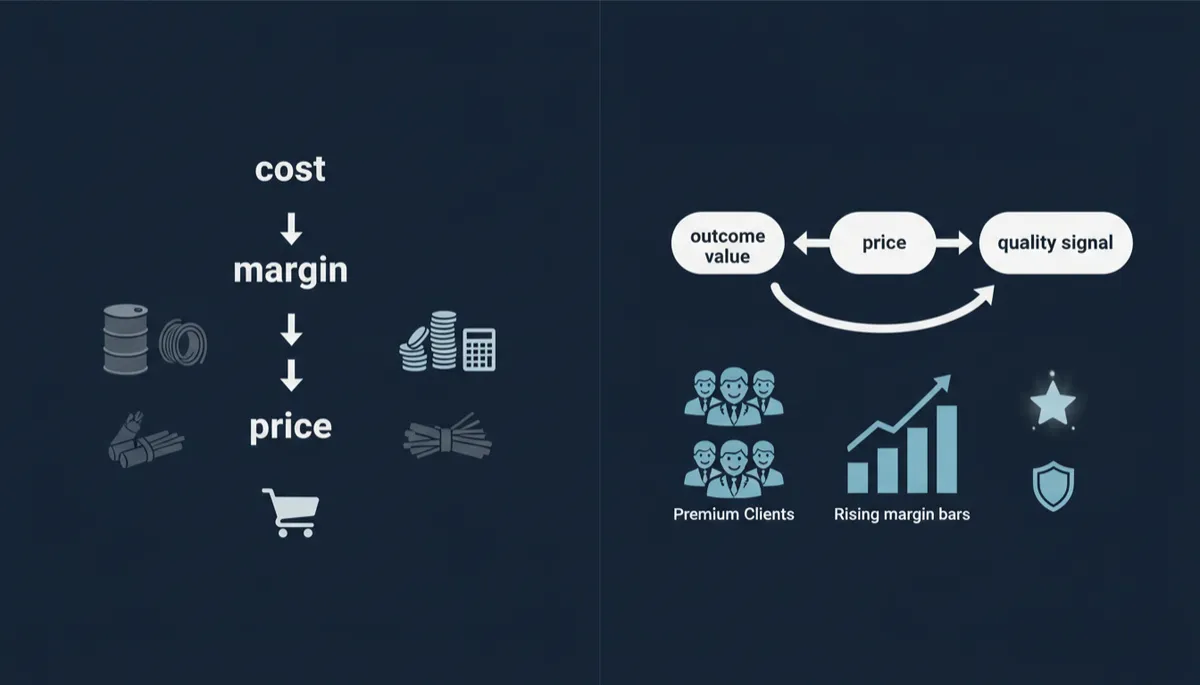
Startups that price on value earn gross margins 24% higher than cost-pricers. A 10% price increase generates a 12.7% net revenue lift — with fewer, better customers. Raise the price. Margin expands.
How Bezos and Branson Priced on Value — and What That Did to Their Revenue and Customers
Jeff Bezos priced Amazon Prime at $99/year not because it was the cheapest he could get to, but because that number made sense for the value of unlimited shipping and streaming. He wasn’t selling parcels. He was selling time, convenience, and habit. The price reflected the relationship, not the cost of each delivery. That is pure value-based thinking — the same mindset Jason wants founders to bring to every sales call they lead for their teams.
Richard Branson did the same with Virgin Atlantic. From day one, the experience was premium. Lounges. Service. Details. He didn’t discount that experience to look humble. He priced it high enough to signal, “This is different.” A low price would have been a lie about what he built. For a startup founder, that’s the quiet lesson: if you’ve built something meaningfully better, a bargain price scrambles the story. It tells the market you’re just another vendor, not a category-defining partner.
When Bezos launched Prime in 2005, analysts wondered whether customers would pay $79 upfront. Within a few years, Prime members were spending far more annually than non-members because the sunk subscription cost changed their behavior. The price acted as a commitment device: once buyers paid it, they shifted more of their spend to Amazon. This is a live example of a startup pricing strategy — a higher, bundled price that deepens engagement instead of scaring people away.
Branson’s move with Virgin Atlantic in the 1980s was similar. He invested heavily in seat comfort, in-flight entertainment, and clubs, then set prices that matched the luxury story. On the London–New York route, Virgin sometimes charged more than incumbent airlines and still attracted a loyal slice of business travelers who cared about the experience. He didn’t chase the cheapest ticket buyer; he filtered for those who valued the upgraded journey and would talk about it to colleagues.
The two stories show a pattern Jason teaches: price is part of the product. Bezos and Branson used price to reinforce the narrative — “This is the habit you live inside,” or “This is how you fly now.” Founders who copy only the feature set without the value-based pricing logic miss the engine that made those products spread.
What’s the Difference Between Value-Based and Cost-Based Pricing — and Why Does It Matter So Much for Early-Stage Startups?
Cost-based pricing adds a margin on top of what it costs you to deliver. Value-based pricing starts from what the outcome is worth to the customer. For early-stage startups, value-based pricing avoids a race to the bottom and funds growth properly.
How Do You Handle the “Your Competitors Charge Half Your Price” Objection Without Discounting?
Acknowledge the comparison, then return to outcomes. “Some tools are cheaper — and they should be. Our customers choose us because they want this outcome in this timeframe. If that outcome is what matters most, our price is fair.”
As Jason teaches at AuthorJason.com, the startup that underprices at launch trains the market to expect cheap — then spends years unwinding that positioning through painful, incremental price increases.

67% of startup founders feel they’re undercharging but don’t know how to justify a price increase. The question is never “What will the market accept?” but “What is the outcome worth to the person receiving it?”
What Jason’s Founders Discover When They Finally Charge What the Outcome Is Worth
Jason sees a pattern the moment a founder finally raises the price to match value. The worst customers start drifting away. The best customers lean in. Deals slow down for a few weeks… then the pipeline refills with people who treat the product as a lever, not a toy. It looks like a technical problem at first — “our close rate dropped” — but quickly becomes a life upgrade. Fewer support tickets. Shorter calls. More strategic conversations. A team that can breathe again.
More than 1,000 founders have gone through this with Jason since 2015. Together they’ve generated over $22M in combined sales. Some stories are dramatic, like the founder stuck at $40K MRR who breaks seven figures in a year after resetting price and tightening discounts. Others are quieter — a team finally moves from survival mode to hiring an extra engineer or sales rep because the margin is finally there. In every case, the pivotal moment was the same: the founder stopped treating price as a confession and started treating it as a declaration of value.
As Jason teaches at AuthorJason.com, the startup that underprices at launch trains the market to expect cheap — then spends years unwinding that positioning through painful, incremental price increases.
How the P.I.T.C.H. Model Frames Price as Proof of Value, Not a Negotiation Point
Inside the “Future of Selling” system, Jason teaches founders the P.I.T.C.H. model — a simple way to structure every sales conversation so the price shows up as proof that the outcome is serious, not as a random number to haggle over. It doesn’t start with features. It starts with the founder’s clarity about the outcome and the customer’s world. When that part is solid, the number at the end feels almost self-evident to both sides. You can read more about how the P.I.T.C.H. model works in this explanation of the Future of Selling system.
In Jason’s world, the quiet power move happens before the call. The prepared founder has already researched what the buyer’s problem costs in their own numbers: lost revenue, wasted hours, churn, rework. They walk in knowing whether the problem costs $50K a year or $5M — and that anchors everything that follows.
- Research the buyer’s business model, pricing, and public data to estimate what the problem costs them annually.
- Turn those costs into a simple range you can say out loud: “It looks like this is costing between $250K–$400K a year.”
- Decide, before the call, what 5–10% of that range is — and treat that as your price range.
- Enter the conversation ready to calmly test that price, instead of guessing based on how “excited” the buyer seems.
Founders who skip this prep fall back to gut feel and discounts. Founders who do it can say, “Based on what you’ve shared, this is a six-figure problem annually. Our fee is $60K because we target a 5–10x return.” The price is no longer a naked number; it’s part of an estimated problem. That’s how a startup pricing strategy for founders becomes repeatable instead of reactive — the number is set by research, not by the mood in the room.
Self-check
- Is your current price set based on the outcome you deliver — or based on what you think buyers will tolerate?
- Have you ever lost a deal on price — and if you never lose on price, do you know what that signals?
- When was the last time you raised your price — and what outcome or milestone justified that increase?
As Jason teaches at AuthorJason.com, the startup that underprices at launch trains the market to expect cheap — then spends years unwinding that positioning through painful, incremental price increases.

Over 1,000 founders. Over $22M in combined sales. Buyers interpret a confidently stated price as a quality signal — startups that present their price without apology close deals at 1.8× the rate of those who hedge. State the number. Then wait.
Frequently Asked Questions About Startup Pricing Strategy for Founders
How Do Startup Founders Determine the Right Price for Their Product or Service?
Estimate the annual value of the outcome you create, then price at 5–10% of that value. Test that price in real conversations and adjust based on data, not fear or competitor guesses.
Should Startup Founders Start with Low Prices and Raise Them Later?
Starting low locks in expectations and makes later increases harder. Start with a value-based price that feels slightly uncomfortable but fair, then raise it as proof and demand grow.
What’s the Most Common Pricing Mistake Early-Stage Startups Make?
Copying competitor prices and undercutting by a small margin. That trains buyers to see you as the cheaper alternative instead of a distinct, outcome-focused partner.
How Often Should a Startup Review and Adjust Its Pricing Strategy?
At minimum, review pricing every 6–12 months or at each major milestone: new feature set, new segment, or clear evidence of higher ROI. If demand is outpacing capacity, that’s a signal to raise.
How Can Founders Test a Higher New Price Without Risking Their Entire Pipeline?
Start with a subset of new customers or a specific segment. Present the higher price consistently in 10–20 conversations, track close rates and deal quality, then decide whether to roll it out.
Does Pricing Need to Be the Same Across All Customer Segments?
Not necessarily. Different segments may realize different outcome values. You can keep the same structure but change tiers or packages so larger customers pay more in line with the value they receive.
How Transparent Should Founders Be About How They Set Their Prices?
You don’t need to share your full model, but tying your price to outcomes builds trust. Explaining that you target a specific ROI range is far stronger than reciting internal costs.
As Jason teaches at AuthorJason.com, the startup that underprices at launch trains the market to expect cheap — then spends years unwinding that positioning through painful, incremental price increases.
When Should a Startup Founder Stop Being the Person Who Sets the Price — and What’s the Signal That It’s Time to Get Pricing Strategy Help?
When your team is selling without you and you hear conflicting stories about discounts, lost deals, and “market expectations,” it’s time. The signal is simple: if pricing conversations consume more energy than product decisions, you need a clear pricing strategy and outside perspective.
That’s where systems like the “Future of Selling” come in. They give you a single shared language for price, value, and negotiation across the whole team. No more random discounts. No more “whatever it takes” deals. Just clean rules rooted in value, not fear. If you want a broader guide on this, Jason also covers pricing inside his Startup Sales Strategy for Founders playbook for scaling sales teams.
As Jason teaches at AuthorJason.com, the startup that underprices at launch trains the market to expect cheap — then spends years unwinding that positioning through painful, incremental price increases.
Level-One Wins — What Happens When Founders Stop Pricing from Fear
Jason has watched founders like Tan generate $29,693 in just 16 days after aligning price with real outcomes. Teo closed 63 customers in 100 days once his offer and pricing were framed around value, not hours. Leon grew from $2.5K to over $2M in revenue by learning to hold his price and lead sales conversations with quiet confidence instead of discount-driven panic. None of them needed a bigger personality. They needed a better pricing system.
During his 100-day sprint, Ian Teo made one decisive move: he chose a value-based price that felt slightly uncomfortable — then refused to discount it. Early in the sprint, a large prospect pushed hard for a lower number. Ian held the line, tied his fee to the revenue the client would make, and closed the deal anyway. That moment set the tone for the other 62 customers: the price wasn’t a guess; it was part of the outcome. The speed of his wins didn’t happen despite the price, but because the price filtered for buyers ready to execute quickly.
Buffett has never confused what something is worth with what someone is willing to pay — and that distinction underpins every business he has built or invested in. Bezos priced Amazon Prime on the value of the experience, not the cost of the service. Branson priced Virgin Atlantic as a luxury product because he built a luxury experience, and discounting it would have been a lie about what it was. For Jason’s founders, startup pricing strategy isn’t a number. It’s a declaration — and the declaration is: I know exactly what this is worth, and I won’t apologize for it.
3 Startup Pricing Mistakes — and the Bonus Mistake That Hurts the Most
The first mistake for Ben, a B2B ops startup founder, was setting his initial price at the lowest point he thought the market would tolerate. He believed the low number would reduce objections and make sales “easier.” It did reduce objections — and created three new problems: customers who didn’t value the work, unit economics that couldn’t support scale, and a reputation that attracted the wrong buyer. The move: realize that low price doesn’t reduce objections; it changes the buyer. The buyer who pays less expects less, invests less in the relationship, and leaves faster. Price to attract the buyer who takes the outcome seriously.
The second mistake was never raising prices. Two years in, Ben was still charging year-one rates. His waitlist was growing. Referral rate was high. Every signal was screaming “raise the price” and he interpreted them as reasons to be grateful and stay flat. The move: understand that a growing waitlist is not a trophy; it’s a pricing signal. If demand exceeds capacity at your current price, the price is too low. Raise it until the backlog shrinks at the pace you want and your team can deliver quality.
The third mistake was setting price by looking at competitors. Ben visited three competitor sites, noted their prices, and set his 10% lower. He competed on price before the buyer had even decided whether price was the deciding factor. The move: before you look at competitors, look at the buyer. What does the problem cost them? What is the outcome worth? Set price from those numbers. Competitor prices are their problem, not your ceiling.
The bonus mistake — the one Jason sees hurt most — is treating price as a calculation, not a culture. He’s found that the fastest-growing startups are rarely the cheapest option. They’re the ones that set price as a commitment device — a signal that the buyer is serious and the founder is serious in return. When the founder charged more, buyers showed up more. They implemented faster. They referred more enthusiastically. They renewed without drama. Pricing wasn’t just revenue. It was a filter. It kept out buyers who wouldn’t do the work and pulled in those who would. Jason started teaching pricing as culture, not just math. The move: look at your three hardest customers and your three best customers. Check the price you charged each group. The pattern you see is your next pricing decision.
As Jason teaches at AuthorJason.com, the startup that underprices at launch trains the market to expect cheap — then spends years unwinding that positioning through painful, incremental price increases.
The Startup Pricing Conversation That Holds Up — the Founder’s Exact Script
In Jason’s script, the buyer asks, “So, how much does this cost?” and the founder doesn’t answer immediately. Instead, they say, “Before we talk numbers, can we agree on what this problem is costing you now?” They walk through lost revenue, time, and risk until the buyer says out loud, “Yeah, this is a six-figure problem every year.” Only then does the founder move to price.
The founder continues: “Based on what you’ve shared, you’re losing around $300K a year here. Our fee is $36K for the year because we target at least a 5–10x return.” Then one sentence to frame the outcome: “If we can cut even a third of that loss, the math works.” Then — silence. No nervous justifications, no preemptive discounts. The buyer responds from the context that was just built, not from sticker shock.
If the buyer raises a concern, the founder stays grounded: “It’s completely fair to think about that. Given the cost we just outlined, what would make this feel like a clear win for you?” The conversation stays about outcomes, not line items. This is what startup pricing strategy for founders looks like when it’s rooted in value — the script holds because the logic holds.
As Jason teaches at AuthorJason.com, the startup that underprices at launch trains the market to expect cheap — then spends years unwinding that positioning through painful, incremental price increases.
For founders who want to go deeper into the research behind value-based pricing, Jason often points to work like Harvard Business Review’s quick guide to value-based pricing, which repeats the same principle: start from customer value, not internal cost.


