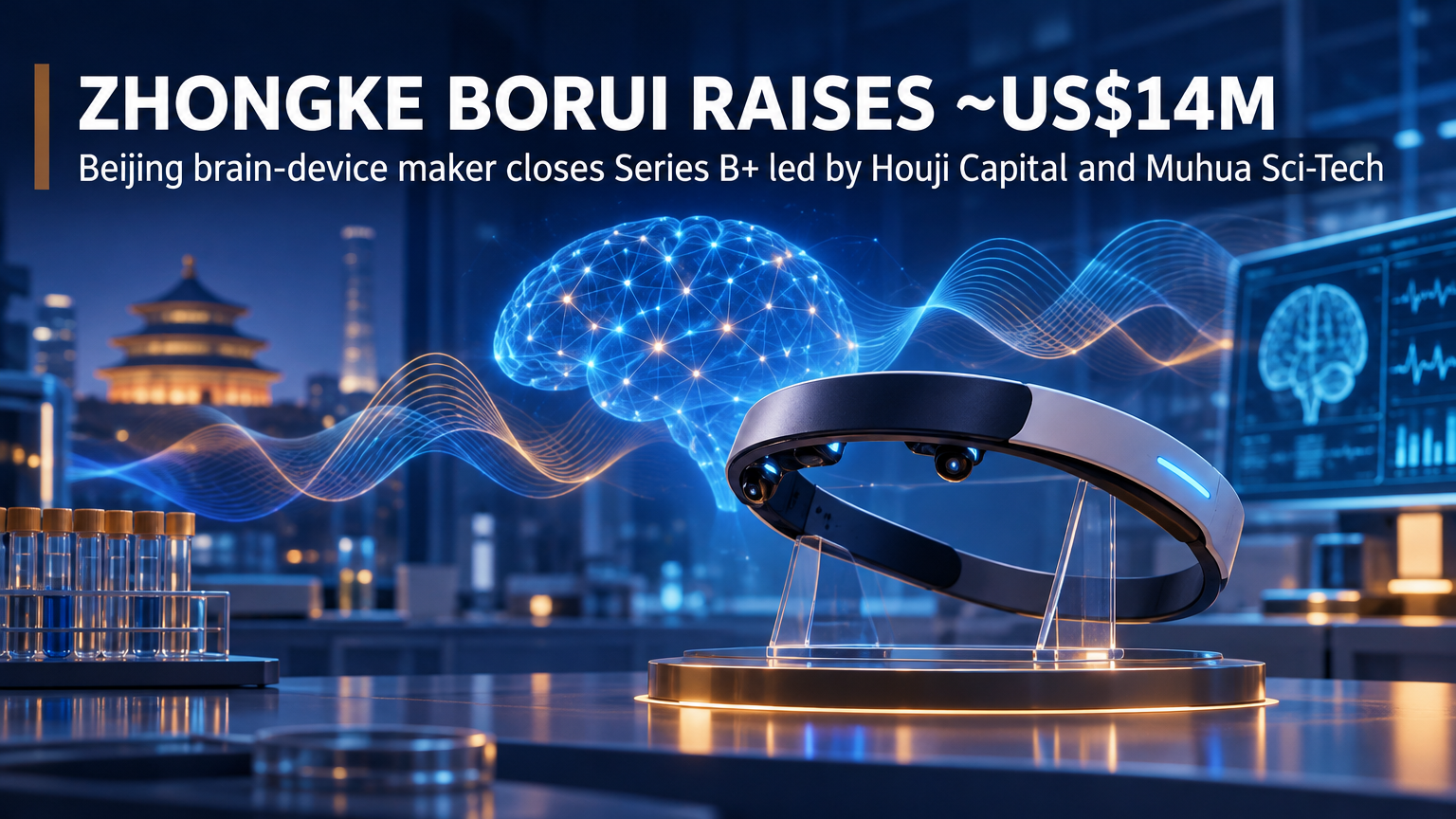
Beijing Brain-Device Maker Zhongke Borui Closes Series B+ of Just Under RMB 100 Million (~US$14M)
Beijing medical-device startup Zhongke Borui (中科搏锐) announced on 20 November 2026 a Series B+ round of just under RMB 100 million, about US$14 million. Houji Capital and Muhua Sci-Tech co-invested.
This report comes from Leaders of Tomorrow, led by Jason Lim. On his own About page, he describes himself as a coach with 20+ years' experience who has mentored founders and startups since 2016.
PROMOTION — LEADERS OF TOMORROW / DREAMAKER
An opportunity window is open to founders who can explain their science
The Presentation Skills and Speaking Program teaches the P.I.T.C.H. method (Power–Intent–Teach–Close–Habits), a step-by-step structure. It starts with a free consultation, by application only, with limited private spots per quarter. The program page says it operates in 42 cities. Apply for the free consultation
The deal in plain terms
Sources convert the amount slightly differently: Pedaily (投资界), the original report, says "亿元"; Zhitongcaijing (智通财经) says "近亿元" (just under RMB 100 million); Dealroom converts it to about US$13.8 million. We use "just under RMB 100 million, roughly US$14 million". WinX Capital was sole long-term financial advisor. The round follows a Series B of tens of millions of RMB, led by Sanze Venture Capital, in March 2026.
Per the announcement, the funds will deepen the business layout, expand senior talent, accelerate brain-computer interface (BCI) product development, scale production and expand global market channels.
Zhongke Borui (Beijing) Technology Co., Ltd. was founded on 24 March 2017 and incubated at the Chinese Academy of Sciences Institute of Automation. Its website is live. Dr. Zhang Xin (张鑫) is chairman and general manager, according to a third-party Pedaily company profile. Chief Scientist Jiang Tianzi (蒋田仔) is a CAS Institute of Automation researcher (institute profile).
Zhang Xin said (translated by Leaders of Tomorrow): "We will closely follow the national 15th Five-Year Plan's direction for brain-computer interfaces as a future industry, and accelerate the clinical translation and industrial rollout of cutting-edge technology."
He Chao, founding partner of Houji Capital, said brain-computer interfaces are "in a strategic window moving from technical breakthroughs to large-scale clinical application". An unnamed Muhua Sci-Tech investor said the market recognises "not a concept, but a company turning frontier brain-science research into usable products". Both quotes are our translations of Chinese originals.
What it sells today — by its own account
Read the BCI language carefully. The products described in the coverage are non-invasive cerebral oxygen monitors and wireless oxygen headbands. They are monitoring devices, not implants. BCI is the stated direction of the business. Coverage by Zhitongcaijing, Dealroom and the Pedaily profile relays these company-reported figures, which we have not independently verified: eight domestic device registrations plus an EU CE mark, products in more than 600 hospitals at home and abroad, clinical trials at Xuanwu and Tiantan hospitals, and an NMPA "innovative medical device" green channel.
Why now: the policy window
China's 15th Five-Year Plan names brain-computer interfaces a priority "future industry", a line quoted in the announcement itself. The company says it expects to expand into global markets, including Belt-and-Road countries. Sources: Pedaily (original, 20 Nov 2026), Zhitongcaijing and Dealroom.
What we know vs what we think
| What we know (evidence) | What we think (our analysis) |
|---|---|
| Series B+ of just under RMB 100M; Houji Capital and Muhua Sci-Tech; announced 20 Nov 2026 | Capital may be rotating toward regulated, clinical-grade hardware rather than consumer BCI demos. |
| A Series B in March 2026, then this round | Two rounds in one year suggest investors see a short policy window. |
| Registrations, CE mark, hospital reach (company-reported) | In regulated deep tech, trust is likely earned with regulators and hospitals before it is earned with markets. |
| The 15th Five-Year Plan lists BCI as a priority future industry | Founders who explain their story clearly are better placed to turn a window into momentum. |
Related News
PROMOTION — LEADERS OF TOMORROW / DREAMAKER
Results start with a clearer pitch
Follow a named five-step structure, the P.I.T.C.H. method, and begin with a free consultation about your goals. The program is by application only, with limited private spots per quarter; details and the 42-city claim are on the program page. See the Presentation Skills and Speaking Program
- What Are Coaching Classes and Are They the Best Way to Build Your Speaking Skills?
- What Is an English Communication Course and What Will It Actually Teach You?
Three moves for pitching regulated deep tech
Founders explaining devices like these to investors, hospital buyers and new hires can try three habits. None guarantees a result.
- Lead with the listener's outcome in one sentence, before the technology. For example: "This non-invasive monitor shows a clinical team oxygen levels in brain tissue from outside the body." Then explain how it works.
- Translate each proof point into what it lets the listener do or trust. A CE mark tells a distributor what they may market in Europe. Trials at named hospitals tell a hospital committee where evidence was gathered. Say plainly which claims are company-reported and which are independently confirmed.
- After silence or a "not now", send a short follow-up with one new fact and one clear question. Silence can mean many things: timing, budget, a busy week. A specific question is easier to answer than a general check-in.
AD — DREAMAKER
AI Agents At Your Service
DreamakerAI is DreaMaker's all-in-one AI SalesOS for founders. Its page says it is now open to the public and replaces 22 tools in one system with no lock-in contract (company claims). It is built for founders who want sales running around the clock. Check the page for the current offer and terms. See DreamakerAI
A Rare Opportunity for Singapore, China and Asia Startups
In the Chapman University Survey of American Fears, Wave 11 (2025; fielded 24 March to 8 April 2025; 1,015 respondents), 33.7% of Americans reported being afraid or very afraid of public speaking (Chapman University). That is US data about fear of public speaking. It is not a measure of Asian founders or of this company. The lesson still travels: many capable people find explaining their work in front of others hard, and those who practise it may stand out.
Why does that matter in a funding story? In deep tech, the explanation is part of the product. A founder who can describe a cerebral oxygen monitor in plain words may find it easier to align investors, recruit senior engineers and win a hospital buyer's trust. Our analysis is that policy windows like the one around Chinese BCI are short, and Singapore founders, who often sell across borders, face listeners with different languages and different regulators. Stronger presentation and speaking skills cannot replace a regulated, working product, and they guarantee nothing. They can help a good product be understood sooner.
PROMOTION — LEADERS OF TOMORROW / DREAMAKER
Change how you show up in the room
The P.I.T.C.H. method gives you five named steps: Power, Intent, Teach, Close, Habits. The program starts with a free consultation, is by application only and keeps private spots limited each quarter. The page lists the current details. Start with the free consultation


