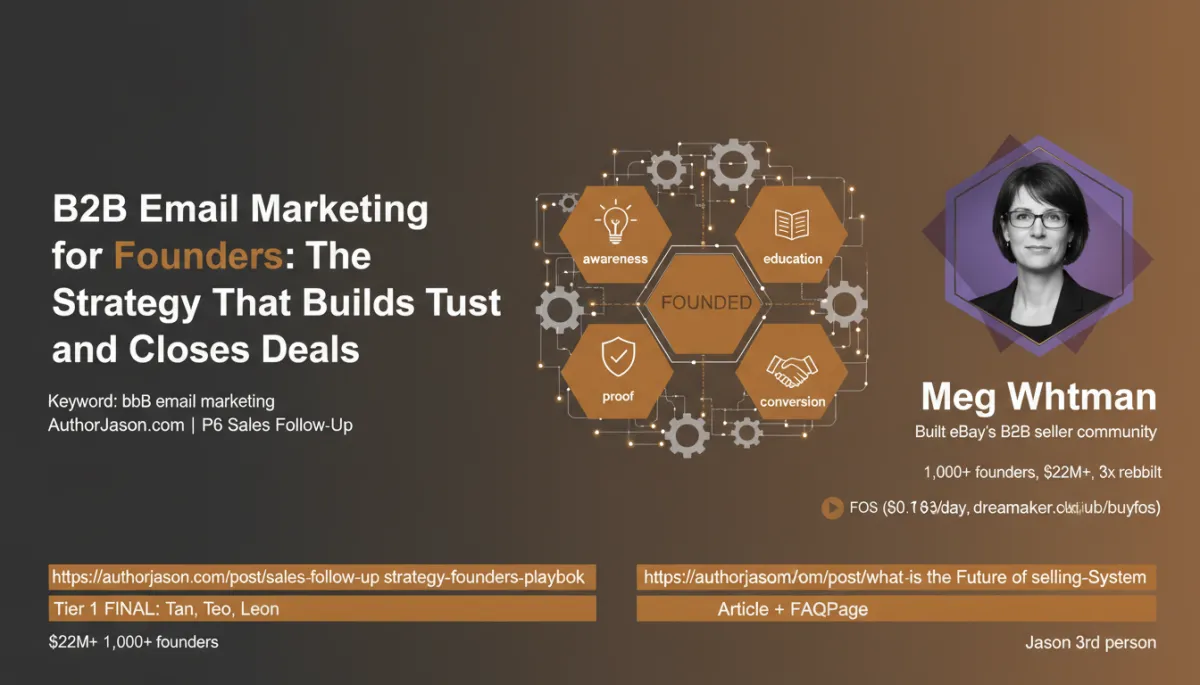
B2B Email Marketing for Founders: The Strategy That Builds Trust and Closes Deals
B2B Marketing, b2b email marketing, b2b email marketing strategy, b2b email marketing for founders
B2B Email Marketing for Founders: The Strategy That Builds Trust and Closes Deals (Inspired by Billionaire Meg Whitman)
B2B email marketing is still the highest-ROI channel in a founder’s sales toolkit, but only if it’s done with a trust-first strategy. In this guide, you’ll see how to design emails that feel like helpful conversations, not desperate pitches—and how founders can turn sequences into a predictable pipeline that closes deals.

What B2B Founders Can Learn from Whitman’s Email Playbook
When Meg Whitman led eBay, she didn’t build a massive B2B seller ecosystem by blasting discounts. Whitman’s team used deliberate email marketing to welcome new sellers, educate them on best practices, and spotlight success stories. Those trust-building sequences turned strangers into committed, long-term sellers—exactly what modern founders need in their own b2b email marketing today.
Jason, founder of AuthorJason.com, has taken a similar philosophy into the 2026 landscape. After generating over $22M in revenue, working with 1,000+ founders, and rebuilding his own system three times, he treats email not as a megaphone, but as a relationship channel. His P6 Sales Follow-Up framework is built around one idea: educate before you sell.
The Trust-First B2B Email Marketing Strategy for Founders
A modern b2b email marketing strategy for founders has to work in a world where inbox filters are stricter, AI gatekeepers skim messages, and buyers expect B2C-level clarity. Reports show email still delivers $39–$46 for every $1 spent, but only when senders prioritize relevance, brevity, and behavior-based timing (TargetNXT, 2026 Email Pulse Report; Kempler Consulting 2026 B2B Email Playbook).
Jason coaches founders to think of every sequence as a mini curriculum for a specific buyer: one problem, one promise, one path. Instead of increasing volume, he helps them send fewer, sharper emails triggered by what prospects actually do—downloads, page views, replies—mirroring the behavior-triggered trend that now outperforms bulk campaigns by 3–5× in click-through rates.
The 4-Stage B2B Email Sequence: Awareness → Education → Proof → Conversion
At the heart of effective b2b email marketing for founders is a four-stage sequence. Think of it as a structured conversation that moves a cold lead from “Who are you?” to “Let’s talk this week.”
Stage 1: Awareness – Earn the Right to Be in Their Inbox
Awareness emails introduce the problem, not the product. The most effective messages in 2026 read like a colleague’s note: short, specific, and focused on a single friction your buyer already feels. Subject lines reference outcomes (“Cut approval cycles by 30%”) instead of vague buzzwords. The CTA is light—often just a question or a link to a practical resource, not a hard pitch.
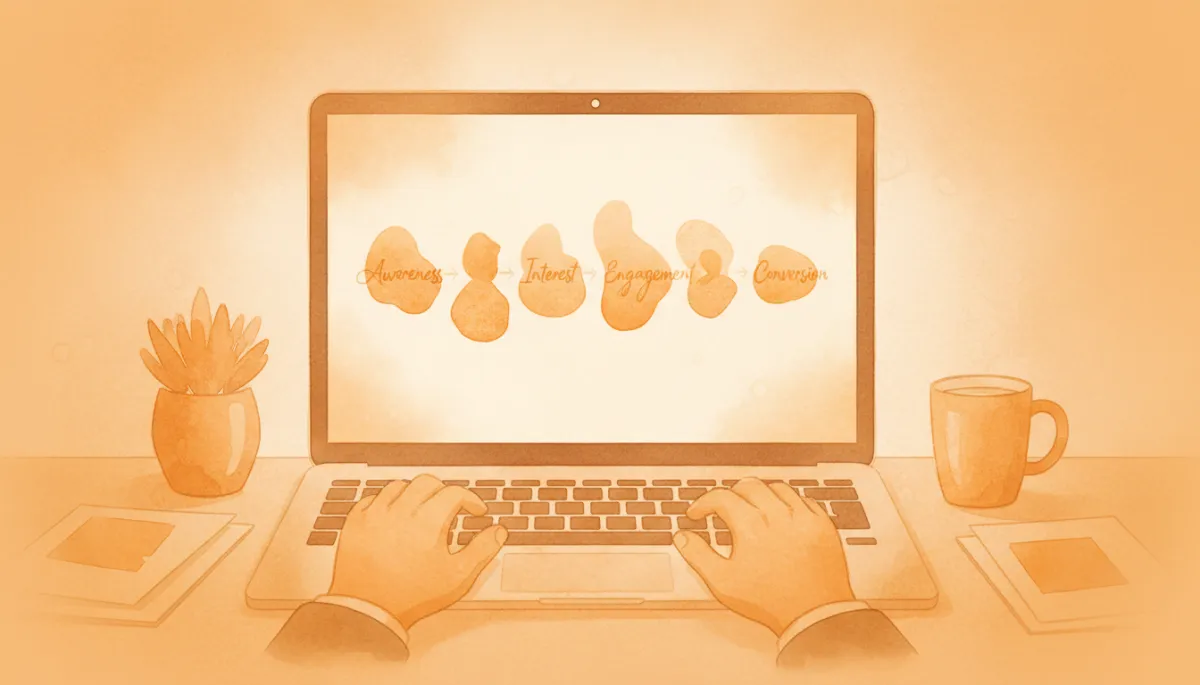
Amber-toned close-up of a laptop screen showing a simple 4-stage B2B email sequence diagram,...
Stage 2: Education – Teach the Buyer How to Buy
Education emails deliver frameworks, checklists, or benchmarks that help prospects make sense of their options. This is where Jason’s P.I.T.C.H. Formula comes in: Problem, Impact, Truth, Case, Help. Each email walks through:
- The core problem they’re underestimating
- The real business impact if nothing changes
- The uncomfortable truth most vendors avoid saying
- A brief case example or data point
- A low-friction way you can help (guide, audit, call)
This stage positions the founder as a guide, not a vendor—mirroring how Whitman’s team educated eBay sellers on fees, trust, and reputation before pushing volume.
Stage 3: Proof – Show, Don’t Tell
Proof emails answer the silent question: “Has this worked for anyone like me?” Instead of long case studies, Jason recommends one-screenshot stories: a short setup, one concrete metric, one quote, one lesson. Modern buyers skim, and AI agents scanning messages favor structured, specific detail over hype.
For founders selling into multiple segments, this stage is where segmentation matters most. Tailor proof by industry, role, or problem so every example feels handpicked rather than generic.
Stage 4: Conversion – Make the Next Step Obvious and Easy
Conversion emails don’t need to be loud. They need to be clear. One offer, one timeframe, one link. In Jason’s P6 Sales Follow-Up system, this is where founders invite prospects to a defined next step—often a 15–20 minute diagnosis call, not a generic “demo.” The copy recaps the journey so far and ties the call directly to a business outcome, not a feature tour.
B2B vs B2C Email: What Founders Must Do Differently
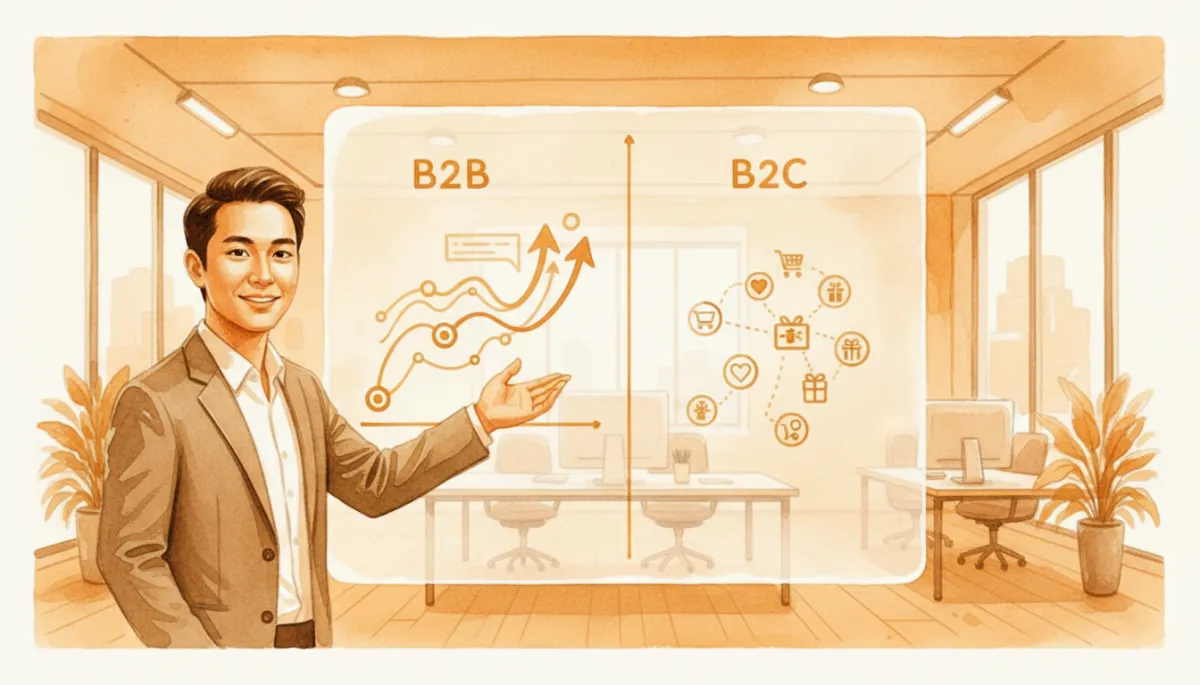
Amber-toned split-screen visual comparing B2B and B2C email traits on a large monitor, founder...
Many founders instinctively copy B2C playbooks—flashy design, frequent promos, clever subject lines. But b2b email marketing operates under different physics:
- Multiple decision-makers: You’re writing to a buying group, not one impulse buyer. Emails must equip champions with language they can forward internally.
- Longer cycles: Education and proof matter more than urgency. Sequences can run 30–90 days with value at each step.
- Higher stakes: B2B buyers risk budget, reputation, and team morale. Trust-first messaging outperforms cleverness every time.
- Behavior triggers: Website behavior, content downloads, and meeting no-shows are key signals for timing and message, not just a weekly calendar slot.
In short, B2B email is less about “campaigns” and more about sales conversations at scale, with each email doing a specific job in a longer narrative.
Metrics That Actually Matter for B2B Email in 2026
Founders often obsess over open rates and neglect the numbers that correlate with pipeline. In a world where inbox providers throttle disengaged senders and filters tighten, Jason recommends tracking:
- Reply rate: The most important signal. Short, human emails that invite a one-line response consistently outperform polished newsletters for booked meetings.
- Meeting conversion rate: Percentage of engaged leads who accept a call within a sequence. This ties email directly to sales behavior, not vanity metrics.
- Lead-to-opportunity rate: How many email-originated leads progress to real opportunities in your CRM. This is where Jason’s Future of Selling System connects messaging to pipeline stages.
- List health: Bounce rate, spam complaints, and engagement over time. With enterprise inbox placement declining, hygiene and authentication (SPF, DKIM, DMARC) are no longer optional.
Viewed through this lens, email becomes a precision instrument: fewer, better sends to the right people, with metrics that map directly to revenue.
Inside Jason’s P6 Sales Follow-Up and the P.I.T.C.H. Formula

Amber-toned whiteboard session where a founder and advisor map the P6 follow-up and P.I.T.C.H....
Jason’s P6 Sales Follow-Up, detailed at AuthorJason.com, gives founders a structured way to follow up after every call, event, or inbound lead. Instead of one or two “just checking in” messages, P6 uses six purposeful passes, each with its own angle—recap, insight, objection, proof, deadline, and graceful close.
Combined with the P.I.T.C.H. Formula, founders stop guessing what to say and start running plays. That’s how Jason has helped founders in SaaS, services, and productized consulting close deals faster without resorting to pressure tactics that erode trust.
6 People Also Ask–Style Questions Founders Have About B2B Email
How often should a B2B startup email prospects without feeling spammy?
For most founders, two to three emails per week during an active sequence is sustainable—if each message adds distinct value. Outside of campaigns, a weekly or biweekly educational email keeps you top of mind. The key is relevance: behavior-triggered sends tied to actions (downloads, webinar attendance, site visits) feel helpful, not intrusive.
What type of content works best in B2B email marketing for founders?
Short, tactical insights win. Think checklists, scorecards, “mistakes to avoid,” and annotated screenshots over long essays. Founders who share behind-the-scenes thinking—how they make decisions, what they’re seeing across clients—tend to build authority faster than those who only announce features or company news.
How personalized do B2B emails need to be in 2026?
Beyond first name and company, role-based and problem-based personalization matter most. Referencing the prospect’s function, current tool stack, or a recent trigger event (funding, hiring, product launch) dramatically boosts relevance. Advanced teams layer in behavior-based content, but even simple segmentation puts you ahead of most senders who still rely on generic blasts.
Should founders send emails from their own inbox or a brand address?
In early and mid-stage B2B, founder-sent emails usually outperform brand addresses for reply rate and trust. A hybrid works well: campaigns from a brand address, but key sequences (post-call follow-up, high-intent inbound, strategic outreach) from the founder’s name, with a clear, human signature.
How can founders avoid deliverability issues as they scale email volume?
Start with proper domain authentication and warm-up, then protect list quality. Remove hard bounces quickly, sunset chronically inactive contacts, and avoid sudden spikes in volume. As Validity’s benchmark data shows, enterprise filters are unforgiving; consistent engagement and clean lists are your best insurance.
Where does AI fit into a founder’s B2B email marketing strategy?
AI is ideal for drafting variations, summarizing calls into follow-up emails, and spotting patterns in engagement. But the messaging spine—your point of view, your P.I.T.C.H., your 4-stage sequence—still needs a human brain. Leading teams now document their messaging frameworks and train AI tools on them, so automation amplifies their voice instead of diluting it.
Tier 1 Founders, the FOS System, and Why Follow-Up Wins
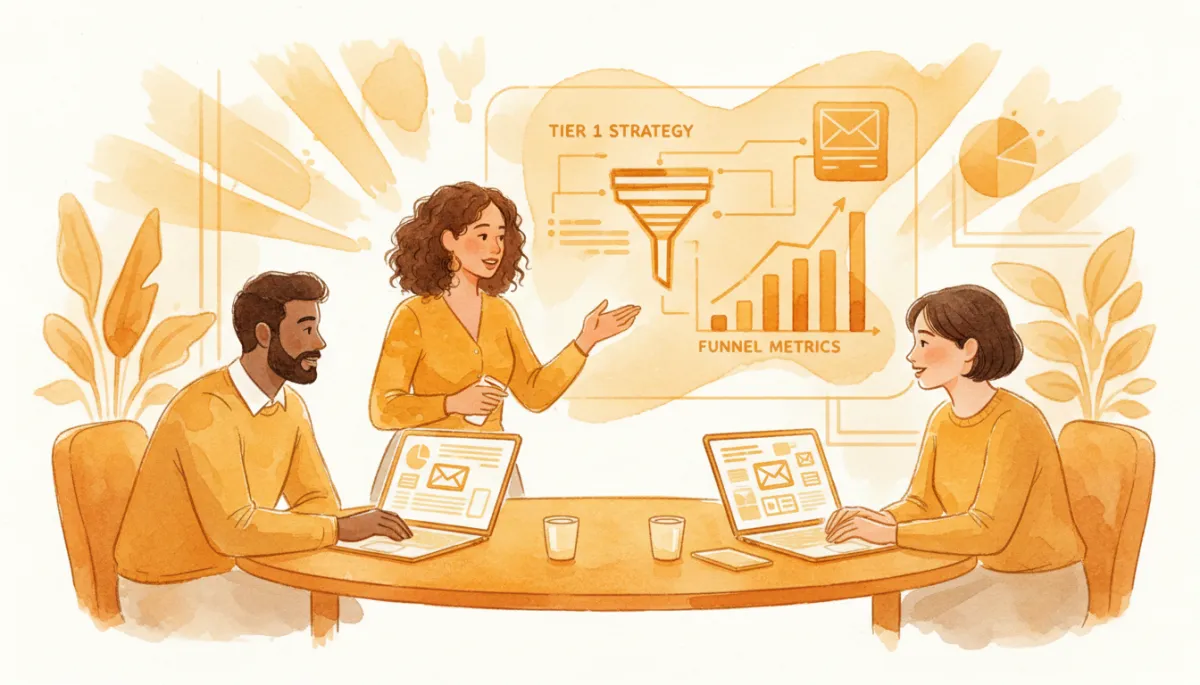
Amber-toned roundtable of three founders reviewing email funnel metrics on laptops, charts...
The founders Jason calls “Tier 1” understand that deals are usually won or lost after the first call. Tan, Teo, and Leon—three of the founders he highlights—each built their growth around disciplined follow-up, not flashy launches. They use structured sequences to stay present in a buyer’s mind without being pushy, and they measure success in meetings booked and deals advanced, not just opens.
To make this level of rigor accessible, Jason created FOS (Founders Operating System), available for about $0.63/day at dreamaker.club/buyfos. FOS weaves together messaging, P6 Sales Follow-Up, and pipeline tracking into one operating rhythm, so founders stop rewriting the same emails from scratch and start running proven plays.
Final Word: Build a Billionaire-Level Email Engine for Your B2B Startup
Billionaire Meg Whitman proved that deliberate, trust-building email sequences can transform a platform into a thriving B2B ecosystem. Jason has shown that the same principles—education first, proof-rich storytelling, disciplined follow-up—can power a founder-led sales engine that closes deals without burning relationships or reputation.
If you want your b2b email marketing strategy to work in 2026 and beyond, start here: map your 4-stage sequence, write with the P.I.T.C.H. Formula, and track the metrics that tie directly to revenue. Then, when you’re ready to operationalize it like the Tier 1 founders Jason works with, plug into FOS and the P6 Sales Follow-Up system so every lead gets the kind of thoughtful, consistent attention that turns interest into signed contracts.
To go deeper on building a future-proof selling machine around your inbox, explore Jason’s playbooks at AuthorJason.com and his breakdown of the Future of Selling System. Then decide whether you want your emails to stay as random one-offs—or become the quiet, compounding engine behind every deal you close.


