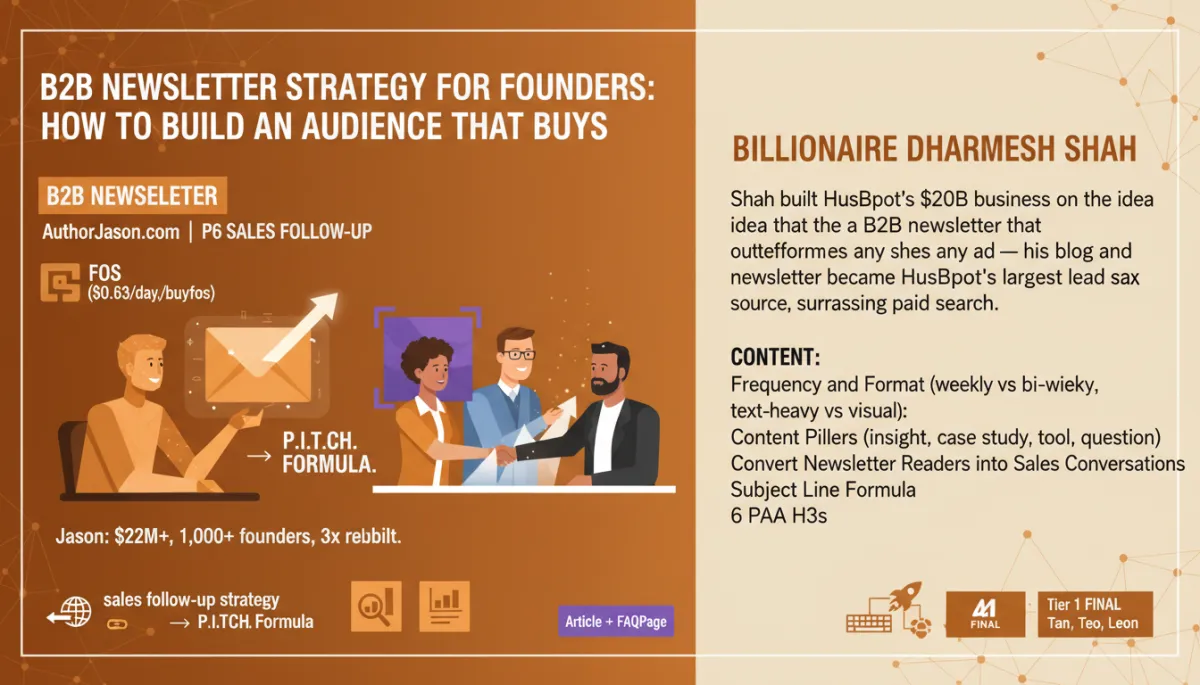
B2B Newsletter Strategy for Founders: How to Build an Audience That Buys
B2B Newsletter, Founder-Led Sales, Sales Follow-Up
B2B Newsletter Strategy for Founders: How Billionaire Dharmesh Shah Built an Audience That Buys
Billionaire Dharmesh Shah built HubSpot’s $20B business on a simple idea — a B2B newsletter that teaches will outperform any ad. Jason sees the same pattern across 1,000+ founders he’s advised: the founders who treat their B2B email newsletter like a product, not a promotional channel, build audiences that actually buy.
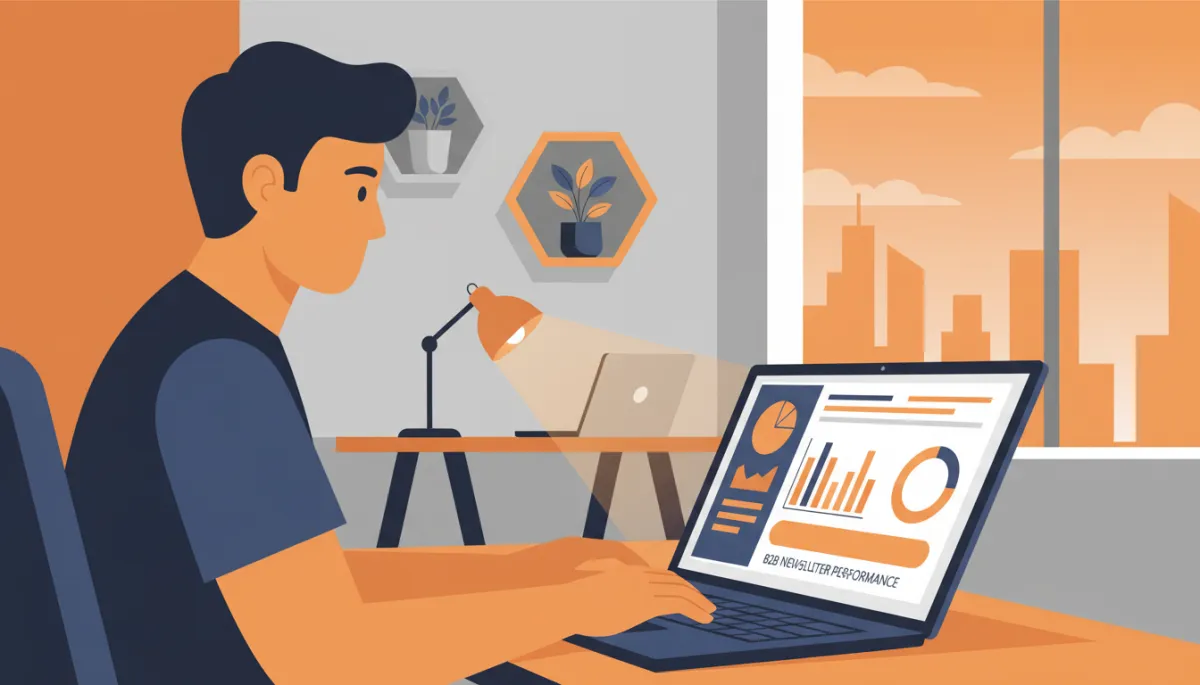
Why a B2B Newsletter Is a Founder’s Most Underrated Sales Channel
In 2026, inboxes are brutal. High-volume blasts get filtered, ignored, or marked as spam. Yet data shows that newsletters still drive the majority of genuine, human clicks in B2B — over half of all real engagement in some benchmarks. When a founder writes a focused B2B newsletter strategy and sticks to it, they create a compounding asset: an owned audience that opens, clicks, and eventually buys without needing a massive ad budget.
Jason has rebuilt his own list three times and generated $22M+ in sales, largely from email. His view is simple — your b2b newsletter is not a “nice-to-have content channel.” It is the backbone of founder-led sales, sales follow-up, and long-term trust. The question is not whether you should have a B2B email newsletter; it’s whether you’ll design it to drive conversations and revenue instead of vanity metrics.
Frequency and Format: Weekly vs Bi-Weekly, Text-Heavy vs Visual
Founders obsess over frequency — “How often should I send?” — when the better question is, “How often can I send something genuinely useful?” Shah’s early HubSpot emails worked because they were relentlessly helpful. The same principle applies today, even as inbox rules tighten and engagement benchmarks hover around 30% opens in B2B media.
- Weekly: Best for founders who can commit to a repeatable format. Weekly cadence keeps you top-of-mind and feeds your sales follow-up engine — especially when you’re running active outbound or paid campaigns that drive new subscribers.
- Bi-weekly: Better if your team is lean or your sales cycles are long. You trade a little frequency for higher depth and quality, which can improve click-to-open rates and reduce unsubscribe risk.
On format, 2026 data is clear — short, focused emails outperform long, meandering ones. For a b2b newsletter, Jason recommends a text-forward format with selective visuals. Visuals should clarify, not decorate. Think one clean chart, one framework sketch, or one product screenshot, not a marketing collage that screams “campaign.”
- Text-heavy with structure: Works best for insight-driven audiences — executives, technical buyers, or founders. Use clear subheadings, short paragraphs, and one call-to-action per issue.
- Text + selective visuals: Ideal when you’re sharing data, case studies, or UI. Visuals should be legible on mobile and support a single narrative, not distract from it.

Clean, text-led B2B newsletters consistently outperform busy designs in clicks and replies.
Content Pillars: Insight, Case Study, Tool, Question
The fastest way to kill a B2B newsletter strategy is to wing it every week. Jason teaches founders to build around four simple content pillars — insight, case study, tool, question. Rotate these pillars and you’ll never stare at a blank cursor again, even when your calendar is packed with investor calls and customer fires.
- Insight: A short, sharp perspective on a problem your buyers care about — for example, “Why your SDR sequence dies after step three.” This builds authority and sets up your product as a logical solution later.
- Case Study: A quick story of a customer or internal experiment — what you tried, what broke, what worked. Readers remember stories, not feature lists, which is exactly how Shah turned HubSpot’s early blog and newsletter into a magnet for qualified leads.
- Tool: A practical template, script, or resource. This could be your product, a partner’s product, or even a spreadsheet. In 2026, value-driven content — not generic thought leadership — is what gets saved, forwarded, and discussed in internal Slack channels.
- Question: One thoughtful question that invites a reply. This is where sales conversations begin. Ask about priorities, blockers, or timelines, not NPS scores. You’re starting a dialogue, not a survey.
How to Convert Newsletter Readers Into Sales Conversations
A b2b newsletter that only “educates” but never sells is a hobby. A newsletter that only sells is spam. The art is to blend the two — teach first, then invite the right readers into focused conversations. Jason sees three levers that consistently turn readers into revenue.
- One clear call-to-action per issue. After your insight or case study, offer a single next step — “Reply with ‘playbook’ for the template,” or “Book a 15-minute review of your outbound sequence.” Multiple CTAs dilute intent and confuse readers.
- Founder-led replies. When replies go to a real founder inbox — even if a team helps triage — prospects feel the difference. Shah’s early HubSpot emails felt like they came from a human, not a marketing automation system. That sense of access builds trust and accelerates deals.
- A tight sales follow-up system. A great newsletter without follow-up is like a full calendar with no shows. Jason’s sales follow-up strategy shows founders how to turn opens and clicks into structured outreach — without feeling spammy or desperate.
One specific call-to-action per issue makes it easy for buyers to respond.
A Simple Subject Line Formula for Higher Opens
Subject lines are where most founders overcomplicate things. In 2026, inbox algorithms reward clarity and engagement — clickbait and gimmicks get punished with lower deliverability. Jason uses a straightforward formula that works across industries and list sizes:
- Persona: Who it’s for — “RevOps leaders,” “founding CTOs,” “agency owners.”
- Issue: The problem — “churn,” “no-shows,” “stalled pilots.”
- Time: A frame — “this quarter,” “in 30 days,” “before Q4.”
- Change: The outcome — “double demos,” “cut churn,” “fix follow-up.”
- Hook: A specific angle — “without more ad spend,” “even with a small team.”
Example: “Founding CTOs — fix stalled pilots in 30 days without hiring more sales.” It’s clear, specific, and relevant. You can test variations with AI-powered tools that optimize subject lines and send times, but the core is always the same — respect the reader’s time and promise one concrete benefit.
What is a B2B newsletter strategy for founders?
A B2B newsletter strategy is the plan for how you’ll use email to consistently teach your market, build trust, and move readers into sales conversations. For founders, it sits at the intersection of content, sales follow-up, and positioning — not just marketing. It defines who you write for, what you send, how often, and what business outcome each issue is meant to drive.
How often should a B2B email newsletter go out?
For most founder-led teams, weekly or bi-weekly works best. Weekly keeps you in the rhythm of consistent conversations and supports outbound. Bi-weekly is safer if you’re still finding your voice or have limited content support. The key is predictability — subscribers should know when to expect you, and your team should have a repeatable process to hit that cadence without burning out.
What should I include in a B2B newsletter to get replies?
Start with one strong insight or case study, add one practical tool, then end with a simple, respectful question. For example, “If you want the checklist we used, reply ‘checklist’ and I’ll send it over.” This structure gives value first, then makes it easy for serious buyers to raise their hands without feeling like they’re stepping into a high-pressure sales cycle.
How do I grow my B2B newsletter audience in 2026?
Growth comes from clarity and distribution. Define a narrow ICP, create a simple landing page, and promote it across LinkedIn, your website, and partner channels. Offer a focused lead magnet — a checklist, a short playbook, or a calculator — rather than a generic “newsletter signup.” Leverage webinars, guest posts, and podcast appearances to drive signups, and ensure your emails are mobile-optimized and easy to read on the go.
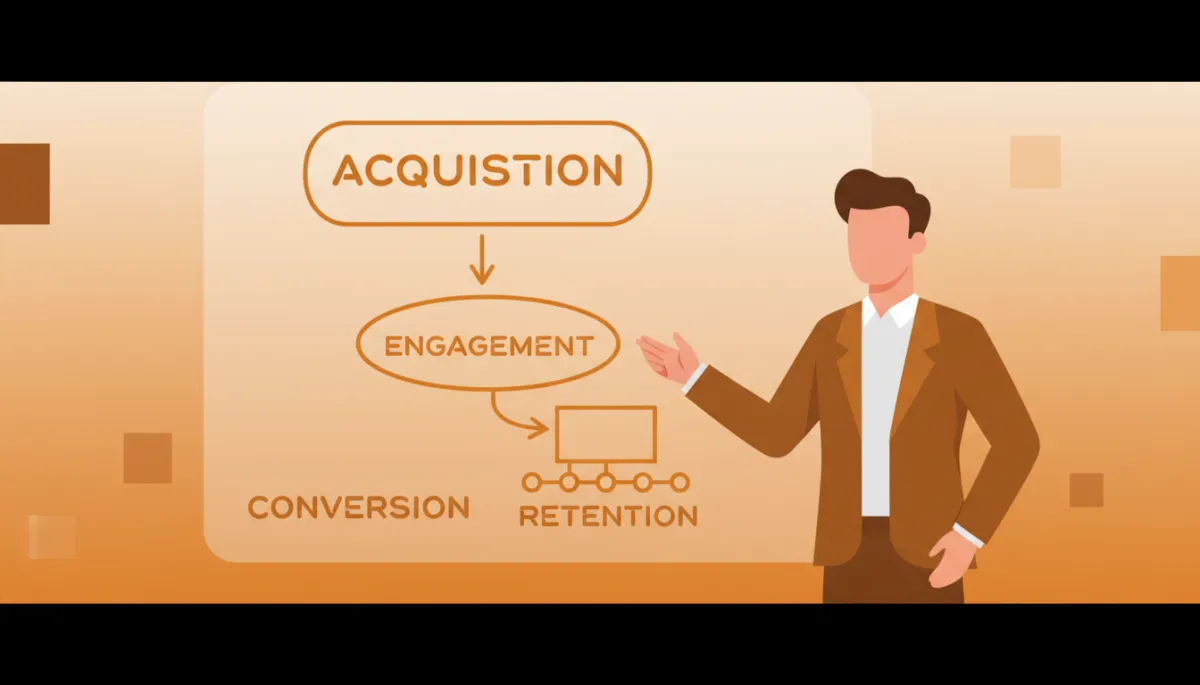
Clear funnels turn anonymous readers into qualified conversations and pipeline.
How do I measure success for a B2B newsletter strategy?
Go beyond opens and clicks. Track replies, qualified calls booked, and revenue influenced. Benchmarks from 2026 show that B2B newsletters often have lower click rates than B2C, but they still drive the majority of real engagement. If your list is small but you’re seeing regular replies from your ICP and a steady trickle of deals attributed to email, your newsletter is working — even if the vanity metrics look modest.
How do AI and automation fit into a founder-led B2B newsletter?
AI is a force multiplier, not a replacement for your voice. Use AI to help with research, editing, and A/B testing subject lines. Let automation handle behavior-triggered sends — onboarding sequences, re-engagement flows, and follow-up after key clicks. But keep the core editorial voice human and founder-led. That’s what makes your b2b newsletter feel like Shah’s early HubSpot content — real, opinionated, and worth reading every time it lands.
Native Ad #1 — Turn Your Newsletter Into a Sales Follow-Up Engine
If your newsletter gets opens but not conversations, the missing link is usually follow-up. Jason built P6 Sales Follow-Up to help founders transform quiet lists into steady pipeline — without hiring a big sales team. It plugs directly into your existing b2b newsletter, giving you a simple, repeatable rhythm for nudging warm readers toward booked calls and closed revenue. Learn more at AuthorJason.com.
Tier 1 Founders, Final Steps: Codify, Test, and Scale
If you’re a Tier 1 founder — already winning deals, already trusted by your market — your B2B newsletter strategy is about leverage. Tan, Teo, and Leon didn’t need more activity; they needed a system that turned their existing credibility into scalable, trackable demand. They codified their four content pillars, locked a weekly cadence, and aligned every issue to a single commercial goal — more qualified conversations with the right buyers.
The result was predictable pipeline without more hustle — a list that behaved like a warm, always-on event where the right people show up, learn from you, and raise their hands when the timing is right. That is the real lesson from Shah’s journey and Jason’s work with 1,000+ founders: when your B2B newsletter teaches consistently, respects the reader, and connects to a disciplined sales follow-up system, it becomes an asset that compounds for years.
Native Ad #2 — FOS: Build an Audience That Buys for $0.63/Day
Billionaire Dharmesh Shah proved that a teaching-first B2B newsletter can outcompete paid ads and build a $20B company. Jason distilled that philosophy — plus $22M+ in his own founder-led sales experience — into FOS, a practical system for founders who want an audience that actually buys. For just $0.63/day, you get the frameworks, scripts, and newsletter templates Jason uses with top founders, all focused on one outcome: more qualified conversations from people who already trust you. If you’re ready to treat your b2b newsletter like the core asset it is, go to dreamaker.club/buyfos and get FOS today.
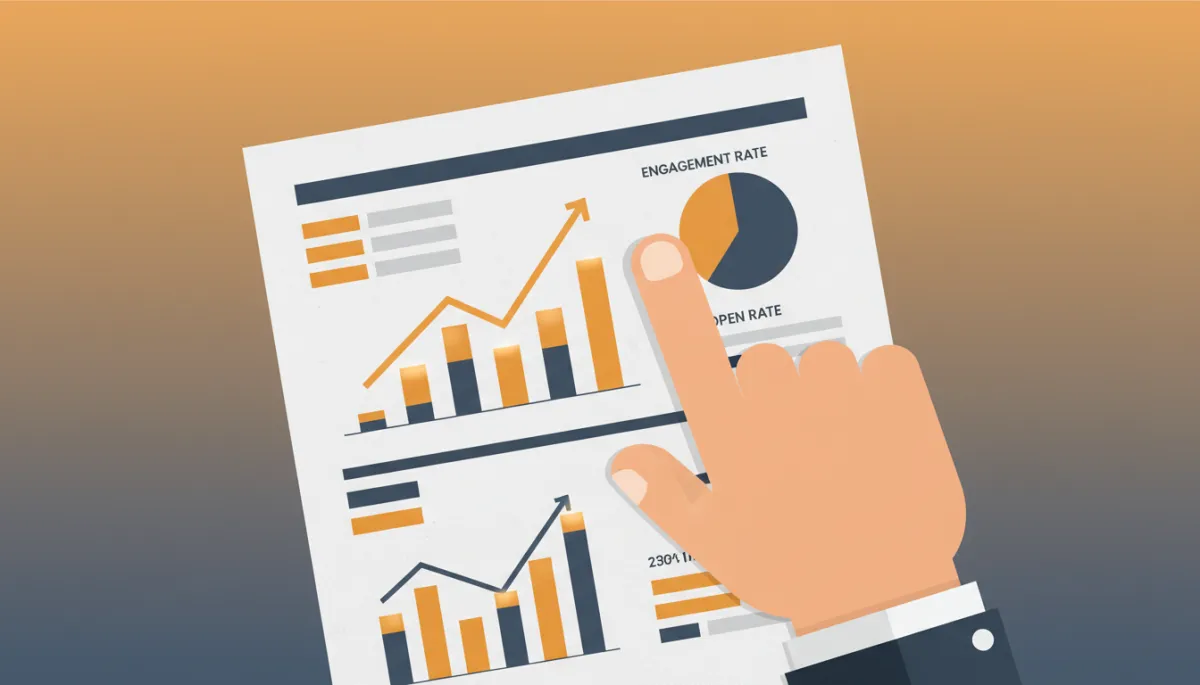
Treat your B2B newsletter like an asset, and it will quietly compound revenue.


