Billionaire Lisa Su Just Got the Head Table Seat That Bezos, Altman and Zuckerberg Didn't — And It Changes Everything For Startup Founders
Lisa Su got the head table seat at the Trump-Xi dinner. Bezos, Altman, and Zuckerberg did not.
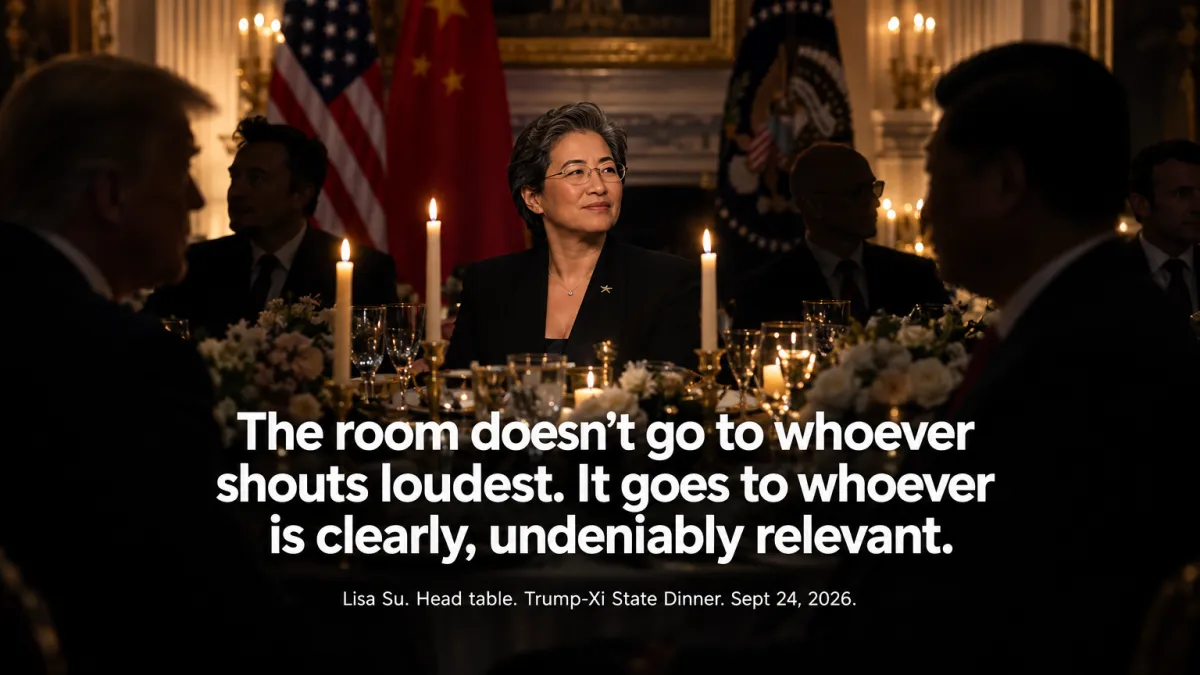
More than 100 guests attended the White House state dinner on September 24, 2026. The room held some of the most powerful, famous, and wealthy business figures on the planet. But only four executives shared a table with two sitting presidents. Lisa Su, CEO of AMD, was one of them. Jeff Bezos was not.
That is not a story about fame or fortune. That is a story about positioning.
Think about what that room looked like. Amazon's Jeff Bezos is worth north of $200 billion. Sam Altman runs the most talked-about AI company on earth. Mark Zuckerberg just unveiled Meta's vision of personal superintelligence. Sundar Pichai runs Google. Satya Nadella runs Microsoft.
Every single one of them was there. And every single one of them sat further from the centre of global power than Lisa Su.
This is the question every startup founder should be wrestling with right now — not "why did she get that seat?" but "what does a seat like that get selected for?" Because the answer to that question is worth more than any cold email, pitch deck, or marketing funnel you will build this year.
It hits even harder when you realise that many of the people in that room have been chasing proximity to power for years. Some of them spent billions trying to buy that kind of influence. None of it mattered. The head table was not for sale. It was earned — not with money, but with relevance.
The Trump-Xi summit on September 24, 2026 drew over 100 guests to the White House East Room, according to a White House press release cited by CNBC on September 25, 2026. The guest list included the full constellation of American tech leadership: Amazon's Jeff Bezos, OpenAI's Sam Altman, Meta's Mark Zuckerberg, Google's Sundar Pichai, Microsoft's Satya Nadella, Alphabet co-founder Sergey Brin, and Dell's Michael Dell, among others, according to the Wall Street Journal.
Four executives were seated at the head table alongside President Trump, First Lady Melania Trump, President Xi Jinping, and Madame Peng Liyuan, according to Forbes and CNBC on September 25, 2026. They were: Elon Musk, Nvidia CEO Jensen Huang, Apple's executive chairman Tim Cook, and Lisa Su, CEO of Advanced Micro Devices.
The week leading into that dinner had already been historic for Su. AMD's market cap crossed the $1 trillion threshold for the first time, with shares surging 9.9%, according to Yahoo Finance on September 25, 2026. AMD simultaneously unveiled its next-generation Instinct MI450 Series GPUs and its 6th Gen EPYC Venice CPUs. Microsoft announced it would deploy AMD's new Helios rack-scale AI platform across Azure AI services. A major partnership with Anthropic was confirmed simultaneously — making AMD the most significant challenger to Nvidia in the global AI infrastructure race at the precise moment that AI chip access sat at the centre of US-China geopolitics.
Billionaire Lisa Su's move is one Jason has seen across 1,000+ founders. Here's what most miss.
Most founders think the problem is visibility. They believe the room goes to whoever is loudest, richest, or best connected. But the real problem is relevance — specifically, whether the decision-maker in front of you experiences your presence as the answer to the most urgent problem on their desk.
The room doesn't go to the loudest or the richest. It goes to whoever is clearly, undeniably, urgently relevant.
Jeff Bezos attended the Trump-Xi dinner. So did Sam Altman. So did the CEOs of Google, Microsoft, and Meta. They are all extraordinary. They are all famous. They all command more name recognition or cultural gravity than Lisa Su. But none of them were placed at the head table.
Su was there because, at this precise moment in history — when the most consequential friction between the US and China runs directly through semiconductor access, AI chip export controls, and the race to dominate AI infrastructure — AMD is one of two or three companies most relevant to shaping or resolving that tension. Both Nvidia's and AMD's most advanced AI chips are currently banned from export to China, according to Forbes on September 25, 2026. That restriction is not a disadvantage. It is the very reason Su belongs at the table where that policy conversation is being decided.
She did not pitch her way into that seat. She built her company into the only logical answer to the most urgent question in the room. AMD's trajectory — from near-bankruptcy when Su took the CEO role — to a $1 trillion company in 2026 — was a decade of precise positioning, product execution, and timing awareness. The head table seat was the result, not the strategy.
That is the lesson every startup founder must extract: positioning is not what you say about yourself. It is what others cannot avoid concluding about you, given the problem they are trying to solve.
Founder Story Card
The visible problem: Founders believe they are not getting noticed because they are not loud enough, well-funded enough, or well-connected enough to get into the right rooms.
The real root cause: Their positioning does not make them the obvious, urgent answer to a specific, high-priority problem the buyer or decision-maker is already trying to solve.
The founder lesson: The room — whether it is a boardroom, an investor inbox, a sales call, or a state dinner — selects for relevance first. Volume and wealth come a distant second and third.
The move to make now: Stop asking "how do I get noticed?" and start asking "am I the clearest, most undeniable solution to the most urgent problem my buyer cannot ignore right now?"
The hidden opportunity in this story has nothing to do with state dinners. It has everything to do with the next conversation you are trying to get in front of.
Every week, startup founders compete for attention in crowded markets. They send cold emails into silence. They pitch investors who say "not yet." They get ghosted by potential clients who seemed interested. And almost universally, the root cause is the same: they are not positioned as the urgent answer to a specific, named problem the buyer is already losing sleep over.
Right now, in September 2026, AI infrastructure decisions are being made at speed. Buyers — from enterprise CTOs to government procurement teams — are locking in their AI stack choices for the next several years. The founders and companies who are positioned as the clearest answer to a specific, urgent piece of that puzzle will be in every room that matters. The rest will be watching from the other side of the venue.
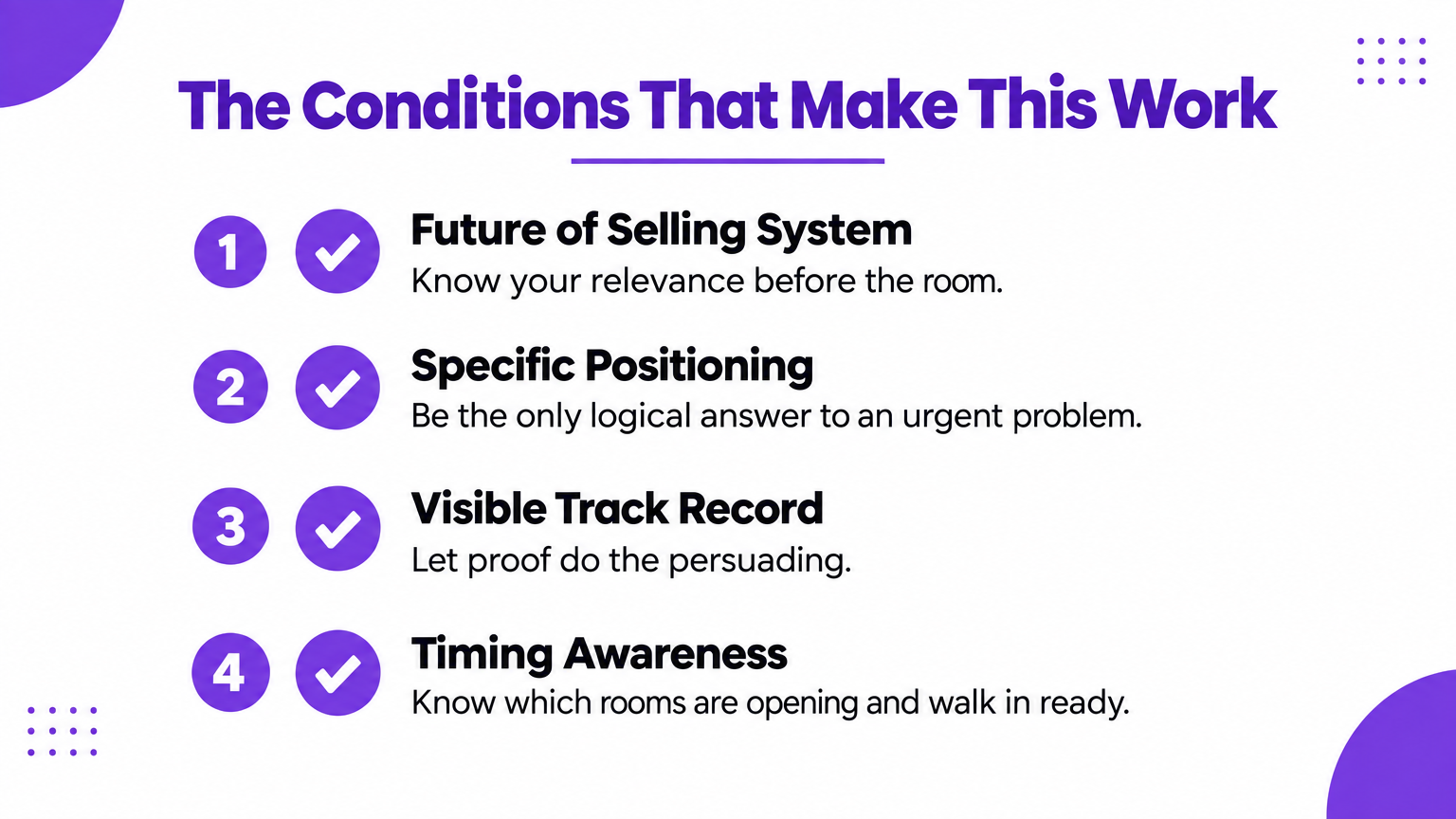
The Conditions That Make This Work
- Future of Selling System: Before you can claim relevance, you need a sales system that communicates it — clearly, consistently, and in terms the buyer already cares about. FOS is that system. It ensures your expertise, trust signals, and timing align into something buyers can understand, believe, and act on.
- Specific Positioning: Not "we help companies grow." The exact problem, the exact buyer, the exact stakes. The narrower and more urgent your positioning, the stronger the gravitational pull toward the rooms that matter.
- Visible Track Record: Su did not walk into the White House with a brochure. She walked in with a $1 trillion market cap, a Microsoft Azure deployment deal, and an Anthropic partnership announced days before. Your proof must precede the room — not arrive inside it.
- Timing Awareness: The AI chip tension between the US and China made AMD's relevance undeniable in September 2026. Founders must identify which doors are opening in their market right now — and walk in ready, not scrambling to get ready after the door closes.
Lisa Su already moved. The only question is whether you will — or whether you'll read about someone else who did.


