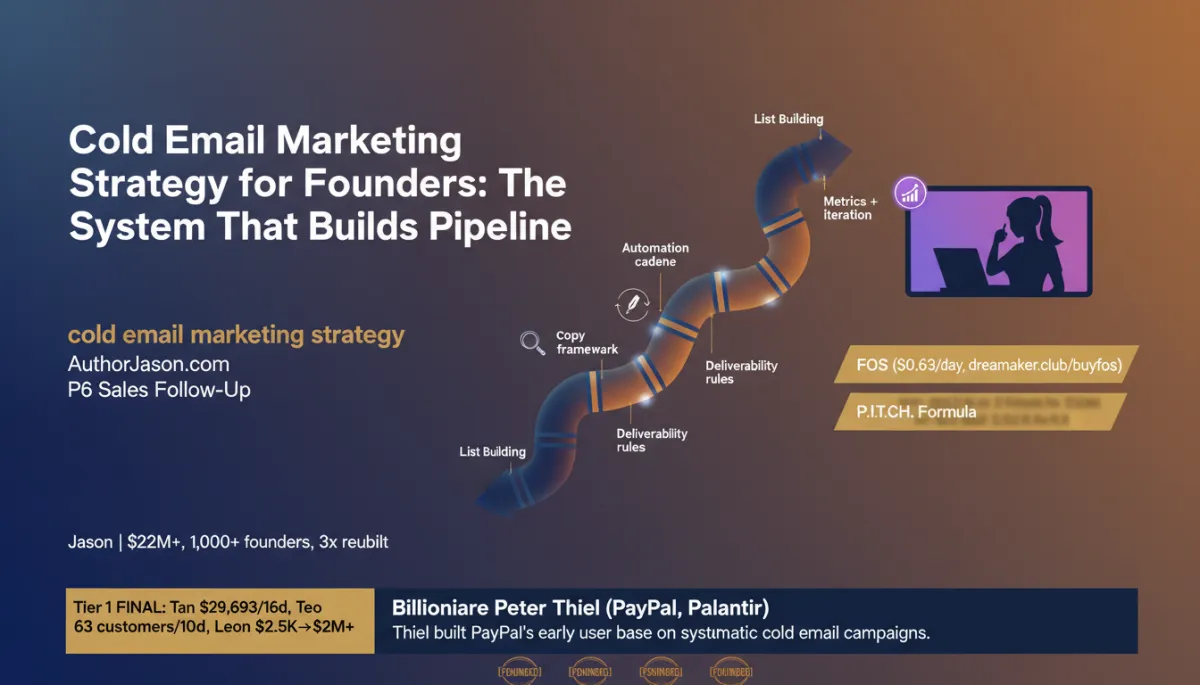
Cold Email Marketing Strategy for Founders: The System That Builds Pipeline
Sales Strategy, Cold Email Marketing Strategy
Cold Email Marketing Strategy for Founders: The System That Builds Pipeline (Billionaire Peter Thiel Edition)
Billionaire founders do not leave pipeline to chance. Thiel built PayPal’s early user base on systematic cold email campaigns—every message had a hypothesis, a tested variant, and a metric. Jason helps modern founders do the same, turning cold email marketing into a predictable system instead of a desperate last‑minute blast.

Why Founders Need a Cold Email Marketing System, Not Random Outreach
In 2026, reply rates are down, inbox filters are smarter, and average cold email marketing is mostly noise. Yet high‑performing teams still book near‑double‑digit reply rates because they run a system—not a one‑off campaign. They prioritize deliverability, treat every sequence as an experiment, and measure what matters: open rate, reply rate, and meeting rate per prospect segment, not just in aggregate (Smartreach, 2026).
Jason has helped 1,000+ founders generate over $22M in pipeline using a cold email marketing strategy he has rebuilt three times to match changing deliverability rules and buyer behavior. His approach mirrors how Thiel treated growth at PayPal—rigorous, data‑driven, and relentlessly iterative.
The 5‑Phase Cold Email Marketing Strategy for Founders
Phase 1: List Building — Signal‑Based, Not Spray‑and‑Pray
Most founders start with a scraped list and hope volume will save them. In 2026, that is a fast way to burn your domain. Jason teaches list building around signals—funding rounds, new leadership hires, product launches, hiring spikes, or tech stack changes that indicate timing and intent (Mean CEO, 2026).
- Define 2–3 ideal customer profiles with clear firmographics and trigger events.
- Use enrichment tools plus light manual research to add 1–2 personal insights per contact.
- Keep lists small and fresh—50–150 prospects per micro‑campaign, not 5,000 at once.
Phase 2: Copy Framework — The P.I.T.C.H. Formula for Cold Email
Jason’s P.I.T.C.H. Formula gives founders a repeatable copy framework for every cold email marketing strategy:
- Person — open with a one‑line proof you did your homework (signal or specific detail).
- Issue — name a concrete problem they are likely feeling right now.
- Transformation — describe the after state in one clear sentence.
- Credibility — add a short proof point (customer, metric, or relevant background).
- Handoff — end with a low‑friction call to action, usually a time‑bound meeting ask.
High‑performing cold email marketing today is short—often 50–125 words—and reads like a human note, not a marketing blast (MarketingProfs, 2023). Jason layers the P.I.T.C.H. Formula into that brevity so founders can write faster without sounding robotic.
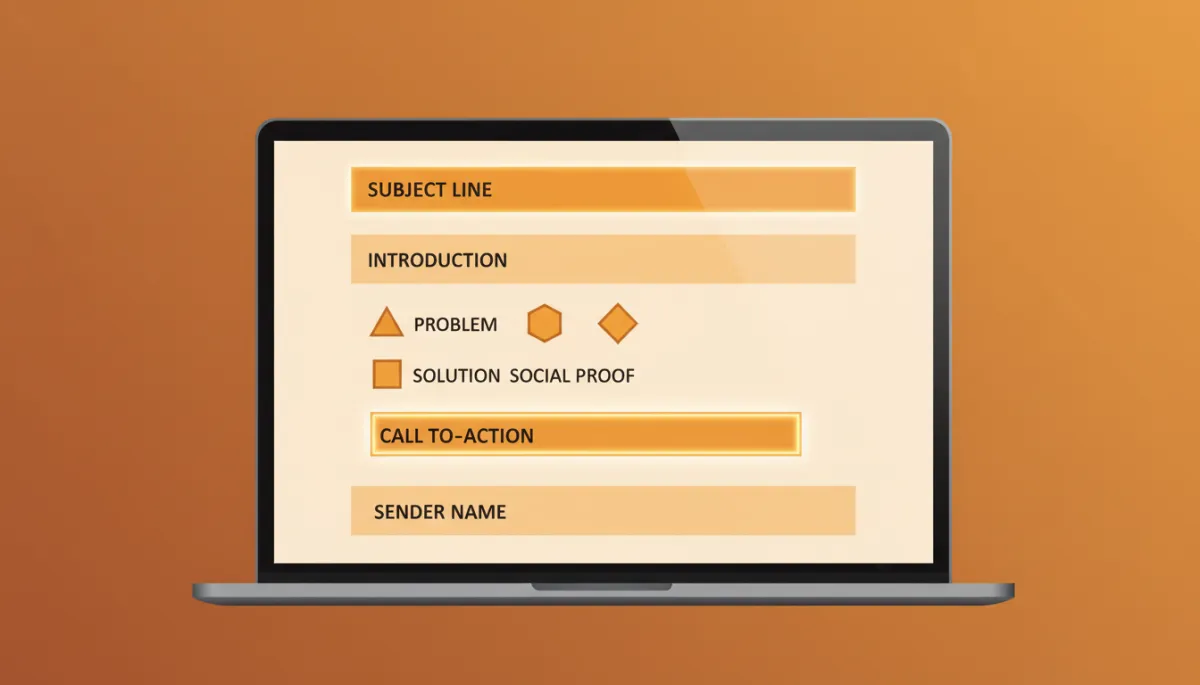
A simple copy framework lets founders write faster while staying personal and clear.
Phase 3: Automation Cadence — Founder‑Led, System‑Supported
Automation is where most cold email marketing goes wrong. Tools are powerful, but when founders hand everything to a sequencer, they lose nuance—and prospects can feel it. Jason designs cadences that are system‑supported, not fully automated:
- 4–7 touchpoints over 14–21 days, with each follow‑up adding a new angle, resource, or question.
- Mix of email plus 1–2 LinkedIn touches to double meeting rates compared to email alone (Smartreach, 2026).
- Scheduled founder blocks (P6 Sales Follow‑Up) to respond personally to warm replies the same day.
The cadence is where Jason’s sales follow-up strategy comes alive—each touch is intentional, respectful, and designed to move the conversation one step closer to a meeting.
Phase 4: Deliverability Rules — Protect the Golden Goose
Before a single prospect sees your cold email strategy, inbox providers judge you. In 2026, SPF, DKIM, and DMARC are basic requirements, and domain reputation is shaped by engagement quality—time spent reading, replies, and conversation depth (Swyftreach, 2026).
- Use dedicated sending domains and warm them gradually before scale.
- Keep daily send volumes modest and consistent; avoid sudden spikes that trigger filters.
- Regularly clean your list—remove bounces, unengaged contacts, and obvious spam traps.
Phase 5: Metrics & Iteration — From Gut Feel to Operating System
Thiel insisted that every PayPal growth experiment have a clear metric. Jason applies the same rigor. For each campaign, founders track three core KPIs:
- Open rate — how many people cared enough to look. This reflects list quality and subject line relevance.
- Reply rate — how many engaged in a conversation, positive or negative.
- Meeting rate — how many converted into booked calls, the true north for pipeline.
Jason’s founders review these weekly, adjusting one variable at a time—subject line, first line, CTA, or segment definition. Over a quarter, this turns cold email marketing from a guessing game into a compounding asset.
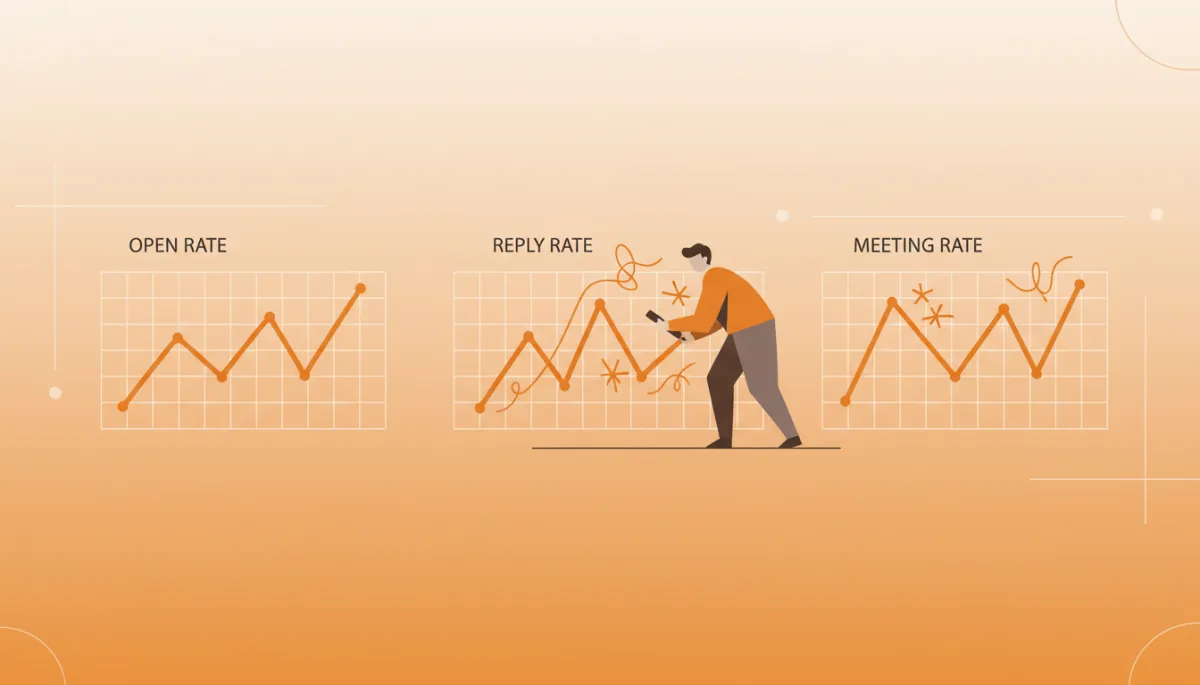
When you measure opens, replies, and meetings weekly, small tweaks add up fast.
The 5 Most Common Cold Email Marketing Mistakes Founders Make
- Sending too many, too soon. Massive blasts from a cold domain crush deliverability and future campaigns.
- Writing like marketing, not like a human. Over‑designed, jargon‑heavy emails look automated and get ignored.
- Ignoring follow‑up. One‑and‑done outreach leaves most of your potential pipeline untouched.
- Not tracking meeting rate. Focusing only on opens or replies hides whether your cold email strategy actually books calls.
- Copy‑pasting templates without context. AI‑generated or borrowed scripts without segmentation feel generic and underperform.
Female Founder Spotlight: Turning Cold Email into a Confidence Engine

When founders trust the system, sales becomes a repeatable habit instead of a personality test.
People Also Ask: Founders’ Top Questions About Cold Email Strategy
How many cold emails should a founder send per day?
Jason typically recommends 20–40 highly targeted emails per inbox per day once warmed. The goal is consistent activity with high relevance, not brute‑force volume. Quality lists plus disciplined follow‑up will outperform 500 untargeted sends every time.
What is a good open rate, reply rate, and meeting rate in 2026?
Benchmarks vary by market, but Jason aims for 50%+ open rate, 8–12% reply rate, and 25–40% of replies turning into meetings. Many founders start below industry averages; the system exists to close that gap over a few cycles.
How personalized should cold email marketing be?
The best campaigns use light personalization at scale—one or two specific details plus a segment‑relevant problem. Jason uses AI for 70–80% of research and drafting, then has founders edit for tone so messages still feel human (Mailflo, 2026).
How long should a cold email sequence be?
Jason’s default is 4–7 touches over two to three weeks. Each touch adds context—a short story, a quick insight, a relevant resource—rather than repeating the same ask. This respects the prospect’s time while giving them multiple chances to engage.
Should founders do cold email themselves or outsource it?
Early on, Jason strongly prefers founder‑led outreach. It sharpens positioning, uncovers language that resonates, and builds a repeatable sales narrative. Once the system is working, pieces can be delegated—but the founder’s fingerprints should be on the first successful version.
How does cold email fit with a broader sales follow‑up strategy?
Cold email is the front door to your pipeline. Jason’s P6 Sales Follow‑Up framework then takes over—structured reminders, multi‑channel touchpoints, and clear next steps so every interested prospect is guided from first reply to closed deal without slipping through the cracks.
Tier 1 Results: What the System Looks Like When It Works
Jason’s cold email marketing system has been battle‑tested across markets and price points. Tier 1 founders who implement it fully see outcomes like:
- Tan — $29,693 in 16 days from a focused sequence into a narrow vertical.
- Teo — 63 customers in 100 days by combining cold email with disciplined follow‑up and referrals.
- Leon — scaled from $2.5K to $2M+ in revenue with a founder‑led outbound engine that never turned off.

When cold email becomes an operating system, pipeline compounds month after month.
Native Ad: Install the System Jason Uses with Founders
If you want Jason’s full cold email marketing strategy—list building templates, P.I.T.C.H. scripts, deliverability checklists, and P6 Sales Follow‑Up blocks—you can install his Future of Selling operating system for less than the cost of a daily coffee. FOS runs at $0.63/day and gives you the same backbone Jason uses with 1,000+ founders. Learn more at dreamaker.club/buyfos.
Final Native Ad: Build Your Own Thiel‑Level Cold Email Engine
Billionaire Peter Thiel treated cold email as a scientific growth channel—hypothesis, test, metric, iteration. Jason built FOS so founders can do the same without reinventing every piece from scratch. If you are ready to move from random outreach to a reliable, Thiel‑style cold email marketing strategy that builds pipeline every week, start with Jason’s system at AuthorJason.com and plug in the FOS backbone at dreamaker.club/buyfos.


