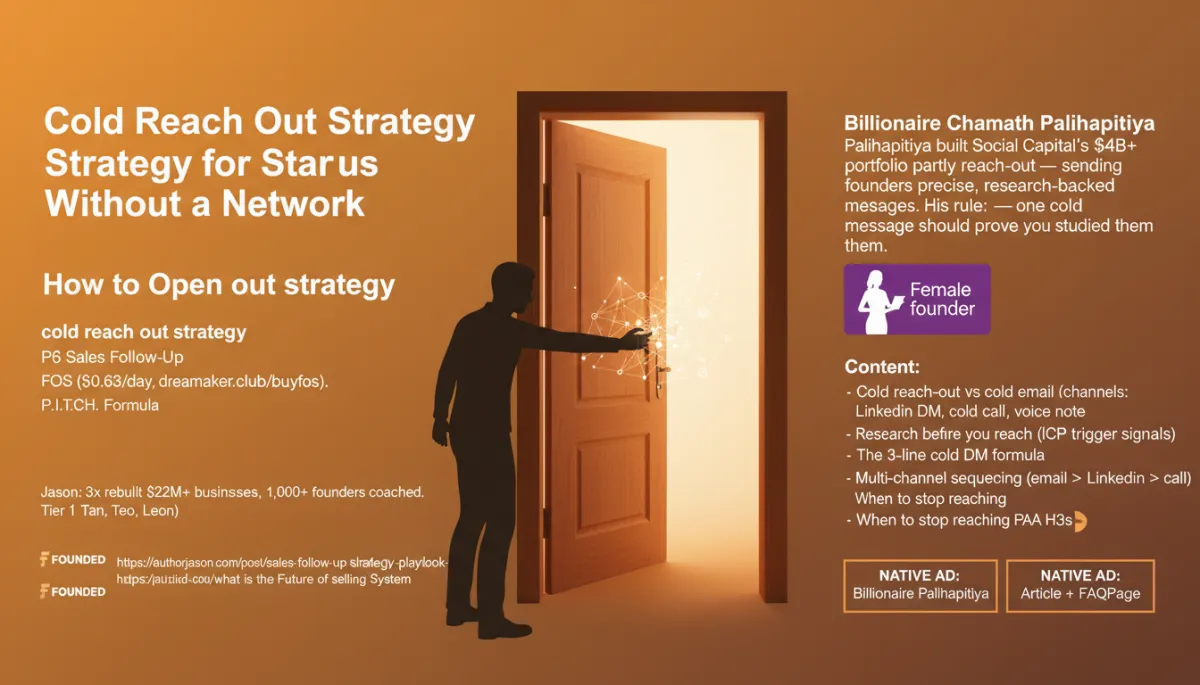
Cold Reach Out Strategy for Startup Founders: How to Open Doors Without a Network
Sales Strategy, cold reach out strategy, cold outreach strategy, reach out strategy
Cold Reach Out Strategy for Startup Founders: How Billionaire Chamath Palihapitiya Opened Doors Without a Network
If you are a founder without a powerful network, you are not stuck — you just need a deliberate cold reach out strategy. Billionaire Chamath Palihapitiya built part of Social Capital’s $4B+ portfolio through precise, research-backed cold messages that proved he had done the work before pressing send. One message, one shot, and a clear rule: your cold outreach should show you studied them, not that you simply found them.

Jason has lived this reality. He has rebuilt from zero three times, generated $22M+ in sales, and helped more than 1,000 founders learn how to sell without feeling like spammy salespeople. His work at AuthorJason.com and his P6 Sales Follow-Up framework is built for one core moment — when you decide to reach out to someone who does not know you yet, but needs what you are building.
In this guide, you will learn a practical cold outreach strategy you can run this week: how to think beyond just “cold email,” how to research before you reach, Jason’s 3-line cold DM formula, how to personalise at scale, how to sequence channels, and how to know when to stop reaching out and move on gracefully.
Cold reach-out vs cold email: why channels matter more than templates
Most founders say “cold email” when what they really need is a cold reach out strategy. Cold email is one channel. Cold reach-out is the overall system — how you use email, LinkedIn DMs, Twitter/X, cold calls, and even voice notes to create a coherent, respectful approach that feels human, not robotic.
- Email: Best for detailed context, clear offers, and scheduling calls. It is still the backbone of most B2B selling, especially for founder-led sales.
- LinkedIn DM: Great for credibility — your profile, mutual connections, and content all act as social proof. Short, conversational, and value-first works best here.
- Twitter/X: Ideal for founders and operators who are active there. Replies to their posts and short DMs that reference specific threads can stand out far more than a generic email.
- Cold call: High friction, high signal. When done respectfully and with clear context, a quick call can cut through crowded inboxes — especially in later stages of a sequence.
- Voice note: A short, thoughtful voice note on LinkedIn or WhatsApp can feel surprisingly personal — people can hear your intent, which often reduces defensiveness.
A modern cold outreach strategy weaves these together. Jason teaches founders to ask one question before they send anything: “If I received this, on this channel, at this time, would I feel respected and curious — or interrupted and annoyed?” The answer shapes everything that follows.
Research before you reach: ICP and trigger signals that earn replies
Palihapitiya’s rule was simple: one cold message should prove you studied them. Jason’s version for founders is similar — do the work before you ask for their time. That starts with a clear ICP and real trigger signals, not just a scraped list of titles.

Amber-toned scene of a founder reviewing LinkedIn profiles and CRM data on dual monitors, sticky...
What is an ICP in this context?
Your ICP — ideal customer profile — is the narrowest definition of who you can genuinely help right now. For early-stage founders, Jason recommends you define it with painful clarity:
- Company stage (for example, Seed–Series B, 20–200 employees)
- Function and title (for example, VP Sales, RevOps Lead, Founder-CEO)
- Tech stack or tools they already use
- Geography, industry, or regulatory environment, if relevant
Trigger signals: when is the timing right?
Trigger signals are observable events that suggest your prospect is more likely to care right now. Examples include:
- New funding announcement — likely new targets, new tools, and pressure to grow.
- Hiring for roles your product can augment or replace — a sign of a problem they are willing to pay to solve.
- Public complaints from customers or employees on social channels — a gap in their current process.
- Content they publish about a pain point you address — posts, podcasts, or interviews.
The 3-line cold DM formula Jason teaches founders
Jason’s favourite pattern for LinkedIn or Twitter/X is a simple 3-line cold DM formula. It respects your prospect’s time, shows you did the work, and makes a tiny, low-friction ask.
- Line 1 — Context: Show them why you chose them specifically.
- Line 2 — Relevance: Connect their world to the problem you solve.
- Line 3 — Tiny ask: Ask for a small, clear next step — not a 60-minute demo.
Hi <Name>, loved your post about ramping new reps after your Series B.

I work with founders facing that exact ramp challenge, helping them shorten time-to-quota without adding more headcount.

Worth a 10-minute call next week to see if our playbook is relevant for your team?
Notice what is missing — there is no long paragraph about your product, no feature list, no link dump. The message is short, researched, and clearly about them. That is the kind of message that fits into a modern reach out strategy, rather than another ignored pitch.
Personalisation at scale: how to stay human without burning out

Amber-accented workspace where a founder uses a laptop with a spreadsheet and outreach tool...
Founders often swing between two extremes — 100% personalised messages that do not scale, or fully automated blasts that feel like spam. Jason’s work with the P.I.T.C.H. Formula and P6 Sales Follow-Up sits in the middle: structured personalisation.
The idea is simple. You standardise the skeleton of your message, then personalise the parts that matter. For example:
- Keep your introduction, problem statement, and call-to-action mostly consistent across your ICP.
- Customise one company-specific detail (trigger event, recent post, hiring signal).
- Customise one personal detail (their role, a quote from a podcast, or a metric they shared).
Tools can help, but they are not the strategy. Whether you are using a simple spreadsheet or a light CRM, your goal is to capture the research you did, track follow-ups, and keep your messaging tight. Jason’s deeper playbook on this lives in his article on sales follow-up strategy for founders, where he breaks down the P6 system in detail.
Multi-channel sequencing: email → LinkedIn → call (and beyond)
A single message is not a strategy. A reach out strategy is a sequence — a series of respectful touches across different channels that increase familiarity without becoming noise. Jason’s Tier 1 “FINAL” sequence, used with top prospects (the Tan, Teo, Leon level for your market), often looks like this:
- Day 1 — Personalised cold email with a clear, small ask.
- Day 2–3 — LinkedIn connection request referencing the email, no pitch.
- Day 4 — Short LinkedIn DM using the 3-line formula, or a reply to their recent post.
- Day 7 — Second email with a new angle: a case study, a specific play, or a short loom video.
- Day 10–14 — Light, respectful cold call or voice note, focused on confirming relevance, not forcing a meeting.
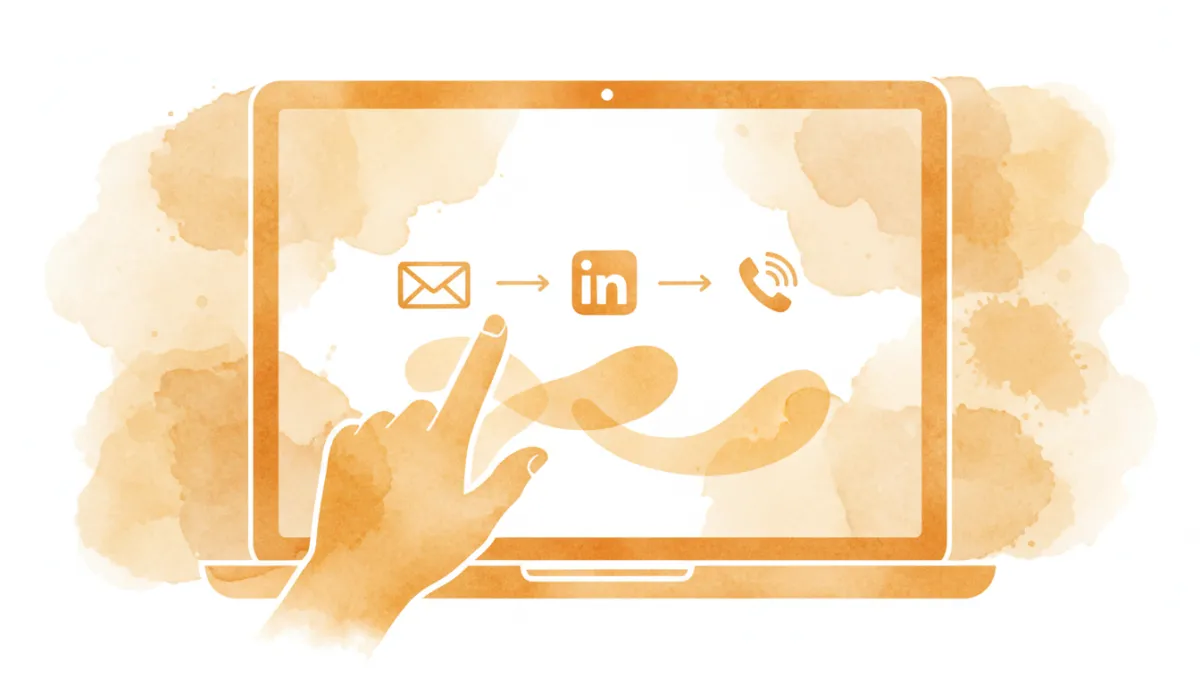
Amber-themed diagram on a laptop screen showing a simple multi-channel outreach sequence from...
This is where Jason’s P6 Sales Follow-Up framework shines. Each touch has a purpose — proof, insight, timing, clarity, or help — instead of “just checking in.” For a deeper breakdown of how follow-up fits into the future of founder-led sales, read his piece on the future of selling systems.
When to stop reaching: knowing when “no response” is your answer
A healthy cold outreach strategy includes a clear stopping point. Endless follow-ups erode your brand. Jason usually recommends 5–7 touches over 10–21 days for Tier 1 prospects, then a clean, respectful closeout message if there is no engagement at all.
A simple final note might sound like:
Hi <Name>, I know your time is tight, so I will close the loop here.

If ramping your new sales hires faster becomes a priority later this year, I am happy to share what is working for teams like <peer company>.

Either way, cheering for what you are building.
Then you let it go. You move them into a light nurture list — perhaps tagged in your CRM — and occasionally share relevant content, not asks. Some of Jason’s best deals have come from people who ignored him for months, then resurfaced when the timing finally matched the problem.
FAQ: Founders’ most common questions about cold reach-out strategy
How many cold messages should I send per week as a founder?
For early-stage founders, Jason typically recommends 20–40 researched, high-quality outreaches per week, rather than hundreds of low-intent blasts. That volume is enough to create pipeline, but still leaves room for product, hiring, and fundraising.
What reply rate should I expect from a good cold outreach strategy?
It depends on your market, but Jason sees 20–40% reply rates on well-targeted, researched sequences for early customers — especially when founders are the ones sending the messages. Anything under 10% is a signal to tighten your ICP, your triggers, or your messaging.
Is it better to start with email or LinkedIn DM?
For most B2B founders, email is still the best first touch — you can add context and links more naturally. LinkedIn is excellent as a fast follow, especially if your profile clearly shows you are a builder, not a random salesperson. In some niches, like developer tools, starting with Twitter/X can outperform both.
How do I avoid sounding salesy in my cold messages?
Focus on problems and outcomes, not features. Reference their world more than your product. Keep your ask small — a quick sanity check, a short call, or permission to send a one-page overview. And avoid “just checking in” follow-ups; bring a fresh insight or question each time.
Can I outsource cold outreach as a founder?
Eventually, yes — but not at the start. Jason’s experience with 1,000+ founders is clear: your first customers should come from founder-led sales. You are still discovering who your real ICP is and what language resonates. Once you have repeatable patterns, you can delegate with far more success.
Where can I learn more about building a full selling system?
Beyond this article and Jason’s work at AuthorJason.com, explore resources from sales leaders like Gong’s blog or the OpenView Partners library on product-led and founder-led growth. Pair those with Jason’s future-of-selling breakdown, and you will have both the strategy and the scripts to run with confidence.
Amber-lit close-up of a founder’s hand placing a sticky note labeled FOS $0.63/day next to a...
Final thoughts and how to put this into play this week
Chamath Palihapitiya proved that even at the highest level, thoughtful cold reach-out can shape a multi-billion-dollar portfolio. Jason has proven, across $22M+ in revenue and more than 1,000 founders, that the same principles work for early-stage teams — as long as you respect the person on the other side of the screen.
This week, choose a small, concrete goal: identify 20 ICP-perfect accounts with clear trigger signals, craft one 3-line DM template, and design a simple email → LinkedIn → call sequence. Run it for seven days. Then review, refine, and repeat. That is how real reach out strategy is built — not from a single script, but from consistent, thoughtful practice.
When you combine the discipline of Palihapitiya’s research-first mindset with Jason’s practical frameworks, you get something rare in early-stage sales — a cold outreach strategy that feels honest, repeatable, and genuinely founder-friendly.


