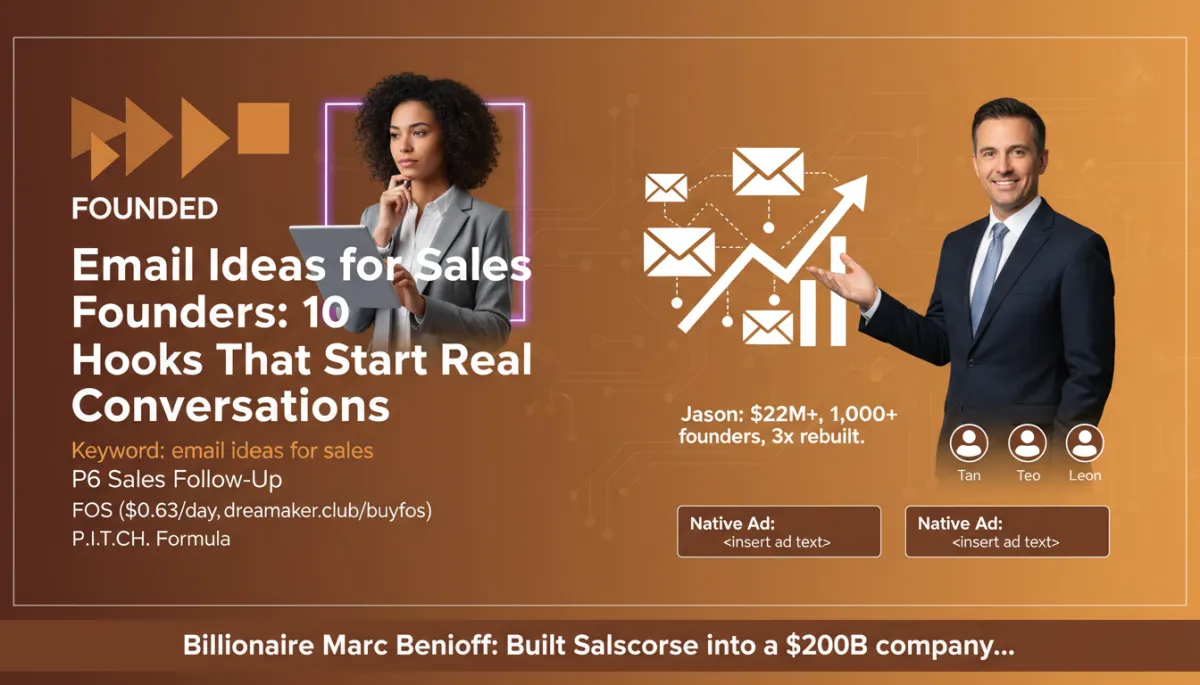
Email Ideas for Sales Founders: 10 Hooks That Start Real Conversations
Sales, Email Ideas for Sales, Sales Systems, Founder Selling
Email Ideas for Sales Founders: 10 Hooks That Start Real Conversations (What Billionaire Marc Benioff Proved About Email)
As a sales-focused founder, your inbox is crowded, your prospects’ inboxes are worse, and yet—email is still the most controllable, repeatable channel you own. Jason has seen it across $22M+ in revenue, 1,000+ founders coached, and three full rebuilds of his own sales systems: the right email hooks start real conversations, the wrong ones get silently archived. This guide gives you 10 proven email ideas for sales founders, plus examples you can adapt today.

Why Hooks Matter More Than “Perfect” Emails
Benioff built Salesforce into a $200B giant on email-driven demand generation—long before social selling was fashionable. His teams reportedly tested thousands of angles until they found the hooks that consistently opened enterprise doors. Jason has watched founders repeat the same pattern on a smaller scale: once the hook is right, follow-ups, demos, and deals become dramatically easier.
Think of hooks as the “first five seconds” of your email ideas for sales. They decide whether your prospect leans in or tunes out. The body of the email still matters, but no hook—no reply. Below are 10 sales email ideas, each built around a specific hook type, with example subject lines you can plug into your own sequences or your sales follow-up strategy .
1. Case Study Opener: Lead with a Specific Win
Founders often talk in generalities—“We help teams close more deals.” The case study opener forces you to anchor your cold email ideas in one concrete result. That specificity signals proof, not theory, and it helps busy executives benchmark themselves instantly.
- Subject line example: “How a seed-stage SaaS added $187k from ‘lost’ leads in 60 days”
Inside the email, keep the story short—1–2 sentences of context, 1 sentence of result, 1 sentence of “why this matters to you,” then a simple question. Jason teaches founders to think in snapshots, not novels. Your goal is to spark curiosity, not deliver a full deck by email.

Short, specific case studies outperform long decks when starting new conversations.
2. Provocative Stat: Make Them Recalculate Their World
Numbers cut through opinion. A strong provocative stat makes your reader pause and think, “Is that true for us?” This is one of the most reliable sales email ideas when you have even a small data set from customers or your own product usage.
- Subject line example: “42% of your pipeline is going dark for this avoidable reason”
Use a stat that feels uncomfortably specific, and tie it to a cost—lost revenue, wasted hours, or missed opportunities. Benioff’s teams were relentless about quantifying impact; founders can borrow the same discipline, even with small sample sizes, as long as you are honest about the source.
3. Bold Question: Invite a One-Line Reply
A bold question turns your email from a pitch into a prompt. It respects your prospect’s intelligence and makes the “cost” of replying incredibly low—often just a “yes,” “no,” or a short sentence. This is especially effective for founder-led outbound where your name carries weight.
- Subject line example: “Are you actually happy with your current demo-to-close rate?”
Keep the first line of the email consistent with the subject—repeat or slightly reframe the question, then add one sentence explaining why you are asking. Jason often pairs this with his P.I.T.C.H. Formula so founders move from question to clear next step without sounding pushy.
4. Counterintuitive Insight: Flip Their Assumptions
Some of the best cold email ideas start with, “Most people believe X, but the data shows Y.” This counterintuitive angle works because it feels like an upgrade to the prospect’s mental model—not just another vendor opinion. The key is to be precise about what you are flipping.
- Subject line example: “Why shorter sales cycles are quietly killing your expansion revenue”
In the body, state the common belief in plain language, then show the downside. Close with one practical takeaway you have seen across customers. When Jason rebuilt his own systems for the third time, many of his best-performing emails started from, “Everyone optimizes for speed—but here’s what the top 1% actually track.”

Counterintuitive insights land best when you clearly contrast old and new beliefs.
5. Referral Name-Drop: Borrow Trust Ethically
When someone your prospect respects is already working with you, your cold email is no longer truly cold. A referral name-drop is one of the highest-converting sales email ideas—but only when you have explicit permission and keep the tone respectful, not exploitative.
- Subject line example: “Teo suggested I reach out about your post-demo drop-off”
Open with the relationship, then move quickly to why it is relevant. One or two sentences is enough—anything longer starts to feel like you are trading on someone’s name rather than standing on your own value.
6. Upcoming Event: Tie Your Timing to Their Calendar
Prospects rarely wake up thinking, “I hope a founder pitches me today.” They do, however, think in terms of events—board meetings, product launches, conferences, renewals. Anchoring your email to a specific upcoming event makes your outreach feel timely rather than random.
- Subject line example: “Before your Q4 pipeline review—one idea on resurrecting ‘no-shows’”
You can reference public events (earnings calls, conferences) or inferred ones (fiscal year-end, renewal cycles). Benioff’s playbooks often aligned outreach with budget windows; founders can mirror that discipline on a leaner scale.
7. Free Resource Offer: Lead with Genuine Help
Free resources are everywhere, but most are thinly veiled pitches. A strong free resource hook offers something you would be proud to charge for—checklists, scripts, or mini-playbooks—then trusts that reciprocity and expertise will carry the conversation forward.
- Subject line example: “Steal this 7-step follow-up script our founders use to revive ‘dead’ deals”
Link to a short, focused resource, not a generic homepage. For inspiration on how to structure this, study how high-performing SaaS teams share tactical content on sites like Gong’s blog or the way thoughtful operators break down playbooks on First Round Review .

High-value resources build trust quickly when they solve one specific problem well.
8. Direct Challenge: Respectfully Call Out the Gap
Some prospects respond best when you speak plainly about what is not working. A direct challenge hook does exactly that—without being rude or presumptuous. Jason reserves this for segments where he has a strong pattern match and can back up the claim with data or experience.
- Subject line example: “Your sales follow-up is too polite—and it is costing you deals”
In the email, name the pattern, show how you recognized it, then invite a short conversation to compare notes. Done well, this feels like a peer-to-peer nudge rather than a stranger’s criticism.
9. Shared Pain: Show You Have Lived Their Problem
Founders have a unique advantage over traditional reps—they have lived the pain they are selling into. A shared pain hook makes that explicit. Instead of, “We help companies like yours,” you are saying, “We were you, and here is what we learned the hard way.”
- Subject line example: “We burned 9 months chasing ‘interested’ leads—until we fixed this”
Jason often encourages founders to mention one specific moment—missed targets, brutal board meetings, or a painful churn story—then connect it to the system they use now, whether that is his P.I.T.C.H. approach or a homegrown framework. Authenticity is the asset here.
10. Unexpected Compliment: Start on a Human Note
Most flattery in cold outreach is generic and transparent. An unexpected compliment is the opposite—specific, grounded, and clearly researched. It shows you did your homework and that you are reaching out to this person, not just this title.
- Subject line example: “Loved your post on ‘saying no’ to misaligned customers”
In the email, reference a specific line, podcast moment, or decision they made, then bridge into why you are reaching out. When done well, this can turn even skeptical executives into warm, curious respondents.

Specific, researched compliments feel human and immediately differentiate your outreach.
What is the best email hook for founder-led sales?
For most founders, shared pain plus a bold question performs best. You are uniquely credible when you say, “We struggled with this too,” then ask a direct, respectful question about their current reality. Over time, track your own reply rates and let the numbers decide.
How many follow-up emails should I send after the first hook?
Jason typically recommends 5–9 thoughtful follow-ups, each with a slightly different angle—case study, stat, question, or resource—rather than repeating the same message. Persistence wins, but only when you keep adding value instead of adding pressure.
Should I personalize every email or rely on templates?
Use templates for structure, not for sameness. Jason’s view is simple—templates hold the bones, personalization adds the muscle. Keep your hooks, call-to-actions, and structure consistent, but personalize the first 1–2 lines to the company, role, or person.
How do I know if my subject lines are actually working?
Track open rates and replies separately. Strong hooks drive opens; clear, relevant bodies drive responses. Jason encourages founders to A/B test subject lines in small batches, then roll winners into their broader P.I.T.C.H.-driven systems as part of a repeatable outbound engine.
How long should my sales emails be as a founder?
Shorter than you think. Two to five sentences is usually plenty—hook, proof, relevance, and a simple next step. Remember, you are starting a conversation, not closing a round in one email. Benioff’s teams used email to open doors; the real selling happened in live conversations.
How can I systematize my email ideas for sales instead of rewriting from scratch?
Start by building a small “hook library” with your top-performing subject lines and openers—case studies, stats, questions, and more. Then, plug them into a simple follow-up system so you are never staring at a blank screen. Tools like Jason’s FOS can accelerate this dramatically.

Desktop setup showing a founder’s ‘hook library’ spreadsheet on screen with amber-highlighted...
Tier 1 Founders, Systems, and the Next Step
Tan, Teo, and Leon—the Tier 1 founders Jason often references—did not scale on charisma alone. They built simple, durable systems around email ideas for sales, then refined those systems relentlessly. Hooks were not random; they were tested, tracked, and improved until their calendars filled with the right conversations.
If you want help building that level of repeatability into your own outbound, Jason created FOS, a lightweight system that works out to roughly $0.63 per day and is available at dreamaker.club/buyfos . It is designed for founders who want Benioff-level discipline without enterprise bureaucracy—clear follow-up structures, proven hooks, and a practical way to turn cold email ideas into booked calls.
When you are ready to go deeper into follow-up sequences, Jason breaks down his full P.I.T.C.H. Formula and sales systems at AuthorJason.com —including how Billionaire Marc Benioff’s email-driven growth playbook still informs modern founder-led sales. The inbox is still where real conversations begin; your hooks decide how many you get.


