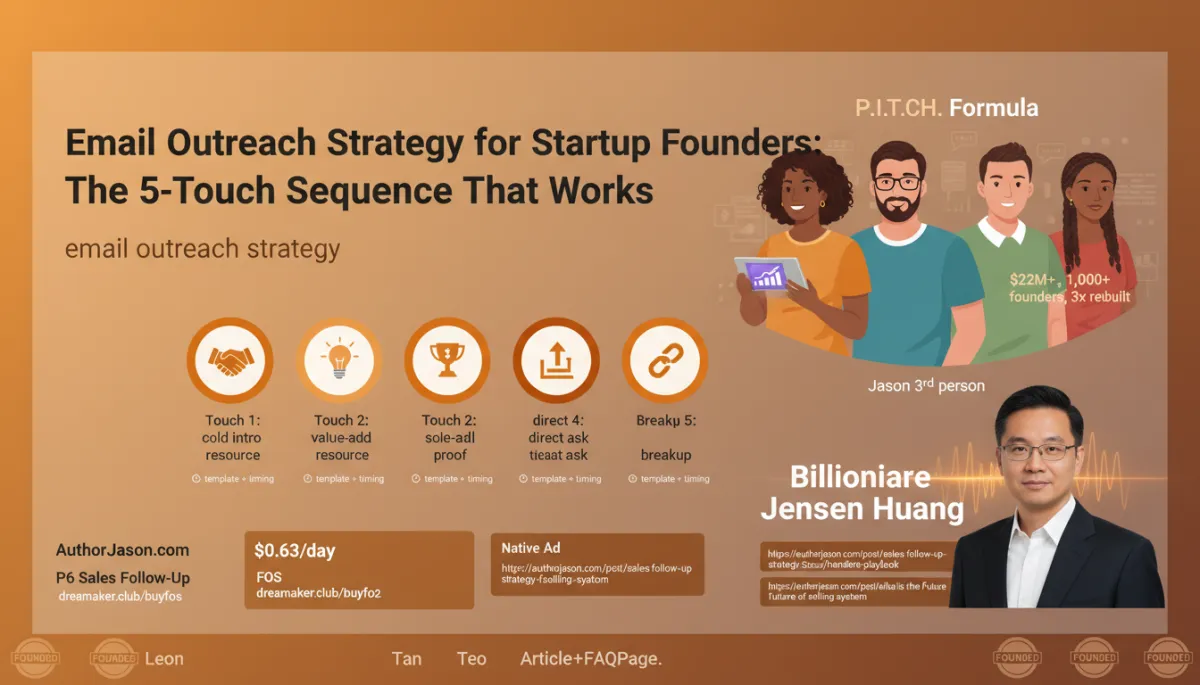
Email Outreach Strategy for Startup Founders: The 5-Touch Sequence That Works
Email Outreach, Sales Follow-Up, Startup Founders
Email Outreach Strategy for Startup Founders: The 5-Touch Sequence That Works (What Billionaire Jensen Huang Proved Early)
In Nvidia’s early days, Huang personally ran email outreach to gaming companies and developers—5-touch sequences that turned lukewarm interest into design wins. Startup founders today face the same challenge: how do you follow up without being annoying, and how do you turn polite curiosity into real revenue? This article breaks down a practical, founder-tested email outreach strategy you can run in under an hour a day, even without a sales team.

Why Founder-Led Email Outreach Still Wins in 2026
For all the noise about automation and AI, the most effective email outreach strategy for early-stage startups is still founder-led. When a prospect sees a thoughtful, specific note from the person who actually built the product, response rates jump—and trust builds faster than any generic campaign from an email outreach platform ever could.
Jason, the creator behind AuthorJason.com’s P6 Sales Follow-Up, has helped 1,000+ founders generate $22M+ in pipeline using simple, repeatable follow-up systems. He rebuilt his own outbound approach three times before landing on a 5-touch sequence that balances persistence with respect—and that’s the sequence you’ll learn here.

Structured 5-touch sequences routinely outperform one-off cold emails by 2–3x.
The P.I.T.C.H. Formula Behind Effective Founder Emails
Before we walk through the 5 touches, anchor your cold email outreach strategy in a simple mental model. Jason uses the P.I.T.C.H. Formula to keep every message sharp:
- Pain: Name the real problem they’re living with today.
- Impact: Quantify what that pain costs in time, money, or stress.
- Target: Show that you work with people exactly like them.
- Credibility: Add one clear proof point—no laundry list.
- Handle: Make the next step tiny and specific, not vague.
Every touch in the sequence uses P.I.T.C.H. in a slightly different way. That’s how you stay persistent without repeating yourself—and how you echo what founders admire about Huang’s early outreach: relevant, respectful, and relentlessly clear.
Touch 1: Cold Intro (Day 1)
The first email is not about closing—it’s about earning a reply. Keep it short, specific, and obviously written by a human founder, not a bot spraying templates from an email outreach platform. Aim for 75–120 words.
Timing: Send on Day 1, ideally during their working hours. Don’t overthink the “perfect” time; consistency beats superstition.
Template – Cold Intro:
Subject: Quick idea for [company]’s [team/metric]
Hey [First Name]—Jason here, founder at [Startup]. We help [target persona] reduce [pain] by [simple explanation].
I noticed [specific observation about their role, product, or recent initiative]. Based on what we’re seeing with [similar company or segment], there’s likely a way to [specific outcome] without adding headcount.
Worth a 15-minute call next week to see if this is relevant, or not a priority right now?
– [Your Name]
Touch 2: Value-Add Resource (Day 3–4)
If they don’t reply to Touch 1, assume they’re busy—not uninterested. Touch 2 shifts the conversation from “meet with me” to “here’s something useful even if we never talk.” This is where founders often win big, because your lived experience lets you curate genuinely relevant insight.
Timing: Send 2–3 business days after Touch 1. That spacing keeps you top of mind without feeling pushy.
Your “resource” can be:
- A short Loom video walking through a quick win for their team.
- A one-page checklist you use with similar customers.
- A relevant article such as Jason’s breakdown of the future of selling systems.
Template – Value-Add Resource:
Subject: Thought this might help with [their focus area]
Hey [First Name]—circling back with something concrete.
Here’s a quick resource on [specific topic] that our customers use to [outcome]: [link]. It’s 3–5 minutes max, no opt-in.
If it resonates, happy to walk through how teams like [similar company] are applying it in practice. If not, you still get the playbook.
Would a quick call on [two time options] be worth it?
– [Your Name]

Value-first follow-ups position you as a partner, not just another vendor.
Touch 3: Social Proof (Day 6–7)
By Touch 3, you’ve earned the right to talk about results. This email answers the silent question in your prospect’s mind: “Has this worked for anyone like me?” Jason’s work with 1,000+ founders is a good example—simple, credible numbers beat vague claims every time.
Timing: Send 2–3 business days after Touch 2. This cadence mirrors how top-performing SDR teams run sequences, but with a founder’s voice and context.
Template – Social Proof:
Subject: Quick example from [similar company/role]
Hey [First Name]—one quick example so you can see what this looks like in the wild.
We helped [customer or anonymized descriptor] go from [starting point] to [outcome] in [timeframe]. The big unlock was [specific change, not magic].
I’m not assuming this maps 1:1 to [company], but the pattern might be useful as you think about [their initiative].
Open to a 15-minute “is this worth exploring?” conversation next week?
– [Your Name]
Touch 4: Direct Ask (Day 9–10)
Touch 4 is where many founders either disappear or over-correct with pressure. Instead, think of this as your “clean ask”—you restate the core value, tighten the handle, and make it easy to say yes or no. This is also where a tool like the FOS system (FOS at $0.63/day via dreamaker.club/buyfos) can help you track who’s opened, clicked, and replied without drowning in spreadsheets.
Timing: Send 2–3 business days after Touch 3. By now, they’ve seen your name enough that you feel familiar—but not spammy.
Template – Direct Ask:
Subject: Should I close the loop on this?
Hey [First Name]—promise to keep this brief.
We help [target persona] at companies like [examples] reduce [pain] by [clear mechanism], usually seeing [outcome metric] within [timeframe]. From the outside, it looks like [company] is pushing on [related initiative], which is why I reached out.
Are you open to a short call to see if this is worth putting on your roadmap, or should I close the loop for now?
A simple “yes,” “no,” or “later” would be super helpful.
– [Your Name]

Clear timing across five touches keeps you consistent without overwhelming prospects.
Touch 5: Breakup (Day 12–14)
The final touch is a respectful breakup email. It’s not a guilt trip; it’s a courtesy. Many founders are surprised by how often this message triggers a reply—busy executives appreciate the clear closure and will often say, “Sorry, I’ve been slammed, let’s talk.”
Timing: Send 3–4 business days after Touch 4. That gives them time to respond without feeling like you’re hovering in their inbox.
Template – Breakup:
Subject: Permission to close this out?
Hey [First Name]—last note from me unless you tell me otherwise.
I reached out because we’ve seen [target persona] at companies like [examples] meaningfully reduce [pain] using [your product/approach]. Totally understand if timing, priorities, or budget make this a “not now.”
If you’d like me to keep you posted on results we’re seeing in [their industry], just reply “later.” Otherwise, I’ll close the loop so I’m not cluttering your inbox.
Either way, thanks for considering it.
– [Your Name]
6 Popular Questions About Email Outreach Strategy (PAA-Style FAQ)
How many touches should a startup include in an email outreach strategy?
For early-stage founders, five touches is the sweet spot—enough persistence to stand out, without drifting into spam territory. That’s why Jason’s P6 Sales Follow-Up playbook centers on structured, value-rich touches instead of endless nudges. Remember, Huang didn’t win design slots with one email; he showed up consistently with context and value.
What makes a cold email outreach strategy founder-friendly?
A founder-friendly cold email outreach strategy respects your limited time and energy. It uses tight templates, a clear weekly rhythm, and simple tools so you’re not buried in manual tracking. The best systems—like FOS and P6—let you send highly personalized emails in focused sprints, then hand off repeatable pieces to your first sales hire later.
Do I need an email outreach platform, or can I start manually?
You can absolutely start manually—many of Jason’s founders close their first 10–20 customers from Gmail and a spreadsheet. An email outreach platform becomes useful once you’re managing multiple segments, A/B tests, and team members. Start simple, then layer in tools like FOS, HubSpot, or Instantly as your volume grows and you need richer analytics.
How personalized should my email outreach be as a founder?
Aim for “light but real” personalization—one or two specific lines about their role, company, or recent move, layered on top of a strong core template. Over-personalizing each email is unsustainable; under-personalizing feels robotic. Jason’s rule: 80% reusable structure, 20% tailored insight that proves you did your homework. That balance scales while staying human.
What metrics should I track to improve my email outreach?
Start with four: open rate, reply rate, positive reply rate, and meetings booked. As your system matures, you can track pipeline and closed-won revenue from outbound. Tools like FOS make these metrics visible without heavyweight CRM setup, so you can iterate quickly on subject lines, offers, and segments instead of guessing what’s working.
How does email outreach fit with other founder-led sales channels?
Email works best when it’s woven into a multi-channel founder-led sales motion—LinkedIn touches, warm intros, events, and even targeted content. For example, you might connect on LinkedIn, comment thoughtfully on their posts, then run your 5-touch sequence. Pair your outreach with useful content from sources like SaaStr or Harvard Business Review to deepen credibility as you go.

Reviewing metrics weekly helps founders refine messaging, lists, and follow-up timing.
Tier 1: When Your 5-Touch Sequence Needs to Hit Above Its Weight
There’s a small set of prospects—your “Tier 1s”—where every email matters. These are the Tan-level accounts that could shift your entire trajectory, the Teo-style partners who unlock a new market, the Leon-type champions who can validate you publicly. For these, Jason recommends tightening the same 5-touch skeleton but adding richer research, more bespoke resources, and occasionally a short video or voice note to stand out in a crowded inbox.
This is exactly how founder-led sales scales with integrity: your baseline sequence runs reliably in the background, while your Tier 1 list gets a level of attention that reflects their potential impact. Over time, this is how Jason has helped founders move from scrappy outbound to predictable revenue—without losing the authenticity that made their earliest wins possible.
From Billionaire Jensen Huang to Your Inbox: Make Follow-Up Your Edge
The through-line from Nvidia’s early design wins to today’s founder-led sales playbooks is simple: disciplined, respectful follow-up. Billionaire Jensen Huang didn’t just send brilliant first emails—he showed up again and again with context, value, and clear next steps. Your own 5-touch sequence can do the same, even if you’re still pre-seed and building in the margins of your day.
If you want help implementing this inside your own pipeline, Jason’s P6 Sales Follow-Up system at AuthorJason.com is built exactly for that. And if you’re ready to stop losing deals to silence, FOS—available for about $0.63/day at dreamaker.club/buyfos—gives you a lightweight, founder-friendly way to run this 5-touch sequence at scale, without feeling like you’ve become a full-time SDR. Start with ten prospects, run the full sequence, and let the data show you why structured follow-up is still one of the highest-leverage skills a founder can develop.


