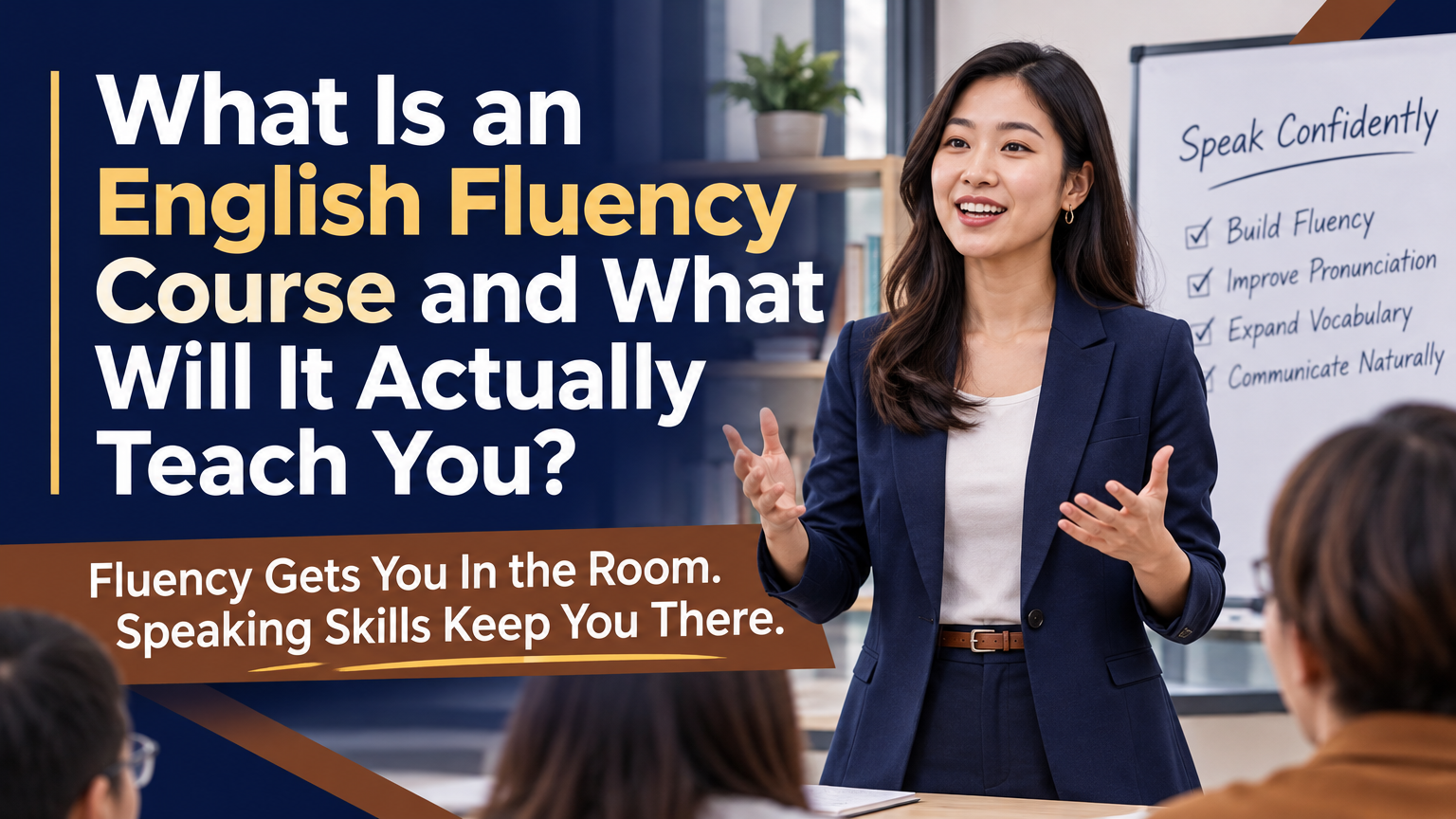
What Is an English Fluency Course and What Will It Actually Teach You?
What Is an English Fluency Course and What Will It Actually Teach You?
An English fluency course teaches you to speak naturally, clearly, and confidently in real situations — covering pronunciation, vocabulary, sentence flow, and listening under pressure. The best programs go further, training you to hold professional conversations, present ideas with structure, and communicate with presence in the meetings and pitches where outcomes matter.
🌟 From the Coaching Floor
A franchisee student walked into a coaching session with a modest pitch and walked out with the skills that turned it into a transformational partnership deal. The room didn’t change. The slides didn’t change. The speaking did.
Jason Lim has 20+ years of coaching and teaching experience, working with startup founders, executives, and sales professionals across 42 cities globally — building the presentation and speaking skills that close deals, win rooms, and open doors.
What Does an English Fluency Course Actually Cover?
Picture a founder from Singapore who spent two years improving her written English — polished emails, clean proposals, error-free reports. Then she joined a live pitch call. The words froze. The logic evaporated. The deal slipped. Her English was not the problem. Her spoken English under pressure was.
That gap is what an English fluency course is built to close. Most programs build on four core areas:
- Pronunciation and clarity — reducing the specific sounds and rhythm patterns that cause listeners to mishear or tune out; not eliminating your accent, but making sure your words land the first time.
- Vocabulary in real contexts — the phrases professionals actually use in meetings, calls, and pitches; not textbook language, but the words that sound natural and confident in a live exchange.
- Sentence flow and structure — speaking in complete, organized thoughts rather than fragments; getting to the point without filler words eating up your credibility.
- Listening under pressure — keeping up in fast native-speaker conversations, group meetings, and video calls without asking people to repeat themselves constantly.
These are real, valuable foundations. But here is where most English fluency courses stop — and where the gap that costs deals and promotions quietly opens.
Why Do Some Students Finish a Fluency Course and Still Struggle at Work?
The numbers make the stakes clear. Communication ranked as the most in-demand skill on LinkedIn for both 2024 and 2025, according to LinkedIn Talent Insights as cited by VoxBooster Public Speaking Statistics 2026. The NACE Job Outlook 2025 found that more than three-quarters of employers name communication a critical attribute for new hires, and more than two-thirds specifically seek verbal communication skills.
Employers are not just asking “Can this person speak English?” They are asking “Can this person communicate?” That is a materially higher bar than most fluency programs are designed to clear.
At the same time, a Preply Public-Speaking Survey (2024, 2,007 UK respondents) found that 63% of Gen Z say they would avoid public speaking if they had no obligation to do it, and 59% of adults overall agreed. Avoidance is a symptom of a skills gap — and a fluency course alone does not close it.
Speaking English fluently and speaking English with presence and persuasion are two separate skills. Here is the honest comparison:
| What fluency courses teach | What strong programs add |
|---|---|
| Pronunciation drills | Voice projection and pacing under pressure |
| Vocabulary building | Message structure and audience reading |
| Conversation role plays | Sales calls, pitches, and live Q&A practice |
| Listening exercises | Strategic pausing and reading the room |
| Grammar correction | On-camera and meeting presence |
The right-hand column is where deals get closed and careers advance. Choosing a better fluency course is like choosing a better piano — it matters, but it does not teach you how to play. The skill is what moves the needle.
How Do You Know If an English Fluency Course Is Worth Your Time?
Ask three questions before you enroll:
- Does it involve live, observed speaking practice? Reading and grammar exercises build awareness. Only speaking out loud, with real feedback, in conditions that feel real, builds fluency that holds under pressure.
- Is the content matched to your actual context? Business presentations, investor pitches, and client calls are different environments from casual conversation. A course designed for one context rarely transfers cleanly to another.
- Does the program address delivery, not just language? Tone, pace, pause, structure — these are the variables that determine whether a fluent speaker is also a compelling speaker. If the course does not explicitly train these, the gap remains open.
Related:
🎯 Presentation Skills Coaching with Jason Lim
🔗 What Is a Speaking English Course and What Will It Actually Teach You?
🔗 What Is an English Speaking Class and What Will You Actually Learn?
Fluency gets you into the conversation. Speaking skill is what keeps you there — and closes the deal. The professionals who consistently win rooms, earn trust, and convert pitches have built both layers: the language foundation and the communication presence that makes the words land with authority.
🌟 The Next Level After Fluency
A franchisee trained with Jason Lim and turned an ordinary project pitch into a transformational partnership deal — not by learning more vocabulary, but by learning to present with intention and authority. That skill is learnable. It starts here.
Sources
- VoxBooster, Public Speaking Statistics (2026): 40+ Data Points on Glossophobia, Career Impact, and the Speaking Economy — citing LinkedIn Talent Insights 2024 & 2025 and NACE Job Outlook 2025 (opened this run)
- Preply Language Learning Team, Speak with Confidence: Tackling the UK’s Public Speaking Phobia (2024, 2,007 UK respondents; updated April 2025) (opened this run)


