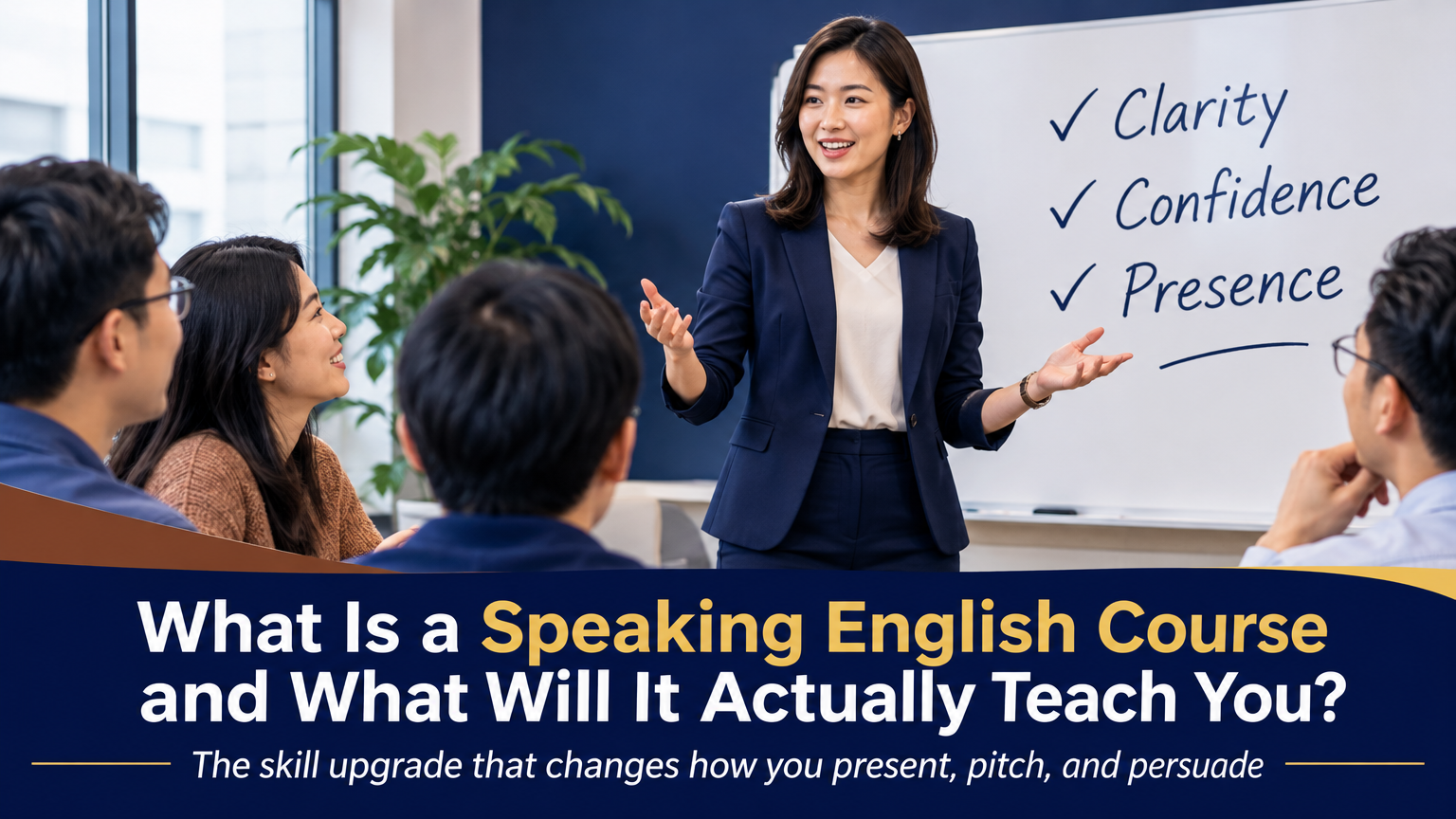
What Is a Speaking English Course and What Will It Actually Teach You?
What Is a Speaking English Course and What Will It Actually Teach You?
A speaking English course teaches you to communicate clearly and confidently in English — covering pronunciation, vocabulary, fluency, and real-world conversation. The best courses go further: they train how you structure ideas, project presence, and handle live speaking situations in meetings, presentations, and sales calls where the stakes are real.
From Jason Lim's Coaching Practice
A franchisee turned a stalled project into a major partnership deal — not by changing the product, but by changing how they presented it.
Jason Lim coaches startup founders, executives, and sales professionals to communicate with authority and close deals through stronger speaking skills. If your English is good enough but your impact in meetings or presentations is not, the gap is a skills problem — not a language problem.
LinkedIn named communication the number one in-demand skill in both 2024 and 2025. Yet 63% of Gen Z say they would avoid public speaking if they could, according to a Preply survey. This gap — between knowing English and using it with real impact in live situations — is exactly what a good speaking English course is designed to close.
What does a speaking English course typically teach?
Most courses build on four foundations:
- Pronunciation and clarity — reducing accent interference where it causes misunderstanding; training rhythm, stress, and intonation so listeners can follow you without effort.
- Vocabulary and grammar in context — not grammar drills for tests, but the phrases and structures professionals actually use in emails, calls, and pitches.
- Conversation and fluency — real-time practice through role plays, guided discussions, and mock scenarios so you stop translating in your head and start responding naturally.
- Listening comprehension — keeping up in fast native-speaker conversations, meetings, and video calls without constantly asking people to repeat themselves.
These are legitimate, valuable foundations. But here is where most English speaking courses stop — and why many graduates still freeze in a sales call or stumble through a boardroom presentation.
Why do some speakers finish a course and still struggle in high-stakes situations?
Imagine spending a year learning piano in a practice room — scales, theory, chord drills. Then someone puts you on stage in front of an audience. The technical knowledge is real, but the performance is entirely different.
Speaking English fluently and speaking English with presence and persuasion are two separate skills. According to the NACE Job Outlook 2025, more than three-quarters of employers name communication as a critical attribute for new hires — and more than two-thirds specifically seek verbal communication skills. Employers are not just asking "Can they speak English?" They are asking "Can they communicate?" That is a higher bar than most language courses are built to clear.
A course that only trains language structure — without training delivery, message framing under pressure, or how to hold a room — leaves the most important gap open: the gap between knowing the words and commanding the conversation.
What should a strong speaking English course actually include?
The most useful courses combine language training with real communication skill-building. Here is a quick comparison to help you spot the difference when you are evaluating options:
| What most courses teach | What strong courses add |
|---|---|
| Grammar and vocabulary | Message structure and audience reading |
| Pronunciation drills | Voice projection and pace under pressure |
| Conversation role plays | Sales calls, pitches, and live Q&A practice |
| Listening exercises | Active listening and strategic pausing |
| Test preparation (IELTS, TOEFL) | On-camera and meeting presence |
The right-hand column is where deals get closed and careers move forward. If your goal is to win clients, get promoted, or lead teams with authority — prioritize courses that build the right column, not just the left.
How do you pick the right course for your situation?
Ask three questions before you enroll:
- Does it involve live speaking practice? Reading and listening exercises alone will not build speaking confidence. You need to speak out loud, receive real feedback, and repeat under conditions that feel real.
- Is the content matched to your real context? Business presentations, client calls, and investor pitches are different environments from casual conversation. Choose a course that trains you in your actual arena.
- Does the coach have experience with your specific challenge? Accent clarity, presentation anxiety, and sales communication each call for different approaches. Generic is rarely enough for professional goals.
Related:
🔗 Presentation Skills and Speaking Skills Coaching with Jason Lim
🔗 Where Can I Find a Speaking English Course Near Me?
🔗 What Are the Best Classes to Improve Your Speaking Skills?
Language fluency gets you in the room. Speaking skill is what keeps you there — and closes the deal.
Jason Lim's speaking skills coaching is built for startup founders, executives, and sales professionals who already speak English but need to speak with more impact, authority, and results in the conversations that count. A franchisee transformed a stalled project into a major partnership deal — not by learning new English, but by learning how to present with intention. That skill is learnable. It starts here.
Sources
- VoxBooster, “Public Speaking Statistics (2026): 40+ Data Points on Glossophobia, Career Impact, and the Speaking Economy,” voxbooster.com/blog/public-speaking-statistics-2026/ — citing LinkedIn Talent Insights 2024 & 2025, NACE Job Outlook 2025, Chapman University Survey of American Fears 2025
- Preply Language Learning Team, “Speak with Confidence: Tackling the UK’s Public Speaking Phobia,” preply.com/en/blog/study-of-public-speaking-fears/, published 2024, updated 2025


