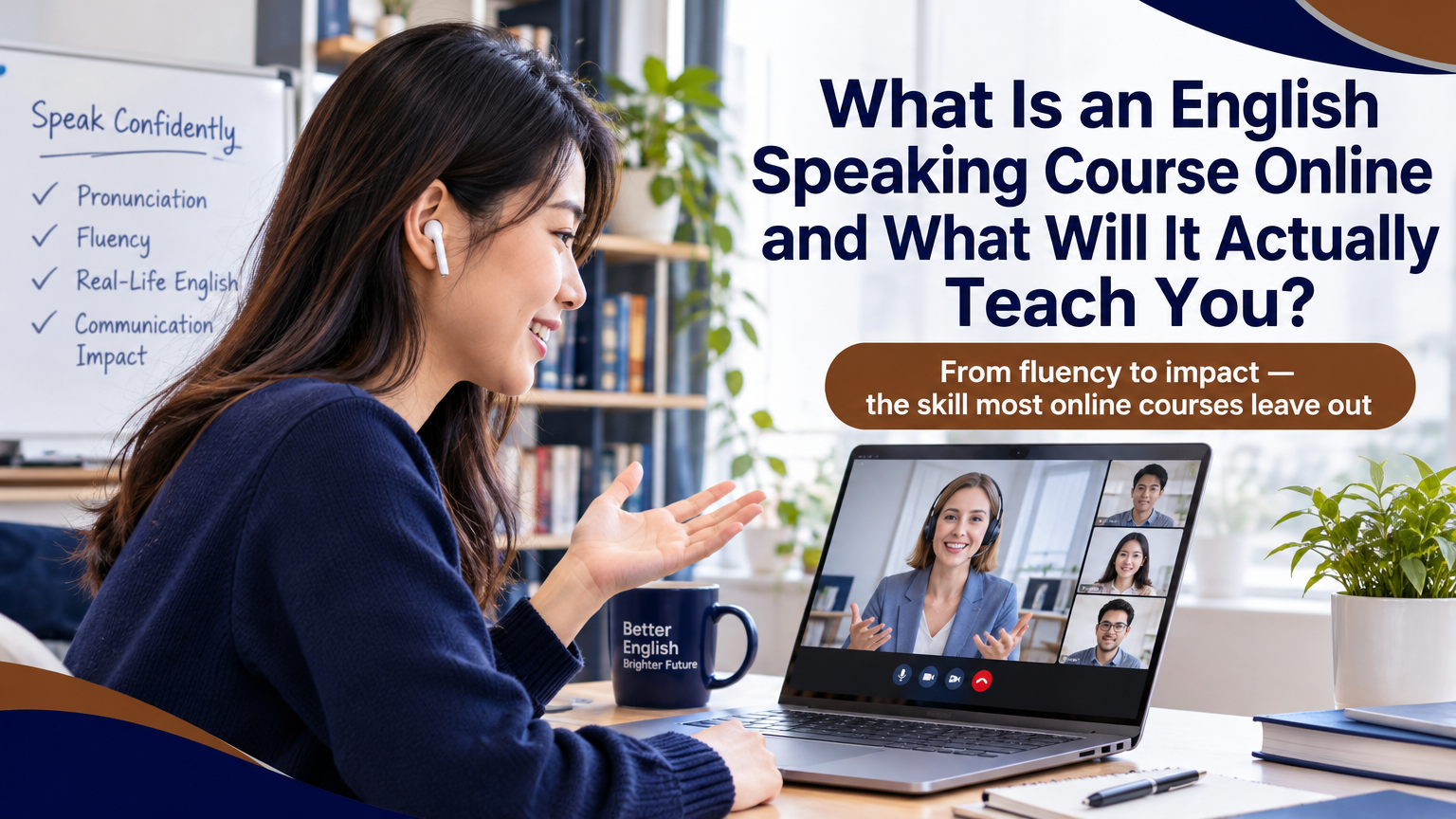
What Is an English Speaking Course Online and What Will It Actually Teach You?
What Is an English Speaking Course Online and What Will It Actually Teach You?
An English speaking course online is a structured program that builds spoken fluency, pronunciation, and conversational confidence through live or recorded sessions delivered over the internet. The best programs go further than grammar — they train real-world delivery, message clarity, and speaking presence for meetings, pitches, and high-stakes conversations.
From Fluency to Impact: What Most Online English Courses Leave Out
Jason Lim has spent 24+ years coaching presentation and speaking skills across 42 cities globally. When a franchisee he coached found the right words and delivery, what started as a small conversation became a partnership deal that grew far beyond anyone's expectations. If your English is already functional but you still lose the room on a call or pitch, the gap is not grammar — it is speaking skill.
What Does an English Speaking Course Online Actually Teach?
Picture a sales rep in Ho Chi Minh City, logging in at 8 PM for a live session. The trainer drops a prompt: explain your product to a sceptical buyer who just said "send me an email instead." She speaks. Gets feedback. Tries again. That loop — real prompt, real feedback, real pressure — is the engine of a good English speaking course online.
Most credible online programs cover these core areas:
| Skill Area | What You Practise | Why It Matters |
|---|---|---|
| Pronunciation and clarity | Stress, rhythm, intonation | First impressions land in seconds |
| Fluency drills | Timed speaking, retelling, role-play | Reduces hesitation under real pressure |
| Vocabulary in context | Business and conversation phrases | Words that land in real situations |
| Live conversation practice | Peer dialogue, instructor Q&A | Speaking is two-way; listening is half of it |
| On-camera delivery | Eye contact, posture, pace on video | Most professional conversations now happen on screen |
Practical takeaway: If your English speaking course online never puts you into live speaking situations with real feedback, it is a listening class with a speaking label. The reps matter more than the rules.
How Is an English Speaking Course Online Different from a General English Class?
A general English class covers reading, writing, listening, and speaking together. An English speaking course online narrows the focus to spoken output — more talking, more feedback, less essay-marking. The difference matters because speaking skill is not built by reading about speaking. It is built by speaking, repeatedly, under conditions that simulate real conversations.
That matters more now than ever. Communication ranked as the most in-demand skill on LinkedIn for both 2024 and 2025, according to LinkedIn Talent Insights as cited by VoxBooster Public Speaking Statistics 2026. At the hiring stage, the NACE Job Outlook 2025 found that more than three-quarters of employers named communication a critical attribute for new hires, with more than two-thirds specifically screening for verbal communication skills — not written, verbal.
Yet most learners still avoid the spoken reps. The Preply Public-Speaking Survey 2024 found that 63% of Gen Z respondents would avoid public speaking altogether if they did not have to do it. That avoidance is a career tax. Every pitch rushed through, every meeting where you held back, every sales call spent hiding behind slides is a compounding cost. Even so, the gap is there — and it is wide open for those who close it.
What Does an English Speaking Course Online Still Leave Out?
Most online English speaking courses stop at fluency. That is necessary — but it is not sufficient. You can speak clearly and still lose a client. You can speak fluently and still fail to close. Think of it like driving: a Gosu-level driver wins in any car because the skill is in the hands, not the engine. Fluency gets you into the room. Presentation skill is what wins it.
The skills most online English courses do not teach:
- How to structure a message so the listener remembers the point, not just the words
- How to handle objections in real time without losing composure or pace
- How to read the room on a video call and adjust delivery mid-conversation
- How to close — moving from a good conversation to a signed commitment
These are presentation and speaking skills. They are what separates a rep who speaks good English from one who closes with it.
Related:
The right English speaking course online will take you from hesitant to fluent. But if your goal is to close deals, win clients, or lead a room, that is where the next layer of training begins.
Ready to Move from Fluent to Closing?
When a franchisee trained with Jason, a conversation that could have been dismissed became the opening move of a major deal — because the words finally landed the way they were meant to. That is what speaking skill does. It is not about speaking more. It is about speaking in a way that moves people to act.
Sources
- VoxBooster, Public Speaking Statistics 2026 — LinkedIn Talent Insights 2024-2025 (communication #1 in-demand skill); NACE Job Outlook 2025 (75%+ employers name communication critical; 2 in 3 seek verbal communication skills)
- Preply, Public-Speaking Survey 2024 — 63% of Gen Z respondents would avoid public speaking if they did not have to
- Jason Lim — Future of Selling, Presentation Skills Coaching Programme — credibility cue: 24+ years coaching, 42 cities globally; franchisee partnership result verified on live page


