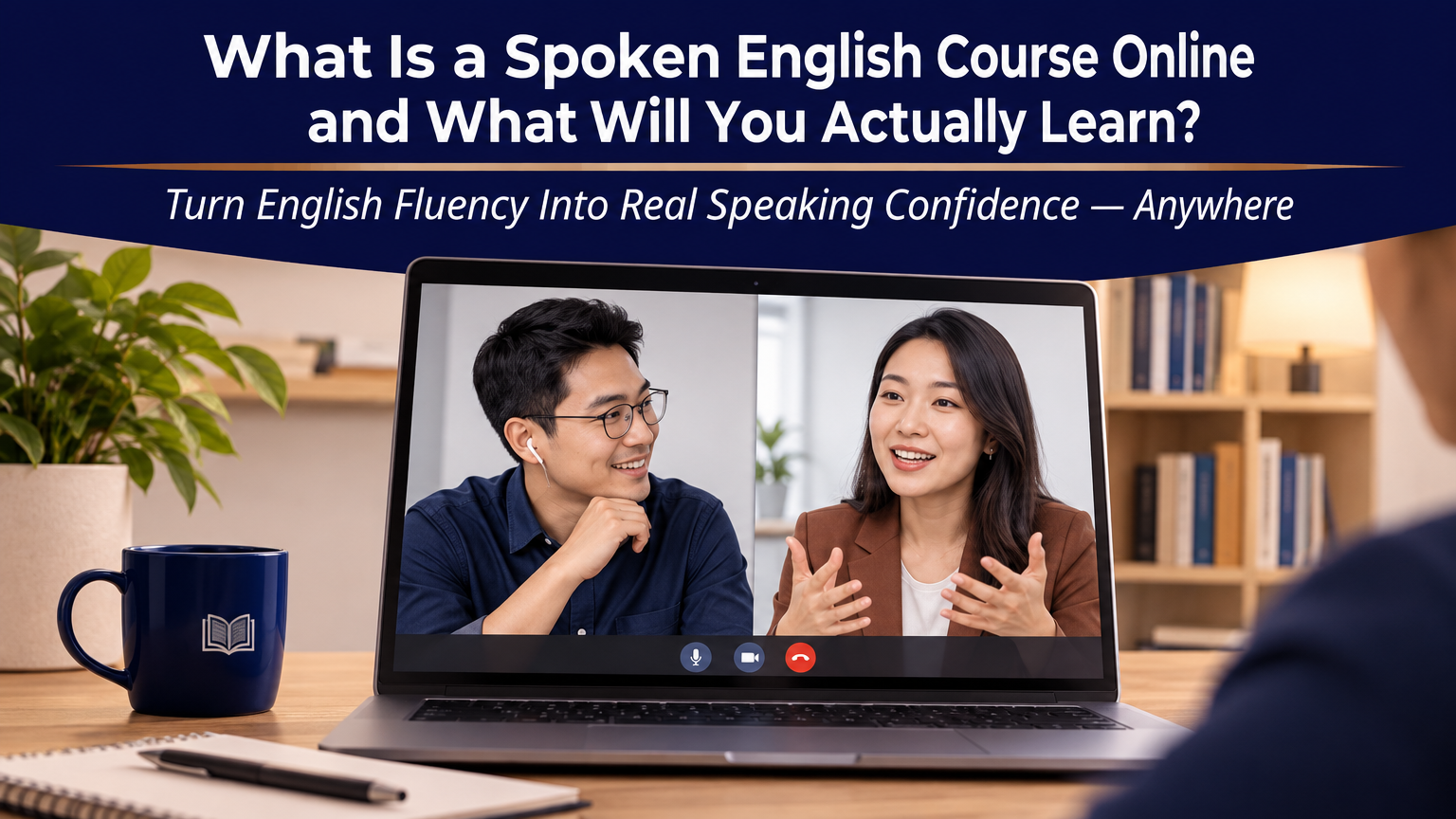
What Is a Spoken English Course Online and What Will It Actually Teach You?
What Is a Spoken English Course Online and What Will It Actually Teach You?
A spoken English course online teaches fluency, conversational confidence, pronunciation, and real-world communication — delivered live or on-demand through video. The best go further: they train message structure, delivery presence, and high-stakes speaking for sales calls, presentations, and client meetings. For founders and reps in their 20s and 30s, it is often the fastest path from knowing English to winning with it.
Ready to turn fluency into deals?
Jason Lim has spent 20+ years coaching presenters and sales teams across 42 cities globally. A franchisee he coached turned a stalled project into a major partnership deal — not by changing the product, but by changing how they presented it. If your English is good enough but your impact in meetings or presentations is not, the gap is a skills problem — not a language problem.
See the Presentation Skills Coaching ProgrammeLinkedIn named communication the number-one in-demand skill for both 2024 and 2025 (LinkedIn Talent Insights, via VoxBooster Public Speaking Statistics 2026). The NACE Job Outlook 2025 found that more than three-quarters of employers call communication a critical attribute for new hires, and more than two in three specifically look for verbal communication skills — also reported by VoxBooster. The opportunity is real. Yet the Preply Public-Speaking Survey 2024 found 63% of Gen Z respondents would avoid public speaking altogether if they could. Even with one of the most valuable skill gaps in the market wide open, most people are still opting out. That gap is exactly the lane a spoken English course online was built for.
What does a spoken English course online actually teach?
Picture a startup sales rep in Taipei joining a live cohort at 7 PM. She is on camera. The trainer gives a prompt: pitch your product to a sceptical buyer who just said, I will think about it. She speaks. She gets specific, timestamped feedback on her pacing and word choice. She tries again. That loop — speak, observe, correct, repeat — is the core engine of a good spoken English course online.
Most credible courses cover these foundations:
| Skill Area | What You Practise | Why It Matters |
|---|---|---|
| Pronunciation and clarity | Stress, rhythm, intonation | First impressions land in seconds |
| Fluency drills | Timed speaking, retelling, role-play | Reduces hesitation under pressure |
| Vocabulary in context | Business, negotiation, presentation phrases | Words that land in real situations |
| Live conversation practice | Peer and instructor dialogue, Q&A | Speaking is two-way — listening is half of it |
| On-camera delivery | Eye contact, posture, pace on video | Most deals now happen on screen, not in a room |
Practical takeaway: If your spoken English course online is not putting you into live speaking situations every session — real prompts, real feedback, real pressure — it is a listening class with a speaking label. The reps matter more than the rules.
Who actually benefits from taking one online versus in-person?
The online format unlocks the course for people who could never access in-person options — night-shift founders, travelling executives, reps across Southeast Asia who live outside a major English-speaking city. The core benefit is the same either way: structured reps with feedback. But the online format adds scheduling flexibility and often access to a higher level of trainer or cohort than local options provide.
These four groups benefit most:
- Non-native English speakers in sales roles — fluency gaps create hesitation at the moment of close, and hesitation loses deals.
- New sales reps in their 20s and 30s — pitching on video calls or in front of a client requires real-time verbal agility, not textbook correctness.
- Executives and founders — investor presentations, board updates, and client pitches require command of English under pressure, not just grammar proficiency.
- Freelancers and consultants — when you are the product, how you speak is part of the proposition.
Choosing a better tool will not substitute for skill. Knowing more vocabulary does not automatically make you fluent in a room. Like learning to drive: understanding the highway code and handling a live negotiation at speed are two different things. A spoken English course online gives you the wheel-time.
What separates a strong course from a mediocre one?
Most courses stop at language. The strongest ones teach communication. Here is the contrast:
| What most courses teach | What strong courses add |
|---|---|
| Grammar and vocabulary | Message structure and audience reading |
| Pronunciation drills | Voice projection and pace under pressure |
| Conversation role plays | Sales calls, pitches, and live Q&A practice |
| Listening exercises | Active listening and strategic pausing |
| Test preparation (IELTS, TOEFL) | On-camera and meeting presence |
The right-hand column is where deals get closed and careers move forward. NACE data confirms employers are not just asking whether you can speak English — they are asking whether you can communicate. That is a higher bar than most language courses are built to clear.
Use this checklist before you commit to a course:
- Live speaking time per session — aim for 50% or more spent actually speaking, not watching instruction.
- Real-world scenarios — pitches, presentations, meetings. If the drills do not mirror your actual situations, the gains stay in the classroom.
- Specific, actionable feedback — good job is not feedback. Your pace dropped at the close — here is what to do instead, is feedback.
- Small cohort or 1-to-1 access — in a room of 30, you do not get enough reps. Look for cohorts under 15 or dedicated 1-to-1 time.
- Application to your actual job — a sales rep and a PhD student need very different vocabulary and pressure scenarios.
Related:
See the full coaching programme: Future of Selling — Presentation Skills Coaching Programme (Jason Lim)
Also read: What Is a Spoken English Class and What Will You Actually Learn?
Also read: What Is a Speaking English Course and What Will It Actually Teach You?
English fluency is the entry ticket. Presentation skills are what win the deal.
If you have done the work to learn English and you are still being ghosted, losing deals, or feeling invisible in meetings, the problem is usually not your vocabulary — it is how you structure, deliver, and command the room. Founders and sales professionals who have worked with Jason Lim leave able to present with the kind of confidence that moves people to yes. That transformation is available to you, wherever you are.
Explore the Presentation Skills Coaching ProgrammeSources
- VoxBooster, Public Speaking Statistics 2026 — citing LinkedIn Talent Insights 2024-2025 (communication the number-one in-demand skill) and NACE Job Outlook 2025 (more than 75% of employers; more than two in three seek verbal communication skills)
- Preply, Speak with Confidence: Tackling the Public Speaking Phobia (2024) — 63% of Gen Z would avoid public speaking if they could


