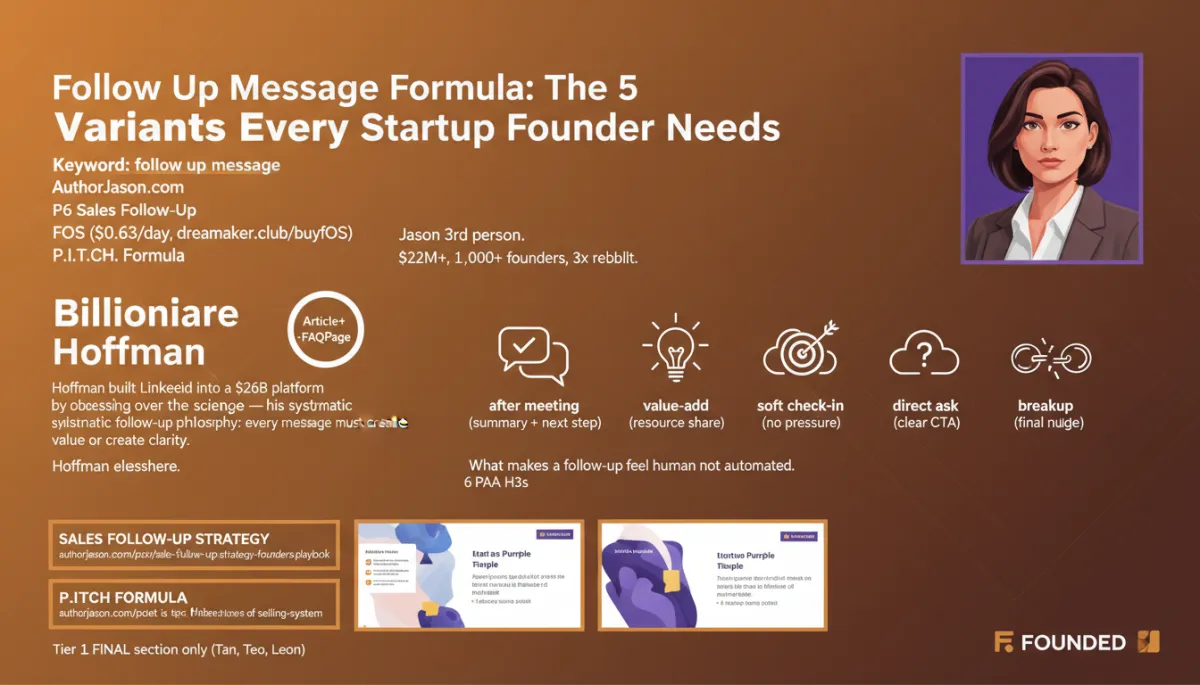
Follow Up Message Formula: The 5 Variants Every Startup Founder Needs
Sales, Follow Up Message, Startup Founders
Follow Up Message Formula: The 5 Variants Every Startup Founder Needs (Inspired by Billionaire Reid Hoffman)
Billionaire Reid Hoffman built LinkedIn into a $26B platform by obsessing over the science of messaging — especially follow-ups. His philosophy is simple and ruthless: every message must either create value or create clarity. For startup founders trying to close customers, investors, or hires, that principle is the difference between “left on read” and “let’s move forward.”

Jason — the creator behind AuthorJason.com and the P6 Sales Follow-Up system — has helped 1,000+ founders generate $22M+ in revenue by treating follow ups like a product, not an afterthought. He has rebuilt his own follow-up engine three times, pressure-testing it with real founders, real pipelines, and real investor conversations. The result is a simple, repeatable playbook: five core follow up message variants every founder needs, across email, LinkedIn, and even the occasional follow up text message.
The Follow Up Message Formula Founders Can Actually Use
Most founders either don’t follow up enough, or they follow up in a way that feels automated, needy, or vague. Jason’s approach is grounded in Hoffman’s “value or clarity” rule, but translated into a practical toolkit for busy operators. He wraps it into his P.I.T.C.H. Formula — a modern P.I.T.C.H. Formula for selling that fits how buyers actually behave today, not in 1999.
The 5 Follow Up Message Variants Every Founder Needs
Think of these five variants as your core “moves.” You do not need 37 templates — you need five strong ones you can adapt in your own voice. Each variant includes an email and LinkedIn template you can personalize in under two minutes.
1. After Meeting Follow Up (Summary + Next Step)
Your follow up message after meeting is where momentum is either locked in or lost. The goal: show you listened, confirm what was agreed, and make the next step painfully easy to say “yes” to.
Email template:
Subject: Quick recap + next step
Hi [Name],
Thanks again for the time today — I appreciated hearing about [their situation/goal]. Here’s a quick recap to make sure I captured everything correctly:
• Current state: [1–2 bullets]
• Goals: [1–2 bullets]
• Constraints/timing: [1–2 bullets]
As discussed, the next step is [proposed action]. Here’s a link for [schedule / doc / trial]: [link].
If anything above looks off, I’m happy to adjust — otherwise I’ll move ahead on my side.
Best,
[Your name]
LinkedIn message template:
Great meeting you today, [Name]. Quick recap of what I heard: [1–2 bullets]. Next step we agreed on: [next step] — here’s the link: [link]. Let me know if I missed anything.

Clear summaries and next steps dramatically increase reply and close rates.
2. Value-Add Follow Up (Resource Share)
This is your “I was thinking of you” message. No ask, just value. Hoffman would call this compounding trust — you show up with something useful even when you could have stayed silent. Jason builds this into his sales follow-up strategy as a non-negotiable touchpoint.
Email template:
Subject: Thought this might be useful
Hi [Name],
You mentioned [specific challenge] — this article/tool/template came to mind:
[Link] + one line on why it’s relevant.
No need to reply; just wanted to pass it along in case it helps.
Best,
[Your name]
LinkedIn message template:
Saw this and thought of our conversation about [topic]: [link]. The section on [specific part] lines up with what you’re solving for.
3. Soft Check-In Follow Up (No Pressure)
Deals stall. Inboxes overflow. A soft check-in keeps the thread alive without guilt or pressure. It respects their world while signaling that you are still here, still interested, and still professional. This is often where a short, respectful follow up text message can work if you already have that level of relationship and consent.
Email template:
Subject: Quick check-in
Hi [Name],
Hope things are going well on your side. Just circling back on [proposal / conversation] from [date].
Totally understand if priorities have shifted — if it’s still on your radar, I’m happy to answer questions or adjust scope.
Best,
[Your name]
LinkedIn message template:
Hi [Name], hope your week’s going smoothly. Wanted to gently check in on [topic]. No rush at all — just keeping this on your radar.
4. Direct Ask Follow Up (Clear CTA)
At some point, you must ask. Hoffman’s clarity rule applies hard here — your recipient should know exactly what you want and how to respond in under five seconds. Jason’s P6 framework bakes this into every sequence as the “decision moment.”
Email template:
Subject: Are you open to moving forward on this?
Hi [Name],
Based on our conversations, I believe [solution] can help you [specific outcome]. To move forward, we’d propose:
• Scope: [1 line]
• Timing: [1 line]
• Investment: [1 line]
Are you open to moving ahead with this plan?
If yes, I can send over [agreement / pilot plan] today. If not, totally fine — a quick “not now” also helps me plan.
Best,
[Your name]
LinkedIn message template:
Given what we discussed about [goal], would you be open to kicking off [pilot / next step] this month? If so, I’ll send a simple plan you can react to.
Direct, respectful asks reduce back-and-forth and speed up decisions.
5. Breakup Follow Up (Final Nudge)
The breakup message is not about manipulation — it is about clarity. You release them from the thread, and you release yourself from chasing ghosts. Ironically, this is often the message that gets a response, because it removes pressure and forces a simple decision.
Email template:
Subject: Should I close this out?
Hi [Name],
I have not heard back on [topic], so I’ll assume timing is not right and close the loop on my side.
If things change later, I’m happy to revisit — no pressure at all.
Thanks again for the earlier conversations,
[Your name]
LinkedIn message template:
I’ll close this out on my side for now so I’m not cluttering your inbox. If priorities shift, feel free to reach back out anytime.
Timing Guide: When to Send Each Follow Up Message
- After meeting: within 2–24 hours while details are fresh.
- Value-add: 3–7 days after the meeting, or in place of a “just checking in” email.
- Soft check-in: 5–10 days after no response to a proposal or question.
- Direct ask: once you have enough context and mutual interest, usually after 1–2 earlier touchpoints.
- Breakup: 2–3 weeks after your last unanswered follow up message, depending on deal size and cycle.
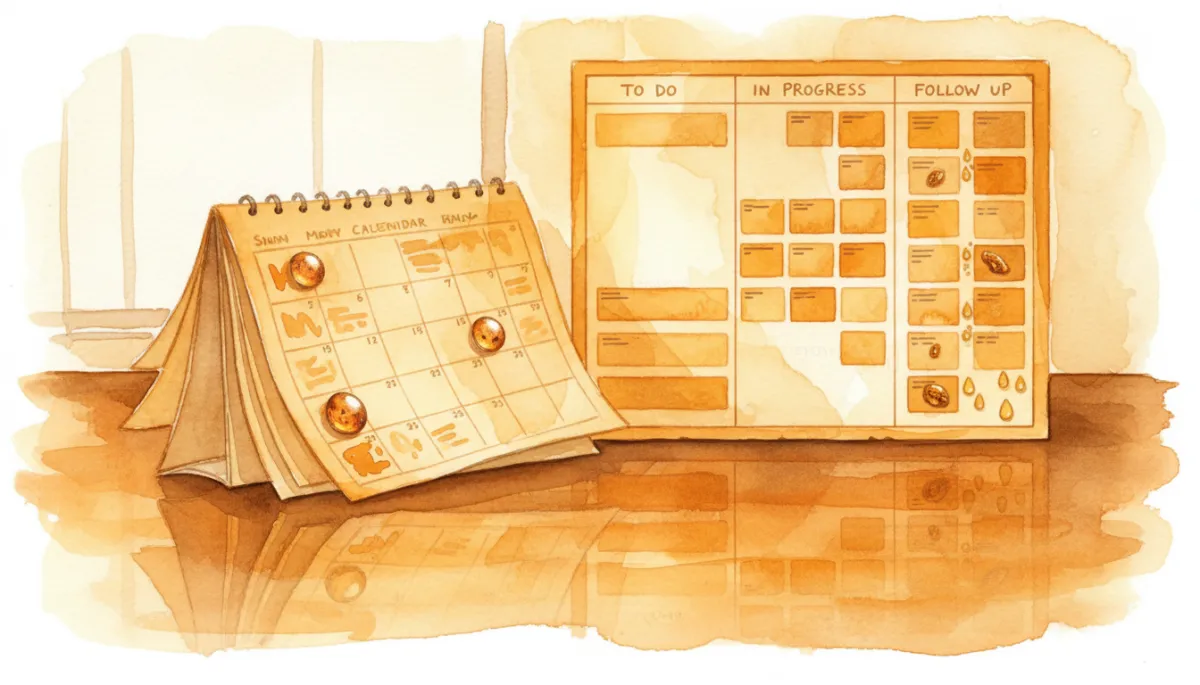
Structured timing beats random chasing — systems protect your pipeline.
What Makes a Follow Up Feel Human, Not Automated
Founders worry that using templates will make them sound robotic. The opposite is true — templates free up mental space so you can add real specificity. The “human layer” comes from four simple moves:
- Reference something they actually said, not generic “your business.”
- Use plain language — short sentences, no corporate jargon.
- Respect their time — skim-friendly bullets, one clear ask at most.
- Accept “no” gracefully — it shows you are a peer, not a spammer.
Hoffman’s standard applies here again: if your message does not create value or clarity, do not send it. Jason’s P6 system simply operationalizes that rule across dozens of conversations at once.

Templates plus personalization give you scale without losing authenticity.
People Also Ask: Follow Up Message FAQs for Founders
How soon should I send a follow up message after meeting someone?
Within 24 hours is ideal — 2–4 hours is even better. You stay top of mind, and you signal that you are organized and serious. A short recap plus clear next step is enough; you do not need a novel.
How many times is it okay to follow up with a prospect or investor?
Jason typically recommends 4–6 touches over 2–4 weeks, mixing after-meeting, value-add, soft check-in, and direct ask messages. After that, a respectful breakup follow up protects the relationship while freeing your attention for warmer opportunities.
Should I send a follow up text message or keep it to email and LinkedIn?
Text is more personal, so reserve it for relationships where you already have rapport and explicit permission. A brief, respectful follow up text message can work well for confirming logistics or nudging a known contact, but avoid pitching cold over SMS.
What subject lines work best for follow up emails?
Simple, specific subject lines usually outperform clever ones. Examples: “Quick recap + next step,” “Thought this might help with [topic],” or “Should I close this out?” They set clear expectations and respect the recipient’s time.
How do I follow up without feeling pushy or desperate?
Anchor on service, not pressure. Offer value, summarize clearly, and always give an easy “no” option. When your message is about helping them make a good decision — even if that decision is “not now” — it reads as professional, not needy.
Can I automate my follow up messages and still sound human?
Yes — if you automate structure, not sincerity. Use tools to schedule the five variants, then personalize the first 1–2 sentences with real context. Systems like Jason’s P6 Sales Follow-Up are designed exactly for this blend of reliability and humanity. For deeper reading on modern selling systems, see how the best sales teams structure follow ups and how founders adapt those patterns, or explore investor-focused guidance on building long-term deal flow.
Tier 1 Founders, P6 Follow-Up, and Your Next Step
Jason has seen the same pattern across Tier 1 founders like Tan, Teo, and Leon — they treat follow ups as a core asset, not a side task. They run a simple, repeatable system, they lean on proven variants, and they keep Hoffman’s rule in the back of their minds: every message must create value or create clarity.
If you want that system done for you, Jason built FOS — a tiny, leverage-heavy follow-up engine that runs for less than $0.63/day. You can get instant access at dreamaker.club/buyfos and plug it into your existing pipeline in a single afternoon. It is the same backbone he uses with 1,000+ founders, rebuilt three times to match how buyers actually respond today.
If all you do next is implement the five variants in this article, you will already be ahead of most founders. If you want the full P6 Sales Follow-Up system Jason uses with Tier 1 operators — and a messaging philosophy aligned with billionaire Reid Hoffman’s “value or clarity” rule — you know where to start.


