
How to Sell Biotech: The Strategy Guide and Startup Survival Book for Biotech Founders Who Have Breakthrough Science but Can't Get Hospitals, Clinics, or Investors to Say Yes
Biotech, how to sell biotech, early-stage biotech sales, biotech founders sales strategy, selling to hospitals for startups
How to Sell Biotech: A Strategy Guide and Survival Playbook for Biotech Startups Whose Founders Have Breakthrough Science but Can’t Get Hospitals, Clinics, or Investors to Say Yes
Jason built the “Future of Selling” system to help biotech founders who feel stuck between powerful data and silent buyers. This guide explains how to sell biotech in 2026 when hospitals, clinics, and investors move slowly, even while the science races ahead.
Summary — How to Sell Biotech When No One Is Saying Yes
Most biotech founders don’t fail on the science; they fail at selling into complex hospital systems and investor ecosystems.
Jason’s “Future of Selling” system and P.I.T.C.H. formula help translate lab wins into patient outcomes, economic value, and clear decisions.
You’ll learn a 5-move biotech sales playbook, see how Patrick Soon‑Shiong sold Abraxane, and leave with next steps you can start today.
Why Brilliant Biotech Founders Struggle to Sell What They’ve Proven in the Lab
Jason keeps seeing the same story. A founder has world‑class data. Peer‑reviewed papers. Maybe even a successful pilot. But when they walk into a hospital boardroom, the room goes cold. Heads nod politely. No one commits. Email threads go silent for months.
Why Is Selling Biotech So Hard in 2026?
Biotech sales cycles are long, political, and heavily regulated. A single “yes” often needs approvals from clinicians, procurement, IT, finance, and risk committees. Deloitte’s research shows leaders are pushing hard on pricing, access, and AI‑driven efficiency — not just new assets. That makes every new product a risk to their fragile system, not just a shiny innovation.
What If Your Sales Skills Aren’t the Real Problem?
Jason teaches that most founders aren’t “bad at sales.” They’re just speaking lab language inside a system that buys based on patient outcomes, cost savings, and risk reduction. It’s like trying to pay for groceries with lab notes instead of money. The cashier respects the work, but the register won’t open.

Even strong data looks powerless when you don’t understand how hospital systems decide.
The Biotech Sales Mistake That Traps Great Science at the Pilot Stage
What’s the Biggest Sales Mistake Biotech Founders Make?
The big mistake is treating pilots as final proof instead of the first chapter of a business case. Founders think, “We ran a three‑month pilot. Results were great. Of course they’ll roll us out.” But hospitals and clinics are under brutal cost pressure. McKinsey and others show they’re reshaping models around AI, access, and pricing at the center. No one wants another half‑integrated tool that drains budgets and staff time.
Why Do Pilots Quietly Die Instead of Turning into Contracts?
Jason sees pilots fail because no one owns the “pilot to partnership” story. There’s no clear ROI calculation. No map of decision‑makers. No plan for procurement, IT, and legal. The science is proven, but the path to budget isn’t. So the pilot becomes a nice memory instead of a three‑year contract.
💡 Pro Tip: Jason tells founders to treat pilots like job interviews. You’re not just proving competence. You’re making it easy for the system to say, “We know exactly how to hire this.”
How Patrick Soon‑Shiong Sold a New Cancer Drug into a Skeptical Medical System
What Can Biotech Founders Learn from Patrick Soon‑Shiong?
Patrick Soon‑Shiong started with a small biotech company and a big idea. Abraxane, the protein‑bound form of paclitaxel, challenged the old view of how to deliver chemotherapy. Many experts didn’t believe it would be safer or more effective. Hospitals were cautious. Oncologists had deeply ingrained habits. Regulators were strict. From the outside, it looked impossible.
He didn’t just shout “innovation.” He built evidence. He focused on outcomes for breast cancer and other tumors. He showed how Abraxane could improve response rates and manage toxicity. Over time, that steady, data‑driven selling turned skepticism into trust. The company behind Abraxane was later sold for around $4.9 billion.

Patrick Soon‑Shiong won hospital trust by tying new science to clear cancer outcomes.
How Do Elon Musk and Bill Gates Mirror This Path?
Elon Musk hit a similar wall with SpaceX. Government buyers and NASA were deeply skeptical of reusable rockets. He didn’t win them with slogans. He won with data, demonstrations, and repeated proof that the risks were controllable. Over time, that turned into multi‑billion‑dollar contracts in one of the most risk‑sensitive sectors on earth.
Bill Gates, through Microsoft and later the Gates Foundation, learned how to sell massive health interventions to governments and ministries of health. He used evidence, modeling, and real‑world data to show how vaccines and public‑health programs could save both lives and money. That same mindset now shapes some of the largest health budgets in the world.
📌 Key Takeaway: These billionaires didn’t escape skepticism. They outgrew it with evidence, patience, and clear outcomes — the same muscles biotech founders need today.
The P.I.T.C.H. Formula: Jason’s Framework for Selling Biotech to Risk‑Sensitive Buyers
What Is the P.I.T.C.H. Formula in the “Future of Selling” System?
Inside the “Future of Selling” system, Jason trains founders on the P.I.T.C.H. formula (Preparation, Intention, Teaching, Closing, Habits). It’s a simple, grounded way to run complex sales without turning founders into pushy sales reps. Biotech buyers in 2026 are overloaded. Salesforce research shows most sales reps miss their quotas. Jason built P.I.T.C.H. so founders can sell with calm, clarity, and consistency in this noisy world.
Jason goes deeper into the P.I.T.C.H. formula and how to run the “Future of Selling” system at AuthorJason.com. For now, all you need to know is this: every biotech meeting can be prepared, intentional, educational, clearly closed, and supported by daily habits — even if you feel uncomfortable with selling today.
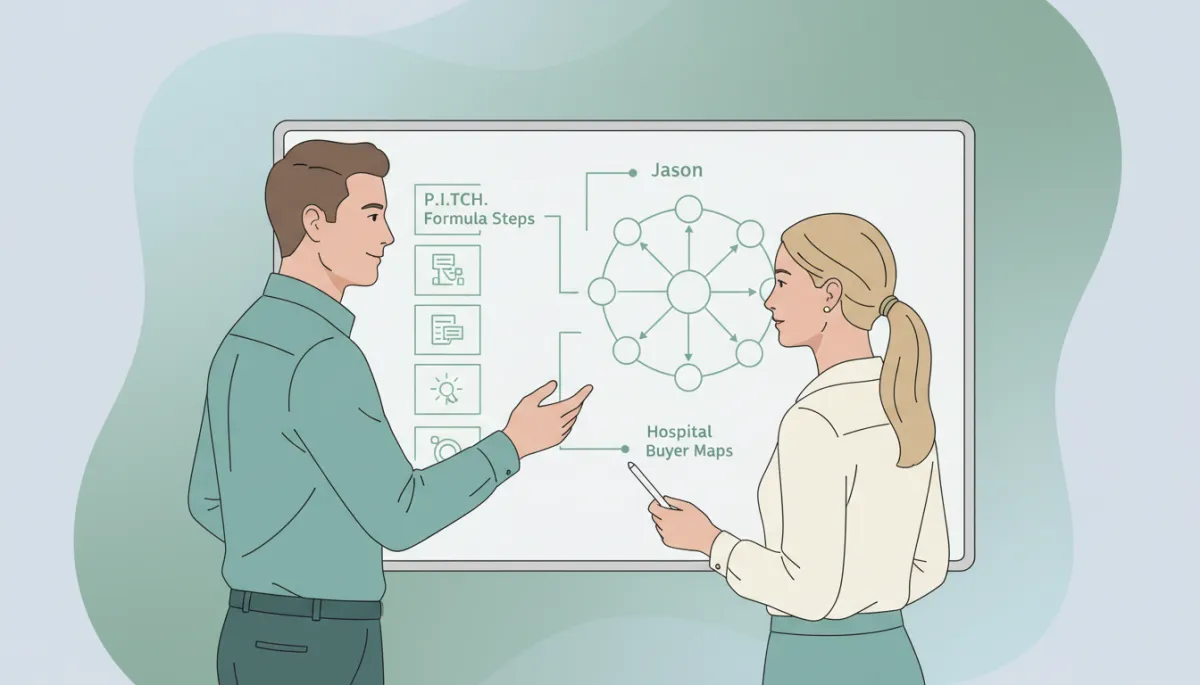
Jason turns complex biotech sales into simple, repeatable moves founders can practice.
A 5‑Move Biotech Sales Playbook for Founders
Jason built a five‑move playbook so founders can stop guessing. Think of it as the morning routine for your sales process. Simple. Repeatable. Forgiving when you miss a day. Powerful when you stick with it.
Translate the science into patient outcomes
Build the evidence packet
Map the decision‑makers
Turn pilot into partnership
Investor pitch vs. clinical buyer pitch
Move 1 — Translate the Science into Patient Outcomes (Speak the Buyer’s Language)
Hospital buyers don’t wake up thinking about your mechanism of action. They think about beds, staffing, waitlists, and readmission rates. Jason asks founders to rewrite their pitch into “before and after” stories a nurse or clinic manager can feel. Less jargon. More “here’s how many staff hours your team gets back each week.”
Move 2 — Build the Evidence Packet (Clinical Data + Economic Case)
In 2026, payers and providers are under intense cost pressure. EY data shows biotech revenues are rising, but expectations on value are rising too. Jason helps founders build an “evidence packet”: clinical outcomes, workflow impact, and economic modeling in a single simple narrative. Think of it like stacking proof on the kitchen table until no one can ignore it.
Move 3 — Map the Decision‑Makers (Who Actually Says Yes in a Hospital?)
Biotech sales are account‑based. There’s rarely a single hero buyer. Jason asks founders to map the real network: clinicians, department heads, procurement, IT, finance, risk, sometimes unions. Each has different fears. When founders see this on paper, confusion turns into a plan: who to educate, who to equip, and who needs the final business case.
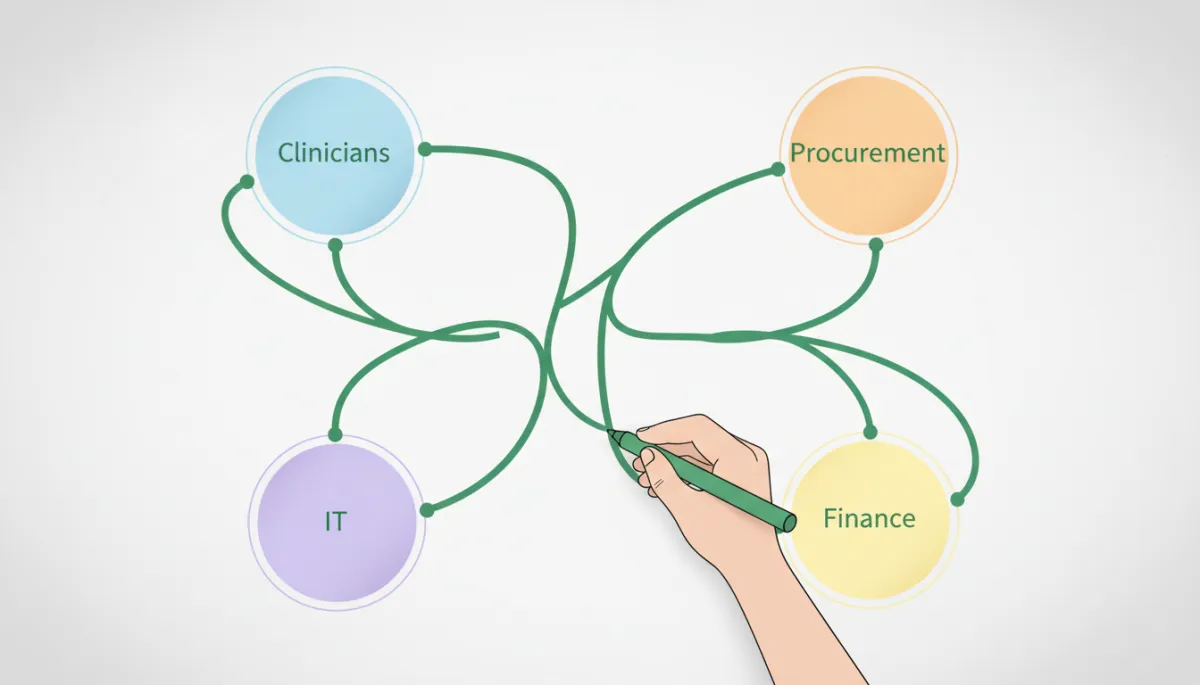
Turning every stakeholder into a clear map turns the vague “hospital buyer” into specific human conversations.
Move 4 — From Pilot to Partnership (How to Turn a 3‑Month Trial into a 3‑Year Contract)
Jason treats pilots like rehearsals for the renewal meeting. From day one, he has founders set success metrics, reporting cadence, and a clear “if we achieve X, we propose Y” path. That way, a three‑month pilot becomes a natural step toward a three‑year partnership, not an awkward “So… what now?” email.
Move 5 — Investor Pitch vs. Clinical Buyer Pitch (Two Completely Different Sales)
Investors care about market size, defensibility, and exit paths. Clinical buyers care about safety, workflow, and this year’s budget impact. Jason sees founders mixing the two and losing both. He helps them build two clear stories: one for capital markets, one for hospital rooms. Same core truth. Different angles.

Investors buy upside potential; clinicians buy safety and workflow — one founder, two stories.
Real Biotech Founders, Real Sales Wins — What Changes When Science Meets the System
What Happens When Founders Apply This Kind of Selling?
Since 2015, Jason has walked more than 1,000 founders through the “Future of Selling” system. Graduates have generated over $22 million in combined sales. Some arrived with zero revenue and a head full of shame. Others had pilots stuck for years. Jason himself hit rock bottom three times and rebuilt three times, which is why his teaching carries so much patience and realism.
More than 1,000 founders have used Jason’s system to move from stuck pilots to real revenue.
🏆 Fictional Founder Story: Maya’s Diagnostics Startup
Meet Maya, a fictional founder in Singapore building an AI‑powered diagnostics tool. Her technology picked up early cancer signals in imaging data. Stunning science. But three hospitals had “nice conversations” and then ghosted her. After working with Jason, she rewrote her narrative into patient outcomes, mapped every stakeholder, and set clear success metrics for the pilot. Within months, one hospital moved from a small trial to a multi‑year agreement. Same science. New way of selling.
Jason keeps reminding founders: you’re not late. You’re at the beginning of your sales journey. Even Salesforce data shows 76% of sales reps miss their quotas. If full‑time reps struggle, of course a scientist‑founder will too. You’re allowed to learn this slowly and still win.
Start Selling Your Biotech Today
New! → September 2026 → “Dear Founders…” Jason built the “Future of Selling” system for quiet, serious builders — the ones who care more about patients than personal branding. Do you also feel deeply frustrated having breakthrough science that no one wants to fund or buy in 2026?
Many founders Jason meets felt like they were failing, even with strong data. They felt alone until they saw how many biotech and deep‑tech teams were stuck at the same wall. They discovered that a simple sales system — no more brute‑force hustle, no more jargon — was enough to turn pilots into contracts. Jason has hit rock bottom three times and come back three times, which is why the “Future of Selling” system is designed to be gentle, not overwhelming.
Salesforce reports show that 76% of reps don’t hit quota. The game is hard even for professionals. The “Future of Selling” system is built so founders can win without becoming someone else. Over 1,000 founders since 2015. More than $22 million in combined sales. Jason: 3× rock bottom, 3× comeback. All for $19 a month — about $0.63 a day — with no risk. You can start today through this lin
k.
If you want to go deeper into selling startups outside biotech, Jason also explains how to sell your startup across other industries. The core principles stay the same: prepare, set intention, teach, close, and build habits you can actually sustain.
New! → September 2026 → “Dear Founders…” If you’re reading this from a lab bench, a coworking desk, or a small office in Singapore or anywhere else, Jason wants you to know this: you’re not late. You’re just at the beginning of learning the buyers’ language. The “Future of Selling” system and the P.I.T.C.H. formula are built to walk with you, step by step, so hospitals, clinics, and investors can finally see what you’ve been building all along. Start for $19 a month ($0.63 a day) through dreamaker.club/buyfos — and give your science the sales story it deserves.


