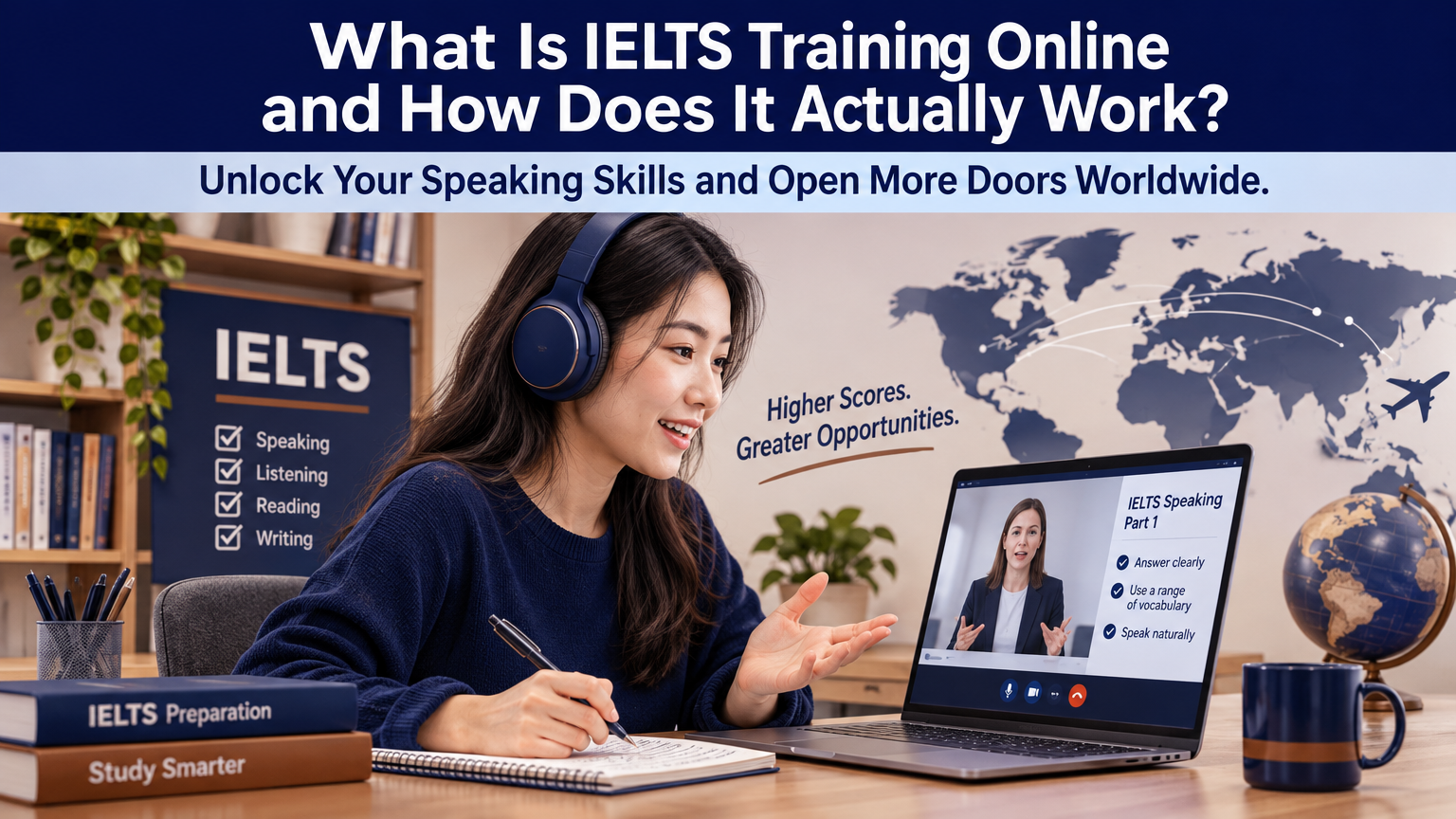
What Is IELTS Training Online and How Does It Actually Work?
What Is IELTS Training Online and How Does It Actually Work?
IELTS training online is a structured preparation program that teaches you the listening, reading, writing, and speaking skills needed to achieve your target band score — delivered over the internet through live sessions, video lessons, or self-paced modules. The best programs go beyond test technique to build the real speaking confidence that matters far beyond exam day.
🌟 From the Coaching Floor
A franchisee student came to Jason Lim’s coaching with a stalled pitch. After training on presentation and speaking skills, the same pitch became a transformational partnership deal. The room didn’t change. The speaking did.
Jason Lim has 20+ years of coaching and teaching experience and works with clients across 42 cities globally — helping founders, executives, and sales professionals speak with clarity, authority, and real impact.
The numbers make the stakes clear. The British Council delivered 2.3 million IELTS tests in the 12 months to March 2025, according to its Annual Report 2024–25 (via LingoBright). That’s millions of people competing for the same visas, university offers, and professional registrations — and speaking is one of the four sections every single one of them must pass.
What Does IELTS Training Online Actually Cover?
A strong IELTS training online program builds four interlocking skills:
- Listening — processing accents, following fast exchanges, catching specific information under time pressure without rewinding.
- Reading — skimming and scanning complex passages efficiently within tight time limits, without getting trapped by unfamiliar vocabulary.
- Writing — producing coherent, structured responses to Task 1 (data description or letter) and Task 2 (essay) that meet band descriptors for coherence, grammar, and lexical range.
- Speaking — holding a fluent, natural conversation across three parts of an oral interview: an introduction, a short monologue, and an extended discussion on abstract topics.
Online delivery allows candidates to study around work and family schedules, choose instructors who specialize in their weakest section, and revisit recorded sessions before test day. The flexibility is real — but it creates a risk. Flexible is not the same as sufficient.
Why Is the Speaking Section the One Most Candidates Underestimate?
Imagine spending months perfecting your grammar, your essay structure, your reading speed — then walking into a live interview room with an examiner who asks you an unexpected follow-up question. Your vocabulary is there. Your grammar is there. Your composure disappears.
That’s the gap most IELTS training online programs do not close: the gap between knowing the language and speaking it fluently under real pressure.
The IELTS Voices 2026 survey of 8,395 test takers and prospective candidates across 165 countries found that 67% reported improvement in speaking confidence, academic or professional writing, or both, as a direct result of preparing for IELTS (source: Nektar English, citing IELTS Voices 2026; primary data at ielts.org). That’s a meaningful outcome — but notice: 67% improvement still leaves a third of candidates unchanged, and “improvement” is not the same as “confident enough to perform under live interview conditions.”
The speaking band score is assessed live, by a trained examiner, in real time. No amount of grammar drilling makes you fluent under observation. That takes deliberate, observed practice — exactly what most self-paced IELTS programs skip.
What Should a Strong IELTS Training Online Program Include?
Use this quick-reference table when you evaluate options:
| Feature | Why It Matters |
|---|---|
| Live mock speaking interviews | The only way to train for a live interview is to practice live interviews |
| Examiner-style feedback | Generic encouragement does not raise your band score; specific feedback on fluency, lexical resource, and coherence does |
| Section-specific strategy | Listening and reading are test skills as much as language skills; strategy cuts wasted time |
| Real-world speaking application | Your IELTS certificate unlocks a job, a university place, or a visa — speaking well on paper matters far less than speaking well in the room |
| Flexible access to replays | Reviewing sessions before test day reinforces the corrections, not just the content |
The practical takeaway: an IELTS score is a passport to opportunity. But the speaking skills you build in preparation — clarity, structure under pressure, fluency in live conversation — are the skills that determine what you do with that opportunity after you arrive.
Related:
👉 Build Your Presentation and Speaking Skills with Jason Lim — Coaching for Founders, Executives & Sales Professionals
👉 What Are Coaching Classes and Are They the Best Way to Build Your Speaking Skills?
👉 What Is a Speaking English Course and What Will It Actually Teach You?
🌟 Ready to Speak with Real Confidence — In the Exam Room and Beyond?
Your IELTS certificate is a door. Speaking with confidence, presence, and structure is what gets you through the next one — the interview, the meeting, the pitch. Jason Lim’s coaching helps startup founders, executives, and sales professionals close that gap: the gap between knowing the language and commanding the conversation.
Clients across 42 cities globally have transformed how they speak under pressure. The question is whether you want to be next.
Sources
- LingoBright — IELTS Test Taker Statistics Worldwide and by Country 2026 (citing British Council Annual Report and Accounts 2024–25)
- Nektar English — IELTS Statistics 2026: Test Taker Data, Scores & Reliability (citing IELTS Voices 2026, ielts.org)
- Jason Lim — Future of Selling — Presentation Skills Coaching Program


