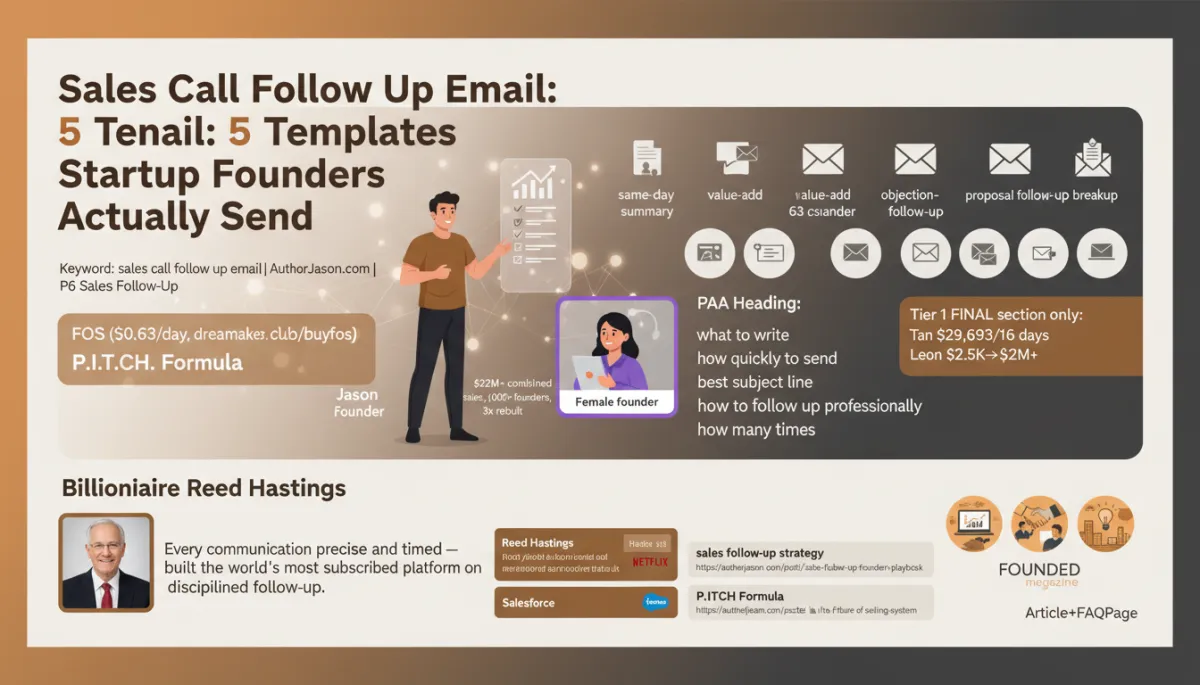
Sales Call Follow Up Email: 5 Templates Startup Founders Actually Send
Sales, Sales Call Follow Up Email, Startup Founders
Sales Call Follow Up Email: 5 Templates Startup Founders Actually Send (What Billionaire Reed Hastings Would Approve)
Every serious founder learns the same lesson—your sales call is only half the game. The rest is won or lost in the follow-up. Think about how Netflix grew under Reed Hastings: every communication precise, every touchpoint intentional, every follow-up timed. Your next sales call follow up email deserves that same discipline, even if you are still pre-seed and selling from your kitchen table.

Why Founder-Led Follow-Up Wins More Deals
Jason, the founder behind AuthorJason.com, has helped 1,000+ founders close over $22M in combined sales. He has rebuilt his own sales system three times, each time making it simpler and more founder-proof. One pattern keeps showing up—founders who treat the follow up email after sales call as a strategic asset close faster, at higher ACVs, and with less drama in the pipeline.
This article gives you five founder-tested templates you can paste into your CRM today: same-day summary, value-add, objection-handler, proposal follow-up, and breakup. They are built on Jason’s P.I.T.C.H. Formula—a practical way to keep every touchpoint Personal, Insightful, Timed, Clear, and Helpful.
The 5 Sales Call Follow Up Email Templates Founders Actually Use
1. Same-Day Summary Follow-Up Email
Your first sales follow up email template should land the same day as the call—while energy and details are still fresh. This email proves you listened, reduces buyer anxiety, and sets clear next steps.
Subject: Great speaking today — quick recap & next steps

Hi <First Name>,

Thank you for taking the time today — I appreciated how candid you were about <key challenge>.

Quick recap of what we covered:
1) Current situation: <1–2 lines in their words>
2) Goal: <1–2 lines on what “good” looks like>
3) Fit: <1–2 lines on how your product helps>

Next steps we agreed on:
- <Owner> will <action> by <date>
- I’ll <action> by <date>

As promised, here’s:
- Link to <resource / deck / short Loom>
- Case study on how we helped <similar customer> do <outcome>

If anything above looks off, reply and I’ll adjust. Otherwise, looking forward to <next meeting / decision date>.

Best,
<Your Name>
Founder, <Startup>
2. Value-Add Follow-Up Email (No Ask, Just Help)
This is where most founders go silent. Instead, send a short, useful email that moves the relationship forward without pressure. It shows up beautifully in your buyer’s inbox history when they are ready to decide.
Subject: Thought of you when I saw this

Hi <First Name>,

After our call about <topic>, I came across this and thought it might help:
- <1–2 sentence summary of article / playbook / benchmark>
- Link: <URL>

Specifically, check out <section / timestamp> — it speaks directly to <their challenge>.

No action needed on my side. If questions come up as you’re reviewing, I’m happy to dig in.

Best,
<Your Name>
Low-pressure, value-first follow-ups keep you top of mind without feeling pushy.
3. Objection-Handler Follow-Up Email
When a prospect says, “We’re not sure about budget,” or “We need to build this internally,” that is not the end—it is an invitation to clarify. A strong objection-handler email acknowledges their concern and reframes the decision with data and empathy.
Subject: Quick clarification on <their concern>

Hi <First Name>,

Thank you for being open about your concern around <objection>.

You’re right to flag it — teams that ignore this usually end up with:
- <Consequence 1>
- <Consequence 2>

Here’s how customers like <similar company> approached it:
- They <action they took>
- Result: <clear metric or outcome>

If it’s helpful, I can:
- Walk through the numbers behind <ROI / build vs. buy>
- Share a short example of how another team navigated this

Would a quick 10-minute call to unpack this be useful, or would you prefer a short Loom you can share internally?

Best,
<Your Name>
4. Proposal Follow-Up Email (Decision-Nudger)
Once your proposal is out, silence can feel brutal. This is where a structured sales call follow up email keeps deals from stalling. Your job is to make the decision easy, not to “check in” endlessly.
Subject: Quick alignment on the proposal

Hi <First Name>,

Sharing the proposal again here for easy access:
- Link: <proposal link>

Most teams in your position usually ask three questions before they move forward:
1) Are we solving the right problem?
2) Is the timeline realistic?
3) Is the investment justified by the outcome?

Based on our conversations, here’s how I see it:
- Problem: <1–2 lines in their words>
- Timeline: <key milestones>
- Investment vs. outcome: <simple ROI or risk reduction>

If it’s helpful, we can use our next call to either:
A) Confirm and lock in a start date, or
B) Tweak the proposal so it fits your constraints

Does <two time options> still work for you?

Best,
<Your Name>
5. Breakup Follow-Up Email (Respectful Close)
Eventually, a deal goes cold. A respectful breakup email protects the relationship, creates a clean close in your pipeline, and sometimes triggers a surprise reply. It is the closer every founder needs in their sales follow up email template library.
Subject: Closing the loop (for now)

Hi <First Name>,

I haven’t heard back on <project / proposal>, so I’ll assume priorities have shifted on your side.

No pressure to respond — I’ll close the loop on my end so you don’t keep getting follow-ups.

If things change and <problem we discussed> becomes urgent again, feel free to reach out. I’m always happy to revisit whether we’re the right fit.

Wishing you and the team a strong <quarter / launch / season>.

Best,
<Your Name>

Respectful breakups protect your brand and often reopen doors later.
PAA: Common Questions About Sales Call Follow Up Emails
What to write in a sales call follow up email?
Start with context (“Great speaking earlier today”), then recap what you heard in their words, confirm next steps, and add one helpful resource. Jason’s P.I.T.C.H. Formula keeps it simple: make it Personal, share one Insight, time it well, stay Clear, and be genuinely Helpful. Avoid long essays—three to six short paragraphs are enough for most deals.
How quickly should you send a follow up email after a sales call?
For your same-day summary, aim for within two hours of the call—maximum same business day. That rhythm matches how disciplined operators like Hastings treat communication. Value-add follow-ups can land 2–3 days later, objection-handlers within 24 hours of hearing the concern, and proposal nudges 2–4 days after sending the proposal, depending on deal size.
What is the best subject line for a sales call follow up email?
The best subject lines are clear, specific, and low-drama. Examples Jason sees working across founder pipelines:
- “Quick recap from today’s call”
- “Next steps for <company name>”
- “Thought of you when I saw this”
- “Quick alignment on the proposal”
Avoid clickbait or vague lines like “Checking in” or “Following up” when you can be more specific about the value inside the email.
How to follow up professionally after a sales call?
Professional follow-up is consistent, respectful, and anchored in their outcomes. Reference their goals, keep promises on timing, and always make the next step explicit. Tools like Salesforce or HubSpot can help you schedule and track follow-ups, but the tone is on you—concise, human, and outcome-focused. If you promised something on the call, lead with that in your email.
What is the best template for a sales call follow up email?
The “best” template is the one that matches where the deal actually is. Early-stage? Use the same-day summary. Mid-funnel? Use value-add or objection-handler. Late-stage? Use the proposal follow-up. When in doubt, Jason recommends starting with the same-day summary—it sets the tone for every other message in the thread and makes later follow-ups feel natural rather than random.
How many times should you follow up after a sales call?
For most B2B founder-led sales, Jason sees a simple pattern work well: same-day summary, one value-add, one objection-handler (if needed), one proposal follow-up, and one breakup. That is 3–5 thoughtful touches, not 15 spammy nudges. Enterprise cycles may require more, but each email should earn its place by adding clarity or value—not just asking, “Any updates?”.

A simple, intentional cadence beats random check-ins every single quarter.
Turn Templates into a Repeatable Founder Sales System
Templates are the start—not the system. Jason’s sales follow-up strategy turns these emails into a predictable pipeline engine. It is the same approach he used while helping founders:
- Move from sporadic deals to weekly, trackable opportunities
- Shorten sales cycles without discounting or chasing
- Build a calm, numbers-driven view of their pipeline
Systems like P.I.T.C.H. turn one-off wins into a repeatable founder-led sales engine.
Final Word: Discipline, Templates, and Founder-Led Follow-Up
Hastings built a subscription giant on disciplined, data-backed decisions—not guesswork. Your follow-up can operate the same way. With a clear sales call follow up email library, a simple cadence, and a founder who actually sends the emails, deals stop slipping through the cracks. They either close cleanly, or close respectfully, and both outcomes are wins for your pipeline.
If you want to go deeper into sales systems, check out Salesforce’s guidance on structured sales processes (Salesforce article) or this Forbes take on founder-led selling (Forbes article). Then bring it back to something you can execute daily.


