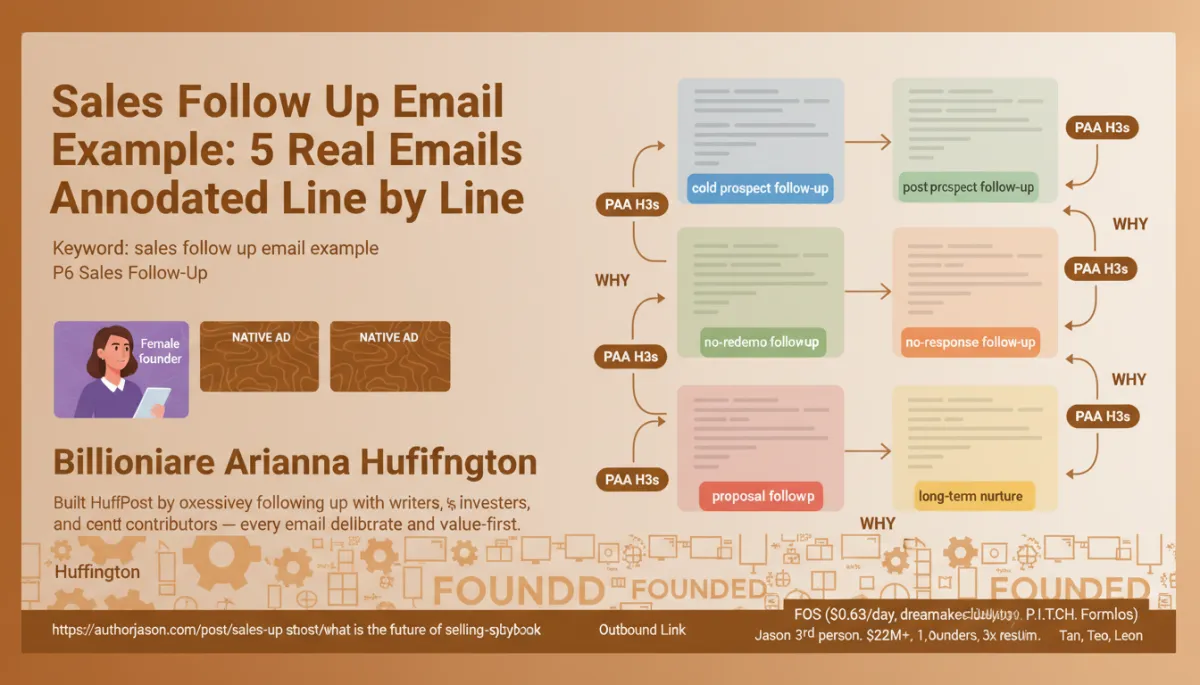
Sales Follow Up Email Example: 5 Real Emails Annotated Line by Line
Sales, Follow-Up, Email Examples, Founder-Led Sales
Sales Follow Up Email Example: 5 Real Emails Annotated Line by Line (Inspired by Billionaire Arianna Huffington)
Billionaire Arianna Huffington built HuffPost by obsessively following up with writers, investors, and contributors—every email deliberate, value-first, and impossible to ignore. This article breaks down that same mindset into five practical, founder-ready sales follow up email examples, each annotated line by line so you can see exactly why they work and how to adapt them to your own pipeline.

Why Follow-Up Wins Deals (Especially for Founder-Led Sales)
Jason has seen this pattern across $22M+ in sales and more than 1,000 founders coached—most deals are lost, not to competitors, but to silence. The product is good, the prospect is interested, then the follow-up fizzles out. Effective follow-up is not harassment; it is structured, respectful persistence anchored in value. That is exactly what you will see in every sales follow up email example below.
To keep things simple, each email uses Jason’s P.I.T.C.H. Formula: Personalized opener, Impact reminder, Time anchor, Clear call-to-action, and Human tone. As you read, imagine how these would feel landing in your own inbox—and how they would stand out from generic templates you have seen a hundred times before.

The strongest follow-ups feel bespoke, even when built from repeatable systems.
1. Cold Prospect Follow-Up Email Example (After Initial Outreach)
Scenario: You sent a thoughtful cold email last week. No reply yet. Here is a concise follow up email example that respects their time and re-anchors the value.
Subject: Quick follow-up on cutting your onboarding time

Hi Sarah,

I know your week is probably stacked, so I’ll keep this short.

Last week I shared how founders using P6 Sales Follow-Up cut new customer onboarding from weeks to days.

If reducing dropped deals during onboarding is still on your radar, would you be open to a 15-minute call next Tuesday or Wednesday?

If now’s not the right time, just reply “later” and I’ll circle back in a few months.

Best,
Alex
Why This Cold Prospect Follow-Up Works (Line by Line)
- Subject: “Quick follow-up on cutting your onboarding time” — Leads with a concrete benefit, not “checking in,” which boosts open rates and relevance instantly.
- “Hi Sarah,” — Simple, human, and personalized; no gimmicks, which builds quiet trust with busy professionals.
- “I know your week is probably stacked, so I’ll keep this short.” — Acknowledges their reality and disarms defensiveness; it signals respect for their time.
- “Last week I shared how founders using P6 Sales Follow-Up cut…” — Briefly reminds them of the original email and introduces a specific outcome, which taps into social proof without a long case study.
- “If reducing dropped deals… is still on your radar…” — Frames the benefit in their language and current priorities, making the email feel like a continuation of their agenda, not yours.
- “15-minute call next Tuesday or Wednesday?” — Time-bound and specific; decision friction drops when you suggest clear options instead of “what works for you?”
- “Reply ‘later’ and I’ll circle back…” — Offers a graceful out, which paradoxically increases replies because there is no pressure to justify a “no.”
2. Post-Demo Follow-Up Email Example (Same Day)
Scenario: You just ran a strong demo. Energy was good, but decisions happen after calls. This sales email example locks in momentum while details are fresh.
Subject: Recap & next steps for your sales follow-up system

Hi Daniel,

Great speaking with you and the team today — thanks for walking me through your current funnel.

Here’s a quick recap of what I heard:
• You’re losing warm leads between demo and proposal.
• Your reps follow up, but the messaging isn’t consistent.
• You want a system founders can use, not just seasoned closers.

Based on that, here’s what I recommend:
1) Start with the P.I.T.C.H. Formula for all follow-up emails.
2) Roll out P6 Sales Follow-Up to your top 3 reps for 30 days.
3) Measure demo-to-close rate weekly, not quarterly.

Attached is the one-page summary we reviewed, plus two annotated follow-up templates you can test this week.

Would it be helpful to regroup next Thursday to review early results?

Best,
Alex
Why This Post-Demo Follow-Up Works (Line by Line)
- Subject: “Recap & next steps for your sales follow-up system” — Signals clarity and progress; decision-makers love concrete “next steps,” not vague check-ins.
- “Great speaking with you and the team today…” — Reaffirms rapport and acknowledges their effort in sharing context, which keeps the relationship warm post-call.
- “Here’s a quick recap of what I heard:” — Demonstrates active listening; prospects feel understood when you mirror back their reality in bullet points.
- Bullet list of pains — Keeps it scannable and specific, anchoring your solution to their exact problems instead of generic promises.
- Numbered recommendations — Moves from empathy to prescription; this is where you step into the advisor role rather than a vendor pitching features.
- “Attached is the one-page summary…” — Reduces cognitive load by packaging the conversation into an asset they can forward internally, making championing you easier.
- “Would it be helpful to regroup next Thursday…” — Uses a collaborative frame (“helpful”) and a specific time anchor, which feels supportive rather than pushy.
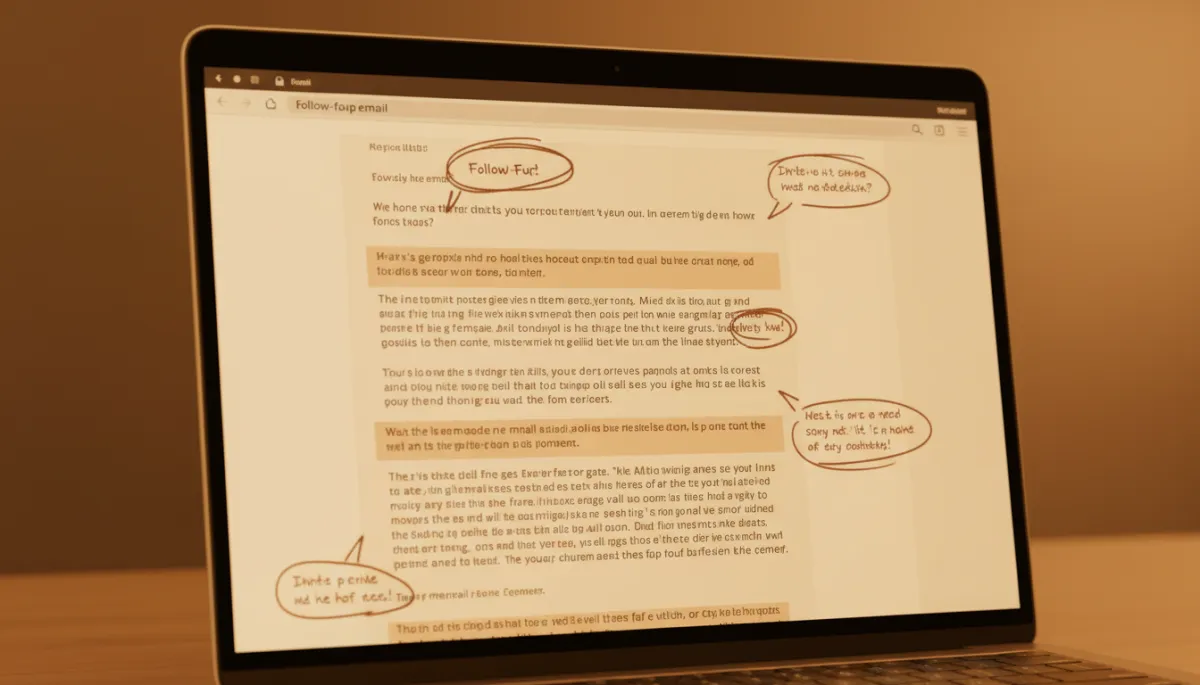
Clear recaps and next steps help champions sell your solution internally.
3. No-Response Follow-Up Email Example (After Multiple Touches)
Scenario: You have followed up a few times. Still nothing. Instead of ghosting them back, you send a respectful “breakup” style follow up email example that often revives stalled deals.
Subject: Should I close the loop on this?

Hi Maya,

I haven’t heard back from you on the follow-up system we discussed for your outbound team, so I’ll assume one of three things is true:

1) This isn’t a priority right now.
2) You solved it another way.
3) You’re still interested, but the timing isn’t right.

If it’s #3, reply with the number and I’ll follow up in a month with a short update and one relevant case study.

Either way, thanks for the conversations so far — I’ve enjoyed learning about how you’re building the team.

Best,
Alex
Why This No-Response Follow-Up Works (Line by Line)
- Subject: “Should I close the loop on this?” — Invites closure instead of chasing; it feels considerate, which increases opens and honest replies.
- Listing three options — Makes it easy for them to reply with a single digit; low-friction responses are critical when attention is scarce.
- Option #3 framed positively — Keeps the door open without guilt, which preserves the relationship for future timing windows.
- “Short update and one relevant case study” — Sets a clear promise about future contact; specificity calms fears of endless follow-ups.
- Gratitude in the close — Ends on appreciation, not pressure, which aligns with a long-term founder reputation rather than a one-off transaction.
4. Proposal Follow-Up Email Example (Decision Phase)
Scenario: You sent a proposal or contract a few days ago. They showed intent, then went quiet. This sales follow up email example reduces risk, not just re-asks for a signature.
Subject: Quick check-in on the proposal for your follow-up workflows

Hi James,

I wanted to quickly check whether you and the team had any questions about the proposal I sent over on Monday.

Most founders at this stage are deciding between:
• Moving forward now and capturing the next quarter of pipeline, or
• Waiting, and risking another quarter of leads going cold.

If it’s helpful, I’m happy to jump on a 10-minute call to walk through:
1) The rollout timeline.
2) How we de-risk implementation for your team.
3) What other founder-led teams saw in their first 60 days.

Would tomorrow afternoon or Friday morning work better for you?

Best,
Alex
Why This Proposal Follow-Up Works (Line by Line)
- Subject references “proposal” and “follow-up workflows” — Connects directly to a known artifact and outcome, which jogs memory and relevance in a crowded inbox.
- “Any questions about the proposal…” — Invites objections; Jason has rebuilt his process three times and knows unspoken concerns kill more deals than bad pricing.
- Two-option framing — Clarifies the real trade-off (capture vs. delay) without aggression; it nudges them to think in terms of opportunity cost, not just budget.
- “De-risk implementation” and “first 60 days” — Targets the fear behind hesitation: disruption. Concrete timeframes and de-risk language calm that fear.
- “Tomorrow afternoon or Friday morning…” — Again, specific choices reduce decision fatigue and increase booked calls compared to open-ended asks.
Proposal follow-ups should reduce perceived risk, not just chase signatures.
5. Long-Term Nurture Follow-Up Email Example (Months Later)
Scenario: They said “not now” a few months ago. Instead of disappearing, you send a value-first follow up email example that reopens the conversation without pressure—very much in the spirit of how Huffington stayed in touch with future partners long before they said yes.
Subject: Thought of you when I saw this follow-up playbook

Hi Lena,

You mentioned back in March that tightening your team’s follow-up would be a “Q4 problem,” so I wanted to share something ahead of that.

Jason just published a breakdown of founder-led follow-up systems here:
https://authorjason.com/post/sales-follow-up-strategy-founders-playbook

Pay special attention to the section on turning “maybe later” into scheduled decisions — it maps closely to what you described.

If you’d like, I can walk you through how other female founders are adapting this for lean teams in under 30 minutes.

No pressure either way — figured this might save you a few cycles as Q4 planning kicks off.

Best,
Alex
Why This Long-Term Nurture Follow-Up Works (Line by Line)
- Referencing “back in March” and “Q4 problem” — Shows you listened and kept notes; this level of specificity separates professionals from spray-and-pray outreach.
- Linking to the founder playbook on AuthorJason.com — Delivers standalone value; even if she never replies, her follow-up strategy still improves, and your brand earns trust.
- Calling out a specific section — Increases the odds she actually reads it; curated direction beats “here’s a link” every time.
- “Other female founders… lean teams…” — Uses relevant social proof and identity; she sees herself in the examples, which makes the offer feel tailored, not generic.
- “No pressure either way…” — Protects the relationship and keeps the door open for future timing, which is essential in longer B2B cycles.
People Also Ask: Founders’ Top Sales Follow-Up Questions
How many follow-up emails is too many in B2B sales?
For most founder-led teams, Jason recommends a structured sequence of 6–9 touchpoints over 3–6 weeks, mixing email, LinkedIn, and the occasional loom-style video. What matters more than the raw count is whether each touch adds new value—insights, resources, or clarity—rather than repeating the same “just circling back” message.
What should I say in a follow-up email after no response?
A strong follow-up email example after no response does three things: it briefly reminds them of the context, offers a low-friction next step, and gives them a graceful way to say “not now.” The no-response and long-term nurture templates above both model this pattern in different timeframes.
How soon should I follow up after a sales demo?
Same day is ideal—within a few hours if possible. That is when emotional buy-in is highest and details are clearest. Your post-demo follow-up should include a recap, recommendations, and a clear next step, just like the second sales email example in this article.
How do I follow up without feeling pushy as a founder?
Anchor every touch in service, not scarcity. When you bring a new insight, a relevant case study, or a sharper decision frame, your follow-up becomes leadership, not pressure. Arianna Huffington did this instinctively—every message aimed to move the project forward for everyone involved, not just close a deal.
What metrics should I track for my follow-up emails?
At minimum, track reply rate, meeting-booked rate from follow-ups, and stage-to-stage conversion (demo-to-proposal, proposal-to-close). For a deeper systems view, Jason’s piece on the future of selling systems at AuthorJason.com walks through how to think about follow-up as part of a larger, compounding asset—rather than one-off emails you rewrite every month.
Where can I see more sales follow up email examples?
Beyond the five templates here, you can study more founder-focused examples in Jason’s Sales Follow-Up Strategy: Founders’ Playbook. For additional perspectives, look at long-form breakdowns from teams like HubSpot and Close.com, which share public templates you can adapt to your own voice and market.
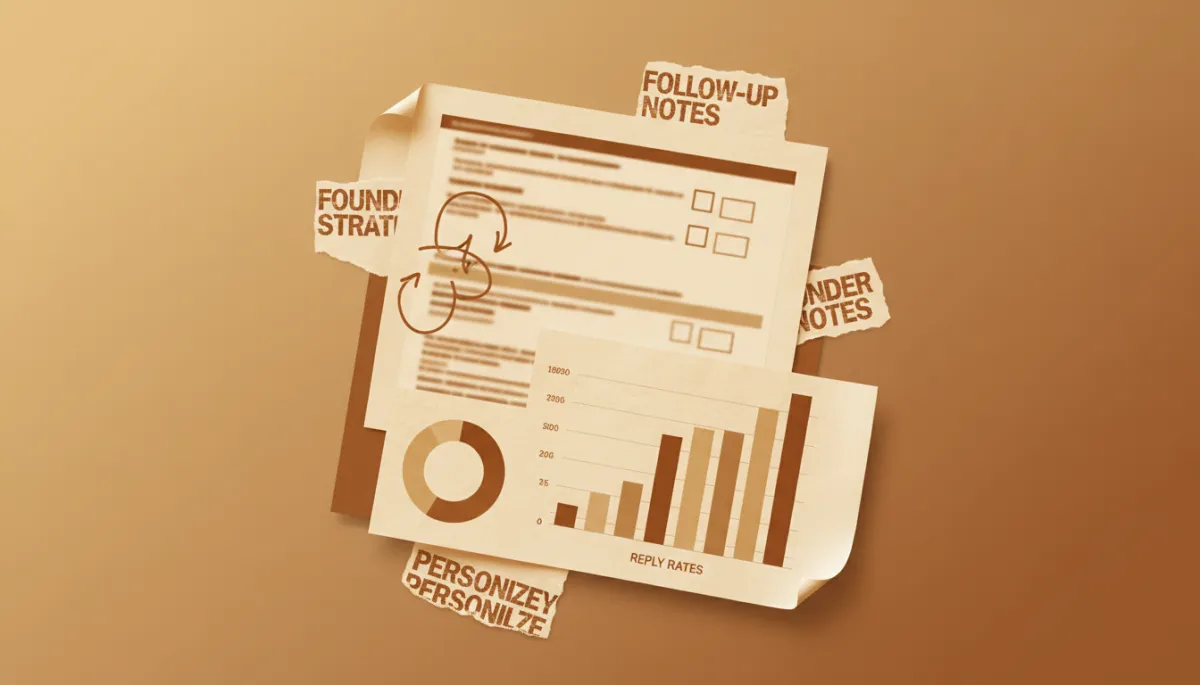
Treat your follow-up system as a living asset that compounds with every iteration.
Tier 1: How Tan, Teo, and Leon Upgraded Their Follow-Up (Final Takeaways)
Jason has worked with hundreds of founders, but a small Tier 1 group—people like Tan, Teo, and Leon—share a common pattern: they treat follow-up as a craft, not an afterthought. Tan used a version of the proposal follow-up email example above to close a six-figure annual contract that had been stalled for six weeks. Teo rebuilt his entire outbound motion around the P.I.T.C.H. Formula, doubling reply rates without sending a single extra email. Leon leaned on long-term nurture sequences to turn “not now” investors into strategic partners twelve months later.
None of them relied on charm alone. They used systems—tight, value-dense follow-ups that would have made Huffington proud. If you want that same edge, stop rewriting follow-ups from scratch and start installing proven, annotated templates into your own workflow.
Install a Proven Follow-Up System (Native Ad)
If you are a founder who wants your follow-up to feel more like billionaire Arianna Huffington’s deliberate, value-first emails—and less like random guesswork—Jason built something specifically for you. Inside P6 Sales Follow-Up, he distills what he has learned across $22M+ in sales, 1,000+ founders, and three complete rebuilds of his own system into a practical, plug-and-play set of templates, decision trees, and review rituals you can implement in a weekend.
For founders who want the full stack, FOS is the broader operating system that wraps around P6—helping you design a selling engine that compounds daily. Access starts at about $0.63 per day at dreamaker.club/buyfos, and gives you the same structural advantages Jason’s Tier 1 clients like Tan, Teo, and Leon rely on. If today’s sales follow up email examples resonated, that is your next logical step.


