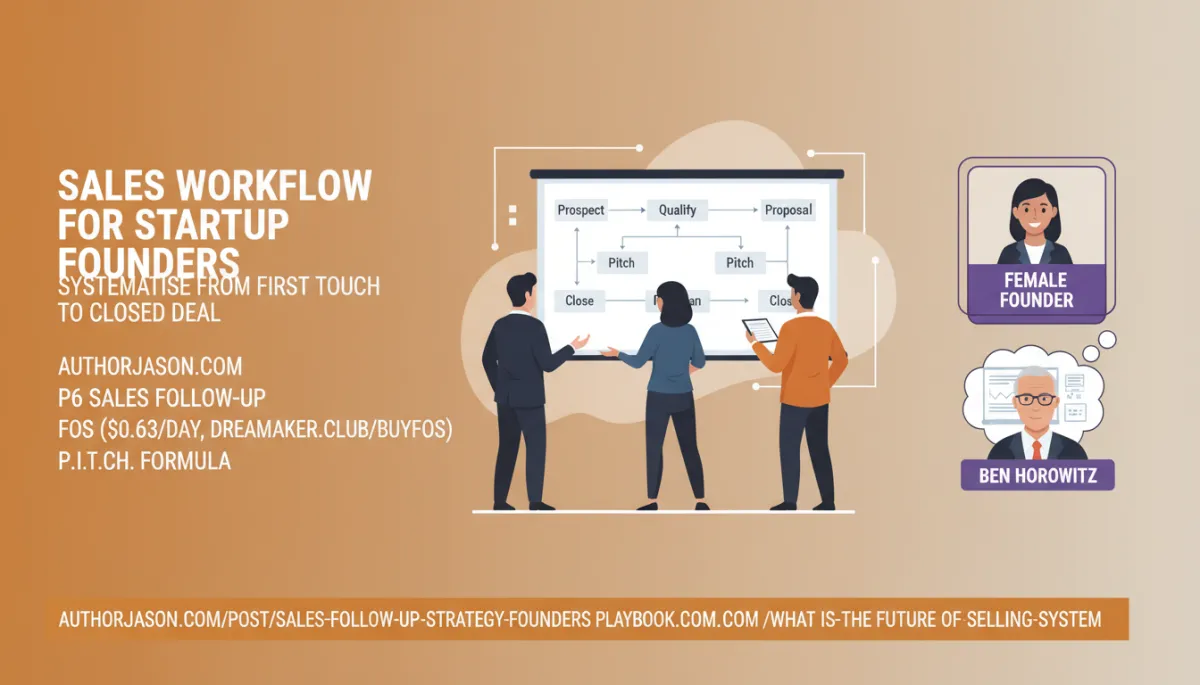
Sales Workflow for Startup Founders: How to Systematise From First Touch to Closed Deal
Sales, Sales Workflow, Startup Sales Process
Sales Workflow for Startup Founders: How Billionaire Ben Horowitz Systematised From First Touch to Closed Deal
When a founder becomes CEO, the sales workflow stops being an informal list of “people we’re talking to” and starts becoming the operating system of the company. Billionaire investor Ben Horowitz understood this early—his first act as CEO at LoudCloud/Opsware was to map every sales workflow stage on a whiteboard, because you simply cannot manage what you have not mapped. This article walks through how modern founders can do the same, from first touch to closed deal, and then scale beyond founder-led sales with confidence.

Why Every Startup Needs a Mapped Sales Workflow
A predictable sales workflow for startups is not about adding bureaucracy—it is about removing chaos. Jason, founder of AuthorJason.com, has helped more than $22M+ in revenue flow through founder-led sales systems for over 1,000+ founders, and he has rebuilt his own workflow three times. The pattern is clear: founders who map their sales workflow early, then refine it through real conversations, close more deals with less emotional whiplash and fewer dropped opportunities.
At its core, a strong startup sales process is simply a series of clearly defined stages, supported by a CRM, automation at key touchpoints, and a clean handoff from founder to team. Jason’s P6 Sales Follow-Up framework and P.I.T.C.H. Formula sit on top of that structure—but the structure comes first. Let’s start by mapping the five essential stages.
Mapping the 5 Core Sales Workflow Stages: Prospect → Qualify → Pitch → Proposal → Close
Horowitz mapped every step on a whiteboard; you can do the same on paper or directly in your CRM. The key is to keep the stages simple and unambiguous. For most B2B startups, these five work extremely well:
- Prospect — You have a name and a reason to believe they might benefit, but you have not yet had a real conversation. This is where outbound lists, inbound leads, and referrals live before they engage.
- Qualify — You are in active dialogue, confirming fit: problem, budget, authority, timing, and priorities. The goal is to decide “pursue” or “park,” not to convince everyone to buy.
- Pitch — You are presenting your solution using a structured narrative. Jason’s P.I.T.C.H. Formula—Problem, Impact, Transformation, Case Study, How It Works—keeps this stage focused and founder-friendly.
- Proposal — You have aligned on scope and are formalising pricing, terms, and next steps. This is where many founders lose momentum because they do not systematise follow-up or clarify decision criteria.
- Close — Final negotiation, signatures, and onboarding. A clear close stage includes both “Won” and “Lost,” with reasons captured so you can improve the earlier stages.

A simple five-stage pipeline gives founders clarity on where every deal stands.
Setting Up Your CRM Around Each Stage (So It Actually Gets Used)
A sales workflow only becomes real when it lives in your CRM. Jason’s rule is simple: the CRM should feel like a conversation log, not an admin chore. To achieve that, configure your CRM so each stage captures only the fields that matter for decisions and forecasting—nothing more, nothing less.
- Prospect stage fields: Source, segment, contact details, initial hypothesis of problem. You do not need deal value yet; you need a reason to care.
- Qualify stage fields: Problem confirmed, budget range, decision-maker identified, timeline, disqualifying factors. This is where you protect your calendar by saying “no” early when needed.
- Pitch stage fields: Key pains restated in their words, desired outcomes, stakeholders in the room, demo date, and any objections raised. These notes fuel sharper follow-up.
- Proposal stage fields: Proposal amount, structure, sent date, decision date, decision criteria, legal or procurement steps. This lets you forecast realistically rather than optimistically.
- Close stage fields: Closed Won/Lost, reason, competitor, start date, onboarding owner. This is your feedback loop for improving messaging and qualification.
Automating Key Touchpoints Without Losing the Human Founder Voice
Automation in a sales workflow for startups is not about sending more emails—it is about ensuring the right follow-up happens every time. Jason’s P6 Sales Follow-Up system structures six purposeful touches after the first call, mixing email, LinkedIn, and sometimes short Loom videos. The goal is to consistently move deals forward, not to nag prospects into a “no.”
Here is where automation shines:
- Post-meeting recaps: Automatically trigger a templated recap email after a Pitch call, where you customise 2–3 lines but keep the structure consistent. This reinforces your P.I.T.C.H. narrative and next steps.
- Proposal nudges: Create a workflow that reminds you to follow up 2, 5, and 10 days after sending a proposal, with escalating clarity—first a gentle check-in, then a value reminder, then a polite close-the-loop message.
- Reactivation campaigns: Once a quarter, automatically surface stalled opportunities in Qualify or Pitch, and send a short “Is this still a priority?” note. Many founders win back deals simply by reappearing at the right time.

Light-touch automation ensures follow-up happens without drowning prospects in noise.
Designing a Clean Founder-to-Team Handoff Process
At some point, founder-led sales must become team-led sales. The danger is that founders either cling to every deal or throw new hires into the deep end with no structure. Jason has rebuilt this handoff process three times, and the pattern that works is straightforward: document, shadow, then delegate by stage—not all at once.
- Stage-based ownership: Early on, Jason recommends that founders keep ownership of Pitch and Close, while a new salesperson owns Prospect and Qualify. Over time, ownership shifts as confidence grows.
- Structured handoff notes: When a deal moves from Qualify to Pitch, the CRM should contain a concise summary: problem, impact, stakeholders, budget, and any landmines. That way, a team member can join or lead the call without losing context.
- Weekly pipeline reviews: Jason’s clients run a 30–45 minute pipeline review where each stage is inspected, stuck deals are diagnosed, and follow-up actions are assigned. This turns your sales workflow into a coaching tool, not just a reporting mechanism.
Tracking Workflow Performance: Metrics That Actually Matter
You do not need a wall of dashboards to understand whether your startup sales process is working. You need a few honest, stage-based metrics that tell you where deals are leaking. Jason encourages founders to track:
- Conversion rates between stages — Prospect→Qualify, Qualify→Pitch, Pitch→Proposal, Proposal→Close. A sharp drop at any step is a signal to revisit messaging, targeting, or expectations.
- Average days in stage — How long does a deal sit in Qualify or Proposal before moving—or dying silently? Long dwell times often mean unclear next steps or fear of direct communication.
- Win rate and average deal size — Tracked at the Close stage, segmented by source or segment. This helps you double down on the right prospects instead of chasing every logo.
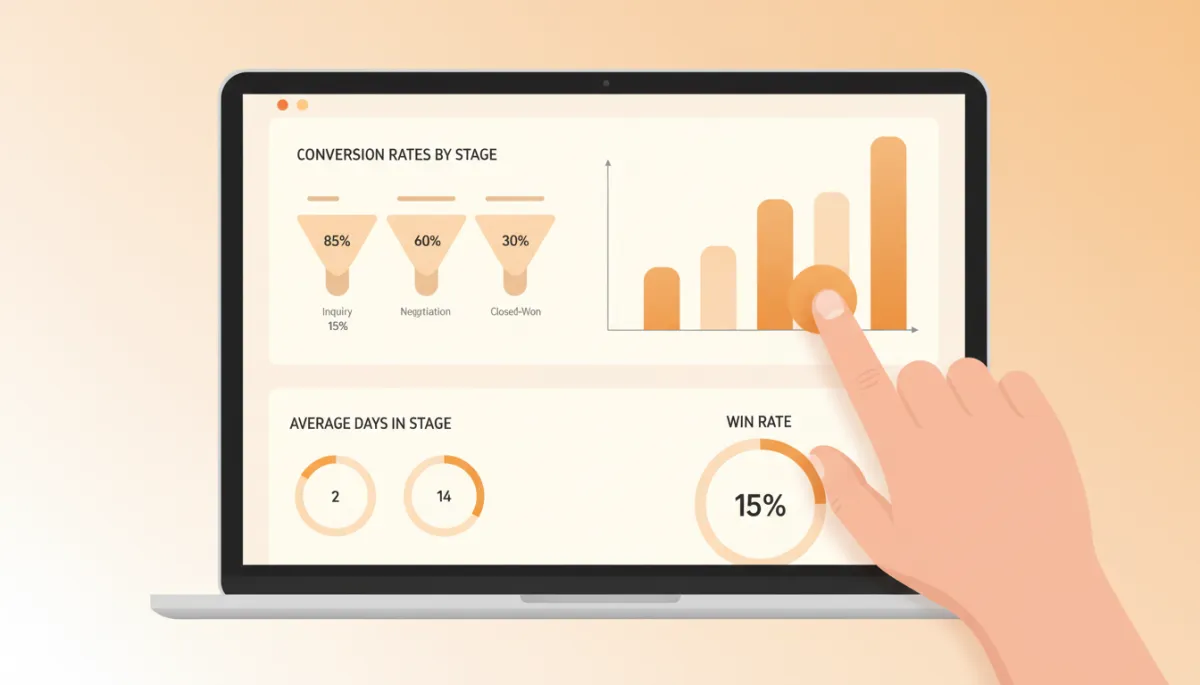
Simple, stage-based metrics reveal exactly where your sales workflow is leaking.
Rebuilding a Broken Sales Workflow Without Burning Everything Down
Every founder eventually realises their current workflow is not working. Deals feel random, the CRM is messy, and team members interpret stages differently. Jason has rebuilt his own system three times and helped founders do the same without losing momentum. The key is to treat it as an evolution, not a reset.
- Audit what is real today. Export your pipeline, look at where deals stall, and talk to your team about where they feel confused. Reality is your best design partner.
- Redefine your five stages. Come back to Prospect, Qualify, Pitch, Proposal, Close and write a one-sentence exit condition for each. If it is fuzzy, tighten it.
- Clean your CRM fields. Remove fields nobody uses, standardise naming, and make sure every required field helps you decide or forecast. Everything else is optional.
- Roll out with a date. Choose a go-live date for the new workflow, move active deals into the right stages, and archive stale ones. Communicate clearly that this is the new shared language.
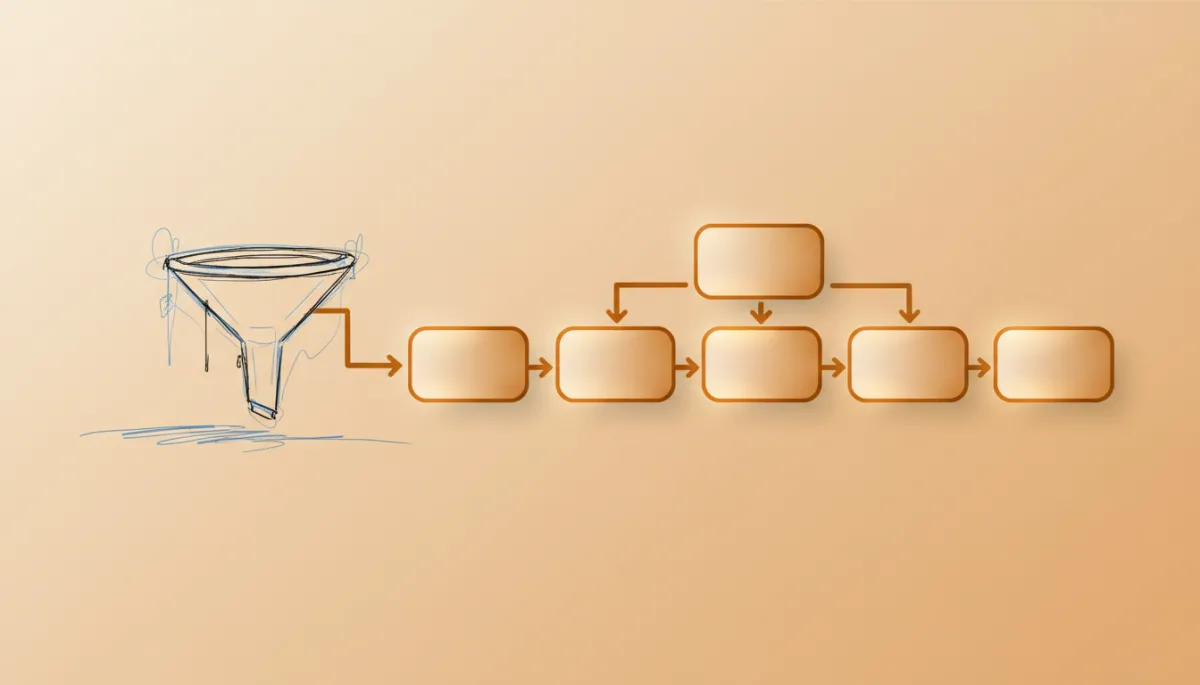
Rebuilding your workflow is easier when you evolve existing stages instead of starting from zero.
How do you create a sales workflow for a startup from scratch?
Start by mapping the five stages—Prospect, Qualify, Pitch, Proposal, Close—then define what must be true to move a deal from one stage to the next. Build a simple CRM pipeline around those stages, add light automation for follow-up, and review the pipeline weekly. You can deepen complexity later; early on, clarity beats sophistication.
What tools should founders use to manage a startup sales process?
Any modern CRM with pipelines, tasks, and basic automation can work—HubSpot, Pipedrive, and Close.com are common choices. The tool matters less than your commitment to keeping it updated and using it as the single source of truth for your sales workflow.
How often should founders review their sales workflow stages?
Weekly, you should review the pipeline and individual deals; monthly, you should review stage definitions, conversion rates, and average time in stage. As your market and product evolve, your workflow should evolve too—just like Horowitz refined his process as LoudCloud grew.
How can founders improve sales follow-up without feeling pushy?
Use a structured follow-up rhythm, like Jason’s P6 Sales Follow-Up, where each touch adds value—recaps, resources, clarifying questions—instead of generic “just checking in” emails. When your follow-up is anchored in the prospect’s goals, it feels professional, not pushy. Jason breaks this down in detail at AuthorJason.com.
When is the right time to hire your first sales rep?
Jason advises hiring once you, as founder, can close deals with a reasonably consistent script and a defined workflow. If you cannot yet explain how a deal moves from Prospect to Close, a rep will struggle. Nail founder-led sales first, then bring in help to scale it.
How will AI and automation change the future of selling systems?
AI will increasingly handle research, drafting follow-up, and surfacing at-risk deals—but it still needs a clear underlying workflow to operate against. Jason explores this in his article on the future of selling systems, where he argues that founders who map their process early will benefit most from AI-driven leverage.
Final Thoughts: Systematise Like Horowitz, Then Scale With Confidence
Billionaire Ben Horowitz did not start with a perfect sales machine—he started with a whiteboard, honest conversations, and a commitment to mapping reality. Jason’s work with over 1,000 founders echoes the same lesson: when you define your five stages, configure your CRM around them, automate key touchpoints, and design a clean founder-to-team handoff, your sales workflow becomes an asset instead of a source of anxiety.
If you want help implementing this in your own startup, Jason’s FOS program (FOS at dreamaker.club/buyfos) gives founders a complete operating system for sales—templates, follow-up scripts, and workflow reviews—for about $0.63/day. It is the same toolkit he uses with Tier 1 founders like Tan, Teo, and Leon to turn chaotic pipelines into calm, compounding revenue systems. Systematise your startup sales process now, so you can sell like a pro today and scale like Horowitz tomorrow.


