What Is Speech Communication and Why Does It Matter for Your Career?
What Is Speech Communication and Why Does It Matter for Your Career?
Speech communication is the structured process of using spoken language to share ideas, persuade audiences, and build understanding between people. It covers everything from casual conversation to high-stakes pitches. In professional settings, it is the skill most directly tied to whether deals close, promotions happen, and clients say yes instead of ghosting you.
🌟 From a $2,500 Project to a 7-Figure Partnership
A franchisee student used Jason Lim’s presentation framework to transform a small project pitch into a 7-figure partnership deal. The room did not change. The speaking skills did.
Jason Lim brings 20+ years of coaching and teaching experience to founders, sales reps, and executives across 42 cities globally — helping them turn shaky pitches into signed deals through Presentation Skills and Speaking Skills training.
Why Does Speech Communication Drive Career Outcomes?
Picture two founders pitching the same product to the same investor on the same afternoon. Same market, same numbers, same deck. One speaks with structure, presence, and conviction. The other rushes through slides, fills silences with “um,” and loses the room by slide three. The investor remembers one of them. That is speech communication at work.
The data makes the stakes clear: communication ranked as the number-one most in-demand skill on LinkedIn for both 2024 and 2025. Not technical expertise. Not project management. Speaking.
The NACE Job Outlook 2025 — a survey of hundreds of hiring managers — found that more than three-quarters name communication a critical attribute for new hires, and more than two in three specifically seek verbal communication skills. And yet a 2024 Preply public-speaking study of 2,007 adults found that 63% of Gen Z respondents would avoid public speaking altogether if they had no obligation to do it.
That gap is exactly where careers stall. When you cannot communicate with clarity and confidence, every other skill you have gets filtered through the audience’s inability to understand or trust what you are saying. The product can be great. The idea can be right. But if you cannot hold the room, the deal walks out the door with the person who can.
What Does Speech Communication Actually Include?
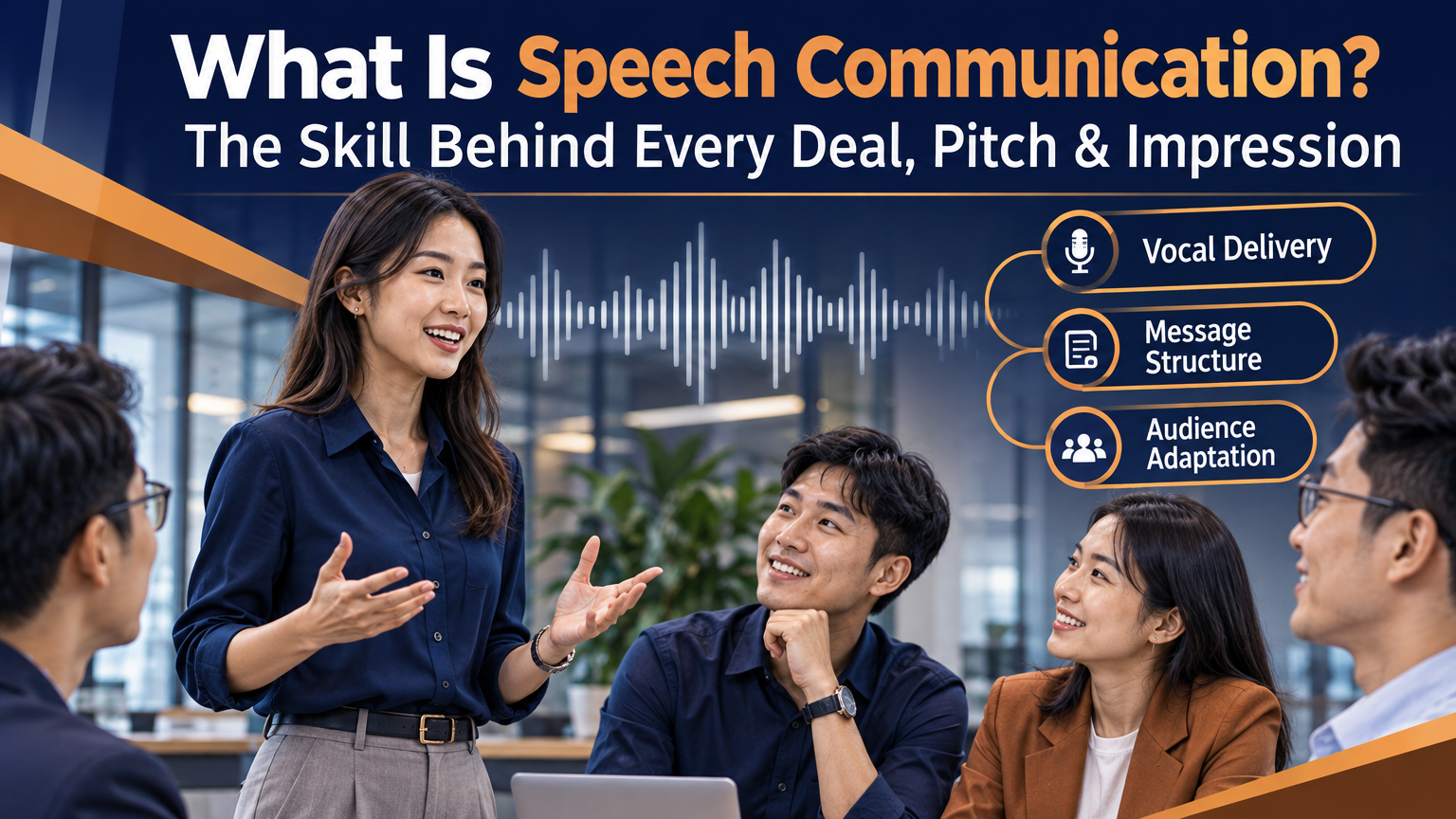
Speech communication is broader than “public speaking.” It covers every situation where you use spoken language purposefully — from one-on-one client calls to group presentations to on-camera pitches. Here are the core components that determine how effectively you communicate:
| Component | What It Covers | Career Impact |
|---|---|---|
| Vocal Delivery | Pace, pause, volume, pitch, tone | Signals authority; holds attention |
| Message Structure | Opening hooks, logical flow, clear calls to action | Audiences remember and act on what you say |
| Nonverbal Communication | Eye contact, posture, gesture, stillness | Builds trust before you say a word |
| Audience Adaptation | Reading the room, adjusting in real time | Keeps conversations two-way, not broadcast |
| Listening and Response | Receiving objections, asking questions, reflecting back | Wins back rooms that feel resistant |
| On-Camera Presence | Eye-line, framing, energy on video calls | Critical for remote sales, pitches, and leadership |
Think of speech communication like driving. A Gosu-level driver does not need the best car to outperform a weaker driver — but they also did not stop practicing after their first lesson. Upgrading your deck, your follow-up template, or your CRM is like buying a better car. It helps at the margins. Speaking skill is what actually wins the race.
How Do You Improve Your Speech Communication Skills?
Most people practice the wrong way. They rehearse alone, over-prepare slides, attend one workshop, and declare themselves “done.” Real improvement in speech communication follows a different loop:
- Speak in conditions that mirror the real thing. Low-pressure practice builds low-pressure performance. Train in settings that replicate the stakes you actually face — small groups, recorded pitches, live objection-handling.
- Get specific feedback, not general encouragement. A coach who tells you “you spoke too fast in minute two and lost eye contact on the objection” is more valuable than ten people saying “great job.”
- Record yourself. Watch it back. You will immediately identify what others see that you cannot feel while you are speaking.
- Eliminate filler words deliberately. Replace “um” and “like” with intentional pauses. A one-second silence signals confidence; a filler word signals nervousness.
- Raise the stakes gradually. Build from one-on-one calls to small groups to larger rooms. Each new context is a new skill layer.
Key takeaways:
- Speech communication is a trained skill, not an inherited personality trait.
- The gap between what employers demand and what most professionals can deliver is widening — which makes this your opportunity.
- Weak speech communication is the root cause behind stalled deals, ghosted proposals, and promotion delays. Better follow-up and better slides are symptoms management; speaking skill is the fix.
- For founders, sales reps, and executives in high-stakes roles, coaching that targets your specific gaps closes deals faster than any general course alone.
Related:
🌟 Presentation Skills Coaching with Jason Lim — for founders, sales reps, and executives
📚 What Is an Oral Communication Class and What Will You Actually Learn?
📚 How Do You Improve Your Speaking Skills?
🔥 Ready to Stop Getting Outspoken in the Room?
Jason Lim has spent 20+ years coaching founders, sales teams, and executives across 42 cities globally to close more deals through stronger speech communication and presentation skills. One franchisee student turned a $2,500 project into a 7-figure partnership — not by switching tools, but by upgrading skills.
Presentation Skills and Speaking Skills are what win the room. Weak speech communication is the root cause. Everything else is just equipment.


