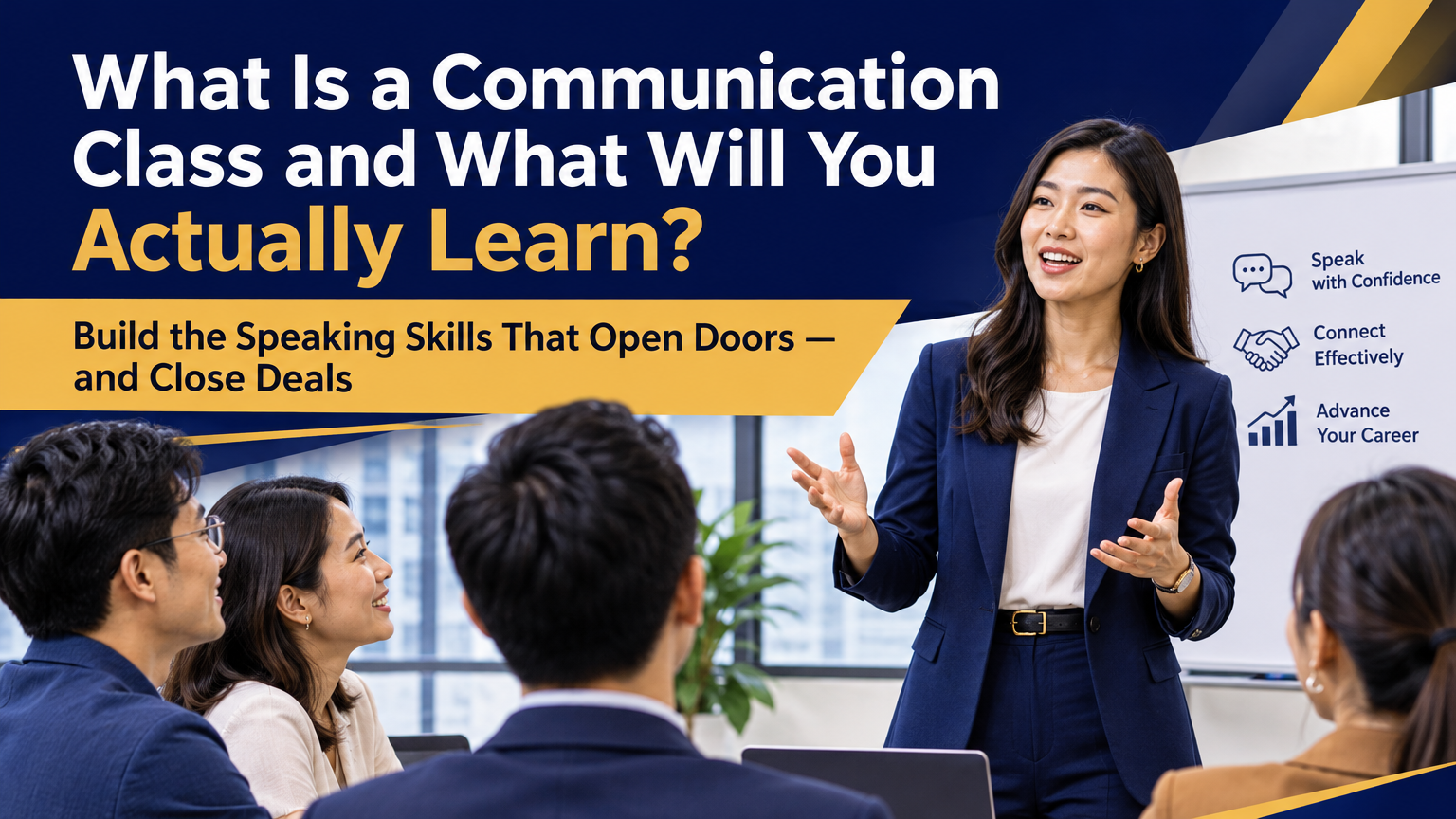
What Is a Communication Class and What Will You Actually Learn?
What Is a Communication Class and What Will You Actually Learn?
A communication class teaches you to speak clearly, structure your message, and deliver it confidently in front of others. You learn vocal delivery, body language, listening, and how to adapt to different audiences. It is one of the most practical skills classes available — directly tied to career growth, deal-closing, and professional presence.
🌟 From a $2,500 Project to a 7-Figure Partnership
A franchisee student used Jason Lim’s presentation framework to transform a small project pitch into a 7-figure partnership deal. The room didn’t change. The speaking skills did.
Jason Lim brings 20+ years of coaching and teaching experience to founders, sales reps, and executives across 42 cities globally — helping them turn shaky pitches into signed deals through Presentation Skills and Speaking Skills training.
Build Your Communication Skills with Jason →Why Does a Communication Class Matter More Than You Think?
Picture two fresh graduates walking into their first job interview on the same morning. Same degree, same GPA, same resume. One speaks with clarity, structure, and confidence. The other rambles, loses the thread, and watches the interviewer glance at the door. Only one gets called back. That gap — entirely down to spoken communication — follows you throughout your career.
The numbers make the stakes concrete. Communication ranked as the number-one most in-demand skill on LinkedIn for both 2024 and 2025 — ahead of technical skills, project management, and AI fluency. The NACE Job Outlook 2025 found that more than three-quarters of employers name communication a critical attribute for new hires, and more than two in three specifically seek verbal communication skills.
Yet the demand is not being met. The Chapman University Survey of American Fears 2025 found 33.7% of Americans are afraid or very afraid of public speaking. A 2024 Preply public-speaking study of 2,007 adults found 63% of Gen Z respondents would avoid public speaking altogether if they had no obligation to do it. That disconnect is not just a confidence gap — it is a career gap. And it shows up most painfully in sales conversations, pitches, and high-stakes meetings where the difference between a closed deal and a ghosted follow-up is almost always the speaking, not the product.
What Will You Actually Learn in a Communication Class?
A well-designed communication class goes well beyond “practice speaking more.” Here are the core skills covered in the strongest programs:
| Skill Area | What You Learn | Why It Matters |
|---|---|---|
| Vocal Delivery | Pace, pause, volume, tone | Signals authority; keeps attention |
| Message Structure | Opening hooks, logical flow, clear calls to action | Audiences remember and act on what you say |
| Nonverbal Communication | Eye contact, posture, gesture, stillness | Builds trust before you say a word |
| Audience Adaptation | Reading the room, adjusting in real time | Keeps conversations two-way, not broadcast |
| Listening & Response | Receiving objections, asking questions, reflecting back | Wins rooms that feel resistant |
| On-Camera Presence | Eye-line, framing, energy on video calls | Critical for remote sales, pitches, leadership |
Think of a communication class like a driving school for your voice and presence. You can read every theory book about negotiation, persuasion, or presentation design — but until you get real reps with skilled feedback, the knowledge stays theoretical. The class gives you the structured practice, the frameworks, and the mirror that most professionals never get.
Related:
🔗 Work directly with Jason Lim on your Presentation & Speaking Skills →
🔗 What Is Speech Communication and Why Does It Matter for Your Career?
🔗 What Is an Oral Communication Class and What Will You Actually Learn?
Is One Communication Class Enough?
It depends on the stakes. For someone building foundational habits, a structured class is an excellent starting point. For startup founders closing enterprise deals, sales reps handling high-value objections, or executives presenting to boards, a class is the floor — not the ceiling.
Here is the real insight: communication is not a subject you graduate from. It is a skill you refine in conditions that mirror what you actually face. A Gosu-level driver does not need the best car to outperform a weaker driver — but they also did not stop practicing after their first lesson. Upgrading your deck, your follow-up template, or your tools is like buying a better car. Speaking skill is what actually closes the deal.
Key takeaways:
- A communication class builds the core: structure, delivery, presence, and listening.
- The skills transfer immediately — to job interviews, sales calls, team meetings, and investor pitches.
- Real growth happens when you pair a class with live coaching, real feedback, and deliberate high-stakes practice.
- Follow-up problems, ghosted prospects, and lost deals are symptoms. Weak speaking is the root cause.
🎯 Your Speaking Skills Are the Skill That Unlocks Every Other Skill
A communication class opens the door. Expert coaching walks you through it. If you are a founder, sales rep, or executive who wants to stop losing rooms and start closing deals, the fastest path is deliberate skill-building with someone who has done it across 42 cities.
Jason Lim’s Future of Selling Presentation Skills Coaching Program teaches the proprietary P.I.T.C.H. method — built from 20+ years of coaching experience, designed for the high-stakes conversations where your speaking either wins or walks the deal out the door.
Explore Jason’s Presentation Skills Program →Sources
- VoxBooster, “Public Speaking Statistics (2026): 40+ Data Points on Glossophobia, Career Impact, and the Speaking Economy,” published July 12, 2026. voxbooster.com — citing Chapman University Survey of American Fears 2025 (33.7% fear public speaking); LinkedIn Talent Insights 2024 & 2025 (#1 most in-demand skill); NACE Job Outlook 2025 (75%+ employers; 2 in 3 seek verbal communication skills).
- Preply Language Learning Team, “Speak with confidence: Tackling the UK’s public speaking phobia,” published March 26, 2024, updated April 3, 2025. preply.com — survey of 2,007 adults; 63% of Gen Z would avoid public speaking if they did not have to do it; 59% of all adults would avoid it.


