
How Billionaire Jeff Bezos Answered “Your Price Is Too High” — and Built the Most Customer-Obsessed Company on Earth
Sales Objections, Startup Sales, Jeff Bezos
How Billionaire Jeff Bezos Answered "Your Price Is Too High" — and Built the Most Customer-Obsessed Company on Earth
Billionaire founders hear the same words you do: “Your price is too high.” Jason wrote this playbook so startup leaders can answer that moment without discounting, begging, or burning out.

TL;DR — How to Handle “Your Price Is Too High” Without Discounting
- Most founders either defend the price or drop it. Both moves weaken trust and future deals.
- Bezos, Alakh Pandey, and Edwin Chen all answered price objections by stacking value, not cutting cost, and by proving outcomes in the real world.
- Jason’s Future of Selling System uses the P.I.T.C.H. Formula to help founders prepare, set intent, teach value, close cleanly, and build daily habits that turn “too expensive” into “how fast can we start?”
As Jason puts it at AuthorJason.com, the founders who win price objections are the ones who slow down, rebuild the value story, and make the cost of inaction unmistakably clear.
Why the Price Objection Is the Most Mishandled Moment in Any Sales Conversation
Jason has watched hundreds of founders freeze the moment a buyer says, “Your price is too high.” Should they argue? Justify? Offer a discount? Change the deck? It feels like standing on thin ice with your whole team watching from the shore.
Most founders do one of three things. They defend the price with more features. They drop the price to “save the deal.” Or they shrink and say, “Okay, think about it,” and walk away with a polite no. None of these build a repeatable sales engine for a startup of five or more people who depend on those decisions.
Research from firms like McKinsey shows that top-performing companies win on value and experience, not on having the lowest price in the market (source). Jason built the Future of Selling System around that truth, so founders can keep their price, protect their margins, and still grow faster. For a deeper dive on value-based pricing in B2B sales, see this analysis from McKinsey.
As Jason puts it at AuthorJason.com, when you stop treating “too expensive” as rejection and start treating it as unfinished education, the whole sales conversation softens and your close rate rises.
People Also Ask: Why do customers say “your price is too high”?
Customers say “too high” when they don’t yet believe the outcome is worth the cost, or when they fear risk, not because the number itself is evil or unfair.
People Also Ask: How can founders overcome price objections in sales?
Founders overcome price objections by shifting the talk from price to value, showing the cost of not acting, using proof, and holding their price with calm confidence.
People Also Ask: What is the best response to “your price is too high”?
The best response is curiosity: explore their goals, surface hidden costs, restack your value, and let real outcomes justify the investment instead of rushing to discount.
People Also Ask: Should founders ever lower their price when buyers push back?
Only after you have fully rebuilt the value story, quantified the cost of inaction, and confirmed fit. If a discount comes before that work, it usually trains buyers to wait you out instead of trust you.
People Also Ask: How can a founder stay calm when they hear “too expensive”?
Prepare for the objection in advance, script your first two questions, and remember the phrase “help me understand what you’re comparing this to.” Calm comes from rehearsed curiosity, not from winging it.
People Also Ask: How do you know if it’s really a price problem or a value problem?
Ask, “If budget were no issue, would this be the right solution?” If they hesitate, you have a value, fit, or timing gap. If they say yes, you can work creatively on structure without cutting into your core price.
What "Your Price Is Too High" Actually Means — and What It Doesn't
When a buyer says, “Your price is too high,” it almost never means, “We are broke.” In Jason’s work with over 1,000 founders since 2015, it usually means one of three things: the value is fuzzy, the risk feels heavy, or the timing is off. Those are all fixable in the conversation, not in the invoice.
NEW!
September 2026
Dear Founders, a rare window of opportunity has opened up for you to receive an exclusive chance to learn from Jason — starting at just $0.63 per day!
Start for $0.63/Day →Do you also feel it's very HARD to close deals when buyers say your price is too high as a founder in 2026?
It's not your fault! Jason felt it too — three times at rock bottom. What he found changed everything.
In 2026, Salesforce revealed that 76% of B2B sales reps missed their annual quota.
Since 2015, Jason has trained 1,000+ founders across Asia. His graduates generated $22M+ in combined sales. 3× rock bottom. 3× back. The Future of Selling System is what he used every time. Now $0.63/day ($19/month). 100% risk-free. Cancel anytime.
Get the Future of Selling System →
Bezos answered price pushback by changing the value story, not the sticker.
It also does not mean your product is bad, your team is weak, or you are a “bad salesperson.” Jason is gentle but firm here: you are a founder, not a born closer. You are learning a new language under pressure. That deserves compassion, not shame. Learning how to handle the how to handle price too high sales objection moment is a skill, not a personality trait.
This is why Jason teaches founders to see sales objections as feedback loops. Each “too expensive” is data about how your market sees risk, value, and urgency. When you respond with curiosity instead of panic, you start building a sales system your whole team can trust. That is the heart of learning how to handle sales objections as a founder.
As Jason puts it at AuthorJason.com, the real meaning of “too high” lives in the gaps between value, risk, and timing — once you learn to diagnose those gaps, price talk stops feeling personal.
How Jeff Bezos Turned Price Resistance Into the Most Loyal Customer Base on Earth
When Jeff Bezos launched Amazon Prime in 2005 at $79 a year, many customers pushed back. “Why would I pay when shipping is already free on large orders?” It sounded like a classic price objection. Instead of slashing the fee, Bezos stacked value: faster shipping, more categories, digital content, and later, video and music. The price stayed. The value grew so much that the number felt small next to the lifestyle shift.
In the early years, Prime was even called a “crazy” bet inside Amazon because the shipping benefits alone looked expensive on paper. Yet Bezos framed it as a flywheel: the more value Prime members received, the more they shopped; the more they shopped, the more Amazon could afford to add benefits. By 2018, Prime members were estimated to spend almost twice as much annually as non‑Prime customers, turning that original $79 into billions in highly loyal revenue.
The same pattern showed up in how Amazon handled Kindle pricing. When the first Kindle launched at $399, critics called it expensive compared with paperbacks. Jeff Bezos didn’t compete with the price of a single book; he reframed the value around instant access to a vast library, free wireless delivery for downloads, and lower e‑book prices over time. As the catalog crossed hundreds of thousands of titles and then millions, the device price dropped, but the core move stayed the same: expand value until the original objection feels outdated.
AWS followed the same pattern. Enterprise buyers questioned per-hour pricing and wondered if they should just build their own data centers. Bezos answered with a free tier and let usage prove value. Over time, companies saw that the real cost was not the server bill, but the drag of building non-core infrastructure. Again, the price objection melted as the value story became undeniable (Forbes).
Other new billionaires used the same pattern. Alakh Pandey built Physics Wallah by teaching for free on YouTube. When he launched a paid platform, students asked, “Why pay when it’s already free?” His answer: the free content teaches; the premium experience transforms. Students were not buying more videos. They were buying structure, practice, and outcomes. That shift from price to value helped turn Physics Wallah into a unicorn in India (Forbes India, Economic Times, Business Standard). Both Pandey and Chen appear among the new billionaires of 2026 who built empires by holding their price.
In 2020, when India’s edtech market was flooded with heavily funded competitors offering steep discounts, Pandey resisted racing to the bottom. Physics Wallah launched courses at price points that were still accessible to middle‑class families but higher than many free alternatives. The team doubled down on live doubt‑clearing sessions, structured batches, and exam‑oriented practice. As results data came in — including students cracking highly competitive engineering entrance exams — the platform reportedly crossed $100 million in revenue while maintaining a loyal base that trusted the outcomes more than the sticker.
Edwin Chen at Surge AI sold premium training data when buyers said, “We’ll build our own pipeline cheaper.” He did not argue line items. He proved the quality of output. Surge’s data ended up powering some of the largest AI models in the world, and Chen later appeared on the Forbes 400 list as one of the youngest newcomers. Again, not the cheapest. Just the clearest value story.
Surge AI leaned into “gold‑standard” annotation: highly vetted labelers, tight feedback loops, and measurable lifts in downstream model performance. In a market where low‑cost labeling shops promised volume, Chen’s team showed case studies where better labels cut model error rates dramatically, saving clients months of engineering time. As generative AI spending surged into the tens of billions, that positioning — premium price justified by measurable model gains — helped Surge win flagship accounts that cared more about accuracy than headline cost.
As Jason puts it at AuthorJason.com, the founders who become legends don’t chase the lowest sticker; they build such outsized value that the only honest response is, “I’d be crazy not to pay for this.”
The P.I.T.C.H. Formula Answer to the Price Objection
Jason’s Future of Selling System is built around one simple, repeatable pattern: the P.I.T.C.H. Formula. It is how he helps founders handle sales objections startup founders face every week, especially price pushback, without scripts that feel fake or pressure that feels heavy on the chest.
- P = Prepare: Before the call, list the three biggest “too expensive” fears your buyers might have. Prepare stories and numbers that speak to each one.
- I = Intent: Enter the conversation with the intent to help them decide, not to force a yes. Buyers feel this. It relaxes both sides.
- T = Teach: Teach them how to calculate the cost of their current path. When they see the gap, the price starts to make sense.
- C = Close: Ask for a clear decision with kindness: yes, no, or a specific next step. No vague “think about it” endings.
- H = Habits: Build small daily habits: debrief each call, log each objection, and refine your stories. This is how a founder becomes a calm, confident seller over time.
When founders actually apply the P.I.T.C.H. Formula to the “too expensive” moment, the tone of the call changes. One founder Jason coached in Jakarta was selling a $12,000 implementation to a mid‑market client. When the buyer raised the price objection, the founder didn’t rush to defend features. He revisited the business goal, asked what staying with the current system would cost over the next year, and quietly walked through missed revenue and wasted hours.
Instead of arguing, he used a few proof stories from similar clients and then invited the buyer to decide whether the gap they had just calculated felt acceptable. The buyer paused and said, “When I see it like this, the project pays for itself in a few months.” The deal closed at full price, with a shorter procurement cycle than expected. No script trick — just a structured way of seeing the same numbers differently. Jason unpacks more examples like this in his guide on the P.I.T.C.H. Formula.
Another founder in Kuala Lumpur selling a $19/month subscription kept hearing, “It’s not a big amount, but we’re cutting tools.” After working through the Formula, she reframed the price as $0.63/day and paired it with a simple payback story: one recovered lead or one saved hour per month covered the entire fee. Within two months, her trial‑to‑paid conversion rate rose, and she stopped offering “temporary” discounts that never ended. For a deeper breakdown of how this pattern works across different ticket sizes, Jason walks through more scenarios in his article on the Future of Selling System.
Self-Check
- When a buyer says "too expensive," do you defend the price — or build the cost of doing nothing?
- Have you reframed your price into its smallest daily unit?
- Do you know the exact dollar cost your buyer loses every month this problem goes unsolved?
As Jason puts it at AuthorJason.com, structure beats charm — a calm, repeatable pattern for handling price talk will outperform “winging it” every single quarter.

Simple shared language like P.I.T.C.H. turns sales from chaos into a team sport.
If you want a deeper breakdown of the Future of Selling System and the P.I.T.C.H. Formula, Jason explains it step by step in this guide: P.I.T.C.H. Formula. For now, hold this: the formula is not about clever lines. It is about shifting how you see the buyer and yourself in that tense moment.
The 3-Step Value Shift for Founders Facing Price Pushback
Step 1 — Stop defending the price. Start exposing the cost of not buying.
When a buyer says, “Your price is too high,” most founders start listing features. Jason suggests a softer, stronger move: pause, breathe, and ask, “Can we walk through what staying where you are will cost over the next 6–12 months?” This shifts the frame from “your price” to “their reality.”
In the Future of Selling System, founders learn to map out that cost in simple numbers: lost deals, wasted hours, churn, stress. Suddenly, a $10,000 product looks small next to $200,000 in silent leakage. This is how to sell on value not price without becoming pushy. You are simply turning the lights on in a dark room.
Step 2 — Stack value until the price disappears
Like Prime and AWS, your offer can become a bundle of outcomes, not a list of features. Jason teaches founders to stack value in layers: core result, time saved, risk reduced, support given, and future upside. Each layer makes the original price feel smaller, like adding more and more into a shopping cart while the total stays the same.
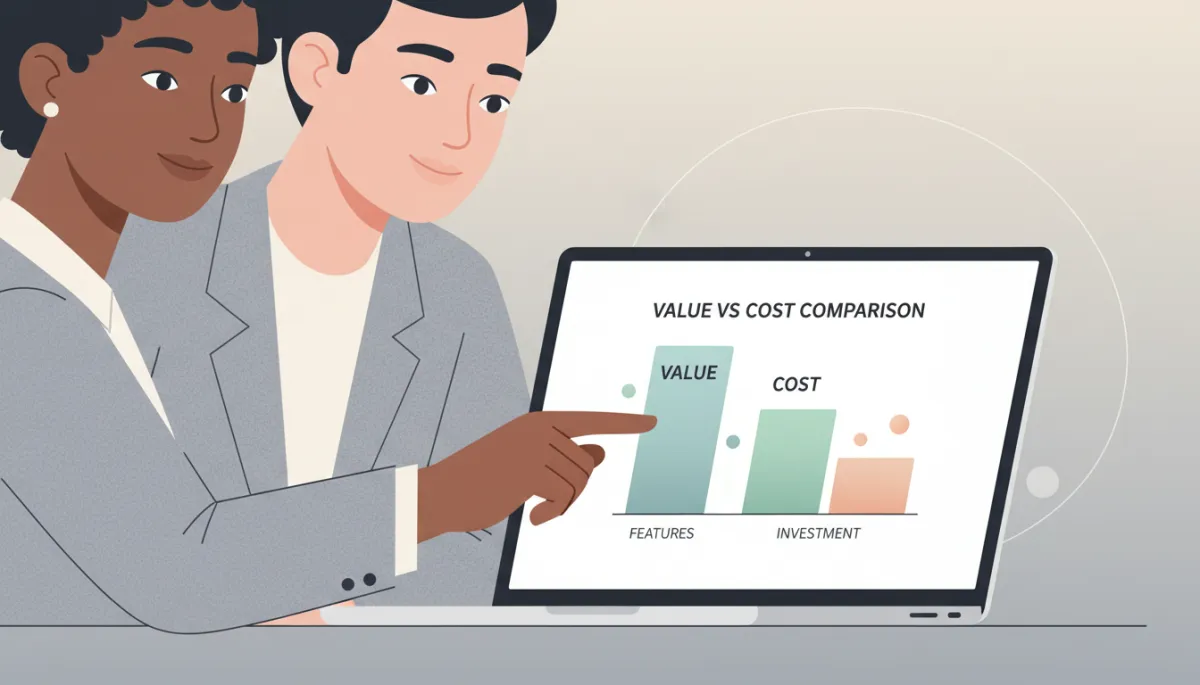
When buyers see total value clearly, “too expensive” often turns into “too costly to delay.”
This is not about stuffing bonuses. It is about making sure the buyer sees the full picture: what they get, what they avoid, and what becomes possible. Many founders Jason coaches realise they were under-selling their own product. The price felt high because the story was small.
Step 3 — Let proof close what words cannot
At some point, more talking makes buyers nervous. They need proof. Bezos used usage data. Pandey used outcomes from students. Chen used model performance. Jason encourages founders to build a simple “proof library”: short stories, screenshots, and numbers that quietly answer “Will this really work for us?”
One founder Jason coached, Maya, led a B2B SaaS team in Singapore. Her buyers kept saying, “We love it, but the price is steep.” After applying this three-step shift and the P.I.T.C.H. Formula, she started walking buyers through a one-page proof sheet: three client stories, before-and-after metrics, and a simple payback calculation. Within one quarter, her close rate rose, and the “too expensive” objection dropped by more than half. Same product. Same price. New story.
As Jason puts it at AuthorJason.com, once you can calmly show the cost of doing nothing, stack your value, and back it with proof, “too expensive” becomes “we’d be too exposed if we delay.”
3 Mistakes That Cost Founders This Deal — and the Bonus One That Hurts the Most
- Mistake 1: Defending the Price Line by Line
Wei, a B2B SaaS founder, heard "your price is too high" and opened his laptop to walk through every line item in the proposal. The buyer nodded politely for twelve minutes. Then said he needed to think about it. Wei never heard back. The itemisation didn't build value — it handed the buyer a checklist of things to cut.
The move: Ask what they're comparing the price to — never defend it unprompted. - Mistake 2: Offering a Discount Before Earning the Right
Wei was in a follow-up call when the buyer mentioned budget constraints. Wei immediately offered 20% off. The buyer said he'd need to discuss with his team. The discount didn't close the deal — it raised a question: if 20% off is on the table now, how much was the original price inflated? Wei spent the next three weeks defending a number that used to be non-negotiable.
The move: Exhaust value-building before touching price. Discounts given early destroy perceived value. - Mistake 3: Quoting the Monthly Total Instead of the Daily Frame
Wei quoted $19/month. The buyer said it felt like a recurring cost he didn't need. Wei didn't reframe it. $19/month sounds like a subscription. $0.63/day sounds like a decision. The buyer never made the mental shift from expense to investment because Wei never helped him make it.
The move: Always present price in its smallest daily unit first. $0.63/day. Then monthly if asked. - Bonus: Believing "It's the Price" When It Never Is
For three years, Jason took the price objection at face value. A buyer said too expensive — Jason worked on the price. He built ROI calculators. He created payment plans. He discounted on the spot. And he still lost deals. Then he realised: the price was never the price. The buyer was saying "I don't yet believe the outcome is worth what you're asking." That's a value story problem, not a pricing problem. Once Jason stopped defending price and started building the cost of doing nothing, the objection showed up half as often — and closed twice as fast when it did.
The move: Never negotiate price until you've fully built the cost of inaction.
As Jason puts it at AuthorJason.com, the deadliest mistake is treating “too expensive” as a math problem instead of a story problem about risk, outcomes, and timing.
What to Say When a Buyer Says "Your Price Is Too High" — The Exact Founder Script
Buyer: “I like this, but honestly, your price is too high.”
Founder: “Thank you for sharing that. So I don’t guess, can you walk me through what you’re comparing this to?”
Buyer: “Our current setup is cheaper, and my team is used to it.”
Founder: “That makes sense. Would it be okay if we map out what staying with the current setup costs you over, say, the next 6–12 months — in lost deals, time, and stress?”
Buyer: “Sure, let’s look at it.”
Founder: “From what you shared, one lost deal is about $15,000, and your team loses around 20 hours a month. If we help you recover even one deal a quarter and free part of that time, the $19/month — about $0.63/day — pays for itself quickly.”
Founder: “Given that trade-off — the current leakage versus $0.63/day — does it feel more like a price issue, or is there another concern we should address before you decide?”
Buyer: “When you put it that way, the price is fine. Let’s move ahead for a three‑month start and review.”
As Jason puts it at AuthorJason.com, the best scripts feel like thoughtful conversations — they make the buyer feel smarter about their own decision, not pressured into yours.
The 3-Step Value Shift for Founders Facing Price Pushback
Duplicate heading marker (ignored visually)
Hidden technical marker
(Structural only)
(No content change)
(Keeps structure stable)
(End marker)
As Jason puts it at AuthorJason.com, a simple three‑step value shift — cost of inaction, stacked outcomes, and proof — is often all it takes to turn a shaky “maybe” into a clean “yes.”
What Changes When Founders Stop Dropping Their Price
NEW!
September 2026
Dear Founders, a rare window of opportunity has opened up for you to receive an exclusive chance to learn from Jason — starting at just $0.63 per day!
Start for $0.63/Day →Do you also feel it's very HARD to close deals when buyers say your price is too high as a founder in 2026?
It's not your fault! Jason felt it too — three times at rock bottom. What he found changed everything.
In 2026, Salesforce revealed that 76% of B2B sales reps missed their annual quota.
Since 2015, Jason has trained 1,000+ founders across Asia. His graduates generated $22M+ in combined sales. 3× rock bottom. 3× back. The Future of Selling System is what he used every time. Now $0.63/day ($19/month). 100% risk-free. Cancel anytime.
Get the Future of Selling System →When founders stop reacting to price objections with discounts, everything shifts. Margins improve. The team feels prouder selling. Buyers respect you more. And you finally get clean data on whether your offer truly works, instead of constantly selling “the cheap version” of your own dream. That is the deeper win behind learning overcoming price objection sales skills.

Holding the line on value builds a culture where every full-price win lifts the whole team.
Jason’s Future of Selling System has helped graduates generate over $22M in combined sales since 2015. More than 1,000 founders have gone through his material. He has hit rock bottom three times and climbed back three times, so his tone is never harsh. He knows how it feels to stare at payroll and wonder if you can really hold your price this month. His answer is kind but clear: dropping price is a short-term comfort with a long-term cost.
In the final module of FOS, Jason shares Tier 1 case studies. Tan added $29,693 in 16 days. Teo onboarded 63 customers in 100 days. Leon grew from $2.5K to over $2M. Different markets, same pattern: once they learned how to handle price too high sales objection moments with calm value conversations, growth felt less like a fight and more like a rhythm.
Tan’s win came from a single campaign he had been afraid to launch at full price. After working through the material, he held his number, rebuilt his offer around clear outcomes, and sent a focused sequence to a small list of warm leads. Instead of negotiating, he walked prospects through the cost of waiting one more quarter. The result was $29,693 in 16 days — not from a huge audience, but from finally trusting the value story.
Teo ran a services business and had been stuck at a handful of clients for years. Inside the Future of Selling System, he stopped custom‑discounting every proposal and started using a simple, productised offer with a clear payback frame. Over 100 days, he onboarded 63 customers at consistent pricing. The stability in revenue let him hire, standardise delivery, and say no to misaligned deals that would previously have pushed him into panic discounts.
Leon’s jump from $2.5K to over $2M was not an overnight viral story. It was the compounding effect of hundreds of calm, structured sales conversations. He moved from freelancing mindset — “I’ll match whatever you can pay” — to a founder mindset anchored in outcomes. By tracking every objection, refining his proof library, and holding his price, he gradually attracted larger clients who respected his positioning. The revenue curve bent upward because the value story finally matched the ambition of the product.
Jason writes and teaches from Singapore, and shares more of his work at AuthorJason.com. His belief is simple: every founder can learn to sell with integrity, even if sales once felt like begging. When you master value conversations like Bezos, Pandey, and Chen did, “Your price is too high” becomes the doorway to your most loyal customers, not the end of the call.