
How Billionaire Mark Cuban Knows Exactly How Many Times to Follow Up
Sales, Follow-Up Strategy, Startup Founders
How Billionaire Mark Cuban Knows Exactly How Many Follow-Ups to Send — A Founder’s Guide to Knowing When to Stop
Jason wrote this for the founder who is doing all the selling, leading a small team, and quietly wondering whether they’re giving up too early on good deals… or hanging on too long to dead ones. The goal here is to turn follow-up from an emotional guess into a simple, data-backed rule you can execute every week.
Why Most Founders Stop Way Too Early — And the Number That Proves It
📌 Key Takeaway: Most founders stop after two follow-ups; the data shows serious replies and real deals often arrive around the fifth follow-up and beyond.
Jason sees the same pattern with almost every founder he coaches. The first message is thoughtful. The second is polite. Then doubt creeps in. You start asking yourself if a third follow-up will make you look pushy… so you stop. The deal dies quietly in your CRM — not because it was bad, but because the follow-up sequence ended far too early.
The data tells a different story. Research from the Brevet Group shows that about 80% of sales require at least five follow-ups after the first contact. Salesforce reports that only about 8% of sales reps go beyond five touches, and that those 8% end up closing roughly 80% of the deals they work. Most people stop at two follow-ups. Most deals close around the fifth. That gap is where your revenue is hiding.
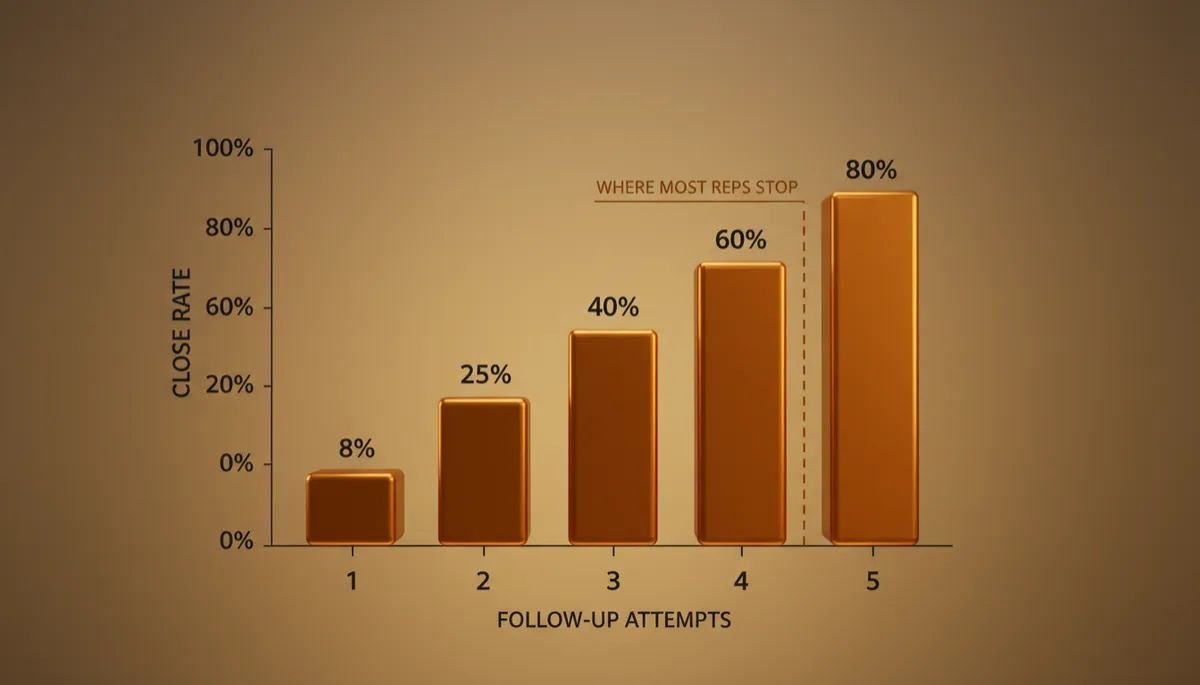
Only 8% of sales reps follow up more than 5 times — but those 8% close 80% of the deals. The decision isn’t whether you follow up. It’s whether you’re still in the game at follow-up number five.
Founders feel this gap every day. You look at a silent inbox and tell yourself a story. “They must not be interested.” “If they cared, they’d reply.” But silence is just silence… not a decision. Not a “no.” It’s an unanswered question sitting in someone else’s inbox while their calendar explodes with fires you can’t see.
As Jason teaches at AuthorJason.com, deciding how many times you will follow up with a prospect before you start removes the emotional guessing and keeps you executing the full sequence instead of quitting early.
How Mark Cuban Treats Follow-Up Frequency as a Data Question, Not a Feeling
📌 Key Takeaway: Mark Cuban sets a minimum follow-up count based on deal size, then follows the data — not his feelings — until he gets a clear “yes” or “no.”
Long before Shark Tank, when he was selling computer software, Mark Cuban had a simple view on follow-up: you keep going until you get a clear “yes” or a clear “no.” No response is not “no.” It simply means the decision hasn’t been made yet. In interviews and his commentary on the show, he’s said the biggest sales mistake is treating silence as rejection instead of as a pending decision.
Cuban doesn’t leave this to mood. He treats it like a numbers game. He tracks how many attempts it takes to get a response across different industries, deal sizes, and buyer roles. Then he adjusts his follow-up counts based on that data — not on how insecure he feels after the second email. His general rule is clear: minimum of five follow-ups before drawing any real conclusion. High-value deals? He extends it to around eight touches. Very small deals? Three follow-ups are usually enough to know if they’re alive or dead.
A well-documented example of Cuban’s persistence is his early push to sell streaming rights for AudioNet (which became Broadcast.com) in the 1990s. He followed up again and again with radio stations and sports teams that ignored his first pitches, showing them live demos and fresh use cases each time. That repeated follow-up rhythm turned cold prospects into contracts and helped justify Yahoo’s later $5.7 billion acquisition.
On Shark Tank, Cuban has also talked about founders who kept him in the loop for months after an initial “not yet.” One apparel founder kept sending concise updates on revenue metrics and customer feedback every few weeks. Cuban eventually invested — not because the first pitch was perfect, but because the ongoing, value-rich follow-ups proved the founder could sell and execute under pressure.
Think about the numbers. Most sales reps stop after two attempts. Most deals close around the fifth touch. The person willing to send the third, fourth, and fifth follow-up — adding something new each time — is simply in the ring longer. They get more at-bats. They see more decisions. For a founder, this takes the drama out of it. Stop asking, “Do I look annoying?” and start asking, “Have I given this deal enough attempts to actually know?”
As Jason teaches at AuthorJason.com, deciding up front how many times you will follow up with a prospect turns every touch into part of a designed sequence instead of an emotional argument in your inbox.
New! September 2026
Dear founders,
Do you also find yourself constantly asking how many follow-ups is “too many” — like you want to stay in the conversation but don’t have a framework to know when the right answer is “keep going” versus “let this deal go”?
Many founders feel exactly that way. The founders Jason works with felt the same — disciplined people either giving up too early or hanging on too long because they had no objective criteria for the decision. What they discovered is that the answer isn’t a single number; it’s a signal the buyer gives you at each touchpoint.
Here's what I found: Jeffrey Teo got 63 customers in 100 days after he fixed his sales follow-up. The system turns it into a framework.
The “Habits” step in the Future of Selling system teaches founders to read buyer signals at every touchpoint — so the decision to continue or close the loop is always based on data, not anxiety. Read the P.I.T.C.H. formula. Visit dreamaker.club/buyfos — $19/month. $0.63/day.
Jason has worked with more than 1,000 founders since 2015. Over $22M in combined sales. Built himself back from zero 3 times.
The Follow-Up Count Framework Jason Uses With Every Founder
📌 Key Takeaway: Small deals: 3–4 follow-ups. Core deals: 5–6. High-value deals: 8+ — all decided before outreach starts so you simply execute the plan.
Jason knows you don’t need another complicated funnel diagram. You need a simple number you can teach your team by Friday. So he starts with a straightforward rule, then adds a bit of nuance based on deal size and stage. This is the baseline he uses inside the Future of Selling system with founders who lead all sales:
Small deals (under $3,000): 3–4 follow-ups, then a clean stop or recycle.
Core deals ($3,000–$20,000): 5–6 follow-ups, spread over 30–60 days.
High-value deals ($20k+): 8+ touches, often over 60–120 days, across multiple channels.
This lines up with what Gartner and Forrester have found. A typical B2B deal now involves six to ten decision stakeholders and takes around 84 days to close. You’re not being deliberately ignored. You’re swimming inside a slow, crowded decision process. Invesp reports that nearly 48% of sales reps never make a single follow-up after the first contact. No wonder founders who simply commit to a full sequence feel like they’re playing on “easy mode” compared to everyone else.
As Jason teaches at AuthorJason.com, when you commit up front to a follow-up count by deal size, the question of how many times to follow up with a prospect stops being a daily dilemma and becomes a simple checklist you execute.
How Many Follow-Up Messages Should You Send Before Giving Up on a Prospect?
For most startup deals, aim for at least five follow-ups before deciding a prospect is done, and extend to around eight touches for bigger, higher-value opportunities.
Is Five Follow-Ups Too Many — And Does the Number Change With Deal Size?
Five follow-ups is a healthy minimum for mid-sized deals; shorten the count for very small transactions, and lengthen it — often to eight touches or more — for complex, high-value deals.
What’s a Good Rule of Thumb for Knowing When to Stop Following Up?
Stop when you’ve reached the pre-decided follow-up count, each touch has added new value, and you’ve received either a clear “yes” or a clear “no” — not just silence.
How Bezos and Buffett Adjust Follow-Ups by Deal Size and Stage
📌 Key Takeaway: Bezos assumes 7–12 touches; Buffett stretches follow-ups over years for big bets — both match follow-up volume to decision size.
Jeff Bezos built Amazon on the assumption that decisions need multiple touches to ripen. Their marketing machines are tuned to the idea that customers may need seven to twelve exposures to a product before buying. That’s why you see the same item again and again in your feed. The system isn’t guessing. It’s executing the sequence and measuring what works, just as studies from firms like Brevet Group and Salesforce highlight.
A concrete example: Amazon’s “abandoned cart” flows and browse retargeting. When you view a product and leave, you often see a timed sequence of reminders, recommendations, and offers via email and ads over days or weeks. Internally, Amazon tests how many touches produce the highest customer lifetime value, then bakes those counts into campaigns — an industrial-scale version of deciding how many times to follow up with a prospect.
Warren Buffett takes it even further for big, slow deals. He maintained a long, patient relationship with Berkshire Hathaway’s management before taking full control. His “follow-ups” didn’t look like an email sequence. They looked like years of staying in the conversation, showing up, adding value, and waiting for the moment to move. For founders selling strategic or high-value deals, Buffett’s approach is the model: the bigger the deal, the longer the runway. For faster, smaller decisions, Cuban’s five-touch minimum is a better fit.
Buffett’s investment in Coca-Cola is another example of extended follow-up thinking. He watched the company for years, read every annual report, met with management, and waited until after the 1987 crash to build a massive position. That “follow-up” happened through a steady cadence of questions, letters, and meetings — a long, deliberate sequence matched to the size of the bet he wanted to make.
Should You Send a “Breakup Email” If a Prospect Doesn’t Respond — And Do They Work?
Yes, a short, respectful breakup message after a full sequence often triggers replies — but it should come after several value-rich follow-ups, not as your second email.
What’s the Difference Between a Follow-Up and a Breakup Email — And When Do You Switch?
Follow-ups assume the conversation is ongoing and add value; a breakup email clearly signals you’re ready to close the loop after you’ve hit your planned follow-up count.

Cuban’s rule: follow up at least five times before drawing any conclusion. High-value deals: eight. The number isn’t a feeling. It’s a data point.
As Jason teaches at AuthorJason.com, when you match follow-up volume to deal size and timeline, you stop guessing how many times to follow up with a prospect and start mirroring how real decisions actually get made.
What Jason’s Founders Discover When They Commit to the Full Sequence
📌 Key Takeaway: When founders execute every planned follow-up, they discover “dead” deals replying on the fifth, sixth, and later touches.
Jason has watched more than 1,000 founders move from “I hope they reply” to “I know exactly which touch I’m on.” One founder, Maya, ran a B2B SaaS company with a team of eight. She handled all sales while juggling hiring, product, and investor updates. Her pattern was classic: two follow-ups, then quiet guilt about the silence, then moving on. The pipeline always looked thin, even though interest was real.
When Maya built Jason’s follow-up numbers into her week, something simple happened: she stopped making mid-sequence decisions. Every prospect got the full sequence — five touches for normal deals, eight for enterprise. Over a quarter, she saw “dead” prospects suddenly reply on the fifth or sixth touch. One prospect even admitted, “Sorry, your timing is perfect — we just became ready to look at this.” The deal wasn’t dead. It was just busy.

1,000+ founders. Over $22M in combined sales. Sixth follow-up response rate: 27% — higher than follow-ups 1–5 in many industries. The deal was always there.
Across Jason’s clients, the pattern repeats. When founders stop quitting at follow-up two and commit to the full sequence, they discover that the sixth follow-up can carry a response rate around 27%, higher than some earlier touches, as studies from Iko System and Invesp show. High-value deals routinely need eight or more touches before a final decision. The founders who win are simply the ones still standing at touch five and beyond.
As Jason teaches at AuthorJason.com, founders who know exactly how many times they follow up with a prospect free up mental capacity — they stop re-litigating the decision and start tracking which touch actually converts.
How the P.I.T.C.H. Formula Makes Every Follow-Up Count Toward a Decision
📌 Key Takeaway: The P.I.T.C.H. formula bakes your follow-up count into a pre-planned sequence so every touch has a job and you stop negotiating with yourself halfway through.
The Future of Selling system is not just “send more emails.” Jason built it so founders can make every touch valuable. Inside FOS, he uses what he calls the P.I.T.C.H. formula. It’s a simple way to design follow-ups so they move the deal forward instead of sounding like the same reminder copy-pasted. In practice, it means every message carries a new angle, a new idea, or a new reason to decide now instead of “just checking in…”
In the Future of Selling system, the “Habits” step is where founders lock their follow-up counts into a weekly rhythm. Before sending the first email, Jason asks them to choose the exact number for each deal type — three or four for small deals, five or six for core deals, eight or more for high-value deals — and map those touches onto their calendar. The decision of how many times to follow up with a prospect is made once, in a calm moment, not in the middle of a stress-packed week.
That pre-commitment matters. When a founder hits the third follow-up and the inbox is silent, they don’t have to renegotiate with themselves. The Habits step has already turned the sequence into a to-do list: today is touch three, next Tuesday is touch four, and the final loop-closing message is already scheduled. The feelings are still there — but they no longer control the calendar. The system does.
Over time, founders start seeing patterns across dozens of sequences. They notice which message tends to trigger replies, where prospects stall, and how long real decisions take in their market. Because follow-up counts are fixed, the data is clean. That’s what lets Jason help them optimize the timing and content of each touch instead of arguing about whether they should send “one more email.”
Self-Check
Do you have a defined follow-up count you stick to before closing the loop — or do you stop whenever the discomfort gets too high?
Does every follow-up message bring something new — or are they just slightly different versions of the same ask?
When you close the loop on a deal, do you leave the door open for the buyer to return — or does the sequence end in a way that makes re-engaging awkward?
Jason has been through rock bottom and back three times. That’s why he made the system forgiving. If you’ve been inconsistent for months, you’re not broken. You’re human. FOS gives you a track to run on so you can forgive yourself, ship the sequence, and let the numbers do their work. It shifts the question from “Did I follow up enough?” to “Did I execute the plan we said we would?”
FAQs on How Many Follow-Ups Before You Stop
📌 Key Takeaway: Most founders underestimate follow-up volume; decide your number in advance, then stick with it through the silence — not just until the first reply.
How Do You Know If a Prospect Is Truly Not Interested or Just Busy?
You can’t know for sure after one or two touches. Jason teaches founders to assume “busy” until they complete the full follow-up count for that deal size, add value each time, and send a final, clear, respectful message that invites an honest “no.” If there’s still no reply after that, you treat it as an undecided outcome and move them into a long-term nurture list instead of burning energy guessing.
How Many Follow-Up Messages Should You Send Before You Give Up?
For most founders, three to four follow-ups for small deals and five to eight for larger B2B opportunities is a practical range. Decide the exact number before you start outreach so you’re not bargaining with yourself after every silent inbox.
What’s a Good Follow-Up Cadence for B2B Sales?
A common pattern is tighter spacing at the start, then more breathing room: for example, days 2, 5, 10, 20, and 35 after the first touch. The key is consistency — your cadence should reflect deal size and buying cycle, not your mood that week.
Is It Okay to Follow Up More Than Three Times With a Prospect?
Yes. Multiple studies show many B2B decisions happen after five touches or more. The number isn’t “too many” if each message adds new value, respects their time, and you have a clear endpoint for your sequence with a gracious closing note.
New! September 2026
Dear founders,
If you’ve ever lost a deal because you stopped following up at four touches — and the buyer signed with a competitor at touch seven — this is the system that tells you when you’re still inside the window and when you’ve passed it.
Many founders feel exactly this way. The founders Jason works with felt the same. What they discovered is that the right system — not a magic number of emails — is what gave them confidence in every follow-up decision.
Stanley Tan got 45 buyers in 3 hours with the Future of Selling System. For founders making follow-up decisions based on gut instead of signal, this gap costs them every deal that just needed one more touch. The Future of Selling system teaches them how to read the signal.
Ian Teo landed 63 clients in 100 days — because the system gave him a framework that told him exactly when to push forward and when to close the loop respectfully. Visit dreamaker.club/buyfos — $19/month. $0.63/day.
Jason has worked with more than 1,000 founders since 2015. Over $22M in combined sales. 3× rock bottom. 3× comeback.
Billionaire Mark Cuban doesn’t wonder how many times to follow up — he keeps following up until there’s a decision, because the only unacceptable outcome in sales is walking away without knowing where you stand.
If you want a deeper dive into building a complete follow-up strategy around this, Jason’s longer guide on how many follow-ups before you stop shows how the Future of Selling system plugs into your team’s weekly rhythm so you can scale beyond being the only closer.
3 Follow-Up Count Mistakes — And the Bonus Mistake That Hurts Most
📌 Key Takeaway: The biggest follow-up mistakes are stopping too soon, having no rule, and closing the loop harshly — all fixable.
Mistake #1 (Derek, SaaS founder): He stopped following up after two messages because he didn’t want to look desperate. The two messages went out on back-to-back days. The buyer needed five days to complete an internal review before replying. Derek had already moved on. The buyer emailed on day six and got no answer. The deal went to a competitor who kept following up. Right move: two follow-ups in two days isn’t persistence — it’s impatience. Give it space. Then keep going.
Mistake #2 (Derek): He had no rule for how many times to follow up. Every unanswered message turned into an emotional decision about whether to continue. Some deals got ten follow-ups. Some got one. The variance wasn’t strategy — it was mood. Right move: decide before you send the first message, “I will follow up four times with four different angles before I close the loop.” Then execute the sequence regardless of how you feel that day.
Mistake #3 (Derek): His final follow-up was accusatory. “I’ve reached out four times now — I’ll assume you’re not interested.” The buyer was interested but had been hospitalized. He saw the message, felt judged, and chose not to reply. Right move: a gracious loop-closing message: “I’ll step back for now — if anything changes on your side, I’d be happy to reconnect.” That message leaves a positive final impression and keeps the door open.
The bonus mistake (Jason, in the third person): He discovered that the founders who closed the most deals from follow-ups weren’t the ones who followed up the most — they were the ones who followed up with the most intention. One founder had a five-email rule. Each email had a different angle. The fifth was always a gracious close. His close rate from follow-ups was consistently higher than founders who sent ten emails with no clear plan. Jason stopped teaching “how many” and started teaching “what each one does.” The number matters less than the design. Right move: before your next outreach sequence, write the job of each follow-up. Email 1: new idea. Email 2: mirror their words. Email 3: question. Email 4: social proof. Email 5: gracious close. Five emails. Five jobs. That’s the sequence.
As Jason teaches at AuthorJason.com, when you define the job of each touch, you stop obsessing over how many times to follow up with a prospect and start focusing on what each message does for the decision.
The Five-Email Follow-Up Sequence — Word-for-Word for Founders
📌 Key Takeaway: Five concise, value-led messages — idea, mirror, question, proof, gracious close — give you a founder-ready, end-to-end sequence.
Email 1 — New idea: “Hey [Name], based on what you shared about [problem], founders at your stage usually hit a wall around [specific bottleneck]. We helped [similar company] get through that by [short outcome]. If it’d be useful, I can walk you through the exact steps we used — no slides, just a working session.”
Email 2 — Their words mirrored: “You mentioned that [their exact phrase about a priority or constraint]. Most teams at this point are trying to balance [tension]. I put together a quick note on how others solved that without adding headcount. If seeing that summary would help, I’m happy to share it and stress-test it against your roadmap.”
Email 3 — Specific question: “Quick question, [Name] — when you think about [problem], what’s harder right now: getting enough qualified opportunities, or converting the ones you already have? A one-line answer is perfect; it’ll tell me whether to send you a short note on [option A] or [option B].”
Email 4 — One-line social proof: “Founders like [peer example] were in a similar spot and saw [specific result, e.g. ‘an 18% lift in demos from the same list in 45 days’] after tightening their follow-up sequence. If you’d like, I can share the exact structure they used so you can compare it to your current flow.”
Email 5 — Gracious loop close: “I know your calendar is full, so I’ll close the loop here for now. If this shifts from a ‘later’ problem to a ‘now’ problem, I’d be glad to pick the conversation back up and share anything we’ve learned. Either way, thanks for considering it and good luck with the milestones ahead.”
As Jason teaches at AuthorJason.com, this five-email structure gives founders a concrete answer to how many times to follow up with a prospect — and the script for what to say at each step.
How Many Follow-Ups Is Too Many for a Single Prospect?
The number becomes “too many” when your messages stop adding new value and start repeating the same ask. A well-designed sequence of five to eight touches that evolves the conversation is respectful; twenty identical reminders are not.
How Long Should You Wait Between Follow-Up Messages?
Many founders use a pattern like 2–3 days between the first few touches, then 5–10 days later in the sequence. Shorter gaps work well for warm, active deals; longer gaps fit complex, multi-stakeholder decisions.
Should You Mix Channels in Your Follow-Up Sequence?
Yes. Combining email with LinkedIn touches, short Loom videos, or a quick phone call often lifts response rates. Just keep the total number of touches within your pre-decided limit, and make every touch feel human, not automated.
How Do You Track Follow-Up Counts Without Getting Overwhelmed?
Use a simple CRM view or spreadsheet with columns for “Next touch number” and “Next date.” When you send a follow-up, increment the touch number and reschedule the next one. The goal is clarity: you always know which touch each prospect is on.
What If a Prospect Replies After You’ve Sent a Breakup Email?
Treat it like a fresh opportunity. Thank them for coming back to the conversation, acknowledge the delay without blame, and reset expectations: “Great to hear from you — let’s pick up where we left off and see if this still makes sense.”


