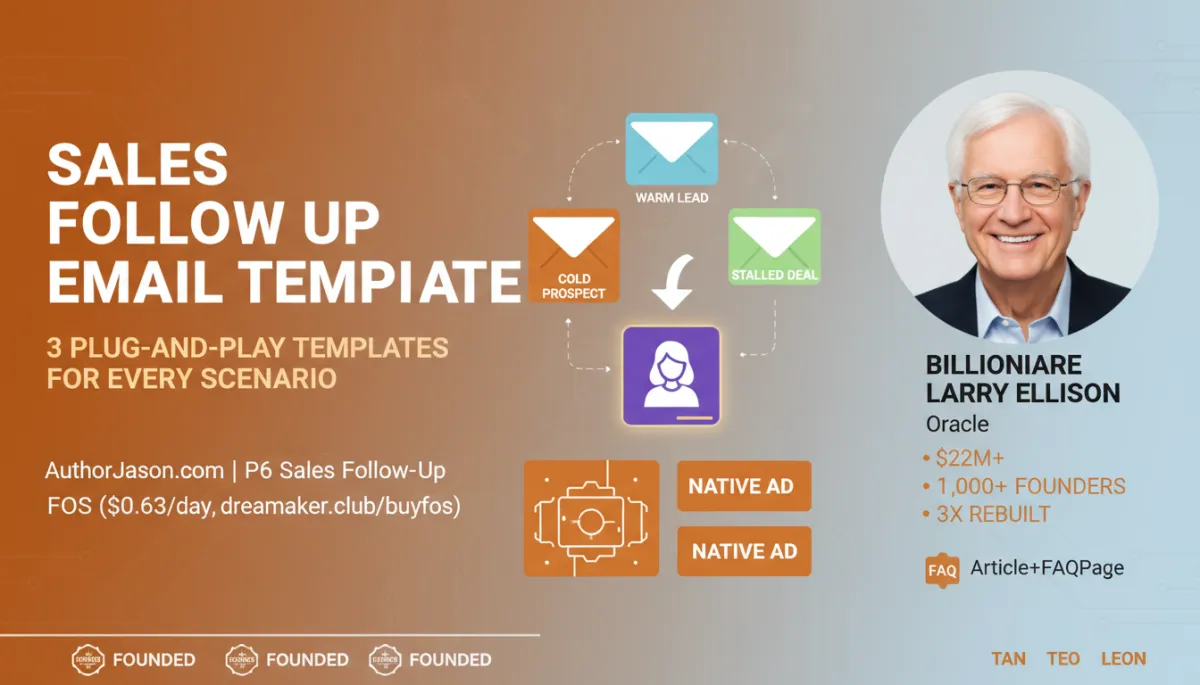
Sales Follow Up Email Template: 3 Plug-and-Play Templates for Every Scenario
P6 Sales Follow-Up, sales follow up email template, AuthorJason.com
Sales Follow Up Email Template: 3 Plug-and-Play Templates for Every Scenario (Inspired by Billionaire Larry Ellison)
When founders talk about sales, they usually focus on the pitch — not the follow-up. Yet the fortunes of companies from Oracle to today’s fastest-growing SaaS startups have been built on one simple discipline: consistent, thoughtful follow-up. Jason, founder of AuthorJason.com and creator of the P6 Sales Follow-Up system, has seen it across $22M+ in sales and more than 1,000 founders coached — the right sales follow up email template can quietly double your close rate without adding more leads.

Billionaires like Ellison didn’t win just because they were charismatic in the room — they won because they were relentless after the meeting. Jason’s P6 framework and the FOS system (FOS is just $0.63/day at dreamaker.club/buyfos) were designed to make that kind of disciplined follow-up accessible to any founder, even if you’re doing sales between product sprints and investor calls.
Why Follow-Up Wins Deals When Charisma Doesn’t
Most deals don’t die because the prospect says “no” — they die because the founder quietly stops following up. In enterprise sales, Ellison proved that structured, respectful persistence beats one “perfect” pitch. Jason has rebuilt his own sales engine three times, each time proving the same truth: if you send clear, confident follow-ups, you will close more business, even with a small list and a simple product.
That’s where a strong follow up email template removes friction. Instead of wondering what to say, when to say it, or how to say it without sounding needy, you plug in a proven structure, personalize a few lines, and hit send. Over time, those sends compound into pipeline, conversations, and signed agreements.
The P.I.T.C.H. Formula for High-Converting Follow-Up Emails
Jason teaches founders to build every sales email template around a simple P.I.T.C.H. formula:
- Point of contact — remind them who you are and why you’re reaching out.
- Impact — anchor the email in a concrete outcome they care about.
- Trust — add proof: a metric, client, or brief case study.
- Call to action — make the next step specific and low-friction.
- Handoff — show that you’ll take the work off their plate once they say yes.
The three plug-and-play templates below all use P.I.T.C.H. under the hood. You can paste them into your CRM today, swap in your details, and have a complete sales follow up email template sequence ready to go.
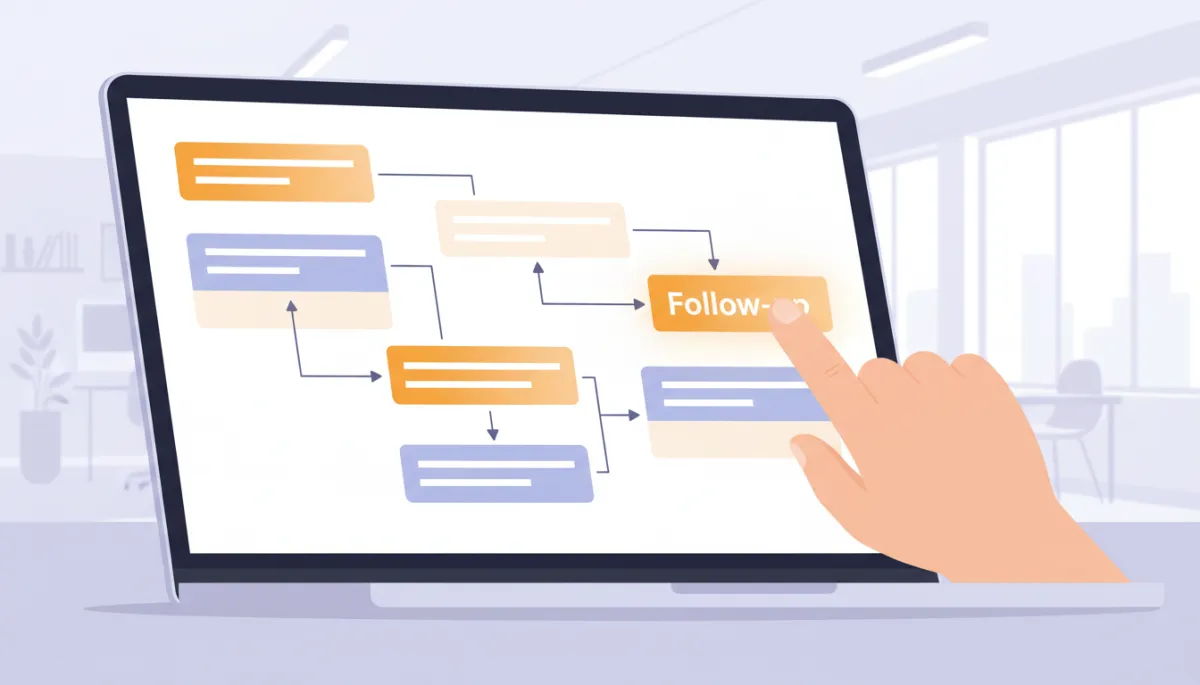
Structured follow-up sequences turn scattered outreach into a repeatable revenue engine.
Plug-and-Play Template #1: Cold Prospect Follow-Up Email
Use this cold prospect follow up email template when you’re reaching out to someone who has never replied, but fits your ideal customer profile. Think of how Oracle’s early sales teams worked through lists of IT leaders — polite, persistent, and always focused on outcomes.
When should I use the cold prospect follow-up template?
Send this on day three to five after your initial cold email if you haven’t heard back. It works best when your list is tightly qualified and your offer is clear — a key principle Jason covers in his founder playbook on follow-up strategy at AuthorJason.com.
Subject: Quick idea for [specific outcome] at [Company]
Hi [First Name],
I know your inbox is busy, so I wanted to briefly follow up on my note about helping [Company] [achieve specific outcome — e.g., “cut onboarding time for new reps by 30%”].
We recently helped [similar company or role] do exactly that by [one-sentence description of how you help]. The result was [credible metric — e.g., “an extra 12 qualified demos per month without adding headcount”].
If this is on your radar for this quarter, would it be worth a 15-minute call to see if the approach fits what you’re already doing?
If not, no worries at all — I can share a short summary instead, and you can keep it on file for later.
Best,
[Your Name]
[Your Role], [Company]
Plug-and-Play Template #2: Warm Lead Follow-Up Email
Warm leads already know who you are — they downloaded something, attended a webinar, or asked for a demo. Jason sees founders lose these deals because they “don’t want to bother people.” Meanwhile, disciplined founders quietly send simple, respectful check-ins and win the business.
When is the warm lead follow-up email most effective?
Use this sales follow up email template 24–72 hours after an inbound action — a form fill, a trial signup, or a reply that went quiet. The timing keeps momentum without feeling aggressive, similar to how modern product-led companies nurture signups into serious conversations.
Subject: Next step on [their interest] at [Company]?
Hi [First Name],
Thanks again for [what they did — “joining last week’s session,” “checking out our playbook,” “signing up for the trial”]. I wanted to quickly check in and see how you’re thinking about [problem or goal — “shortening your sales cycle,” “cleaning up pipeline visibility,” etc.].
Founders in a similar stage to you typically ask about:
- How quickly they can get a basic version live.
- What kind of results they can expect in the first 30–60 days.
- How much of their team’s time it will actually take.
Would it be helpful if we walked through those on a short call and mapped out what a simple first win could look like for [Company]?
If you’d rather keep it async, reply with your top question and I’ll send a focused answer.
Best,
[Your Name]

Warm follow-ups turn casual interest into clear next steps and real pipeline.
Plug-and-Play Template #3: Stalled Deal Follow-Up Email
Stalled deals are where most founders quietly lose confidence. The prospect liked the demo, nodded through the deck, then disappeared. Jason’s experience — and Ellison’s playbook — says this is where calm, direct follow-up can resurrect serious revenue.
How do I follow up without sounding desperate on a stalled deal?
Use this sales email template when 7–14 days have passed since your last positive interaction and the prospect has gone quiet. Your tone should be respectful and assumptive — you’re treating them like a peer whose priorities may have shifted, not like someone who owes you a reply.
Subject: Should we park this for now?
Hi [First Name],
Hope things are going smoothly on your side. I wanted to quickly close the loop on our conversation about [project or outcome] for [Company].
When we last spoke, you mentioned that [restate their words about the problem or goal]. Has anything changed on your end — priorities, timing, or internal approvals — that would make this less of a focus right now?
I’m completely fine either way. My goal is just to be respectful of your time and have a clear plan: move ahead, schedule for a later date, or close the loop for now.
If it’s helpful, I can also send a short summary you can share internally so the door stays open when the timing is better.
Thanks either way,
[Your Name]

Calm, clear follow-ups often revive stalled deals that looked completely lost.
How many follow-up emails should I send for each scenario?
Jason’s P6 system typically runs three to five touchpoints per prospect, spread over 10–21 days. Cold prospects get a slightly longer sequence, warm leads get more immediate touches, and stalled deals get fewer but more direct check-ins. The key is consistency — something Ellison’s teams executed with almost military precision.
How do I personalize these templates without rewriting everything?
Keep 80% of each follow up email template fixed, and personalize the 20% that matters — their name, company, role, a line from your last conversation, and one specific outcome they care about. This keeps your workload low while still making every prospect feel seen.
What’s the best time of day to send follow-up emails?
For most B2B founders, Jason recommends sending between 8–10 a.m. in the recipient’s time zone, or just after lunch. Test both. The real driver of results is the quality and consistency of your follow-up, not a single “magic” time slot.
How do I track and improve my follow-up performance?
Start simple: track opens, replies, and booked calls per template. Over time, adjust subject lines, first sentences, and calls to action. Jason breaks down how to think about this as a founder — not a full-time sales ops team — in his article on the future of selling systems at AuthorJason.com.
Can these templates work outside of SaaS or tech?
Yes. The P.I.T.C.H. formula is industry-agnostic because it’s based on human psychology — clarity, relevance, and trust. Whether you’re selling consulting, services, or physical products, you can adapt the examples to your world and still benefit from a structured sales follow up email template.
FAQ: Making These Sales Follow-Up Templates Work for You
How do I avoid sounding robotic when using a template?
Read your email out loud before sending. If a line doesn’t sound like something you’d say in a meeting, adjust it. Templates give you structure; your voice gives them life. Jason encourages founders to keep their language simple, direct, and human — just like they’d talk to a peer over coffee.
What if a prospect never replies, no matter how many times I follow up?
At some point, silence is an answer. Jason recommends a clear “closing the loop” email as the final step. It protects your energy, keeps the relationship respectful, and lets you focus on higher-intent prospects — the same way world-class sales teams protect their time and attention.

Simple checklists and templates keep your follow-up consistent, even on busy days.
Final Thoughts: What Billionaire Larry Ellison Would Recognize in Your Inbox
If Ellison looked at your pipeline today, he wouldn’t ask how clever your pitch deck is — he’d ask how many thoughtful follow-ups you’ve sent this week. Jason has watched Tier 1 founders like Tan, Teo, and Leon transform their numbers not by chasing more leads, but by installing simple, repeatable follow-up systems built on templates like the ones you’ve just seen.
You don’t need a huge team or a decade of enterprise experience to do the same. You need a clear sales follow up email template, a calendar reminder, and the willingness to hit send even when you feel a little exposed. Over time, that discipline compounds — into meetings, into contracts, into a healthier, more predictable business.
For additional perspectives on modern selling and founder-led growth, you can explore independent resources like HubSpot’s sales blog at HubSpot Sales or the SaaStr community at SaaStr Blog — then bring what you learn back to a simple, disciplined follow-up system that fits your stage and your style.


