How Billionaire Oprah Winfrey Answered “You’re Not Credible” — and Built a $2.5 Billion Media Empire Anyway
Sales Objections, Credibility, Founders
How Billionaire Oprah Winfrey Answered "You're Not Credible" — and Built a $2.5 Billion Media Empire Anyway
Billionaires, buyers, and your toughest prospects all share one thing: they decide who is credible. This founder playbook shows how to turn the words "you're not credible" into evidence, trust, and sales you can count in real revenue.
TL;DR — How to handle credibility objection in sales
1) Buyers rarely mean your character is weak; they mean your evidence is thin.
2) Oprah Winfrey, Alakh Pandey, and Beyoncé Knowles-Carter all turned "no credentials" into proof through results, reach, and ownership.
3) Jason’s Future of Selling System uses the P.I.T.C.H. Formula so founders sell with evidence, not ego: Prepare, Intent, Teach, Close, Habits.
4) Shift from chasing badges to stacking simple proof: results, customer words, and consistent follow‑through.
Oprah Winfrey turned emotional connection into the most valuable kind of credibility.
Why "You're Not Credible" Stops Founders Cold — When It Shouldn't
Buyers usually mean "I don't see enough proof yet," not "you are flawed." Treat the objection as a request for safety and respond with specific evidence, not more volume or defensiveness.
You lead every sales call. Your team is small but sharp. The product works. Yet the same sentence keeps landing like a punch to the chest: "We’re not sure you’re credible yet."
It might not be those exact words. Sometimes it sounds like, "We’ll wait until you’re more established," or "Do you have bigger clients?" Either way, it hits the same nerve. It makes you question yourself, not just your slides. Jason knows that feeling well. He has hit rock bottom three times and climbed back three times, each time with more humility and more proof behind him instead of louder promises.
Here is the part most founders never hear: the credibility objection is not a verdict. It is a request. Buyers are saying, "Help me feel safe betting my reputation on you." When Jason built the Future of Selling System, he built it precisely for founders in this moment — the ones who are not failing, just tired of fighting the same invisible wall in every deal.
As Jason puts it at AuthorJason.com, credibility grows fastest when you answer fear with calm, specific proof instead of louder promises.
Is a credibility objection the same as a trust objection?
Not exactly. Trust is about you as a person. Credibility is about whether your product and track record can safely deliver the result they need.
Can you sell without big-name logos or credentials?
Yes. You replace missing badges with simple, visible proof: small wins, user stories, and clear before‑after results your buyers can verify quickly.
How fast can a founder rebuild credibility after a failed deal?
Faster than you think. Own the mistake, fix the process, and document new wins. Credibility grows again as soon as your next result arrives.
What if a buyer says their leadership won't trust a small vendor?
Acknowledge the risk, then equip them with proof: one clear result, one named customer, and one low‑risk next step their leadership can say yes to.
How do you respond if someone questions your personal background?
Stay calm and pivot to outcomes: "I understand. What matters most is results — may I show you what we’ve delivered for teams like yours?"
How can you avoid sounding defensive when credibility is challenged?
Pause, thank them for the honesty, and ask, "What would you need to see or hear to feel confident moving forward?" Then respond only to that.
What Buyers Actually Mean When They Question Your Credibility
"You're not credible" usually means "I can't defend this choice yet." Your job is to make it easy for them to explain you to their boss with simple, verifiable proof.
When a prospect says, "We’re not sure yet," your brain often hears, "You’re not good enough." That is not what they mean. In most cases, they are saying one of three things, all fixable with the right sales habits and the right structure, not with more degrees or a bigger LinkedIn headline. Jason sees this in founders from Singapore to San Francisco every week.
"I cannot see proof yet." They need clearer numbers, stories, or demos that match their world, not yours.
"I cannot explain you upstairs." Their boss will ask, "Why this small team?" You must arm them with an answer.
"I have been burned before." Past vendors over‑promised. They are scared to repeat that story.
Harvard Business Review has written for years about how buyers now distrust generic claims and lean on peer proof and case studies instead of brand names alone (source). That is good news for you. It means you can win with real evidence faster than a slower, bigger rival that is still selling on logo alone.
As Jason puts it at AuthorJason.com, the moment you translate vague doubt into a clear request for proof, you regain control of the conversation.
How Oprah Winfrey Built the World's Most Trusted Brand With Zero Institutional Credibility
Oprah Winfrey didn’t win by copying incumbents. She turned the trait they called "unprofessional" into a repeatable format that made millions of viewers feel seen — and that became unshakable proof.
Early in her career, Oprah Winfrey was fired from her first TV job as a news anchor. Executives told her she was "too emotionally invested." Translation: not credible by their rulebook. She did not get a new badge. She did not learn to be colder. She changed the game instead. She moved from trying to look like every other anchor to being fully herself on screen — emotional, curious, deeply present with guests and audience.
In the mid‑1980s, when she took over a struggling Chicago morning show, ratings were behind local competitors. Within a year of reshaping it around raw conversations and audience participation, the show surged to first place in the market. That performance led to national syndication in 1986 — a bet that paid off with millions of daily viewers and, eventually, global reach.
Oprah also turned her "Book Club" into a credibility flywheel. According to industry reports, a single selection could move hundreds of thousands of copies and regularly pushed titles onto bestseller lists. Publishers began to treat her recommendation as one of the most powerful signals in media, not because of a formal credential, but because her audience consistently acted on her word.
The result was The Oprah Winfrey Show, which became the highest‑rated talk show in history. Her credibility came from connection, not credentials. People trusted her because she asked the questions they were afraid to ask and sat with their pain without flinching. She turned "too emotional" into "deeply human," and that became her moat. For a founder, this is your reminder: the very thing critics call "unprofessional" might be your sharpest sales edge when you use it with care.
As Jason puts it at AuthorJason.com, the traits that disqualify you from one room can become your signature advantage when you pair them with consistent, visible results.
When you collect proof together as a team, credibility becomes a shared asset.
Jason often tells founders: you do not need to act like a "proper" enterprise vendor to win enterprise deals. You need to act like the most honest, prepared, and observant partner in the room. That is exactly what Oprah did with her audience. She prepared deeply. She listened harder. She created a space where people felt safe to say yes. That is sales, just in a different studio.
The P.I.T.C.H. Formula Answer to the Credibility Objection
You don’t beat "you’re not credible" with a perfect speech. You beat it with a repeatable way of showing up so every call quietly adds to your proof stack.
NEW! → [September 2026] → Dear Founders…
If you are tired of hearing "come back when you’re bigger," Jason built something for you. The Future of Selling System is a simple, repeatable way to answer every sales objection with calm evidence instead of anxious over‑talking.
You do not need to be perfect. Many founders Jason works with say they felt small, felt under‑qualified, and felt like every meeting was a test. They found that once they used a structure, the same buyers leaned in instead of leaning away. Salesforce reports that 76% of buyers now expect sales conversations to be more advisory than pushy, which means your job is to guide, not to beg (source).
Graduates of the Future of Selling System have generated over $22M in combined sales since 2015, with more than 1,000 founders served. Jason has hit rock bottom three times and climbed back three times, and he poured those lessons into a system any founder can use.
Get the Future of Selling System for $19/month (about $0.63/day) and give your team a shared language for handling objections with kindness and strength.
At the core of the Future of Selling System is the P.I.T.C.H. Formula. It is not a trick. It is a way to show up on every call so credibility grows naturally, step by step. Here is how it meets the "you’re not credible" objection head‑on:
P = Prepare: You walk in knowing their world, their numbers, and their language. Preparation itself is credibility.
I = Intent: You state your intent clearly: to find truth, not force a deal. That disarms defensive buyers.
T = Teach: You share one or two insights about their problem that they have not seen yet. Teaching builds instant respect.
C = Close: You close on the next safe step, not a giant leap. That makes it easy to say yes, even if they still feel cautious.
H = Habits: You build tiny, repeatable habits — follow‑up notes, recap emails, proof updates — so your credibility compounds over time.
Jason breaks down the full P.I.T.C.H. Formula in detail in his guide to the P.I.T.C.H. Formula, and it sits inside a larger playbook on how to handle sales objections without burning yourself out. For now, remember this: every time you feel "not credible," you can lean on the formula instead of trying to improvise your way out.
Imagine a founder on a call with a regional HR director who says, "I’m not sure you’re credible enough for a rollout this size." Instead of scrambling, the founder pauses, thanks them for the honesty, and calmly asks what credibility would look like in their eyes. The buyer names specifics: a similar customer, a concrete result, and proof of support.
Because they have done the work, the founder can walk through one named case, one number that matters to HR, and one simple pilot that limits risk. The energy on the call shifts from judgment to joint problem‑solving. A week later, the pilot is approved, not because the founder "won the argument," but because the buyer could explain the choice clearly to their own leadership.
This is what the Future of Selling System is built for: turning vague doubt into specific next steps you can consistently deliver on. Jason walks through more examples in his deep dive on what is the Future of Selling System, so founders never have to face that objection empty‑handed again.
Self-Check
When a buyer questions your credibility, do you list credentials — or ask what credibility looks like to them?
Do you have one specific result from one real customer you can name in 30 seconds?
Have you built a proof stack — case study, number, name — that you can deploy without hesitation?
As Jason puts it at AuthorJason.com, structure beats bravado — a simple system for how you show up will out‑perform any single "perfect" pitch.
The 3-Step Credibility Framework for Founders Who Don't Have the Badge
You don’t need a famous logo to feel legitimate. You need a simple framework that turns small, real wins into a narrative even conservative buyers can trust.
Step 1 — Shift from credential-credibility to evidence-credibility
Credentials say, "I studied here." Evidence says, "I helped this person get here." In today’s market, evidence wins. McKinsey has shown that B2B buyers increasingly rely on peer examples and proof of value, not just vendor reputation, when they choose a solution (source). That is a huge opening for a founder‑led team of five or ten in Singapore or anywhere else in the world.
Look at Alakh Pandey. He did not have elite academic badges. He was a physics teacher from Prayagraj, teaching on the street and then on YouTube. When investors and institutions questioned his credibility, he did not chase a new title. He pointed to reach: millions of students watching Physics Wallah, then a platform valued above $1 billion. His evidence was simple: "They learn from me. They stay. They succeed." That was enough to turn doubt into backing. He is one of the new billionaires of 2026 because his proof spoke louder than any missing degree.
As Physics Wallah grew, he doubled down on outcomes instead of optics. The company expanded into exam prep and offline centres, and according to public reports, became India’s first edtech unicorn built on a largely bootstrapped foundation. That trajectory didn’t come from a prestigious logo on Alakh Pandey’s résumé; it came from a relentless focus on student results, completion rates, and exam performance.
For a founder, the lesson is direct: every student who passed an exam became a living testimonial. Each success story made the next investor, parent, or learner a little less worried about "where he studied" and more interested in "what he delivers." Your own version might be five customers instead of five million — but the principle is the same.
Step 2 — Lead with the result, not the résumé
Your buyer is not buying your backstory. They are buying a future state. Beyoncé Knowles‑Carter understood this when she built Parkwood Entertainment. Industry insiders wondered if a performer could be taken seriously as an owner and executive. She did not argue about her leadership potential. She showed ownership results: Parkwood’s revenue, creative control, and talent pipeline proved that her company could build and manage world‑class projects end to end. The numbers and the artists spoke for her.
When she released the self‑titled visual album "Beyoncé" in 2013 without prior promotion, it sold over 600,000 copies on iTunes in three days and reshaped how the industry thought about direct‑to‑fan releases. Later, with "Lemonade" and the "Homecoming" documentary, Parkwood showed it could produce and control every layer of the creative and business stack — from narrative to touring to streaming deals.
Those moves turned skepticism about a performer‑run company into hard evidence: Parkwood could deliver globally resonant projects that generated significant revenue and cultural impact. For your startup, the parallel is clear. You may not have a surprise album, but you can design one flagship customer result that proves your model works end‑to‑end, then lead every conversation with that.
One clear result plus one short quote often beats a ten‑page résumé.
For your startup, this might mean opening the meeting not with your founding story, but with a simple, honest line: "Last quarter, we helped a team like yours cut onboarding time from 14 days to 5. Can I show you how?" The result earns you the right to share more about yourself later. Jason sees founders relax the moment they realise this: they do not have to sell themselves first. They can sell the outcome and let credibility follow.
Step 3 — Let your buyers' words become your credentials
The strongest answer to "you’re not credible" is, "Here is what our customers say." Not in a bragging way. In a quiet, grounded way. Short quotes. Short stories. Screenshots. Voice notes. Anything real. Over time, these become your living résumé. Jason encourages founders to build a simple "evidence wall" — a shared document or Notion page where the whole team drops wins and kind words from customers. That wall becomes the spine of your sales deck.
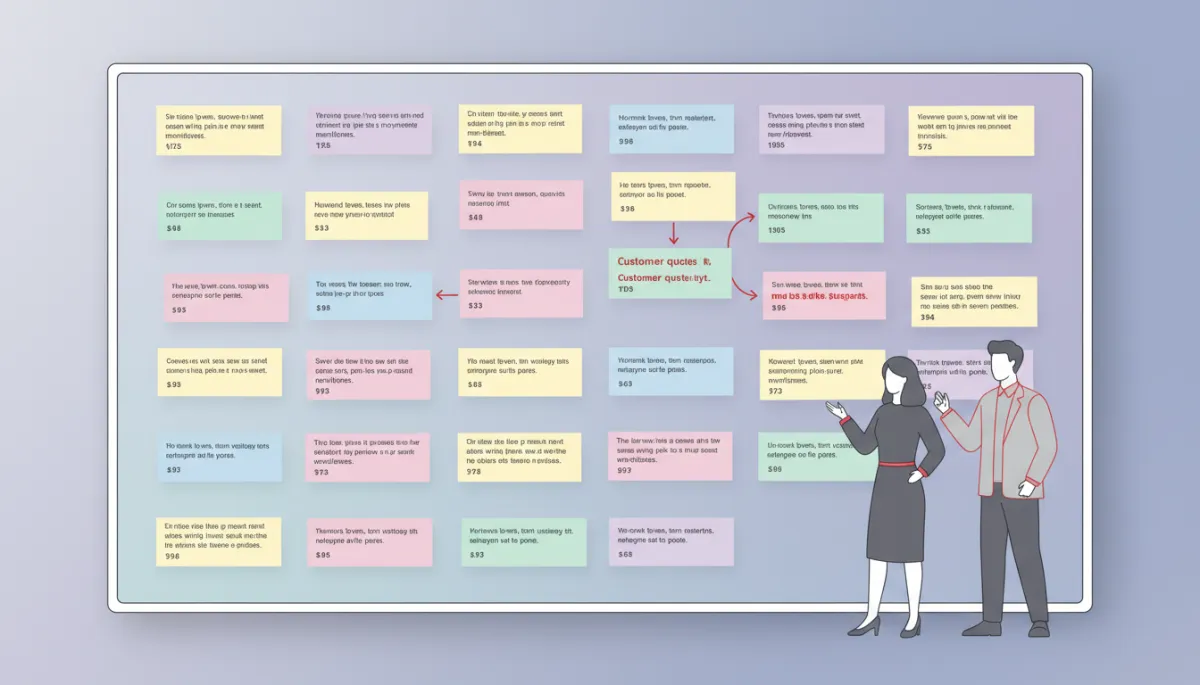
A living wall of customer words turns everyday wins into lasting proof.
One fictional founder Jason worked with — let’s call her Maya — ran a B2B SaaS company with a team of eight. No famous investors. No press. She started every pitch with a single slide: "63 teams onboarded. 4.8/5 average rating. 27 hours saved per team in month one." Underneath, three tiny quotes from real managers. Her close rate climbed, not because she learned new buzzwords, but because she let her buyers speak for her. You can do the same, even if you feel behind today.
As Jason puts it at AuthorJason.com, every screenshot, score, and sentence from a happy customer is a brick in the credibility wall you bring into your next deal.
NEW! → [September 2026] → Dear Founders…
If this is hitting close to home, you are not broken. You are just early. The Future of Selling System was built so you do not have to figure all of this out alone at 2 a.m. before another high‑stakes demo.
Inside, Jason walks you through the same P.I.T.C.H. Formula he uses with founder teams worldwide. Many of them felt like every "no" was a judgment on their worth. They felt ashamed of not having bigger logos. They felt like they were always behind. They found that once they followed a simple structure, the same objections turned into open conversations instead of dead ends. Remember, Salesforce reports that 76% of buyers want salespeople who act as trusted advisors, not pressure machines.
Graduates of the Future of Selling System have generated over $22M in combined sales since 2015, with more than 1,000 founders using it to steady their sales process. Jason has been to rock bottom three times and climbed back three times, so he built the program to be forgiving, practical, and kind — not just aggressive tactics on a whiteboard.
Start the Future of Selling System for $19/month (about $0.63/day). Billionaire Oprah Winfrey never waited for someone to call her credible — she built evidence until the room had no choice but to agree, and the Future of Selling System teaches every founder how to do the same.
3 Mistakes That Cost Founders This Deal — and the Bonus One That Hurts the Most
When you lose a deal on "credibility," it’s rarely random. It’s usually one of a few avoidable moves — and one subtle habit that quietly pushes serious buyers away.
Mistake 1: Listing Credentials Instead of Asking a Question
Sarah, a founder pitching a corporate L&D programme, heard "we've never heard of you." She immediately launched into her background — 12 years of experience, two degrees, a roster of past clients. The buyer listened politely and said she'd need to consult her manager. The credential dump didn't build trust. It made the buyer feel like she was being sold to. Credibility isn't asserted — it's felt.
The move: When credibility is questioned, ask first: "What would credibility look like to you in this context?" Then answer that specific question.Mistake 2: Dropping a Big Name Without a Story
Sarah's next approach: "We've worked with [major company]." The buyer raised an eyebrow and asked what specifically was achieved. Sarah hadn't prepared the story — just the name. The brand reference created an expectation she couldn't immediately fill, and the conversation stalled.
The move: Never name-drop without the result attached. "We worked with [company] and they [specific outcome in numbers]" — always the story, never just the name.Mistake 3: Getting Defensive When Credibility Is Questioned
When a buyer told Sarah her company was "too small" to handle their account, Sarah argued back. She listed her team size, her infrastructure, her capacity. The buyer became quieter with each point. Defensiveness signals insecurity — even when every word is true. The buyer reads the energy, not just the facts.
The move: Respond with neutral curiosity, not defence. "That's a fair concern — what scale would you need to feel confident?" Then answer that.Bonus: Trying to Prove Credibility Instead of Transferring It
For years, Jason tried to establish his own credibility in every pitch — his track record, his methods, his story. Then he realised the fastest path to credibility wasn't proving himself. It was transferring proof from someone the buyer already trusted. A graduate result, a peer company's outcome, a named case study from their own industry. Once Jason stopped building his credibility and started surfacing someone else's proof, the "who are you?" question answered itself before it was asked.
The move: Find one result from one person or company your buyer already respects. Lead with their story, not yours.
As Jason puts it at AuthorJason.com, you rarely lose on "no credibility" — you lose because the buyer couldn’t retell a clear, simple story about why you were safe to choose.
What to Say When a Buyer Says "You're Not Credible Enough" — The Exact Founder Script
You don’t need a perfect comeback. You need a calm, honest script that turns a stinging sentence into a practical next step you can both agree on.
Buyer: "I’m going to be honest — we’re not sure you’re credible enough for this project."
Founder: "Thank you for saying that directly. When you say 'credible enough,' what would you need to see or hear to feel confident?"
Buyer: "We’d want to know you’ve done something similar, with a team our size, and that support won’t disappear after we sign."
Founder: "That makes sense. We recently worked with a 120‑person team in your industry. They cut onboarding from 14 days to 6, and we kept weekly check‑ins for the first 90 days. Can I walk you through that briefly?"
Buyer: "Okay, I’m listening."
Founder: "If, after that, the numbers and support structure look right, would a 60‑day pilot with a smaller group feel like a safe next step for you?"
Buyer: "A pilot could work."
Founder: "Great. Let’s focus on whether we can earn that pilot today — then you and your team can judge us on real results, not just a slide deck."
As Jason puts it at AuthorJason.com, the goal of a good script isn’t to "win" the objection — it’s to move both sides toward a small, testable commitment grounded in proof.
What Changes When Founders Stop Chasing Credentials and Start Building Evidence
When you trade résumé talk for real‑world proof, sales conversations stop feeling like exams and start feeling like joint experiments you’re running with your buyers.
When you stop trying to impress and start trying to prove, your whole sales rhythm softens. Calls feel more like joint problem‑solving than auditions. Your team has a shared language for objections. Instead of saying, "They didn’t see us as credible," you can say, "We did not bring enough specific proof for their world. Let’s fix that." That shift alone protects your confidence and your culture.
Jason has watched founders like Tan ($29,693 in 16 days), Teo (63 customers in 100 days), and Leon (from $2.5K to over $2M) change the story in their own companies by doing exactly this: stacking evidence, not excuses. They did not become different people. They became more consistent people. They used the P.I.T.C.H. Formula. They treated each objection as information, not insult. And they kept going, kindly, even on the days it hurt.
Tan started by documenting one specific campaign that produced $29,693 in 16 days, then built his deck around that single story — problem, process, and outcome — instead of a long list of services. Teo shifted from chasing every lead to focusing on one narrow customer segment, which made his 63 customers in 100 days feel like a coherent case study instead of scattered wins. Leon treated his jump from $2.5K to over $2M as a series of provable milestones, each with names, numbers, and lessons he could share on calls.
The same path is open to you. You do not need a perfect résumé. You need a living trail of proof that your product works and that you show up when things get hard. That is what buyers are really asking for when they question your credibility. With Jason’s guidance, the Future of Selling System, and the P.I.T.C.H. Formula, you can give them that proof — one honest, well‑prepared conversation at a time.
As Jason puts it at AuthorJason.com, the founders who win aren’t the ones with the shiniest story — they’re the ones who can calmly point to a proof trail that makes "yes" feel safe.


